

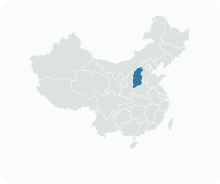
Get to know Hequ County

Photo adjustments
Full frame retained; EXIF orientation normalized, proportionally resized to at most 800 pixels and converted to WebP. No generated pixels or subject changes. Cards may crop the display.
- Administrative area
- County · 县
- Part of
- Xinzhou
- Chinese name
- 河曲县
- Local areas
- County guide
Area & population
- Population · 2020
- 123,505
Source: cited geographic source, as of the dates shown.
Setting and landscape
The land is higher in the east and lower in the west, between 836 and 1,637 metres above sea level. The Yellow River runs for 71.6 kilometres through the county and bends along its western border, which is where the name Hequ, "river bend", comes from. The county government describes Hequ as the meeting point of the Yellow River and the Great Wall, its "two dragons".
History and culture
The Song dynasty set up Huoshan County (火山县) here in 1067, and the Jin created Hequ County in 1153; an older name for the area is Yuzhou (隩州). Hequ is the home town of Bai Pu (白朴), one of the four great dramatists of the Yuan dynasty.
Poor soil and uncertain harvests made Hequ a starting point of zou xikou (走西口), "going beyond the west pass": men left each spring to work in the Daqing Mountains (大青山) and the Hetao (河套) area of Inner Mongolia and came back in winter. The partings produced the county's mountain songs, shanqu (山曲), which became Hequ folk songs (河曲民歌) on the first national intangible heritage list in 2006. Errentai (二人台), which grew out of shanqu, is thought to be about two hundred years old.
The Hequ River Lantern Fair (河曲河灯会), on the national list since 2008, is held on the fifteenth day of the seventh lunar month and draws people from both banks of the river in all three provinces. It opens with rites to Yu the Great (大禹) and chanting by monks; at night the boatmen's, ferry and coal-boat associations set lanterns on the river to mourn the dead and pray for safety. The fair lasts three days, with opera each evening.
What to see
The county government lists Niangniang Tan (娘娘滩) as the only inhabited island on the Yellow River, and names Haichao Chan Temple (海潮禅寺), a provincial protected site, Cuifeng Mountain (翠峰山), Longkou Gorge (龙口峡谷) and stretches of the old Great Wall among its sights. The county's northern sightseeing route takes in the site of the old Xikou ferry (西口古渡), the Wenbi Pagoda (文笔塔) and the Hucheng Tower (护城楼).
Food and local products
Farming in the hills centres on potatoes, maize, minor grains and livestock, while the river flats grow vegetables and melons. Broomcorn millet (糜黍), haihong fruit (海红果) and selenium-rich grains are the products the county singles out.
Highlights
- Hequ River Lantern Fair 河曲河灯会: Three-day festival from the fifteenth day of the seventh lunar month, with lanterns floated on the Yellow River; national intangible heritage since 2008.
- Hequ folk songs 河曲民歌: Shanqu songs of the zou xikou migrants; national intangible heritage since 2006.
- Niangniang Tan 娘娘滩: Described by the county as the only inhabited island on the Yellow River.
- Haichao Chan Temple 海潮禅寺: Provincial protected temple complex on the county's southern sightseeing route.
Sources for this guide
河曲县概况 · Hequ County People's Government
河曲县 - 维基百科 · Wikipedia (Chinese) · CC BY-SA 4.0
灯会(河曲河灯会) · China Intangible Cultural Heritage Network (ihchina.cn)
河曲民歌 · China Intangible Cultural Heritage Network (ihchina.cn)
Original English written from the listed sources and checked sentence by sentence against quoted extracts by a separate reviewer. Updated 2026-09-26.
Explore Hequ County
Core places to explore, with English and Chinese names.
Hequ County 河曲县
Plan your visit
Getting there
Hequ County is about 150 km in a straight line from central Xinzhou. Search for 河曲县 in a map app to find stations and your accommodation.
Where to stay →More in Xinzhou
Sources & geographic information
Administrative names and parent areas: Official geographic directory · Reference date 2026-09-06.
Some facts checked against 河曲县 — Wikipedia contributors, CC BY-SA 4.0.
Map data © OpenStreetMap contributors. Pins mark approximate centres, not entrances or boundaries.