

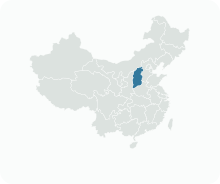
Get to know Linyi County

- Administrative area
- County · 县
- Part of
- Yuncheng
- Chinese name
- 临猗县
- Local areas
- County guide
Area & population
- Population · 2020
- 482,559
Source: English Wikipedia, as of the dates shown.
Setting and landscape
The county government divides the land into two units. The loess tableland known as the Emei Ridge (峨嵋岭) covers just over half the county, rising from about 500 metres on its southern edge to about 600 metres in the north, with Gushan (孤山) in the northeast corner as the highest point at 820 metres. The Sushui plain (涑水平原), at 360 to 400 metres, covers most of the rest. Neighbours are the Yanhu district (盐湖区) to the southeast, Yongji (永济) to the southwest and Wanrong (万荣) to the north.
The climate is warm-temperate and continental, with dry, windy springs and rain concentrated in summer; the county records an extreme high of 42.8°C, which its government lists as the highest in the province.
History
The area's old name is Xunyang (郇阳). The county government records that Yi Dun (猗顿), a merchant of the Spring and Autumn period, grew fruit, planted mulberries and kept cattle and sheep here, and it counts the Tang poet Wang Wei (王维) and the Yuan playwright Guan Hanqing (关汉卿) among the area's notable figures. The present county was formed in 1954 by merging Linjin County (临晋县) and Yishi County (猗氏县); the county seat is in Yishi town (猗氏镇). Local traditions on the national intangible-heritage list include luogu zaxi (锣鼓杂戏), a drum-and-gong drama, and Linyi meihu opera (临猗眉户).
What to see
The county has six nationally protected monuments. The Linjin county yamen (临晋县衙) in Linjin town (临晋镇), the former county office of Linjin, was built in the Dade years of the Yuan dynasty and faces south along an axis of three halls; the main hall is an original Yuan structure and the rear two are Qing buildings. The county government describes it as the only surviving Yuan-dynasty county yamen in China. It was nationally listed in 2001.
The Miaodao Temple twin pagodas (妙道寺双塔) stand inside the Shuangta primary school north of the county town. They are square, storeyed brick pagodas about 80 metres apart, the eastern one of seven storeys and the western one of nine; an inscription dates the western pagoda to 1069 in the Northern Song. They were nationally listed in 2006.
Food and local products
Orchards dominate the farmland. The county government lists 700,000 mu of apples, 250,000 mu of peaches and 200,000 mu of jujubes, alongside pears and persimmons, and states that its fruit area and output are the largest of any county in China.
Highlights
- Linjin County Yamen 临晋县衙: Yuan-dynasty county office with an original Yuan main hall; national monument since 2001.
- Miaodao Temple Twin Pagodas 妙道寺双塔: Two square brick pagodas of seven and nine storeys; the western one dated 1069.
- Linyi meihu opera 临猗眉户: Local opera on the national intangible-heritage list.
Sources for this guide
临猗概况 · Linyi County People's Government
自然地理 · Linyi County People's Government
临猗县 · Wikipedia (Chinese) · CC BY-SA 4.0
临晋县衙 · Wikipedia (Chinese) · CC BY-SA 4.0
妙道寺双塔 · Wikipedia (Chinese) · CC BY-SA 4.0
Original English written from the listed sources and fact-checked against them. Updated 2026-09-26.
Explore Linyi County
Core places to explore, with English and Chinese names.
Linyi County 临猗县
Plan your visit
Getting there
Linyi County is about 25 km (straight-line distance) from central Yuncheng. Search for 临猗县 in a map app to find stations and your accommodation.
Where to stay →More in Yuncheng
Sources & geographic information
Administrative names and parent areas: Official geographic directory (dmfw.mca.gov.cn) · Reference date 2026-09-06.
Some facts checked against 临猗县 — Wikipedia contributors, CC BY-SA 4.0.
Some facts checked against 临晋县衙 — Wikipedia contributors, CC BY-SA 4.0.
Some facts checked against 妙道寺双塔 — Wikipedia contributors, CC BY-SA 4.0.
Map data © OpenStreetMap contributors. Pins mark approximate centres, not entrances or boundaries.