

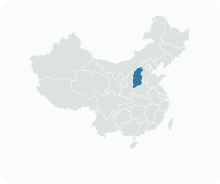
Get to know Xinjiang County

- Administrative area
- County · 县
- Part of
- Yuncheng
- Chinese name
- 新绛县
- Local areas
- County guide
Area & population
- Area in the source
- 594.00 km²
- Population · 2020
- 282,230
Source: cited geographic source, as of the dates shown.
History
Northern Zhou rulers gave the area the name Jiangzhou, and in 1912, when the prefecture became a county, it was called Xinjiang, 'new Jiang', because a Jiang County (绛县) already existed. The walled county seat, Longxing (龙兴镇), is known as the 'Lying Ox City' (卧牛城): its north-south main street is the ox's spine, the side lanes its ribs, two large ponds east and west its eyes and the Tang pagoda in the north its tail. The walls were rebuilt under the Yuan. Old Jiangzhou stood where the Fen met a post road and was a river port known for casting and crafts; under the Tang it was a major mint.
What to see
The Jiangzhou Hall (绛州大堂), on high ground in the west of the town inside Xinjiang Middle School, is the surviving main hall of the old prefectural office (绛州署), rebuilt under the Yuan. Seven bays and 30 metres wide, it is larger than the usual five-bay hall of a prefecture, and a stone tablet of 1101 listing seven rules for officials is set into its north wall. It has been nationally protected since 1996, with the town's bell, drum and music towers added in 2001.
Longxing Temple (龙兴寺), at the end of North Street, is the tallest structure in the town. Founded in the early Tang as the Biluo Taoist temple (碧落观), it became Longxing Temple in 670. Its octagonal brick pagoda was raised to thirteen storeys and 42.4 metres when it was rebuilt in 1784, and the Yuan main hall holds seven painted statues 4.5 metres tall.
Jiyi Temple (稷益庙), in Yangwang town (阳王镇) 15 kilometres south-west of the county town, honours Houji (后稷) and Boyi (伯益). Its main hall is painted on three sides with 131 square metres of murals completed in 1507, showing more than 400 figures from the legends of the Three Sovereigns, Yu the Great, Houji and Boyi.
Crafts and local traditions
Jiangzhou drum music (绛州鼓乐), listed as national intangible heritage in 2006, is played on sets of drums of different shapes using more than a dozen techniques, such as striking the rim, rubbing the drumhead and knocking the drum rings. Jiangzhou Chengni inkstones (澄泥砚), listed in 2008, are fired pottery inkstones made from silt taken from a bend of the Fen, and come in colours with names such as 'eel yellow' and 'rose purple'. The county's other national listings include dough figures (面花) and carved lacquer (剔犀).
Highlights
- Jiangzhou Hall 绛州大堂: Yuan-era main hall of the old prefectural office; national protected site since 1996.
- Longxing Temple 龙兴寺: Temple with a 42.4-metre, thirteen-storey brick pagoda rebuilt in 1784.
- Jiyi Temple 稷益庙: Main hall with 131 square metres of Ming murals completed in 1507.
- Jiangzhou drum music 绛州鼓乐: Drum ensemble tradition; national intangible heritage since 2006.
- Chengni inkstones 澄泥砚: Fired inkstones made from Fen River silt; national intangible heritage since 2008.
Sources for this guide
绛州鼓乐 - 中国非物质文化遗产网 · China Intangible Cultural Heritage Network (ihchina.cn)
砚台制作技艺(澄泥砚制作技艺) - 中国非物质文化遗产网 · China Intangible Cultural Heritage Network (ihchina.cn)
新绛县 - 维基百科,自由的百科全书 · Wikipedia (Chinese) · CC BY-SA 4.0
绛州大堂 - 维基百科,自由的百科全书 · Wikipedia (Chinese) · CC BY-SA 4.0
龙兴寺 (新绛) - 维基百科,自由的百科全书 · Wikipedia (Chinese) · CC BY-SA 4.0
稷益庙 - 维基百科,自由的百科全书 · Wikipedia (Chinese) · CC BY-SA 4.0
Original English written from the listed sources and checked sentence by sentence against quoted extracts by a separate reviewer. Updated 2026-09-25.
Explore Xinjiang County
Core places to explore, with English and Chinese names.
Places to explore around Xinjiang County
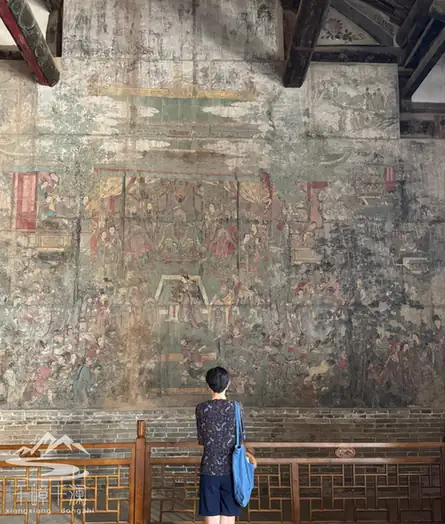 Jiyi Temple · 稷益庙
Jiyi Temple稷益庙
Ming temple to Houji and Boyi in Yangwang, Xinjiang County, whose main hall keeps 1507 murals by painters from Yicheng and Jiangzhou.
Read the place guide → AI illustration · AI 示意图(仅供参考,非该地点实拍)
Jiangzhou Prefectural Office绛州署
Jiangzhou Shu in Xinjiang County brings together the former prefectural hall, three historic towers, a reconstructed City God Temple and the Jiangshou Juyuan Pool garden.
Read the place guide → Main gate of Longxing Temple with its pagoda behind, Xinjiang County, Yuncheng · 运城市新绛县龙兴寺山门与宝塔 Source-recorded photograph date: 2024-04-02.
Longxing Temple in Xinjiang County龙兴寺
Longxing Temple occupies elevated ground at the northern end of Longxing Road in Xinjiang County, Yuncheng.
Read the place guide →Plan your visit
Getting there
Xinjiang County is about 70 km in a straight line from central Yuncheng. Search for 新绛县 in a map app to find stations and your accommodation.
Where to stay →Build your route
Jiyi Temple and Jiangzhou Prefectural Office are both listed here. The linked place guides have entrance and visit details.
Continue with Yuncheng →More in Yuncheng
Sources & geographic information
Administrative names and parent areas: Official geographic directory · Reference date 2026-09-06.
Some facts checked against 新绛县 — Wikipedia contributors, CC BY-SA 4.0.
Some facts checked against 绛州大堂 — Wikipedia contributors, CC BY-SA 4.0.
Some facts checked against 龙兴寺 (新绛) — Wikipedia contributors, CC BY-SA 4.0.
Some facts checked against 稷益庙 — Wikipedia contributors, CC BY-SA 4.0.
Photo: Jiyi Temple · Source photographer · License not provided. EXIF orientation normalized; resized without changing aspect ratio; converted to WebP. No subject edits.
Photo: Longxing Temple in Xinjiang County · Patrick20242023 · CC BY-SA 4.0. Full frame retained; proportionally resized and converted to WebP. No retouching or changes to the photographed subject. Card displays may crop the view.

Map data © OpenStreetMap contributors. Pins mark approximate centres, not entrances or boundaries.