


Get to know Zhuji

- Administrative area
- County-level city · 县级市
- Part of
- Shaoxing
- Chinese name
- 诸暨市
- Local areas
- County-level city guide
Area & population
- Area
- 2,311.41 km²
- Population · 2020 census
- 1,218,072
Source: English Wikipedia, as of the dates shown.
Zhuji is a county-level city under Shaoxing, and it sits in southwestern Shaoxing with a large 2,311-square-kilometre administrative area. It is not a compact old-town destination: the city-side riverfront, western waterfall country and northern lakeside villages are separate outings, so a map pin for “Zhuji” is not an entrance to all of them. The municipal profile describes five subdistricts and 18 towns or townships, a useful reminder that the name covers both an urban centre and a wide rural region.
The city’s most recognisable cultural thread is Xi Shi, the legendary beauty associated with the Yue kingdom. At Xi Shi’s Hometown, the Huanjiang riverside, Xi Shi Hall, the Museum of Famous Women, Fan Li Shrine, Zheng Ancestral Hall and Ancient Yue Street form a walkable cultural landscape rather than one enclosed monument. Look at the rebuilt timber carvings and masonry details in the halls, then slow down beside the water and the Huansha Stone; the official city guide treats the riverfront, buildings and evening programmes as one connected visitor setting.
West of the city, Wuxie changes the scale completely. A five-step waterfall drops through a wooded valley above Wuxie Lake, with the East Source offering the classic waterfall walk and the quieter West Source following streams and gentler paths. The route normally begins at Qingkou and continues through the lake and mountain scenery; water levels and trail conditions change the character of the falls, so allow several hours rather than treating Wuxie as a quick photo stop.
What to explore
The riverfront and Xi Shi’s Hometown
Use the public riverfront for a gentle introduction to Zhuji. Ancient Yue Street is the social side of the area, while the halls and shrines provide the more concentrated look at local architecture and the Xi Shi–Fan Li story. The city’s cultural-tourism department also describes a night-time river cruise and immersive programmes, but these are programme-specific rather than a guaranteed nightly schedule. Check the current performance or boat listing before planning an evening around them.
Do not read “Xi Shi’s Hometown” as a synonym for the whole of Zhuji. It is a distinct riverside scenic area, and current visitor listings describe the surrounding public setting as free to enter while individual museums, halls, boat rides or performances may be sold separately. Confirm the product and entrance at the time of visit, especially if you need a passport-compatible booking route.
Wuxie Waterfalls and the western hills
Wuxie is the full nature outing: the lake crossing, wooded paths, temple area and waterfall sequence are all part of the experience. A current visitor information page lists seasonal hours of 07:30–17:00 from 1 May to 7 October, with last entry at 16:30, and 08:00–16:30 from 8 October to 30 April, with last entry at 16:00. It also lists a first boat from Dam Wharf at 08:10 and a last boat from the Waterfront Square at 16:30; treat these as planning information to recheck on the day.
The same listing says advance reservation is required and that a free scheduled boat crosses from the dam into the scenic area, with paid boats offered separately. The fare, reservation channel, and rules for overseas visitors are not stable enough to state as a single city-wide fact here. Bring time for the return crossing, and do not start a longer East Source–West Source hike close to the last boat.
Villages, ancestral halls and the pearl country
For a rural extension, the Ministry of Culture and Tourism’s “Xi Shi’s Garment” route links Xi Shi’s Hometown with Shisidu Village in Wuxie Town, Canglü Ancient Buildings, Zhou Ancestral Hall, Wuxie Scenic Area, Majian Old Street and Dai Ancestral Hall. This is a connected countryside route, not one ticketed attraction: Shisidu’s Qing-period halls reward a slow architectural walk, while Dai Ancestral Hall now presents local history, folk culture and named historical figures. The same source gives approximate road times of 15 minutes from Zhuji’s high-speed station to Shisidu and 30 minutes to Majian, but village opening arrangements and transport are best confirmed locally.
Another side of everyday Zhuji is Shanxiahu’s Pearl Town, where ponds, villages and roads support pearl cultivation, processing, display and trade. The municipal tourism page also lists a pearl museum, wetland park and jewellery-trade facilities. Go for the working landscape and production story, not as a substitute for the central riverfront; the town is a separate stop and needs its own onward transport plan.
For a simple local bite, look for Ciwu hand-pulled noodles (次坞打面). The municipal food guide describes a hand-made dough with a springy chew and a rich broth, and Ancient Yue Street lists Ciwu noodles among its food businesses. Menus and recipes vary by shop, so ask what toppings are included rather than assuming a vegetarian bowl.
Getting there and getting back
The practical arrival point is Zhuji Railway Station (诸暨站), a high-speed and conventional rail station at No. 1 Yuedu Road in Chengxi Industrial New City. A current rail guide places the station about 7 km from Xi Shi’s Hometown and about 17 km from Wuxie, and lists buses from the station or nearby Jidian Market.
For Xi Shi’s Hometown, the same guide lists Zhuji Bus 21 (诸暨21路) to the Xi Shi Hometown Tourist Zone stop, followed by about a 250-metre walk. It also lists buses 1, 2 and 113 as serving the area from the railway-station side. For the return, reverse the bus journey from the tourist-zone stop or use a taxi back to 诸暨站 Zhūjì Zhàn; exact departure times should be checked locally.
For Wuxie, published visitor guidance lists Tourist Line 57 (57路旅游专线) as a round-trip link between the railway station, Xi Shi’s Hometown and Wuxie. Another rail guide describes Zhuji Bus 153 (诸暨153路) from Jidian Market to Qingkou, followed by about 1.3 km on foot to the scenic area. These are useful route names, not a promise of a current interval: confirm the day’s last return before entering the hills.
A taxi is the simpler choice for the rural route. Show the driver 五泄风景区 Wǔxiè Fēngjǐngqū, “西施故里旅游区(苎萝东路2号)”, 十四都村藏绿古建筑 Shísìdū Cūn Cánglǜ Gǔjiànzhù or 马剑镇戴氏宗祠 Mǎjiàn Zhèn Dàishì Zōngcí as separate destinations; do not ask for only “Zhuji” when you need a particular gate. There is no verified metro route applicable to these visits in the sources reviewed, so the useful combination is rail to Zhuji, then a confirmed bus, taxi or booked local transfer.
Explore Zhuji
Core places to explore, with English and Chinese names.
Places to explore around Zhuji
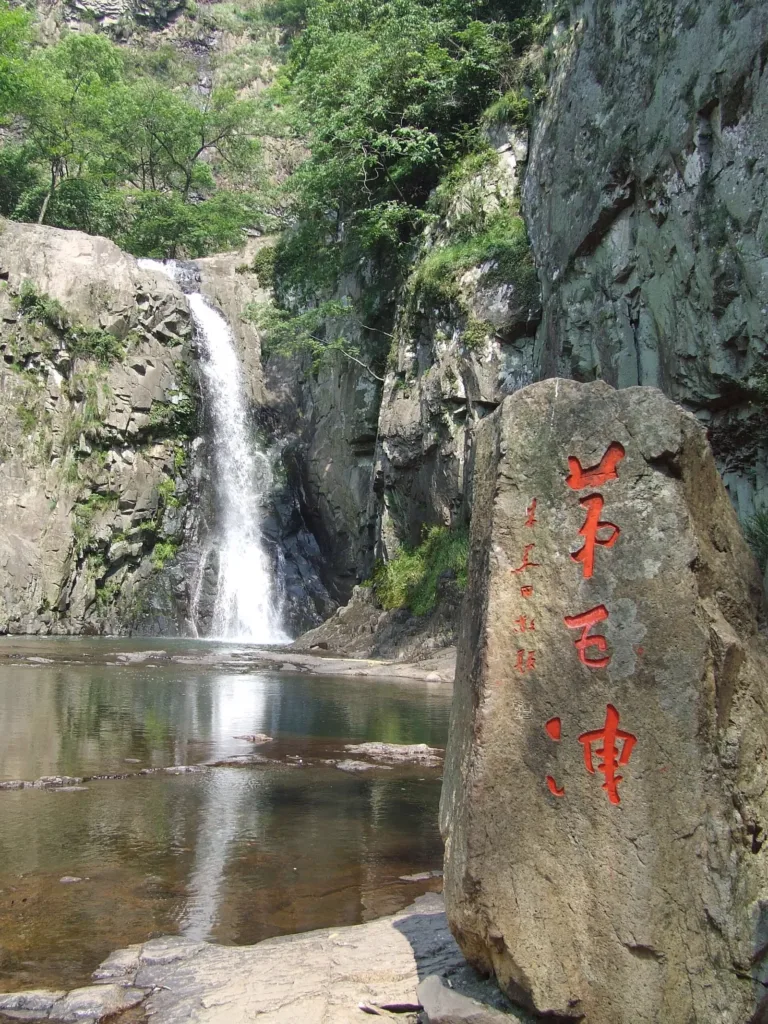 A waterfall in the Wuxie scenic area, Zhuji, Shaoxing, photographed in May 2007; the portrait view includes the pool and a red-lettered rock marker. Photo: Pyzhou · CC BY-SA 3.0
Wuxie Waterfalls五泄
Wuxie is a ticketed mountain-and-water landscape in Zhuji, Shaoxing, built around a five-stage waterfall and a lake crossing. Its most rewarding visit combines the boat across Wuxie Lake with a wooded walk to the eastern falls, rather than treating it as a quick city-centre stop.
Read the place guide →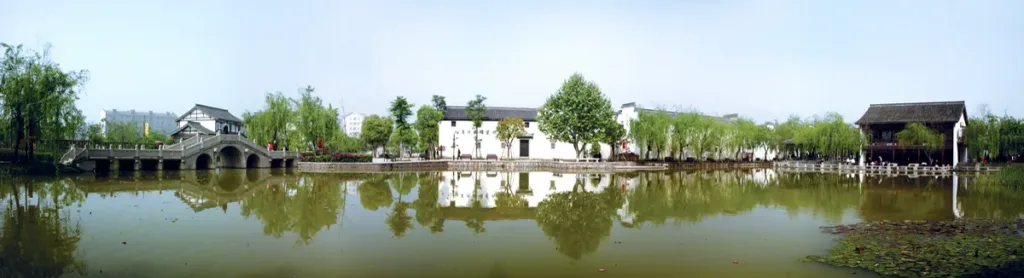 A wide pond-side view of Xi Shi Hometown in Zhuji, with a stone bridge, whitewashed traditional-style buildings, willows and lotus plants. Photo: Chen Tieming (陈铁铭) · CC BY-SA 4.0
Xi Shi Hometown西施故里
Xi Shi Hometown is Zhuji’s riverside cultural landscape built around the local memorial tradition of Xi Shi. Its special character comes from the combination of a reconstructed hall complex, the Huansha River and Zhuluo Hill setting, and optional paid halls and night performances rather than from a single untouched ancient building.
Read the place guide →Plan your visit
Getting there
Zhuji is about 50 km (straight-line distance) from central Shaoxing. Search for 诸暨市 in a map app to find stations and your accommodation.
Where to stay →Build your route
Wuxie Waterfalls and Xi Shi Hometown are about 20 km apart (straight-line distance). The linked place guides have entrance and visit details.
Continue with Shaoxing →More in Shaoxing
Sources & geographic information
Administrative names and parent areas: Official geographic directory (dmfw.mca.gov.cn) · Reference date 2026-09-06.
Background text adapted from Zhuji — Wikipedia contributors, under CC BY-SA 4.0. Text has been shortened and reorganized; source revision 1345161044.
Map data © OpenStreetMap contributors. Pins mark approximate centres, not entrances or boundaries.
Image credits & notes (1)
- Traditional courtyard houses above the river in Zhuji · 浙江省诸暨市传统庭院式民居,远眺市区河流 Source-recorded photograph date: 2008.Photo: zjctming · CC BY-SA 4.0Resized for the web; the photo itself has not been edited. Thumbnails may show a cropped view.
