

Getting Around China: Metro, Buses and Shared Bikes
Public transport in China for foreigners is easiest with Amap to plan the journey and Alipay to pay for it. That is the combination I recommend: let the map tell you which station, train direction, transfer and exit to use, then open your city’s transport code at the gate.
The metro is usually my first choice for crossing a large city, especially when roads are busy. Walk or take a shared bike for the short final stretch. A direct bus can be excellent; a complicated bus journey just to save a small fare usually is not worth your holiday time.
Quick takeaways
- Start with Amap → Routes → Transit. Compare walking distance and transfers, not just the shortest displayed time.
- Activate the city’s Metro or Bus transport code in Alipay or WeChat before your first ride.
- For the metro, use the same live code service and account at entry and exit. Each traveler needs their own code or ticket.
- Take water bottles and other liquids out of your bag for separate inspection at metro security. Check restrictions before carrying sprays or sharp tools.
- For a shared bike, the ride is finished only when the lock and app confirm it—not when you stop pedaling.
In this guide
- 1. Plan the route in Amap—the part locals rely on
- 2. Get a metro code in Alipay or WeChat
- 3. Enter the station: security first, then the gate
- 4. Find the right train, transfer and exit
- 5. Take a city bus without missing the last scan
- 6. Unlock a shared bike—and finish the ride properly
- 7. When your code or phone fails
- Useful Chinese phrases
1. Plan the route in Amap—the part locals rely on
You do not need to study a whole metro map before leaving the hotel. Amap, also called Gaode Maps or 高德地图, is the practical starting point for navigating Chinese cities. The network map helps you check the route; Amap does the day-to-day planning.
Open Amap, find your destination, and check that it is the correct branch or entrance. A railway station, its metro station and a nearby hotel can have very similar names. Then tap Routes → Transit; in Chinese, look for 路线 → 公交地铁. Set the starting point to your actual location or hotel—not a station on the other side of town.
Open the route details and read these in order:
- Walk to the station. Check the entrance and walking route. The nearest station pin may not be the entrance you need.
- Line and direction. Note the line number, the named direction and the station where you get off.
- Transfer. Check where to change trains and how much walking the transfer involves.
- Exit and final walk. Look for the recommended numbered or lettered exit and the remaining walk to your destination.
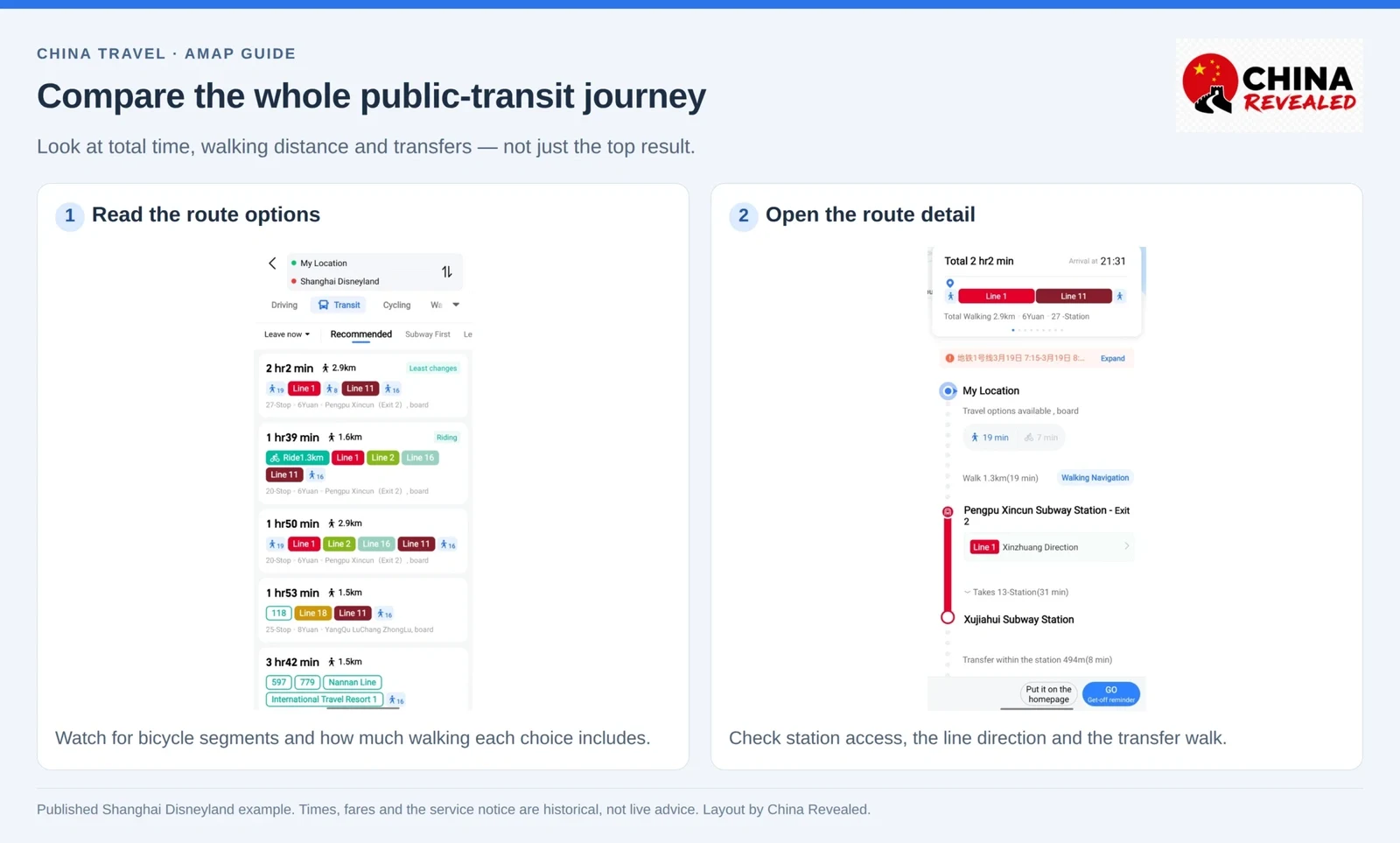
I would usually choose one easy transfer over three changes that save five minutes. Amap may offer a route containing a bicycle leg; read the small walking and cycling icons rather than assuming everything under Transit is a train ride.
Keep the route open while traveling. Take a screenshot of the station names and exit as a navigation backup, but use the current route for service changes and last-train information. A screenshot of directions is useful; a screenshot of your dynamic transport code is not.
If you need help setting up the English interface, use our Amap guide for foreigners.
2. Get a metro code in Alipay or WeChat
A transport code / 乘车码 is your digital ticket. It is different from the ordinary payment code you show in a shop. The gate reads the code on your phone; you do not point your phone camera at the gate.
Set up your wallet and payment method before travel. Our Alipay guide and WeChat Pay guide cover that separately.
Alipay: my first choice for a new visitor
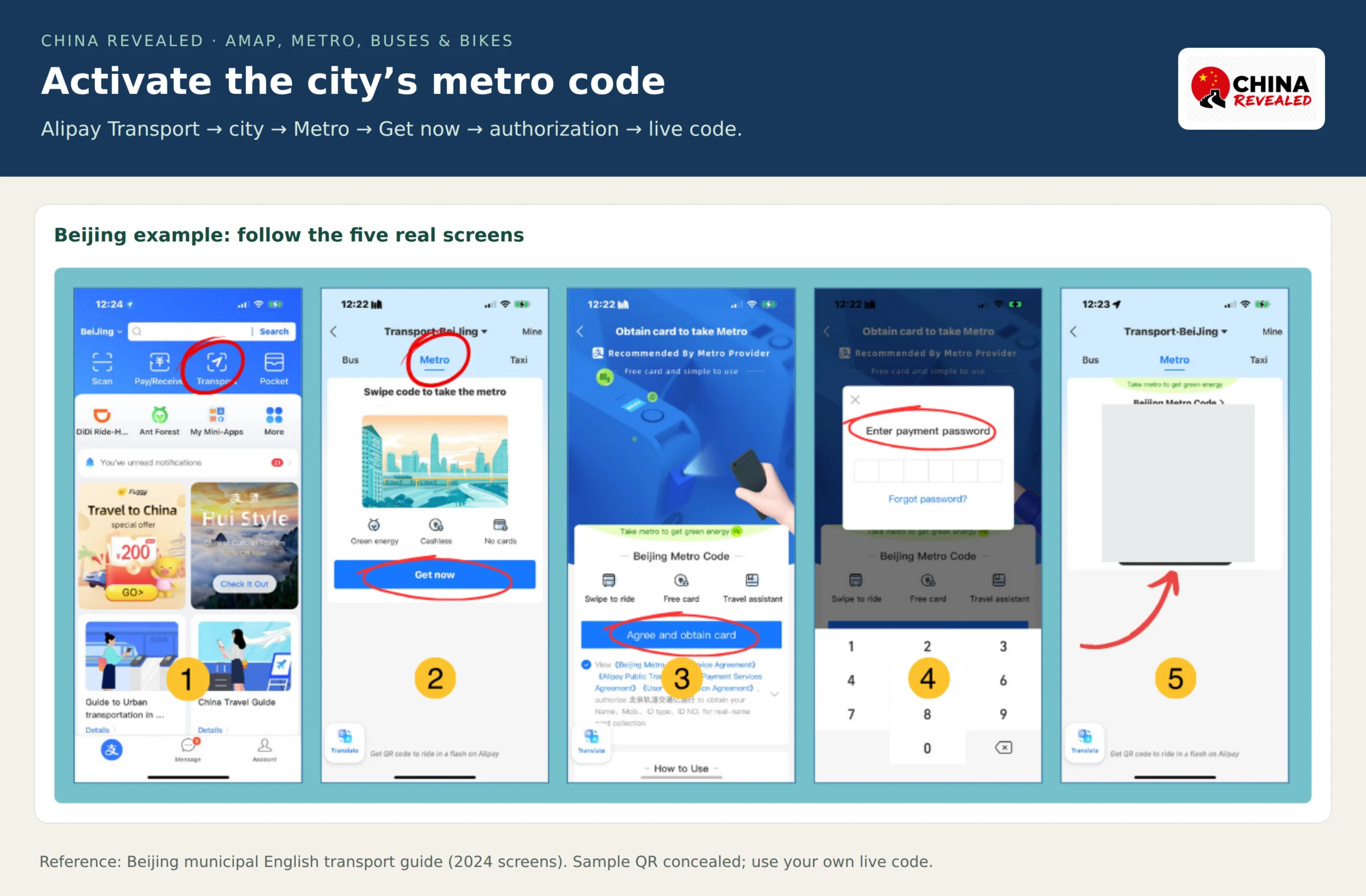
- Open Alipay → Transport / 出行. Some versions call this Travel; search for 出行 if the icon is not on the homepage.
- Check the city at the top. Change it when you move from Beijing to Shanghai or another city.
- Choose Metro / 地铁, then the local metro card or ride-code service.
- Tap Get now / Claim now / 立即领卡, accept the displayed transit agreement and authorize payment. Complete any identity check requested by that service.
- Open the generated metro code. You are ready when the local service name and live QR code appear—not just the card-application page.
WeChat: useful if it is already your working wallet
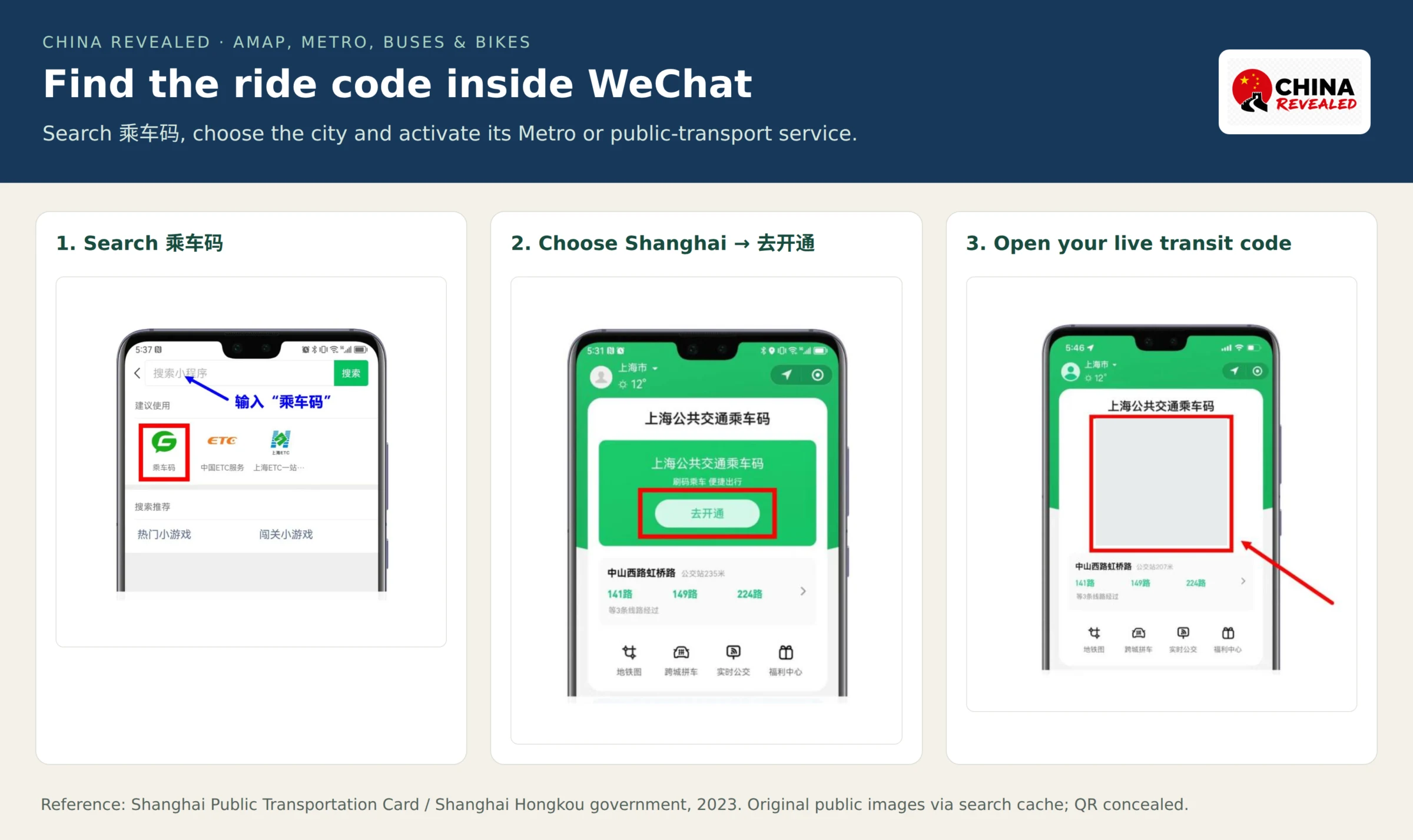
In WeChat, search for 乘车码 in Discover → Mini Programs, or open the available transport service under Me → Services → Transport / 出行服务. Select your city and the Metro/Subway product, then follow the activation and automatic-payment prompts.
Some cities use a combined public-transport code; others show separate bus and metro services. Choose the service explicitly labeled for the transport you are taking. The Shanghai reference below shows the combined 上海公共交通乘车码.
A foreign card linked to the wallet is a good start, but local transit services have their own activation checks. If one stops at a document or payment method you cannot use, buy a single-journey ticket at the station and continue your day. There is no need to install several local apps just to make the first metro journey.
3. Enter the station: security first, then the gate
Follow Amap to the entrance, go downstairs, and look for security before the ticket gates. Allow a few extra minutes at a busy interchange or when carrying luggage.
Take your water bottle, drinks and other liquids out of your bag before the checkpoint. Present them separately to the security inspector rather than leaving them buried inside a suitcase. Staff may put the bottle through a liquid detector, inspect it or ask you to take a sip. Keep it out until the check is finished, then collect it and put it back in your bag.
Put your bag or suitcase through the baggage scanner as directed, pass through the passenger check, and collect your belongings. Metro security is not the airport’s blanket 100 ml liquids rule. Ordinary drinking water can generally travel with you after the separate liquid check.
Do not pack a pocket knife, pepper spray or other defensive device in your sightseeing bag. Restrictions on sharp tools, flammable products and pressurized sprays differ by city; check the station’s posted list if you are carrying them. A small day bag is much easier than a bulky suitcase during the commuter rush.
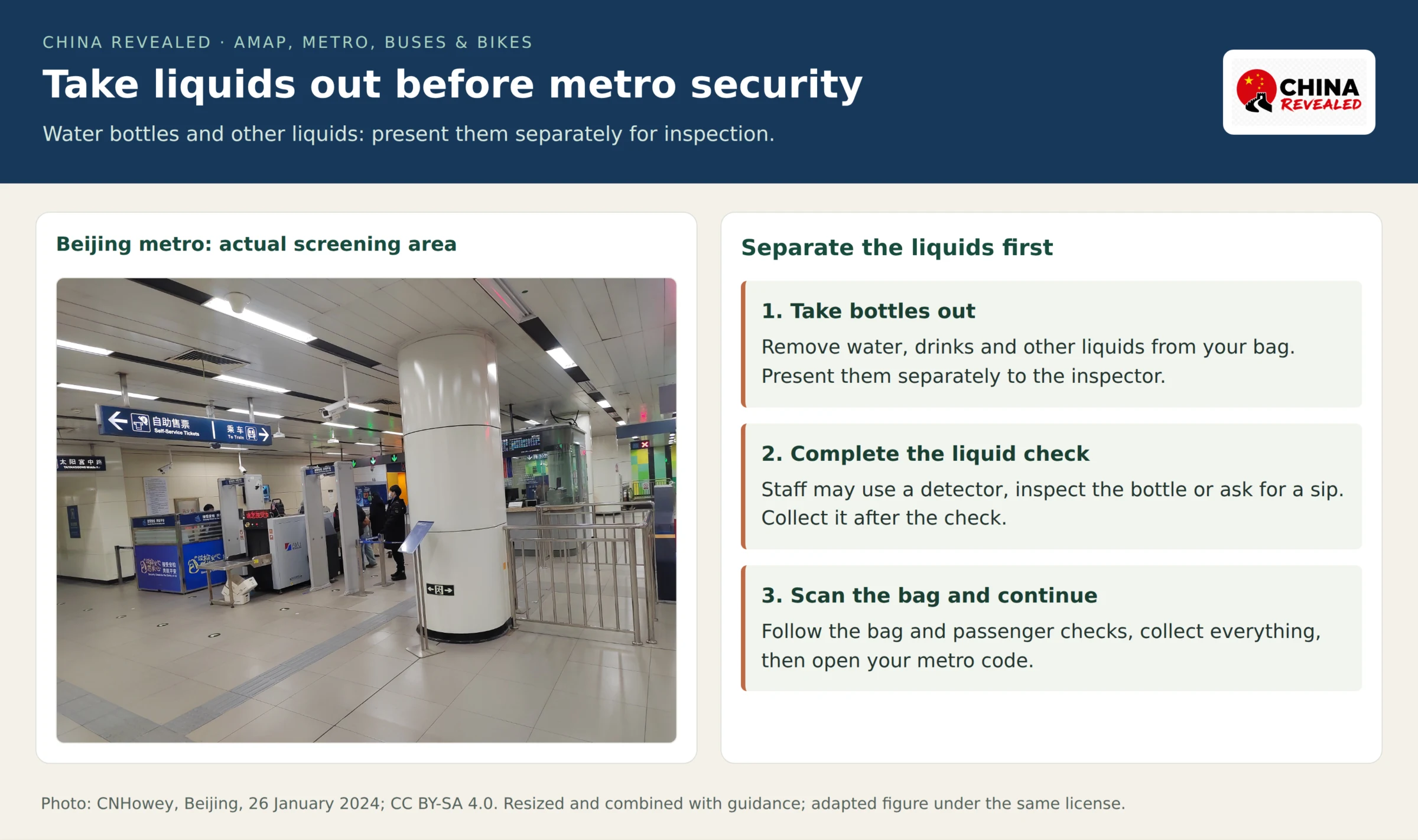

At the gate, open your live metro code, turn up the screen brightness if needed, and hold it steadily over the QR reader. Wait for the success signal and open gate before walking through.
One code is for one traveler. For a family, adults should use their own codes or separate tickets; ask the counter about the local child-fare rule. Use the wider staffed gate for a stroller or large suitcase.
4. Find the right train, transfer and exit
Direction matters more than the line color
Follow signs for the line in your Amap route. Then match the direction or terminal station name shown in the route detail to the platform signs. Before boarding, check that the next station is on your route. Line numbers and station names are more reliable than trying to remember colors.
Some trains take a branch or terminate early. Check the destination on the platform display and train, not just the line number. Let passengers off before boarding and move away from the doors once inside.
Transfer without accidentally leaving the station
At the interchange, follow Transfer / 换乘 signs for the next line. On a normal paid-area transfer, stay inside the system and do not go through an exit gate to buy another ticket. Long transfer corridors are common—that is why the walking time in Amap matters.
If Amap specifically shows an out-of-station transfer, follow that instruction and the local signs; it is a different arrangement from the usual internal transfer.
Choose your exit before going upstairs
At your destination, check Amap’s recommended exit, scan out using the same app or mini program, same account and same transit service you used to enter, then follow the numbered or lettered exit signs. Do not switch from Alipay to WeChat halfway through a metro journey.
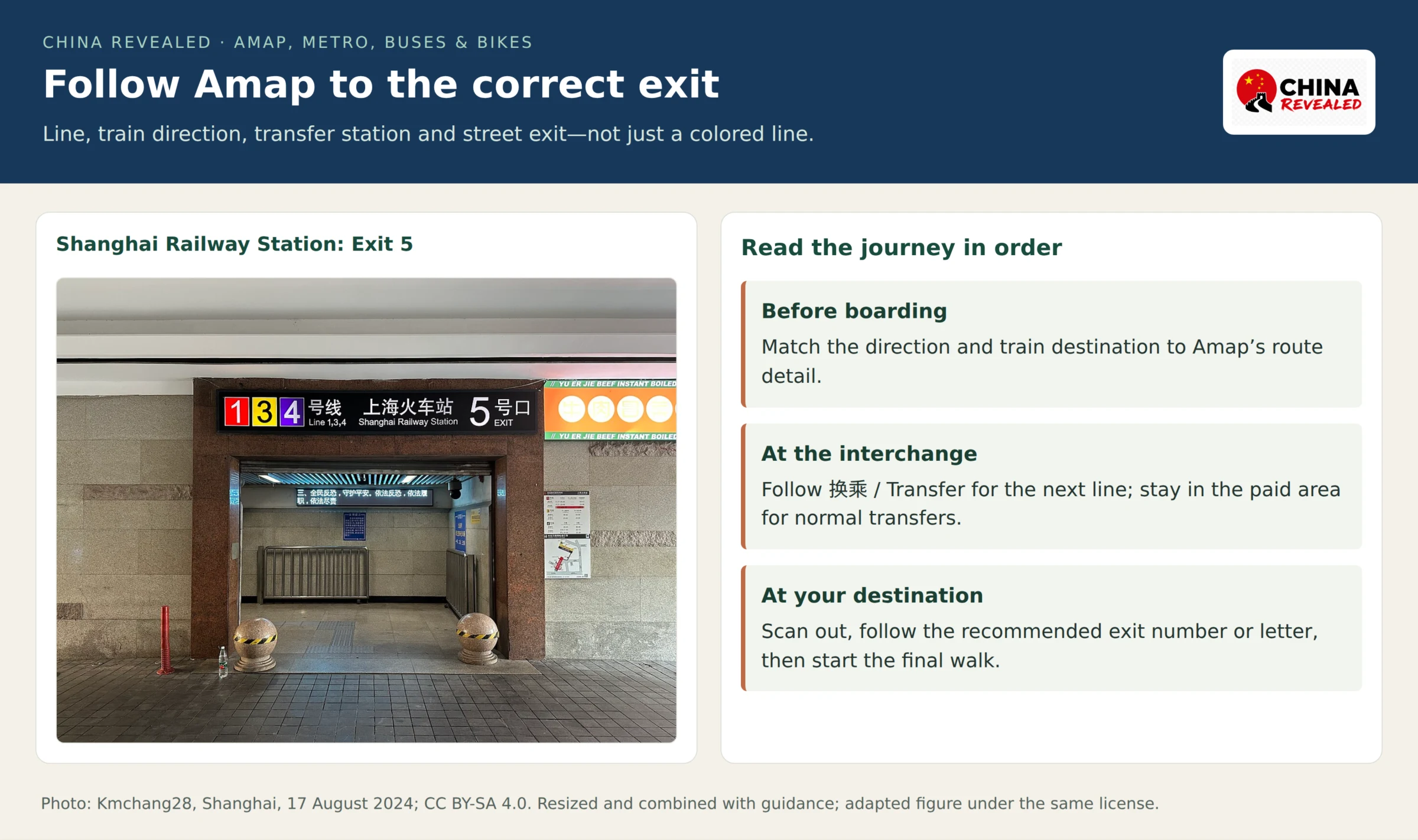

The fare is normally calculated from your entry and exit records and collected through your authorized payment method. It may appear later rather than immediately; find it in the transit service’s Ride history / 乘车记录.
My local-planning tip: finish your sightseeing travel outside the weekday commuter peaks when possible—roughly 7:30–9:30 am and 5–7 pm in many big cities. For a late return, check the last departure for your actual line, direction and transfer in Amap; there is no single closing time for every station.
Traveling with a stroller or someone who needs fewer stairs? Check the entire route from street level to the platform, including any transfer and the destination exit. Our guide to China with kids or older parents covers the practical entrance checks, family facilities and easier transport choices.
5. Take a city bus without missing the last scan
Buses are useful when Amap shows a straightforward route to the door, or when the metro leaves a long final walk. Start with Amap → Transit, open the bus route and check the boarding stop, direction, bus number and stop where you get off. Stops on opposite sides of the road serve opposite directions.
In Alipay, open Transport → Bus / 公交, check the city and activate the bus code. In WeChat, use the city’s bus service in the transport mini program. A combined city code can serve both modes, but a Metro-only code is not your bus ticket.
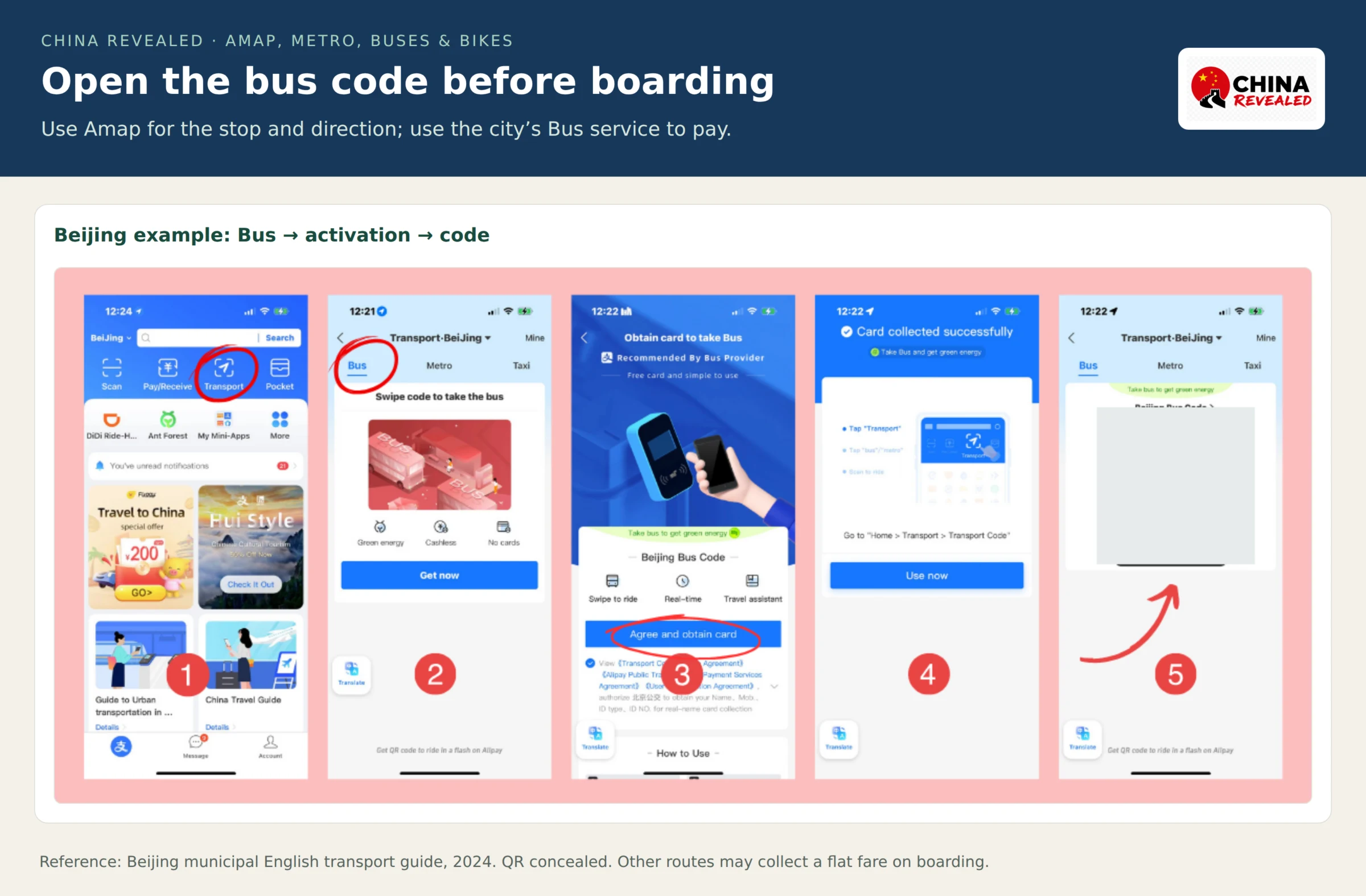
Board at the designated door and show your code to the reader. Listen for the success beep. Keep Amap’s stop list open so you can recognize your destination, and use the stop-request button if needed.
Before you get off, check whether the route requires another scan. Beijing’s regular buses do; flat-fare routes in other cities may collect the whole fare when you board. Follow the signs or ask the driver:
下车要扫码吗? — Do I need to scan when I get off?
On a scan-out route, use the same code when alighting so the system can calculate the correct journey. If you forget, open the service’s ride history and follow its correction instructions.
Cash is a useful backup. Carry small RMB notes or coins and the correct fare: onboard fare boxes generally do not give change. For a distance-priced route, show the driver your destination before paying. Leave a busy bus with a suitcase for another day if a metro or DiDi ride is simpler.
6. Unlock a shared bike—and finish the ride properly
Shared bikes are excellent for the last kilometer from the metro to your hotel, a park or a restaurant. Use Amap → Cycling / 骑行 for the route, especially around divided roads and large junctions. Walking directions are not automatically a safe cycling route.
You will commonly see blue Hellobike/哈啰, yellow Meituan/美团, and turquoise Qingju/青桔 bikes. Start with a pedal bicycle, not an e-bike or scooter, if you only want a simple short ride.
First ride: choose the service and check the bike
In Alipay, open Transport → Bike / 单车 → Scan to unlock. You can also use the operator’s official app or supported mini program: Meituan for Meituan bikes, and DiDi/Qingju for Qingju bikes. Read the operator name on the bicycle rather than guessing from color alone.
Allow camera and location access. The first ride can ask for a phone number, identity details and payment authorization. Select Passport if offered; if the form only accepts a Chinese identity card, use the operator’s official foreign-user support or another travel option.
Before scanning, squeeze the brakes, check the tires, adjust the saddle and make sure the bike is usable. Scan the bicycle’s label, review the rate and any parking conditions, then tap Confirm unlocking / 确认开锁 if prompted. Wait until the lock releases before moving the bike. You do not need a monthly riding pass for one short trip.
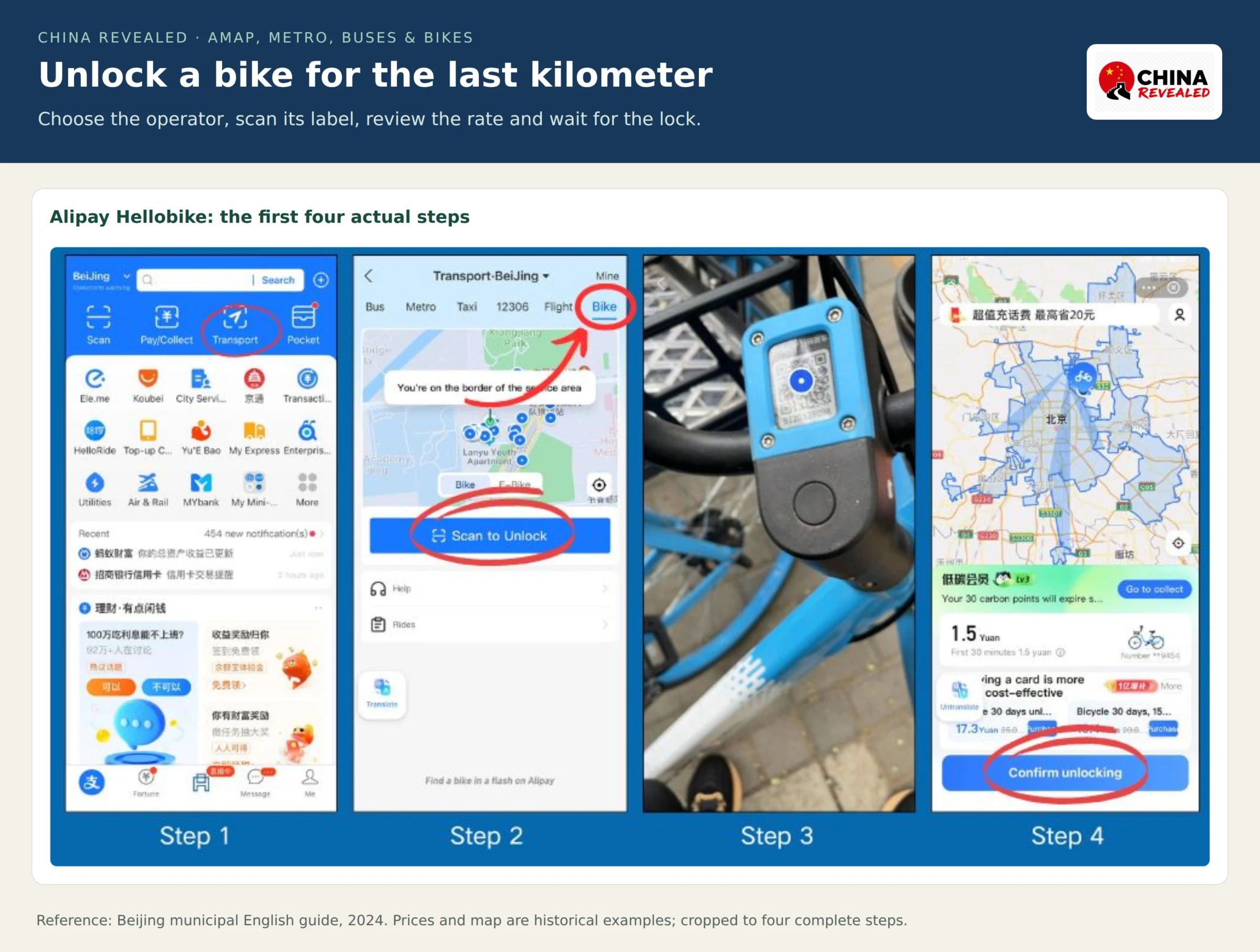
Ride in the permitted cycling lane, obey signals and watch for turning vehicles and other riders. Do not ride against traffic or while holding your phone. Ordinary pedal-bike riders must be at least 12 years old; do not put a passenger on a shared single-seat bike.
Park, lock, confirm—the three-part finish
- Check the app’s parking area before the final stretch. You may need an approved zone inside the operator’s service boundary; a row of other bikes is not proof that parking is permitted.
- Park neatly in the designated area. Keep sidewalks, tactile paving, metro entrances and doorways clear.
- Follow that bicycle’s lock instructions. Some require closing the rear-wheel lock by hand; others use an in-app End ride / Return bike / 结束行程 action.
- Wait for the app to confirm that the ride has ended. Check the final duration, charge and payment status before walking away.
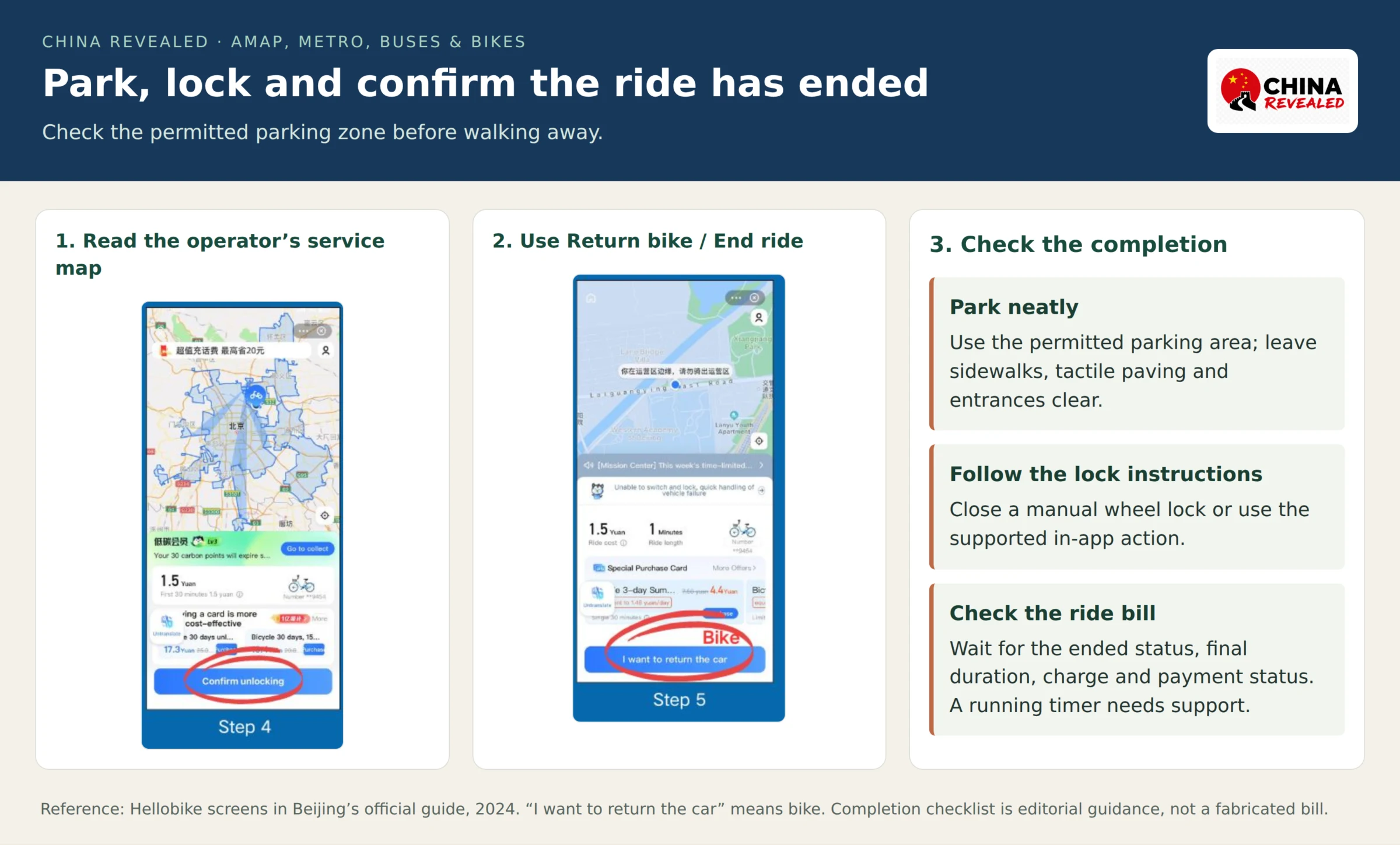
If the timer keeps running, stay with the bicycle. Check the lock, GPS location and parking-zone message, then use Help / 客服 / Report a problem in the ride. Keep the bike number, time and a photo of how you parked it. Do not leave an active ride and expect the charge to stop by itself.
Book hotels, flights, train tickets, attractions and other travel services on Trip.com.
7. When your code or phone fails
| Problem | What I would do |
|---|---|
| No transport code yet | Step aside, select the correct city and Metro/Bus service, then finish its activation. |
| Gate will not read the code | Check the service, brighten the screen and refresh the live code once. Then ask station staff. |
| Exit gate says the journey is incomplete | Show staff your entry station and current ride history. Let them repair or supplement the record. |
| Phone battery dies inside the metro | Go to the service counter for the local exit-ticket procedure. Keep the receipt to reconcile the original ride later. |
| Foreign card or passport not accepted by the local code | Buy a single-journey ticket at the machine or staffed counter. Ask about a local visitor card if staying longer. |
| Bike will not unlock or end | Use the operator’s in-ride support; for an unfinished ride, stay beside the bike until it is resolved. |
At a ticket machine, choose English, select your destination station, buy the required number of tickets and keep your own ticket until you exit. Cash and wallet payment are common options; ask the counter for a supported alternative if yours fails. Some cities, including Beijing and Shanghai, also support eligible international bank cards directly at marked gates. Use that only where the service is clearly shown, and keep the same card or device for entry and exit.
Carry a charged phone and a small cash backup. That solves more travel problems than downloading another transport app.
Useful Chinese phrases
| Show this | Meaning |
|---|---|
| 请问去这个地方坐哪条地铁? | Which metro line should I take to this place? |
| 这趟车是去这个方向的吗? | Is this train going in this direction? |
| 在哪里换乘? | Where do I transfer? |
| 我应该从几号口出? | Which numbered exit should I use? |
| 我的乘车码打不开,想买一张单程票。 | My ride code will not open. I would like a single-journey ticket. |
| 下车要扫码吗? | Do I need to scan when I get off? |
| 单车锁了,但是还在计费。 | The bike is locked, but the fare timer is still running. |
The routine to remember: Amap for the route, the local ride code for entry and exit, and the app’s end-of-ride confirmation for your bicycle. Learn those three things and most city travel becomes straightforward.
Transport rules and service guidance checked October 16, 2026.
About China Revealed
China Revealed is an independent English-language travel guide dedicated to China.
We bring together China travel guides, destination information, local insights and practical travel resources in one place.
Our travel database covers China's provinces, cities, famous attractions, hidden gems, local cuisine, transportation, accommodation, visa requirements, digital payments, mobile connectivity and the other practical details travelers need to explore China.
We focus on depth, careful research and accuracy. Our guides combine official sources, detailed destination data, local knowledge and regularly updated information to give reliable, practical travel advice.
Whether you're visiting China for the first time or exploring beyond the popular destinations, China Revealed is an all-in-one resource for discovering the real China.
China Revealed — Your practical guide to China.
Some links on China Revealed, such as Trip.com booking links, are affiliate links. If you book through them, we may earn a commission at no extra cost to you. This does not change what we recommend.