

China With Kids or Older Parents: A Practical Guide

Traveling in China with kids or older parents works best with fewer hotel changes, easy transport and time to rest—not a packed sightseeing checklist. I would spend more on a useful hotel location and a straightforward transfer before upgrading every attraction ticket.
China’s high-speed trains, large shopping malls and modern city transport can make a family trip comfortable. The details to sort out are practical: whether everyone has a seat, how far the station entrance is, where the lift and toilet are, and whether the hotel room actually fits your family.
Quick takeaways
- Choose fewer bases and one main outing a day. Keep the afternoon flexible for naps, a park or a hotel break.
- Book for the real group size and every child’s age. “Family-friendly” does not confirm beds, a cot, breakfast or connecting rooms.
- For China Railway tickets, use age on the travel date—not height. Declare free under-6 children; buy a child ticket if they need their own seat.
- Check the complete step-free route. A nearby metro entrance or a ramp at street level does not guarantee lift access to the platform.
- Keep passports, essential medicines and a Chinese contact card accessible. Save the hotel address offline and arrange any transport assistance ahead.
In this guide
- Build an easier itinerary
- Choose a hotel that works for the whole family
- Get around without exhausting everyone
- Book trains and flights with children
- Find baby-care rooms and usable toilets
- Food, supplies and the day bag
- Health preparation and medical help
- Stay together and save these Chinese phrases
Build an easier itinerary
Fewer cities usually makes a better family trip
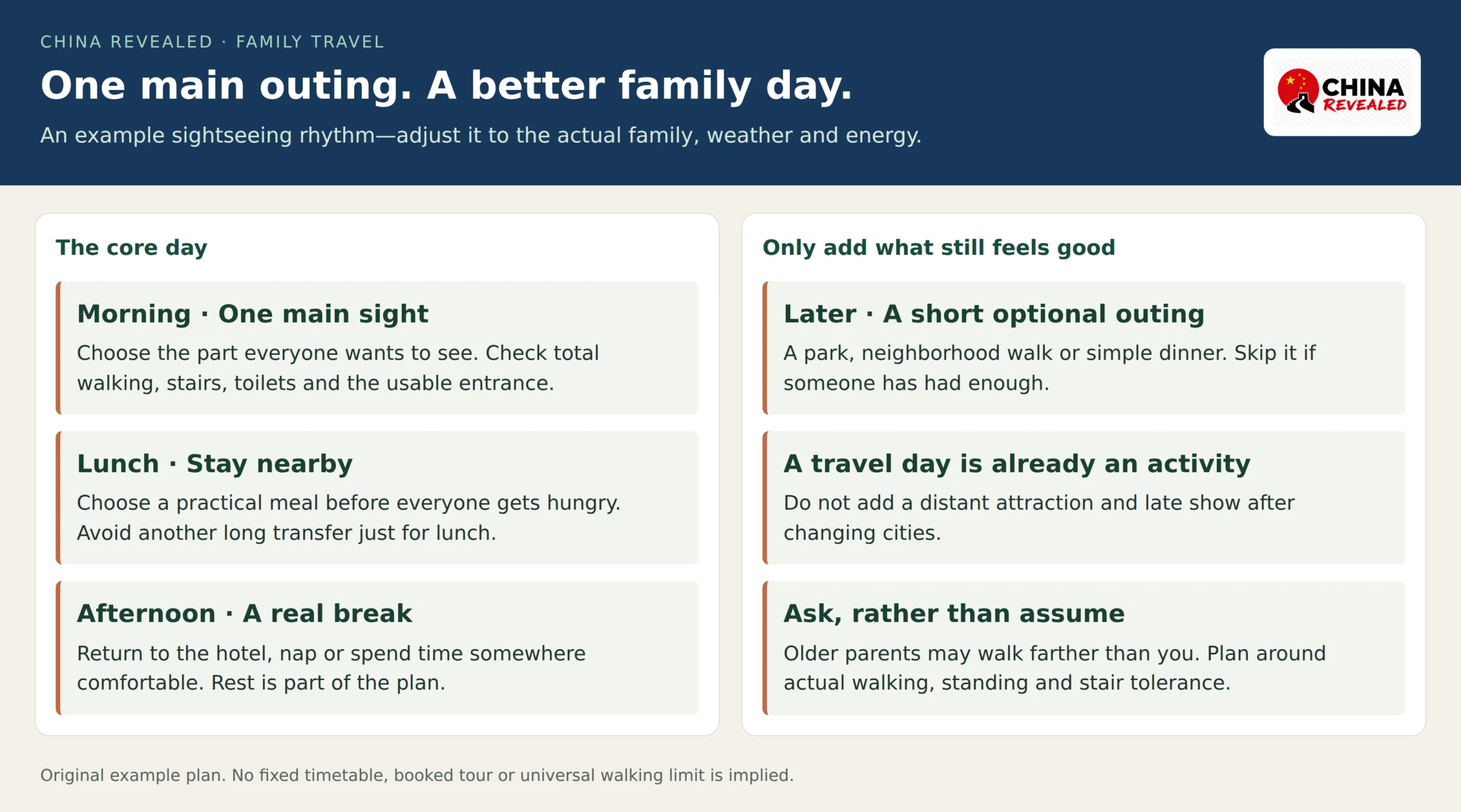
For a first visit, I would choose two or three bases rather than move hotels every other night. Several nights in one place lets you learn the local shops, find a breakfast everyone likes and leave heavy bags behind. A travel day is already an activity; do not add a distant museum and a late show after changing cities.
Build the plan around the actual group. Ask older parents how long they are comfortable walking or standing, whether stairs are a problem, and what they want to see. Some will happily walk farther than you. For children, protect normal meal and sleep times and include something they genuinely enjoy, not just a shorter version of an adult history tour.
One large sight in the morning, lunch nearby and a proper break is a strong starting point. Add a short afternoon outing only if everyone wants it. Parks, a neighborhood walk or a simple meal can be better than another queue.
Choose comfortable weather and avoid needless peak-day crowds
Spring and autumn are useful starting points for many classic sightseeing routes, but check the weather in your actual destinations. If your dates are flexible, work around the full Labour Day and National Day holiday breaks. July and August also bring school-holiday crowds and heat on many popular routes. Our weather, holidays and crowds guide helps you choose the dates.
If school holidays are your only window, shorten outdoor days, book essential transport early and use air-conditioned indoor stops during the hottest hours. Do not save a little hotel money by putting the family far from everything.
For a scenic area or day tour, ask about total walking, stairs, standing time, shuttle queues and the return journey. A cable car is not proof of an easy visit: there may be steps before boarding and after arrival. Request a slower or private tour when it genuinely removes the difficult parts. Read the inclusions and guide language before paying.
Check children’s and seniors’ ticket eligibility at the specific attraction. Age or height thresholds, foreign-passport eligibility and proof vary; a free admission category can still need a reservation, and transport inside the site may be charged separately. Use our attraction-ticket guide for the booking and entry steps.
Choose a hotel that works for the whole family
Location and room layout matter more than a long amenities list. I would look for meals and a supermarket within an easy walk, a workable taxi pickup point and a lift to the room. Read recent photos of the entrance: a charming older building may have stairs before you reach the lift.
Enter all adults, all children and their actual ages when searching. Then confirm the bedding and occupancy in writing. A room described as “children stay free” may mean sharing an existing bed, not an extra bed. A cot can be limited, and adjoining rooms are not necessarily connecting rooms with an internal door.
For someone who has difficulty stepping into a bath, ask for a walk-in shower and a seated toilet. If wheelchair access matters, ask for doorway and bathroom details—not just whether the hotel has an “accessible room.” A photo or measured answer is more useful than a general yes.
Send this before committing to the room:
We are [number] adults and [number] children aged [ages]. Please confirm that this room accepts the whole group, the actual beds, and any cot or extra-bed charge. Are breakfast and children’s meals included? Is there a step-free route from the entrance to the room, and a walk-in shower? Please confirm our expected arrival time as well.
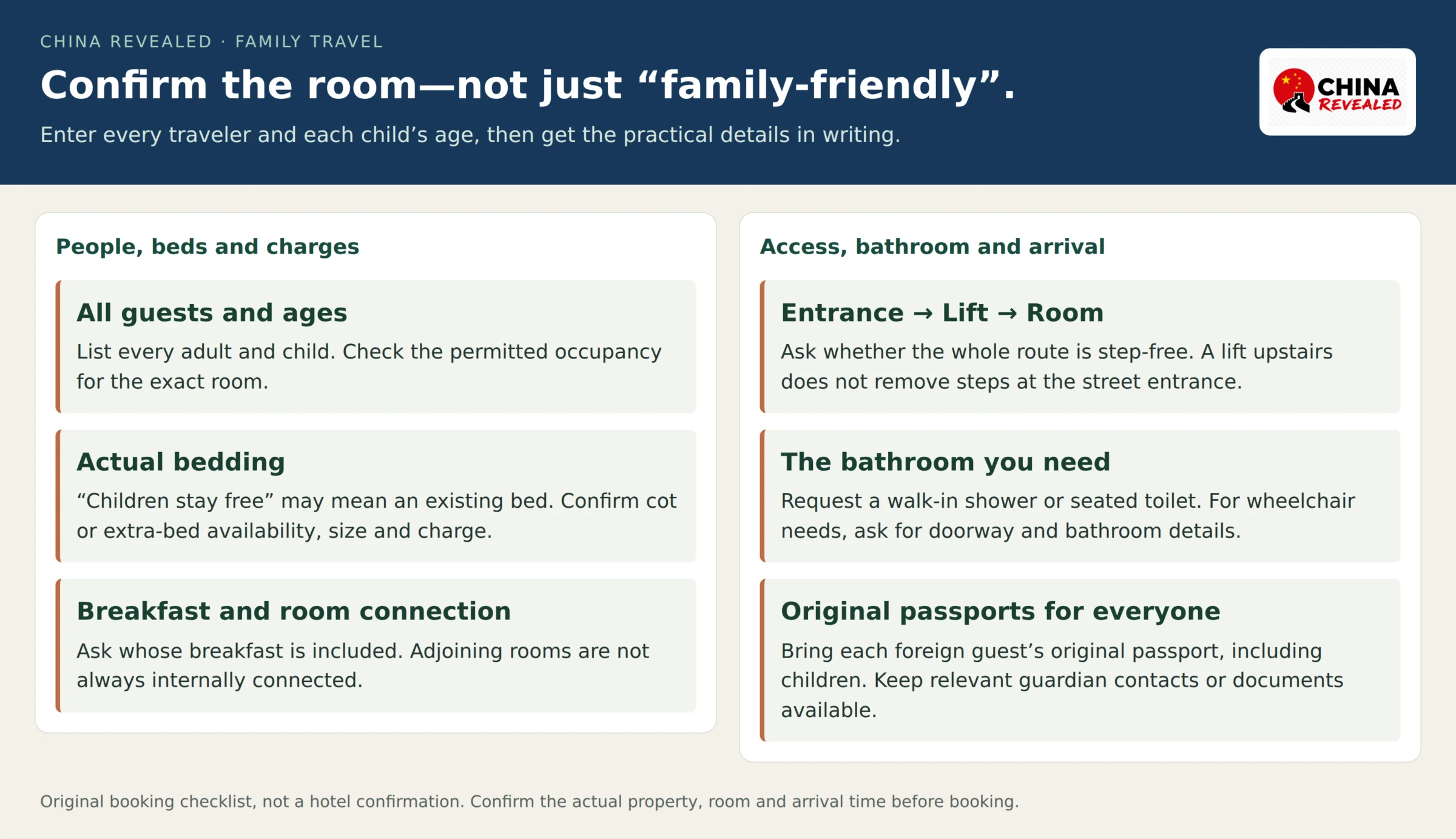
Bring the original passport for every foreign guest, including children, for check-in. Check each traveler’s entry documents individually; an adult’s visa does not cover another family member. Hotels may also ask about a child’s relationship to the accompanying adults and guardian contact details.
A copy of a birth certificate or relevant guardianship document is useful when surnames differ or a child travels with grandparents. For travel with one parent or another adult, check departure-country, transit-country and airline consent requirements beforehand; do not assume one universal permission-letter rule applies everywhere.
Get around without exhausting everyone
The easiest route is not always the shortest one
For a stroller, walking aid or wheelchair, look at the whole journey: hotel entrance, pavements, station entrance, platform, transfer and the final street exit. Large stations can involve a long walk even when the train ride itself is short.
Use Amap for the route, then check 电梯 (lift), 无障碍电梯 (accessible lift) and the specific exit with station staff. An escalator is not a substitute for a lift when using a stroller or wheelchair. A street-level ramp may lead only to an entrance with escalators inside.
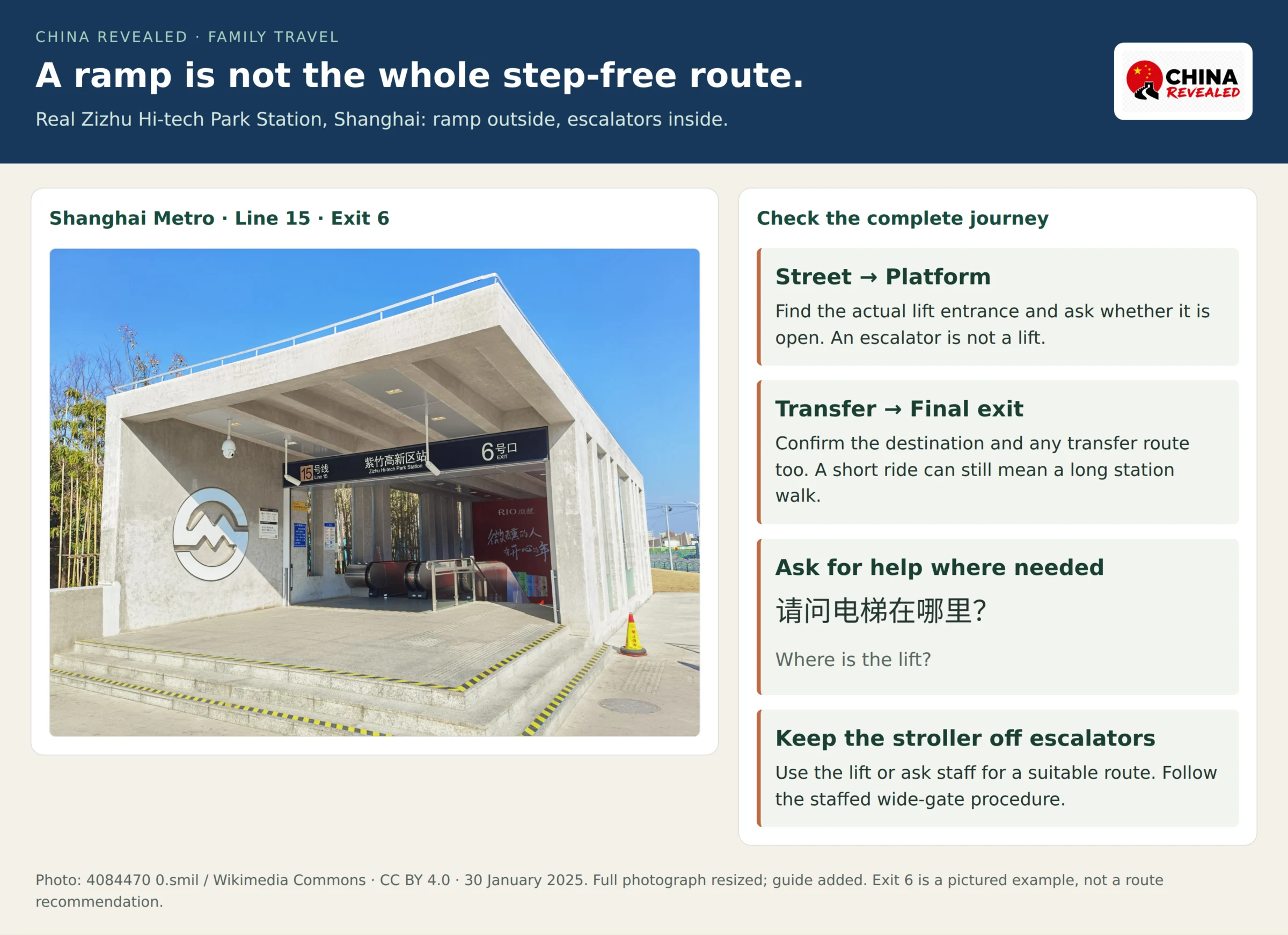

Ask whether the lift route is open and needs staff to unlock a door or operate a service. In Beijing, the metro’s 96165 service can help arrange accessible travel; station help buttons and staff are another route. For other cities, use their own operator or station service—not Beijing’s number.
Have the staff check the destination and any transfer too. If you need airport wheelchair assistance or help boarding a train, request it through the actual airline or railway before travel and ask for that service’s deadline and meeting point.
For ordinary city rides, every paying passenger needs their own ticket or supported live travel code; do not scan one adult’s personal code repeatedly for the whole family. Ask the counter about the local child-fare rule and use the staffed wide gate when needed. Our metro and bus guide covers the route, code and gate steps.
A stroller, a carrier and a car do different jobs
A compact folding stroller is useful on smooth city pavements, in malls and for tired toddlers. A suitable carrier can help with steps and uneven paths, provided the child and adult can use it comfortably. Do not assume an entire old town, hillside or scenic trail will work with either a stroller or wheelchair. Check the specific route before setting out.
For airport transfers and road journeys with young children, reserve a suitable child restraint in advance. Ordinary taxi and ride-hailing orders do not guarantee one. Give the provider the child’s age, height and weight and confirm the seat type, installation, vehicle size and luggage space. Holding a child on your lap is not a substitute for an appropriate child safety seat.
For older parents, a direct car can save a difficult station transfer; the metro may be easier than sitting in traffic. Choose based on the journey rather than loyalty to one transport mode. Never put a child on the back of an ordinary single-seat shared bicycle.
Book hotels, flights, train tickets, attractions and other travel services on Trip.com.
Book trains and flights with children
China Railway child tickets: three age bands
For China Railway’s real-name tickets, the age is calculated on the date of travel:
- Under 6: each adult with a paid ticket may bring one child free, without a separate reserved seat. Declare that child when booking.
- 6 to under 14: buy a child-discount ticket. At the 6th birthday, the child enters this band.
- 14 and over: buy a full-fare ticket. The 14th birthday is already in this band.
An additional under-6 child beyond an adult’s one free allowance needs a child-discount ticket. A free child who needs their own seat also needs a child-discount ticket. For a longer journey, I would buy the seat rather than plan hours with a restless child on someone’s lap. Children under 14 should travel with an adult.
Use each child’s own passport details for their ticket or free-child declaration, and bring that original passport. If the free-child declaration was missed, arrange it at the station ticket window before traveling. Use a staffed gate if the document reader cannot process a passport, and allow time for identity checks.
Book the family together and check the issued carriage and seat numbers, not just the seat preference you requested. Seats together depend on availability. Ordinary second class is a sensible starting point; first class can be worth the extra space on a longer journey if the price works for you.
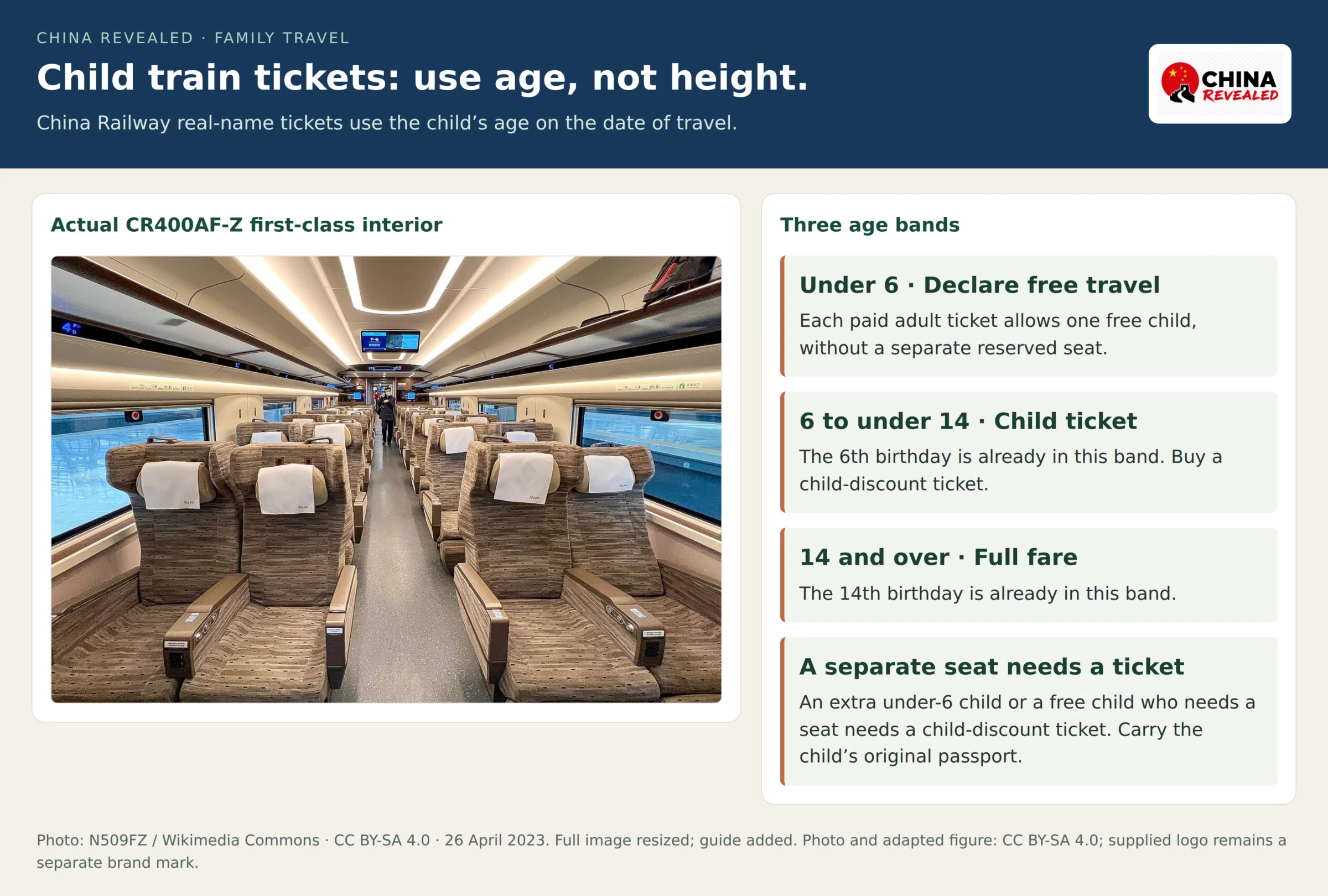

Fold the stroller when needed and keep doors and aisles clear. Ask crew where larger items can be stored and where the accessible toilet or changing facility is on that train; carriage layouts vary. Keep snacks, a change of clothes and essential medicines near your seat, not buried in the largest suitcase.
Flights use different age categories
Do not carry railway ages into an airline booking. For example, Air China uses under 2 for infants and 2 to under 12 for accompanied children, with its own minimum infant-age and accompaniment rules. A lap-infant fare does not include a separate seat. The actual airline sets the applicable ticket, seating and baggage conditions; a cheap adult fare is not proof the child will receive another fixed percentage discount.
Confirm a seat for each child who needs one, ask about sitting together early, and check stroller handling with the operating airline. Cabin acceptance, gate checking and the place where you collect the stroller can differ. A requested bassinet or wheelchair service needs confirmation, not just a booking note.
For both trains and flights, I would choose a daytime departure that does not force everyone out of bed before dawn. Compare hotel-to-hotel time and transfers, not only the time shown on the train or flight listing.
Find baby-care rooms and usable toilets
母婴室: baby-care or nursing room
Large malls, airports and some transport stations have 母婴室. They are useful places to look for changing facilities or a private feeding area. Ask a service desk for the location and access; facilities differ, so carry your own changing mat and supplies.
Read the room’s entrance and cubicle signs. Some breastfeeding areas restrict entry to mothers; a father or other caregiver should ask which family area they can use rather than assume every nursing room has the same access rule. Never leave a child unattended on a changing surface.
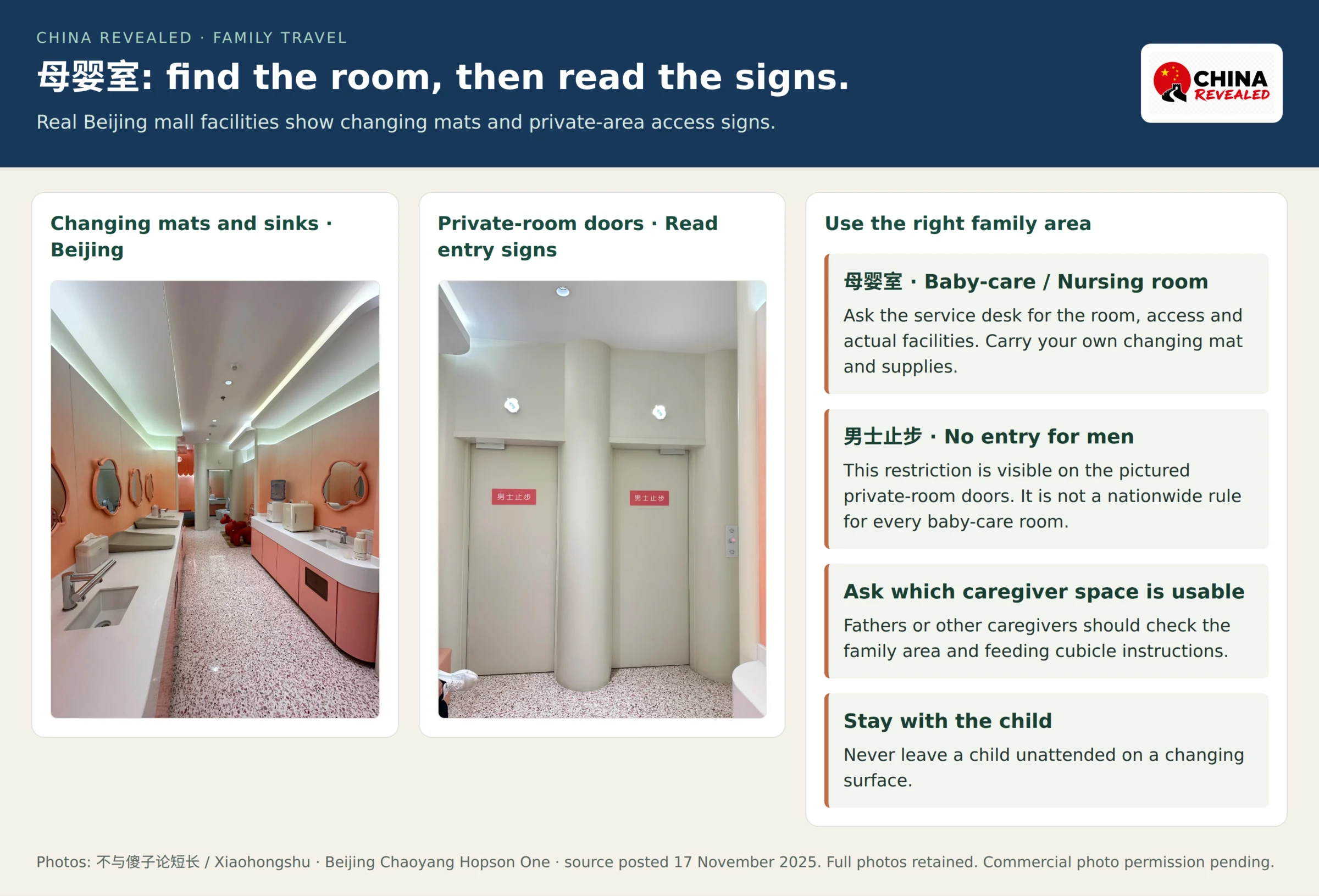
A seated toilet is worth locating before it becomes urgent
Chinese public toilets can have both squat and seated options. If squatting is difficult, ask for 坐便器 or a 无障碍卫生间. 家庭卫生间, 亲子卫生间 and 第三卫生间 are other useful labels for family or assisted-use facilities. A particular room may be single-user or have its own caregiver arrangement; check the sign or ask staff.
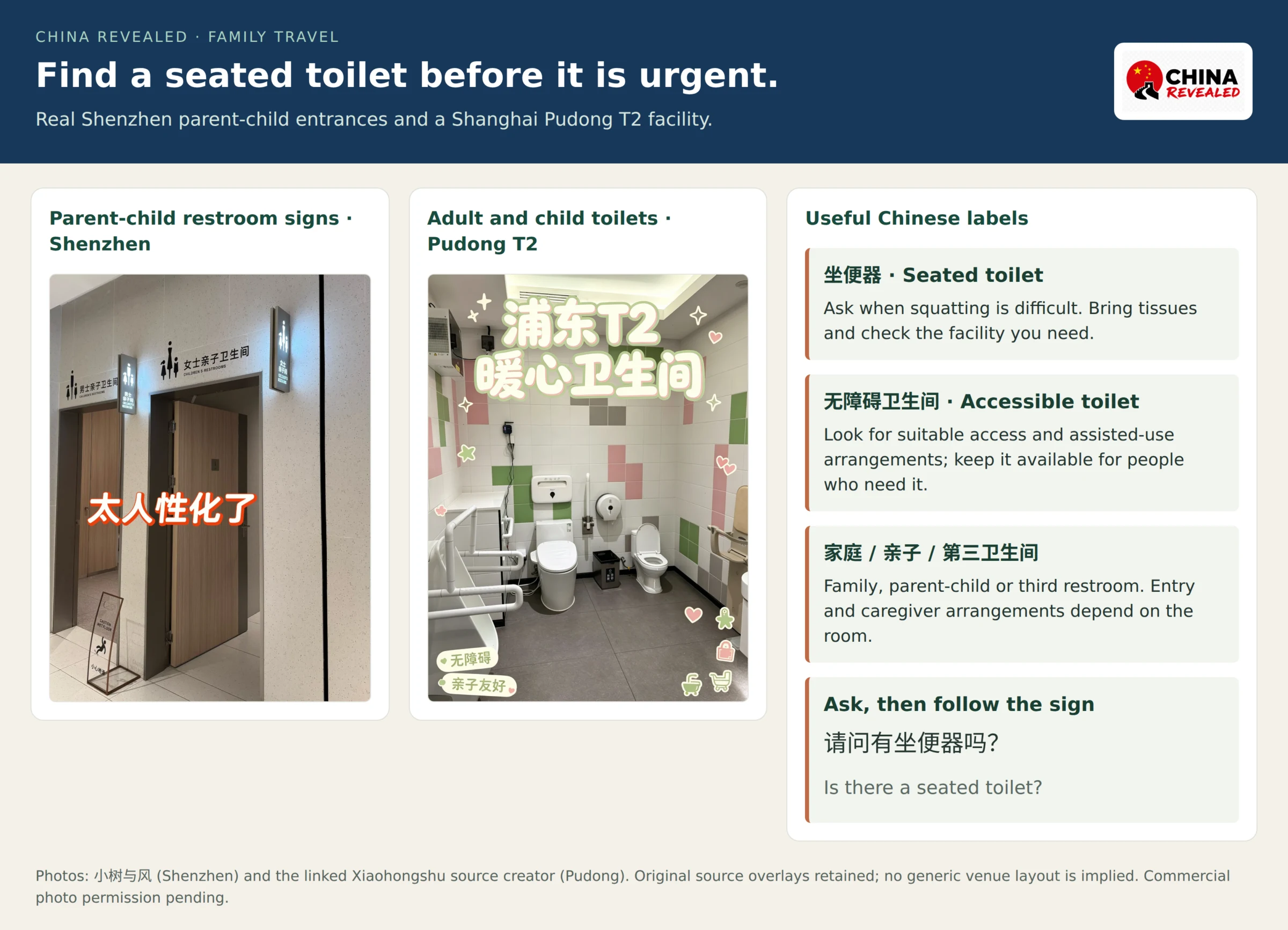
Malls make useful practical stops for food, toilets and an indoor break. Do not wait until you are deep inside a huge attraction to find out where the next usable toilet is. Carry tissues and hand-cleaning supplies, and keep accessible facilities available for people who need them.
Food, supplies and the day bag
For children, start with dishes they recognize: rice, noodles, plain steamed buns or a simple freshly cooked dish. Ask for 不要辣—no chili. Choose the texture and portion for the child’s age, and check ingredients if there is an allergy. “Not spicy” does not mean free of peanuts, eggs or seafood.
Eat before everyone becomes hungry and choose a restaurant near the day’s route. For older parents, ask about seating and any stairs to the dining room. Shared dishes can make it easy to order a mixture, but keep individual medical and dietary needs clear.
Diapers and wipes are easy to look for in city supermarkets and baby shops; 纸尿裤 is diapers and 湿巾 is wet wipes. Bring a starting supply and any items your child must have. If a particular formula is essential, plan enough of that product and check China’s entry rules rather than rely on finding the identical version locally. Prepare formula according to its instructions with suitable water; a public hot-water dispenser is not by itself a complete preparation plan.
Keep the day bag manageable: water, weather protection, tissues, a few snacks, necessary medicines and the family’s contact information. For a baby, add diapers, wipes, a changing mat and spare clothes. Keep items you need quickly in the small bag, not at the bottom of the stroller basket underneath everything else.
Health preparation and medical help
Before booking a demanding trip, review it with a clinician if there is a chronic condition, significant mobility issue or very young infant. A visit around 4–6 weeks before travel gives time to review routine vaccines, medicines and the activities you actually plan. Older age alone is not a reason to rule out the trip.
Bring essential medicines in their original labeled packaging with a medication list, English generic names and prescriptions or a doctor’s letter where needed. Keep them in carry-on luggage and allow for a travel delay. Check the rules for medicines and any equipment before bringing them into China. Ask your insurer specifically about China, existing conditions, age restrictions and medical assistance.
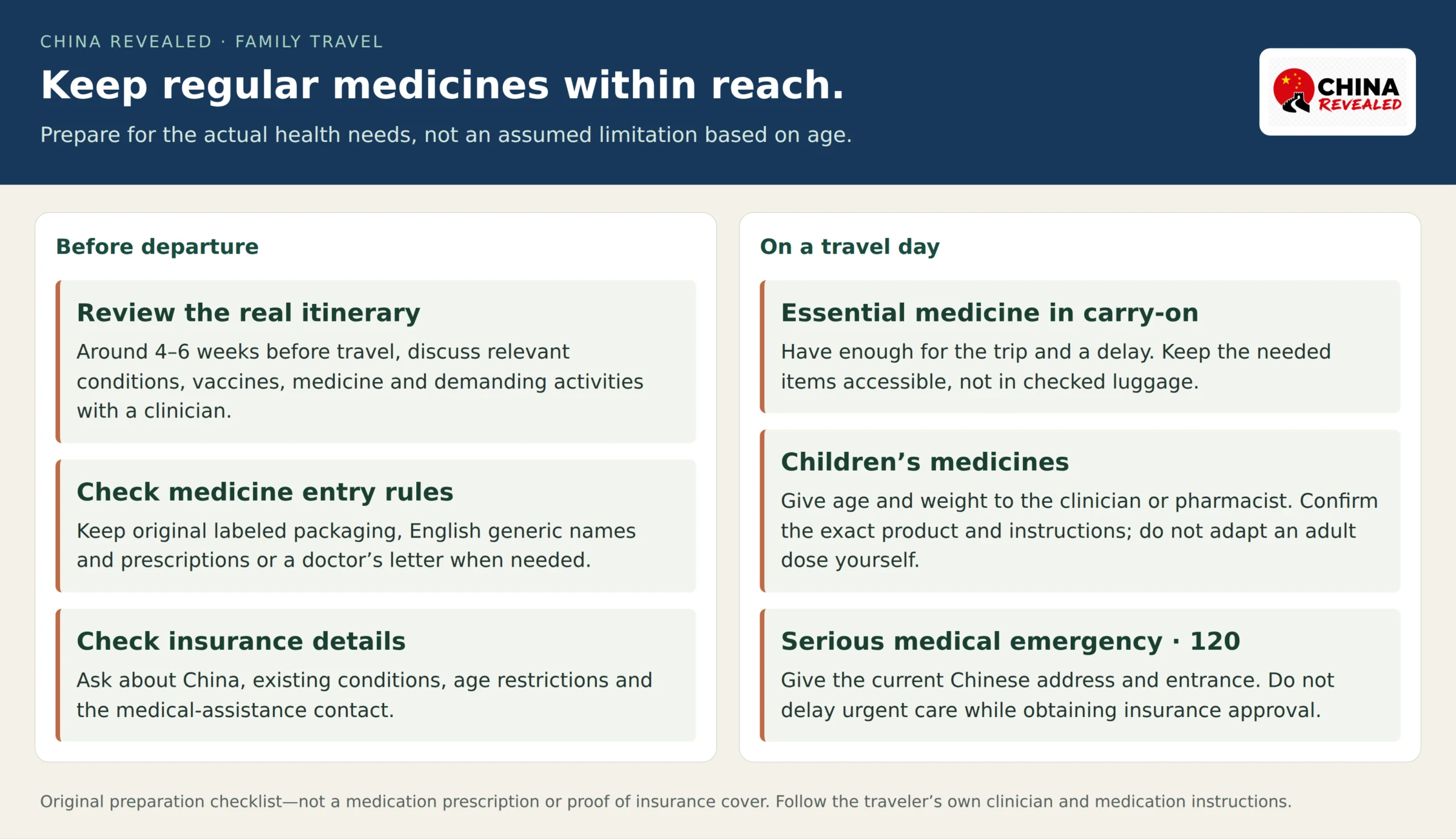
For mild problems, a licensed neighborhood pharmacy or clinic can be a convenient first stop. For a child’s medicine, give the pharmacist or clinician the child’s age and weight and check the exact product and instructions. Do not adapt an adult dose yourself. If a young infant has a fever, or anyone is unusually drowsy, struggling to breathe, unable to keep fluids down or becoming seriously unwell, seek medical assessment promptly.
Our medical-care guide explains staffed registration, pharmacy collection and insurance paperwork. Have hotel staff call a suitable facility when language or passport registration is the difficult part.
On hot days, use cooler hours for walking and take regular shaded or indoor breaks. For anyone on a fluid restriction, follow their own clinician’s plan rather than generic “drink more” advice. Do not leave children or older adults waiting in a parked vehicle. Treat a serious heat-related collapse or confusion as an emergency.
High-altitude destinations need a separate plan, including sleeping altitude and gradual ascent. They are not a sensible last-minute addition because there is one spare day. Discuss the actual route with a clinician when anyone has a relevant health condition.
For a serious medical emergency in mainland China, call 120. Give the current Chinese address and entrance, and ask staff or a companion to help communicate. Do not delay urgent treatment while trying to obtain insurance approval.
Stay together and save these Chinese phrases
Choose a clear meeting point before entering a large station or attraction. At gates and security, agree which adult is staying with which child while the other handles bags or tickets. Do not rush through a train door separately to save a few seconds.
Give a child—or an adult who wants a backup—a simple card with the hotel’s Chinese name and address and a reachable family contact. Keep passport numbers and detailed medical information off a publicly visible wristband. Save the same information offline on phones; a data eSIM alone does not necessarily provide a number that staff can call.
If a child or vulnerable adult goes missing, alert the venue or station staff immediately and call 110 for police help. Give the last-seen location, clothing and any urgent needs. A photo taken that morning can help describe them; do not wait for a planned meeting time if someone needs protection or assistance.
You can decline unwanted photographs or touching politely: 请不要拍孩子,谢谢。 (“Please don’t photograph the child, thank you.”) Friendly interest is not an obligation to agree.
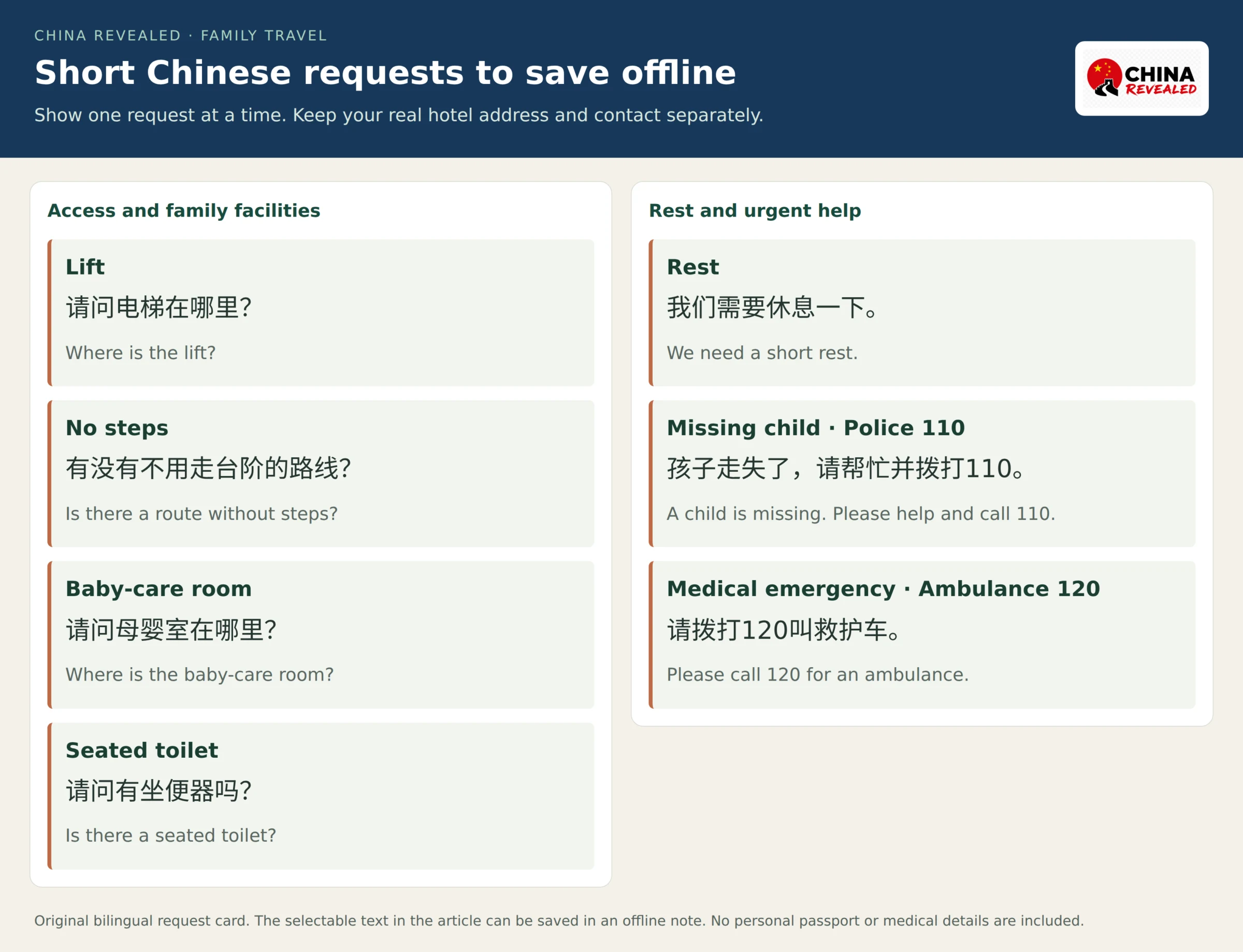
Save these short requests as selectable text:
请问电梯在哪里? — Where is the lift?
有没有不用走台阶的路线? — Is there a route without steps?
请问母婴室在哪里? — Where is the baby-care room?
请问有坐便器吗? — Is there a seated toilet?
我们需要休息一下。 — We need a short rest.
孩子走失了,请帮忙并拨打110。 — A child is missing. Please help and call 110.
请拨打120叫救护车。 — Please call 120 for an ambulance.
My simplest recommendation: make the difficult parts easy before you leave the hotel. Confirm the seat, choose the usable entrance, know the next meal and toilet stop, and keep the afternoon flexible. That leaves the family time to enjoy China instead of spending the day catching up with the itinerary.
About China Revealed
China Revealed is an independent English-language travel guide dedicated to China.
We bring together China travel guides, destination information, local insights and practical travel resources in one place.
Our travel database covers China's provinces, cities, famous attractions, hidden gems, local cuisine, transportation, accommodation, visa requirements, digital payments, mobile connectivity and the other practical details travelers need to explore China.
We focus on depth, careful research and accuracy. Our guides combine official sources, detailed destination data, local knowledge and regularly updated information to give reliable, practical travel advice.
Whether you're visiting China for the first time or exploring beyond the popular destinations, China Revealed is an all-in-one resource for discovering the real China.
China Revealed — Your practical guide to China.
Some links on China Revealed, such as Trip.com booking links, are affiliate links. If you book through them, we may earn a commission at no extra cost to you. This does not change what we recommend.