

Entry & permits for Tibet (Xizang)
Foreign tourists need Tibet entry approval, commonly called a Tibet Travel Permit, and an organised visit arranged through a specialist travel agency in China. Confirm your approved route before booking transport. Requirements differ for Taiwan residents and for travellers using mainland or Hong Kong/Macao Chinese resident documents; check the document guide before you book.
Check the travel-document requirements →Policy scope verified: 2026-09-06. UK FCDO: China regional travel advice ↗ State Council Taiwan Affairs Office: Tibet entry approval ↗ Xizang Department of Culture and Tourism: Medog border permit notice ↗
Explore the region
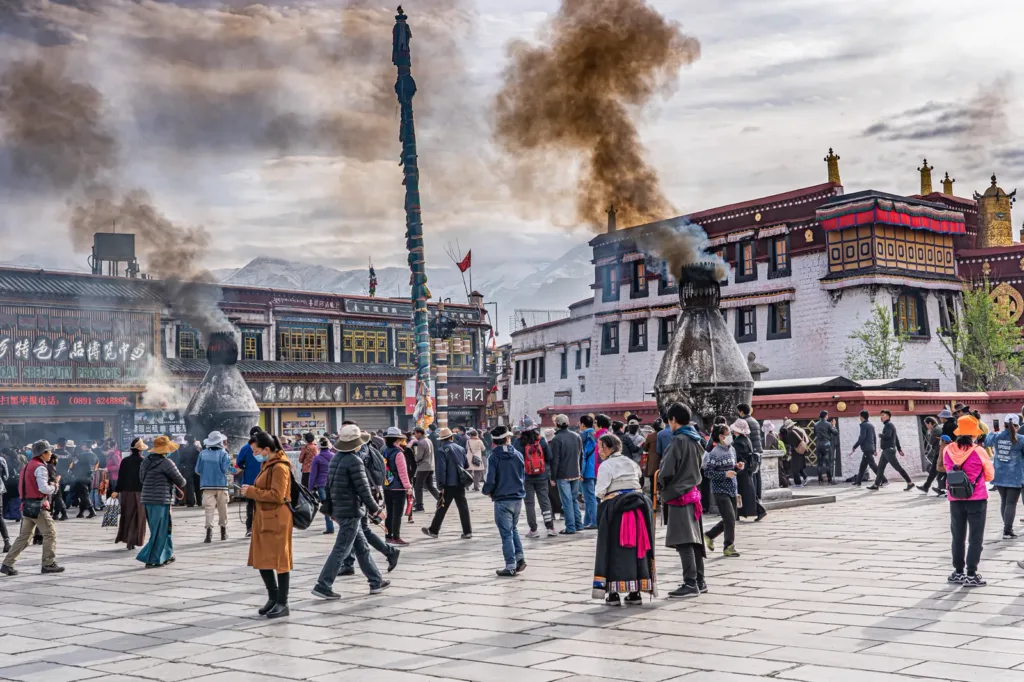
Lhasa is best understood as a living religious city rather than a checklist of monuments. In the old urban core, Jokhang Temple sits at the centre of Barkhor, a clockwise pilgrimage circuit that is also a market, a neighbourhood and a daily street. The route grew around the temple from the seventh century; today, worshippers, residents, shopkeepers and visitors share the same compact historic fabric. Walk with the direction of the circuit, leave room for people who are praying, and ask before taking photographs.
The city’s larger landmarks give that intimate centre a striking counterpoint. The Potala rises from Red Mountain with its White and Red Palaces; the seventh-century Jokhang and the eighteenth-century Norbulingka are the other two components of the UNESCO-listed Historic Ensemble of the Potala Palace. Together they connect palace, temple and garden to Lhasa’s religious, artistic and administrative history. Look for the way whitewashed walls, dark window bands, painted interiors and the dry mountain valley change from one setting to the next. Treat an active temple as a place of worship first, and a visitor site second.
Lhasa also makes sense at a tea table. A typical local-food introduction can move from sweet tea and Tibetan noodles in a morning tea house to tsampa later in the day. Sweet tea is made by boiling black tea, then adding milk and sugar; butter tea is a salted tea enriched with butter and churned. Tsampa begins with roasted highland barley milled into flour. It is mixed with butter tea, curds or sugar and kneaded by hand into small pieces, so the toasted grain, dairy richness and final texture remain easy to notice. Tibetan noodles may be served with a rich yak-bone broth, while yak meat, dairy and highland barley connect city eating to the wider plateau food system. These are regional Tibetan traditions rather than a claim that every recipe originated in Lhasa, and recipes vary between households and shops.
At roughly 3,600–3,700 metres, Lhasa is also a place where the first day should be deliberately unhurried. The CDC advises gradual acclimatization, only mild exercise during the first 48 hours at altitude and avoiding alcohol during that period. Plan a short old-town outing before adding longer or higher excursions, drink normally, and take worsening symptoms seriously rather than treating them as a test of endurance.
Before you book
Foreign visitors to Tibet need Tibet entry approval, commonly called a Tibet Travel Permit, arranged through a specialist travel agent in China, and must travel on an organised tour under the current guidance cited here. Confirm the approved route before buying transport. This requirement is separate from a temple, palace or park ticket: a venue admission or reservation does not replace Tibet entry approval. Do not assume that a foreign visitor may independently tour Tibet, and do not seek ways around the permit or reception requirements. Rules can change or permits can be paused, so check the latest official and travel-advice information for your nationality and route.
Religious sites have their own access, photography and behaviour rules. Ask before photographing inside a Buddhist monastery, do not block pilgrims, and follow local staff instructions. A ticket, if one is available, governs that site’s visit only; it is not evidence of permission to enter Tibet.
Arriving and moving around
The city’s air gateway is Lhasa Gonggar International Airport (拉萨贡嘎国际机场), but the airport is not in Lhasa municipality: it is in Gonggar County, Shannan, on the south bank of the Yarlung Tsangpo. An official February 2026 airport guide listed a 30-yuan airport bus taking about 70 minutes from the T3 terminal to the Civil Aviation ticket hall in Lhasa, with the city departure point at 1 Niangre Road (娘热路1号). It also listed a service from Liuwu Coach Station (柳梧汽车客运站) and flight-linked departures from the airport. Treat these as useful current-operating clues, not permanent timetables; confirm the route, last bus and ticket channel on your date.
Rail arrivals use Lhasa Railway Station (拉萨站), not the airport. China Railway’s station guide lists bus routes 89 and 86 at the station; route 89 connects through the museum and Potala area, while route 86 serves Zhaji Temple. Check the live service before relying on an older station guide. In the old town, use Barkhor Square beside the Jokhang as an orientation point, group nearby streets and temples together, and plan the Potala, Norbulingka and distant monastery or lake visits as separate excursions rather than assuming that every Lhasa listing is walkable from the centre.
Combine your visit
Suggested order for this visit:
-
Barkhor circuit八廓街
Begin by understanding the streets surrounding the Jokhang.
-
Jokhang Temple大昭寺
Visit the religious focus of the old centre when access is available.
-
Ramoche Temple小昭寺
Continue north to a distinct temple with its own revered Shakyamuni image.
This is an editorial sequence based on the features described in the sources. Confirm access locally; no walking time, shared admission or guaranteed interior access is implied.
Find Lhasa overview
拉萨 · 拉萨
The pin marks the area, not the entrance.
More places nearby
Approximate straight-line distances between map pins, not travel distances.
Potala Palace 布达拉宫
Less than 1 km awayThe Potala rises from Marpo Ri, Lhasa’s Red Hill, as a stepped mass of white walls surrounding the crimson Red Palace. Its former residential and ceremonial spaces trace the history of the Dalai Lamas, while chapels and gilded…
View guide →Ramoche Temple 小昭寺
1 km awayRamoche stands north of the Barkhor and is traditionally paired with the Jokhang as one of Lhasa's two great early temples. Its central object of devotion is a gilded image representing Shakyamuni at eight years old, giving this…
View guide →Barkhor 八廓街
1 km awayThe Barkhor is the ring of streets surrounding the Jokhang, formed as pilgrims walked around the temple and traders gathered along their route. Its eastern, southern, western and northern sections still combine religious…
View guide →Sources & visit information
Sources checked on 23 October 2026. Hours, tickets, reservations and transport can change; confirm with the operator before you go.
Image credits & notes (1)
- Barkhor Square beside Jokhang Temple, Lhasa, Tibet, photographed on 15 May 2019. Photo: Stan AdamPhoto: Public domain