

Explore the region
An oasis made visible
Turpan is easiest to understand as a city built around a water problem. The municipal government describes a continental, warm-temperate desert climate with very little rainfall, frequent strong winds and a recorded extreme high of 49°C. The same climate that makes the basin harsh also gives it long sunshine, heat and a long frost-free season for grapes and other fruit.
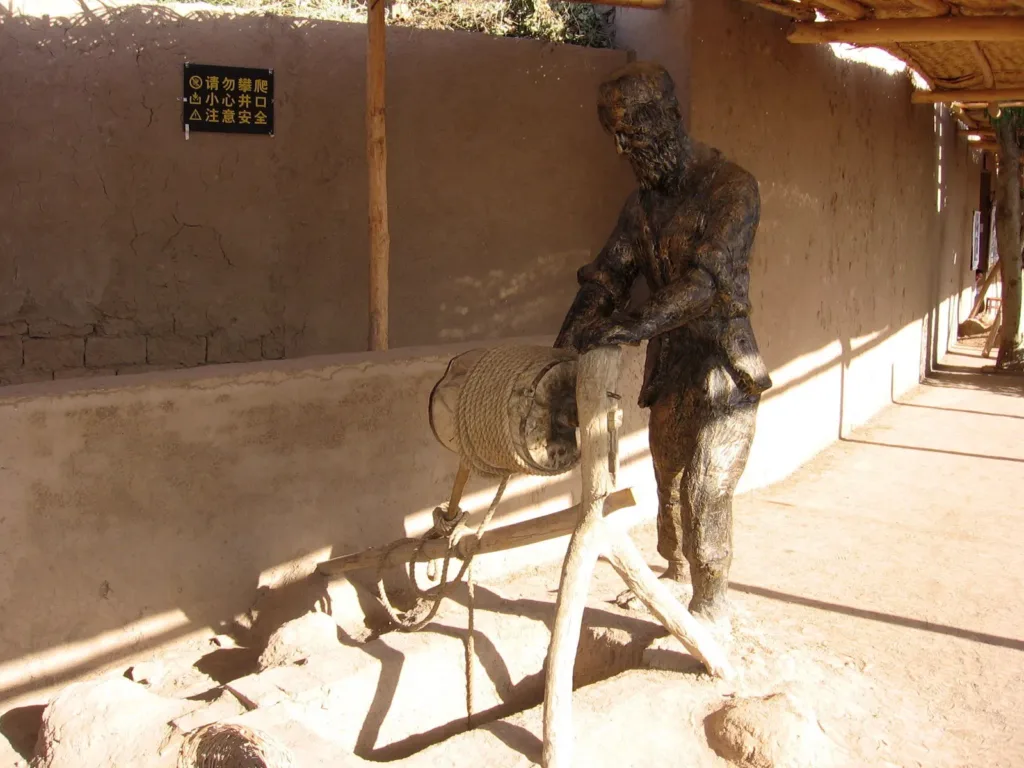
The answer is the karez system: vertical wells, underground channels, open channels and small reservoirs that move groundwater by gravity. It is not only a museum story. UNESCO describes the Turpan basin’s karez channels as part of the water management that supported Qocho and other Silk Road settlements, and notes that many remain in use. A Turpan government account explains how the underground channel limits evaporation while the system’s gentle flow feeds the oasis.
That relationship is still visible in ordinary rural details. Vines shade lanes and courtyards, while tall earthen drying houses turn part of the autumn grape harvest into raisins. The city government describes the harvest-and-drying season as a distinct part of local agricultural life; it says fresh grapes can take roughly 30–40 days to dry in a local drying house, depending on the conditions.
A city spread across archaeological landscapes
Turpan is not a compact old town with every major sight around one square. The modern urban area is the base, while the archaeological landscape fans out across Gaochang District and the wider prefecture-level city. Jiaohe lies to the west. Gaochang, Astana and the Flaming Mountains form an eastern group, with Bezeklik and Tuyoq extending the day farther into the basin and the mountain valleys.
This is why Turpan rewards a directional plan. A visit to Jiaohe is a western outing; Gaochang and Astana make sense as a separate eastern day; the museum can supply context before or after either route. The ruins are not isolated curiosities: UNESCO places Jiaohe and Gaochang within the transnational Silk Roads property, a corridor that carried trade, religions, technologies and artistic practices between civilizations over many centuries. Its description specifically connects the extremely arid Turpan basin, the karez network and the growth of oasis settlements.
The scale of the record is unusually tangible. The National Cultural Heritage Administration reported in 2026 that Turpan has 1,491 immovable cultural-heritage sites and a history in which seven religions, 19 writing systems and 25 languages were present. Those figures are a reminder to look beyond one famous ruin: museum objects, burial evidence, Buddhist cave art, earthen city walls and living irrigation landscapes belong to the same regional story.
Plan for heat, distance and season
Build the visit around the landscape rather than trying to collect every pin in one rushed day. Keep western and eastern excursions separate, and allow extra time if you add Shanshan County, Tuyoq or a desert site. The city government’s administrative page covers a prefecture-level city with Gaochang District, Shanshan County and Toksun County; a listing under “Turpan” does not mean it is in the downtown area.
Outdoor ruins, red mountain slopes and desert edges offer little shade. In the hot season, start exposed walks early, carry water and cover your head and skin. Wind, dust, heat and temporary site restrictions can change the practical experience, so check each venue’s current entrance and operating notice before setting out. The government’s climate description supports planning for heat and dryness; it does not establish a universal opening calendar for every attraction.
Grapes are seasonal in the field. Fresh fruit and harvest activity are most visible around the picking and drying period, while the drying houses show how the same crop becomes raisins. Do not assume that a particular picking, festival or tasting activity is available outside its announced season.
For food, use the Chinese dish name rather than an English transliteration when searching. In Meituan (美团) or Amap/Gaode Maps (高德地图), search the dish name, then check the current menu, recent reviews, opening status and that day’s supply near your location. This is a way to find options, not an endorsement of a particular restaurant. Ask about stock, cooking fat, broth and allergens; appearance alone cannot establish that a dish is vegetarian, halal or safe for an allergy.
Arrive and move around
There is no metro to use as the default way around Turpan. The city’s published transport information instead lists local buses, intercity coaches and taxis. It records route 2 between the city and Turpan Jiaohe Airport via Turpan North Railway Station, route 5 between Grape Valley and the library, route 6 to Emin Minaret, and route 101 serving the Karez Folk Culture Park area. Route details and service hours can change, so use the Chinese destination name in Amap and confirm the return leg before leaving the city.
For rail travel, distinguish 吐鲁番北站 (Turpan North Railway Station) from 吐鲁番站 (Turpan Railway Station) when buying a ticket. The official 12306 query identifies Turpan North as a current bookable station, while an official Xinjiang government railway account distinguishes the other station in Daheyan Town. They are not interchangeable arrival points for a city tour. Check the station name shown on the ticket, then arrange the last leg to your accommodation or the day’s first entrance.
吐鲁番交河机场 (Turpan Jiaohe Airport, TLQ) is another arrival option. A 2025 China Civil Aviation News report says the airport’s air–rail corridor entered service that year, linking the airport with the high-speed rail station for transfers. Flight routes are schedule-dependent, so use the airline or airport’s current timetable rather than an old route list.
A 2025 municipal tourism report also described a 20-yuan tourist loop from Turpan North Railway Station through several Gaochang District sights. Because that report described a newly launched, season-linked service, treat it as a useful lead rather than a permanent timetable: confirm that it is operating on your dates and ask where the return bus departs.
For ticketed A-level attractions, foreign visitors should check the individual venue’s current passport-entry and reservation instructions. Xinjiang’s culture-and-tourism authority said in 2024 that A-level sites using online reservations should add passport and foreign permanent-resident-ID booking fields, but that regional direction is not proof that every venue has the same English interface, counter process or entry lane. Use the passport details and identity-check method stated by the venue, and do not assume a domestic-ID booking flow will work for you.
Combine your visit
Choose from these complementary stops when planning your visit.
-
Turpan Museum吐鲁番博物馆
Begin with the archaeological context.
-
Jiaohe western outing交河故城西线
Choose a dedicated visit west of the city.
-
Gaochang eastern outing高昌故城东线
Plan the eastern ruins as another directional route.
This is a suggested combination, not a timed route; confirm the opening and transport arrangements for your date.
Find Turpan overview
吐鲁番 · 吐鲁番
The pin marks the area, not the entrance.
More places nearby
Approximate straight-line distances between map pins, not travel distances.
Turpan Museum 吐鲁番博物馆
1 km awayTurpan Museum connects the basin’s ancient cities with the objects recovered from them. Written documents and coins reveal administration and trade, while burial displays preserve clothing and other evidence of everyday life. A…
View guide →Emin Minaret 苏公塔
2 km awayEmin Minaret, also called Sugong Tower, is an eighteenth-century brick tower beside a mosque near Turpan. Its tapering circular form is covered with repeating geometric patterns created in the brickwork. The adjoining mosque’s…
View guide →Grape Valley 葡萄沟
7 km awayGrape Valley is an irrigated corridor beneath the Flaming Mountains northeast of Turpan. Water flowing through the valley supports vineyards that contrast sharply with the dry hills around them. The visitor area combines…
View guide →Sources & visit information
Sources checked on 31 October 2026. Hours, tickets, reservations and transport can change; confirm with the operator before you go.
- Turpan Basic Situation Introduction (2026) ↗
- Silk Roads: the Routes Network of Chang'an-Tianshan Corridor ↗
- Exploring Turpan's Karez Wells ↗
- Grape Drying Houses During the Harvest Season ↗
- Turpan: The Glory of the Flaming Continent Through the Ages ↗
- Comprehensive Transport Services Information ↗
- Gaochang District Opens a Tourist Bus Loop ↗
- Turpan Jiaohe Airport Passenger Throughput Surpasses 700,000 in 2025 ↗
- Xinjiang Received Nearly 2.3 Million Inbound Visitors in the First Half of 2024 ↗
- China Railway 12306 Ticket Query ↗
- Turpan Railway Link Between the Southern Xinjiang and Lanzhou-Xinjiang Railways ↗
Image credits & notes (1)
- A karez museum exhibit at Turpan Karez Paradise, showing the traditional well-and-winch system used to explain Turpan’s underground irrigation. Photo: ColegotaPhoto: CC BY-SA 2.5