

Explore the region
The grouping was created from five separate scenic areas and awarded the national 5A rating in November 2014. The five parts are Huizhou Ancient City in She County‘s Huicheng township; the Tangyue archway group with Bao Family Garden in Zhengcun township, also in She County; and Tangmo, Qiankou and Chengkan, all three in Huizhou District.
Two practical consequences follow. There is no single gate and no single ticket window — you enter each part separately, and the tourist bus that links the ancient city with the villages of Huizhou District covers 45 km. And the value of the name is the contrast between the parts: a prefectural seat, a family’s row of commemorative archways, a garden village, a museum of rescued houses and a village laid out on feng-shui principles. Two or three of them make a full day; all five in one day means sitting on buses.
Huizhou Ancient City 徽州古城 — She County
This is the administrative half of the story: a walled prefectural seat where the prefecture and the county were housed inside the same walls for centuries, giving the old town a “city within a city” outline. The city wall is entered through the central south gate, 南谯门 (Nanqiao Gate); immediately inside stands the 徽州府衙 (Huizhou Prefectural Office), rebuilt in 2009 on the Ming Hongzhi-period plan of one central axis and five gates, with a courtyard layout that puts the administration at the front and the magistrate’s residence behind, and reuses Ming timber forms such as curved beams and shuttle-shaped columns.
Walk east out of the office and you reach the single most photographed object in the group: 许国石坊 (Xu Guo Archway), raised in 1584 for the grand secretary Xu Guo. It is the only surviving eight-pillar archway in China — instead of the usual four columns it is closed on four sides by eight, and twelve lions sit at the column bases. Nearby streets to fold into the same walk include 斗山街, 徽园 and the 陶行知纪念馆, all listed as parts of the ancient city.
South of the old town, at 渔梁 (Yuliang), the 渔梁坝 dam crosses the Lian River: the oldest and largest ancient river dam on the upper Xin’an River, 138 m across at the crest and 27 m wide at the base, its stone blocks locked together with ingot-shaped pins and dovetail tenons. The 1 km 渔梁老街 beside it keeps more than 300 old shop-houses; walk down any of the side lanes and the river opens up suddenly.
Tickets and entry. Since the start of 2022 the walled town has had no gate ticket: residents and visitors walk in and out freely, and the old city’s income now comes from individual sites and shops. The prefectural office is ticketed separately, listed at CNY 48, with an evening performance ticket around CNY 98. Buses stop at the 徽州古城游客中心 (Huizhou Ancient City Visitor Centre), which is also the most reliable address to give a driver.
Tangyue Archways and Bao Family Garden 棠樾牌坊群·鲍家花园 — She County
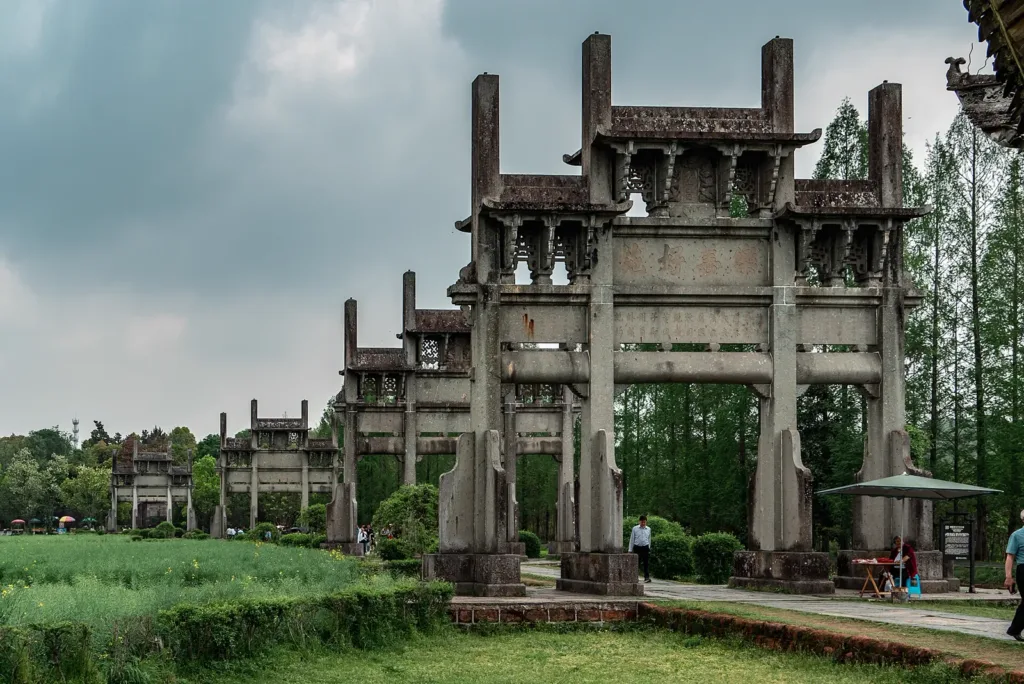
Seven stone archways stand in a line on the approach to Tangyue village, erected between 1420 and 1820 by the Bao family. Read them as a public record of the family’s claims to virtue rather than as decoration. 慈孝里坊 (1420) commemorates a father and son who each offered to die in the other’s place when bandits seized them; 鲍灿孝子坊 (1534) honours a son who sucked the pus from his mother’s feet; 鲍文龄妻节孝坊 (1776) and 鲍文渊妻节孝坊 (1787) record widows who raised children alone; 鲍逢昌孝子坊 (1797) marks a boy who found his missing father; 鲍象贤尚书坊 (1622) records an official who rose to the Ministry of War; and 乐善好施坊 (1820) thanks the salt merchants 鲍漱芳 and 鲍均 for donations to the army and to famine relief. Filial piety, chastity, charity and office — the standard sequence — are each given a stone gate with carved panels and inscriptions.
At the western end of the row stand three ancestral halls: 敦本堂, the Bao branch hall known as the men’s hall; 世孝祠; and 清懿堂, the women’s hall, built in the Jiaqing period on the instruction of the merchant 鲍启运 to honour mothers and restored in 1994. 清懿堂 is the only surviving women’s ancestral hall in China, and its plan matches the men’s hall — three courtyards, five bays, fine brick carving on the entrance, a plaque in Zeng Guofan’s hand, and tablets of Bao family women in the rear hall. Comparing the two halls, which face each other, is the sharpest way to see how clan rules assigned space.
About 500 m away, 鲍家花园 (Bao Family Garden) is a Huizhou-style penjing garden — potted landscapes of stone, pine and flowering trees, some cultivated for centuries, arranged in a park that was once counted among the great private gardens of southern China. Look for named specimens and for the long composite landscape made of more than a hundred separate pots.
Tickets and hours. One ticket covers the archways and the garden: CNY 100 full, CNY 50 half price for children between 1.2 m and 1.5 m according to an English guide, while local listings apply the half price to visitors aged 60–65, 6–18-year-olds and full-time students. Hours are listed as 07:30–17:30. The row of archways is on flat ground; the garden is a short walk away.
Tangmo 唐模 — Huizhou District
Tangmo is the group’s demonstration of water engineering and garden-making at village scale, and the most useful place to learn to read a Huizhou water mouth (水口), the landscaped threshold where a stream leaves a village. Work through it in the order the village presents itself: the water mouth and its bridge, weir, pavilion and old trees; the 水街, where houses and a covered arcade line both banks of the 檀干溪; the 檀干园 (Tangan Garden); the 镜亭 (Mirror Pavilion); the 同胞翰林坊, an archway for two brothers who both passed into the Hanlin Academy; the 高阳桥; and the millennial ginkgo.
檀干园 is the story that visitors remember. A Qing merchant recreated West Lake in miniature beside the village so that his elderly mother could see the scenery without making the journey — a pond, causeway, bridge, pavilions and an island laid out on the model of the Hangzhou original, which is why it is called the Small West Lake and, more pointedly, the Filial Son’s Lake. The 镜亭 in the middle holds 18 stone stelae cut with calligraphy attributed to figures including Zhu Xi, Su Shi, Mi Fu and Dong Qichang, set into the walls of the pavilion.
Tickets and entry. Admission was listed at CNY 80 in late 2025. The village has an east and a west entrance with car parks at each, and buses stop at 唐模景区/唐模村. It is a level walk along the stream, with stone paving and a few steps at the bridges.
Qiankou Residences 潜口民宅 — Huizhou District
Qiankou is a museum, not a lived-in village, and it is the best single stop for understanding how a Huizhou house is put together. Starting in the 1980s, 24 Ming and Qing buildings that could not be protected where they stood — houses, ancestral halls, a stone archway, a road pavilion and a gate — were dismantled in villages around She County and Huizhou District and rebuilt here on the slope of Zixia Hill. The site is a national key cultural relic listed in 1988; the Ming section opened in 1990 and the Qing section in 2007.
The museum has two halves: the southern 清园 (Qing garden), where the buildings sit along a ring path, and the northern 明园 (Ming garden), reached across a small lake and up a low hill. In the Ming half, follow the sequence of gate house, 荫秀桥 bridge, the stone 方氏宗祠 archway with its 魁 rebus carved as a demon standing on a measure box, the 善化亭 pavilion, 乐善堂 — a hall built for villagers over eighty — then 曹门厅, 司谏第 and a group of houses in which Yuan and Ming construction methods are still visible.
Expect buildings rather than interiors: furniture and household objects are largely absent, and several rooms are used by souvenir sellers. A careful walk takes about an hour and a half, and the Ming half involves climbing a small hill.
Tickets and entry. No admission fee is charged, but a reservation is required according to the ticketing listing, and the museum is listed as open 08:00–17:00 with last entry at 16:30; travel listings report that it closes on Mondays except on public holidays, which is worth confirming before you travel. Telephone numbers published for the site are 0559-3535986 and 0559-3535501. The entrance is on 潜黄路 in Qiankou village, in the same district as Tangmo, about 4 km away, and about 8 km from Chengkan.
Chengkan 呈坎 — Huizhou District
Chengkan was sited and shaped by feng shui. The village takes its name from the 坎 position of the eight trigrams; the 潨川河 was diverted to run through the settlement, and the lanes were laid out as two channels, five streets and ninety-nine alleys inside roughly half a square kilometre, with more than 300 Yuan, Ming and Qing structures still standing. It is a village to walk slowly, looking at how water, lanes, halls and gate towers relate to each other rather than at any single façade.
The key building is 罗东舒祠 (the Luo Dongshu ancestral hall, formally the Shrine of Mr Luo Dongshu), begun in the Jiajing period and finished in 1611. Its four courtyards rise one after another, and the rear hall, 宝纶阁, is the reason to come: about 13.6 m high and eleven bays wide, with shuttle-shaped columns, curved beams and bracket sets in the Song manner, carved stone balustrades and beam paintings that have survived four centuries. A plaque in Dong Qichang’s hand hangs in the hall. The building is a national key cultural relic listed in 1996.
Tickets and entry. Admission is listed at CNY 107, half price CNY 53 for students, children aged 6–18 and visitors aged 60–65, with free entry for children under 6 and visitors over 65. The main entrance and ticket office are at the south-western corner of the village beside the Chengkan bus station, with a viewing platform about 100 m away for the classic overview of white walls and grey roofs; the northern gate leads towards 宝纶阁. English signage is scarce, so a local guide or a downloaded plan helps, and the village is noticeably quieter than Hongcun. Note that 永兴湖, the pond in the village, is artificial — it was dug in 2007 — so do not read it as an original feng-shui feature.
Putting a visit together
Group the parts by geography rather than by rating. Huizhou Ancient City and the Tangyue archways are both in She County and are linked by 歙县2路 buses, which run from the county bus station to 鲍家花园 and on to the archway group. Tangmo, Qiankou and Chengkan are all in Huizhou District and sit within a few kilometres of each other. A sensible first visit is one city or village plus one contrasting site: the ancient city with the archways, for example, or Qiankou with Chengkan.
Since 3 April 2026 there is also a single bus line, 游2路, that runs from 徽州古城 to 西溪南 and stops at 棠樾牌坊群(鲍家花园), 唐模景区, 蜀源村, 大灵山, 呈坎北门, 呈坎南门 and 潜口民宅. It is the only line that touches most of the group, but it operates on weekends and public holidays only, runs four times a day in each direction between 08:00 and 16:00, and charges by distance, up to CNY 20 for the full 45 km.
Tickets, opening and reservations
Listings checked in October 2026 price the five parts separately rather than as one gate ticket: the walled town of Huizhou is free to enter, the prefectural office is a separate CNY 48, the archways and Bao Family Garden share a CNY 100 ticket, Tangmo is CNY 80, Chengkan is CNY 107, and Qiankou charges nothing but asks for a reservation. Concessions follow national categories — children, students, older visitors, serving and disabled soldiers, and people with disabilities — with the exact age and height bands varying between listings, so check at the window with a passport or student card rather than relying on a website.
Opening hours also differ by part: the walled town is open to walk at any hour, while the ticketed sites generally run from mid-morning to late afternoon, with the archway group listed as 07:30–17:30, the buildings inside Chengkan as 07:30–18:00 and Qiankou as 08:00–17:00 with last entry at 16:30. Evening programmes, such as the ancient city’s night show, are sold separately.
Getting there and moving between the parts
There is no metro in Huangshan, and none of the five parts is served by one. Arrivals come by high-speed train to 黄山北站 (Huangshan North Railway Station), which sits in Huizhou District between the ancient city and the villages, or to 歙县北站 (Shexian North), one stop further east and the closer station for She County.
From 黄山北站:
- 游1路 runs to the 徽州古城游客中心, calling at 西溪南, 唐模景区, 汪村边, 棠樾牌坊群(鲍家花园), 郑村, 歙县公路客运站, 歙县人民政府, 歙县饭店 and 歙州中心市场. The trip takes about 60 minutes and costs CNY 10, with a CNY 5 fare to the 汪村边 boundary. A 2026 holiday notice gave first and last departures of 08:30 and 19:40 from the station, and 08:20 and 19:40 from the ancient city visitor centre.
- 徽州17路 runs from the station to the terminus at 呈坎; the published timetable shows eight departures a day in each direction.
- 徽州13路 runs along 迎客松大道 through 西溪南 and on to 岩寺; get off at 文峰公园 and walk 320 m to 岩寺汽车站 for county buses towards She County.
- 徽州8路 connects 江坦岭 with 唐模村 and 棠樾牌坊群. To reach 江坦岭, take 徽州13路 or 32路 from the station forecourt and walk about 160 m; allow roughly 80 minutes from the station to the archways.
From elsewhere in the region:
- From 歙县北站, 歙县702路 runs directly to 徽州古城.
- From 屯溪老街 in downtown Tunxi, take 12路 to 市人力资源市场, change to 6002路 for 歙县饭店 and walk about 1 km to the ancient city, for roughly CNY 7 in total.
- From the Huangshan scenic area’s south gate at 汤口, a tourist shuttle runs to 徽州古城 four times a day for CNY 35, passing 呈坎 and 棠樾牌坊群.
By taxi or ride-hailing, give the driver the specific site rather than the group name: 徽州古城游客中心 for the ancient city, 棠樾牌坊群 or 鲍家花园 for Tangyue, 唐模景区 for Tangmo, 潜口民宅博物馆 for Qiankou, and 呈坎景区 for Chengkan. Neighbouring parts are close — Tangmo is about 4 km from Qiankou, with Chengkan about 8 km further on — but Chengkan lies about 25 km east of the She County seat where the ancient city stands, so each leg is a separate trip rather than a short hop.
On peak days the district police publish traffic controls: at Mid-Autumn and National Day in 2026, Chengkan village operated one-way traffic with four car parks and two designated areas inside the village area, 1,110 small-car spaces in total; Tangmo used its east and west car parks with 230 small-car spaces and controlled traffic around 潜口转盘, 坤沙 and 汪村边 during the 15:00–20:00 folk programme; and buses were extended to run until the end of the evening programme at Chengkan, with a temporary stop at the 呈坎镇政府 car park. Arriving by bus and leaving the car behind is the simplest way through such days.
Practical notes
Village lanes in Tangmo and Chengkan are stone-paved, narrow and uneven, and Chengkan sits in a basin with steps at bridges and hall entrances; the Ming half of Qiankou is on a small hill. The archway row at Tangyue and the streets of the ancient city are the flattest ground in the group. The area is humid, with spring rain and hot summers, so an umbrella and shoes with grip do more good than any packing list.
The naming traps are worth memorising. 徽州区 (Huizhou District) is the district around 岩寺 where Tangmo, Qiankou and Chengkan stand; 徽州古城 (Huizhou Ancient City) is in 歙县 (She County), a different jurisdiction, about 25 km away. Neither has anything to do with 黄山风景区, the Huangshan mountain scenic area at 汤口, which is a separate destination with its own transport and tickets. English signage is limited outside the main sites, so keeping the Chinese names above on your phone is the practical way to buy tickets and give directions.
Find Ancient Huizhou Cultural Tourism Area
古徽州文化旅游区 · 安徽 · 黄山市
No reliable map pin yet: search by the Chinese name.
Sources & visit information
Sources checked on 22 October 2026. Hours, tickets, reservations and transport can change; confirm with the operator before you go.
- 古徽州文化旅游区(维基百科) ↗
- 古徽州文化旅游区门票预约官网(合肥本地宝) ↗
- 中国之城丨歙县:一座没有屋顶的徽派文化艺术馆(新华社) ↗
- 歙县:'徽州古城'的'蝶变新生'(中新网安徽) ↗
- Bao's Family Garden(TravelChinaGuide) ↗
- 棠樾牌坊群(维基百科) ↗
- 清懿堂(维基百科) ↗
- 黄山市徽州区潜口镇唐模村(合肥工业大学中国安徽传统建筑文化平台) ↗
- 黄山市徽州区呈坎镇呈坎村罗东舒祠(合肥工业大学中国安徽传统建筑文化平台) ↗
- 江南第一村:呈坎(人民日报海外版) ↗
- 呈坎村(维基百科) ↗
- Chengkan Village(TopChinaTravel) ↗
- 潜口民宅(维基百科) ↗
- 拯救远去的古宅(中国经济网转载中国青年报) ↗
- 潛口民宅博物館景点页(Trip.com) ↗
- 潜口民宅博物馆开放时间与门票参考价(去哪儿旅行) ↗
- 从黄山北站出发,畅达黄山市各景点的公交/班车全攻略(澎湃新闻) ↗
- 黄山北站⇌徽州古城!旅游公交优化调整(凤凰网安徽,来源:黄山市人民政府发布) ↗
- 关于黄山北站至徽州古城旅游公交中秋国庆节期间调整运营时间的公告(搜狐转载长运出行) ↗
- 串联17个景点!黄山市这条旅游公交专线开始试运营(凤凰网安徽,公告原文) ↗
- 黄山市徽州区:坐上公交游徽州'游2路'串起诗画风景新体验(人民网安徽) ↗
- 徽州古城旅游攻略之公共交通篇(搜狐) ↗
- 关于2026年中秋、国庆假期徽州区景区古村落交通动线优化服务的通告(黄山市公安局徽州分局) ↗
Image credits & notes (1)
- The seven Ming and Qing archways of the Tangyue group stand in a line on the approach to Tangyue village, She County. Photo: 王淞Photo: CC BY-SA 4.0