

Explore the region
What Tangmo is, and how it differs from the famous villages
Tangmo (唐模) is a village in Qiankou Town 潜口镇, Huizhou District 徽州区, in the south of Huangshan City. It is not Huizhou Ancient City 徽州古城, which stands in She County 歙县: the two similar names sit on opposite sides of a district boundary, and taxi drivers will assume the wrong one if you only say “Huizhou”. Tangmo was administered by She County until modern times and now belongs to Huizhou District.
The village was established in the Tang dynasty and grew through the Song and Yuan to its peak in the Ming and Qing. Its name is explained locally as “Tang model village” (唐朝模范村), after the dynasty that the founding Wang family served. It was listed as a Chinese historic-cultural village in 2007 (third batch) and since 2014 has been one of the five parts of the national 5A-rated Ancient Huizhou Cultural Tourism Area; before that group rating it was a 4A attraction in its own right. The village has been open to visitors since August 1998.
What separates Tangmo from Hongcun, Xidi and Chengkan is its treatment of shuikou 水口 — the “water mouth”, the engineered point where a stream enters or leaves a settlement, which Huizhou builders treated as the village’s front door and a place to hold good fortune. Tangmo turned its water mouth into a garden, so the approach is a composition of ponds, dykes, trees and pavilions rather than an open field. The village promotes itself as China’s first water-mouth garden village (中国水口园林第一村).
One planning consequence: the tranquil village of older English guidebooks is tranquil no longer. The operator reported more than 500,000 visitors between January and August 2026, up 571% year on year, and it hit its capacity ceiling on 26 September and again on 1 October 2026.
The water-mouth garden: Tangan Garden 檀干园
At the east entrance, before any building, a camphor tree leans over the path with red ribbons and love-locks tied to its branches. It is more than 400 years old and is known as the 槐荫树 (huaiyin, “locust shade”): village accounts and traveller reports say the 1950s Huangmei-opera film The Heavenly Match (《天仙配》) filmed the scene in which the tree speaks up as matchmaker for the Seventh Fairy and Dong Yong under it. Next to it stands the Shadi Pavilion 沙堤亭, an octagonal three-storey pavilion first built in the Zhengde period of the Ming; the name comes from the custom of spreading yellow sand on the road for villagers returning home in office, a wish that those who leave will rise.
A few steps on, the Tongbao Hanlin Archway 同胞翰林坊 honours two brothers of the village’s Xu family who both passed the highest imperial examination and entered the Hanlin Academy under the Kangxi emperor; the carvings of plum blossom on the pillars are read as “bitter cold brings the plum’s fragrance”, a comment on the grind of study behind the family’s success. Together with the later scholar Xu Chengyao, the village boasts “three Hanlin from one village” (一村三翰林).
Behind the archway lies Tangan Garden 檀干园, and the story that gives the village its most quoted sentence: a rich Xu merchant who ran thirty-six pawnshops (the “thirty-six dian“) had a mother who longed to see Hangzhou’s West Lake but could not travel. He dug ponds and raised dykes beside the village and reproduced the lake — “three pools mirroring the moon”, a Bai Causeway, a Jade Belt Bridge, an islet pavilion — so that, as villagers put it, the whole village lives inside a painting. Everyone calls it the Little West Lake (小西湖).
The garden was never only ornament. Its ponds are linked in three parts over roughly ten mu and double as the village’s water works and boundary marker, which is exactly why Huizhou’s water-mouth gardens are worth looking at as hydraulic engineering and not just scenery.
The islet pavilion is the Jing Pavilion 镜亭 (Mirror Pavilion), reached by bridge and dyke. Its walls carry 18 stone slabs of calligraphy by eighteen masters of the Song to Qing dynasties — Zhu Xi, Su Shi, Mi Fu, Huang Tingjian, Zhao Mengfu, Wen Zhengming, Zhu Yunming, Dong Qichang, Bada Shanren and others — engraved in cursive, running, seal and clerical scripts. Read the small labels next to the panels; the modest size of the pavilion hides the fact that this is one of the more serious collections of rubbings-calligraphy in a southern Anhui village.
In the garden’s south-east corner, the Hegao Jingshe 鹤皋精舍 group includes the Zhonglie Temple 忠烈庙, dedicated to Zhang Xun and Xu Yuan, the two commanders who held Suiyang against An Lushan’s forces in 757; Xu Yuan is the ancestor of Tangmo’s Xu clan. The couplet on the door posts — about preferring the city to fall than to break faith, and about loyalty outshining the sun and moon — is the village’s statement about why a merchant village keeps a martyrs’ shrine at its gate.
Tangan Garden was listed in 2019 in the eighth batch of national key cultural relics protection units (唐模檀干园, 8-0313-3-116), which makes it the village’s highest-designated monument.
The water street 水街 and the village it still is
The Tangan Stream 檀干溪 runs from west to east through the village; its name is taken from a line in the Book of Songs — “hack, hack the sandalwood, place it on the river’s bank” — and it is the reason the village is arranged the way it is.
This is the part to walk slowly. Both banks are stone-slab lanes with whitewashed houses, shops and halls shouldering the water; ten stone bridges of different shapes cross the stream inside the village (“ten bridges, nine forms”). A rain corridor more than forty metres long runs along one bank with meirenkao bench railings built into it — seats with a back, which is where you can sit with the water at eye level instead of looking down at it. Further along, the Gaoyang Bridge 高阳桥 is a covered lounge bridge with a double arch and a five-bay wooden upper storey; the Xu family, who came from Gaoyang in Henan, raised it so their descendants would not forget where they came from. The upper storey now has tables, and tea is served on the bridge.
The lanes lead past the Xu Family Ancestral Hall 许氏宗祠 — more than 3,600 square metres, one of the largest Ming and Qing ancestral halls in the Huizhou region, and the subject of a structural consolidation in 2025 — and further on the village’s oldest ginkgo, said to be over a thousand years old, which villagers link to the Wang ancestors who planted ginkgo when they settled here. The former residence of Xu Chengyao 许承尧故居, marked 翰林府 (Hanlin Mansion), is a provincial-level protected building: Xu (1874–1946) was one of the last Hanlin scholars, founded boys’ and girls’ schools in Tangmo that survive in today’s village primary school, and wrote Xishi Xiantan (《歙事闲谭》), a foundational work on Huizhou studies. The hall displays his portrait and a funeral couplet he wrote for himself at seventy. The Shangyi Hall 尚义堂 and other clan halls along the route are used as stages for the day’s performances.
Two practical notes. Tangmo is a lived-in village, not a museum enclosure: the signposted route keeps visitors along the stream and the main lanes, and courtyards that are people’s homes are not part of it. And several halls are opened or closed according to the performance schedule, so a building that is shut at noon may be in use by the evening.
What is on now: daytime stages and the night lanterns
The village began running an evening show after a giant aoyu fish lantern — built for the 2025 National Games opening ceremony — was borrowed for a Spring Festival programme in 2026; the response was strong enough that the performance became permanent. It is called 满池娇·独占鳌头 (“A Pool of Delights: First Among the Fish”). A huge illuminated aoyu lantern rises above the white walls and black roofs while smaller Hui-style fish lanterns process along the stream and the lanes below. From 23 September 2026 the night show starts at 18:18; it is dark on Mondays except during public holidays, and the flying lantern is cancelled in rain or strong wind. It was suspended on 12 and 13 October 2026 for equipment maintenance, and on peak days of the 2026 National Day holiday the operator added a second show at 20:30.
Daytime is no longer simply sightseeing either. Depending on the day’s board you can catch short pieces at fixed points around the village: a wedding comedy under the entrance camphor, a sung excerpt on the Gaoyang Bridge, and a courtroom tale from the Ming tax-silk case staged in the Shangyi Hall. The operator lists these as a rotating repertoire rather than a fixed timetable, and adds seasonal programmes, so check the board at the gate when you arrive rather than planning around a specific title.
Newer permanent additions are worth an hour of your visiting time: the Wuli 坞里 craft hall in a restored old house, where visitors paint fish lanterns, mould clay lanterns or carve small wooden fish; and the Xin’an wellness parlour, which serves herb teas built on the region’s Xin’an medicine tradition. The village’s own Sino-French guesthouse, the Tangmo Family Inn (唐模法国家庭旅馆), is the flagship lodging — a cooperation project with the Franche-Comté region using three groups of old Huizhou houses reassembled from around the former prefecture. Staying overnight includes two tickets per room, which matters given the booking system below.
Tickets, booking and opening hours
- Booking is compulsory, and it is not a formality. Since 10 September 2026 the scenic area has enforced a reservation system: tickets are bought in advance through Douyin, Ctrip or the Huangshan Tourism official platform, daily ticket numbers are capped, and tickets sell out. The on-site window is kept for verifying concession documents and handling pre-booked groups, not for selling you a walk-up ticket on a busy day.
- Capacity. The limit was reached on 26 September 2026 and again by 16:35 on 1 October 2026, when the operator asked unbooked visitors to go elsewhere; on 4 and 5 October it suspended offline sales altogether. Weekdays outside Chinese public holidays are far easier.
- Concessions published on the Huangshan booking platform: free for children under 1.2 m, visitors aged 65 and over, disabled visitors, serving military personnel and journalists with documents; half price for children 1.2–1.5 m, visitors aged 60–64 and students with a valid card. Bring the ID or passport used for the booking — entry is by document check at the gate.
- Price. The standard adult ticket appears as ¥80 in a local round-up of the five Ancient Huizhou sites, but booking channels display their own prices and time-limited discounts, and we could not verify a current official price notice. Check the figure in the booking channel when you reserve rather than relying on any number printed elsewhere.
- Hours. These are published inconsistently: the Huangshan booking listing shows appointment entry from 07:30 with same-day booking closing at 16:00, while the attraction’s platform listing shows 08:00–20:30, which probably reflects performance nights. If your day includes the night show, arrive in the afternoon, confirm the gate and last-entry time when you book, and expect to leave after dark.
- Contact. The operating company, Tangmo Tourism Development Co. under the Anhui Provincial Tourism Group, is based at the site: 0559-3548888 and 0559-3539091. The platform listing adds a ticket enquiry line, 0559-3539095.
Getting there and back
There is no metro in Huangshan, so no metro option applies here. The rail gateway is Huangshan North Railway Station 黄山北站; from there you have three usable options, all of which stop within walking distance of the ticket gate.
- Tourist bus 游1路 is the simplest. It runs north station → Xixinan 西溪南 → Tangmo Scenic Area 唐模景区 → Wangcunbian 汪村边 → Tangyue Memorial Archways and the Bao Family Garden 棠樾牌坊群·鲍家花园 → … → Huizhou Ancient City visitor centre, and was introduced on 1 October 2024. As revised on 26 April 2025 it covers 15 stops with roughly 36 departures a day and about an hour end to end. The fare is ¥10 for the whole route and ¥5 within the Wangcunbian boundary section; the free-ticket categories are children under 1.3 m, serving and disabled military, disabled police and specific disability categories — everyone else pays full fare, with no other discounts. First and last departures from the north station were 09:00 and 19:40 in the April 2025 notice, and 08:30 to 19:40 under the 2026 Mid-Autumn and National Day holiday schedule.
- Tourist bus 游2路 is the connective route for a village-hopping day, in trial operation since 3 April 2026 but running only at weekends and on statutory holidays. It links Xixinan, the Qiankou Residence Museum 潜口民宅, Dalingshan, Tangmo, and Huizhou Ancient City over 45 km and 17 stops, leaving in both directions at 08:00, 10:30, 13:00 and 16:00, with section fares between ¥5 and ¥20.
- District buses 徽州13路 / 32路 plus 徽州8路 are the everyday public option and the cheapest. Take 徽州13路 from the north station (or 32路 from the forecourt) to Jiangtanling 江坦岭, then transfer to 徽州8路 and get off at the Tangmo stop. The same corridor to Tangyue takes about 80 minutes including the transfer, so budget similar time; the point to watch is the direction of 徽州8路 at Jiangtanling, which the local guide flags explicitly.
- Taxi or ride-hailing. Give the driver Tangmo Scenic Area 唐模景区 in Qiankou Town, Huizhou District; the street address on the platform listing is 潜唐路1号. Cars set down at the main ticket gate. The village has an east and a west car park with 230 car spaces and 15 coach spaces between them.
- Coming back after the night show. On 1 October 2026 the scenic area listed evening departures from its west car park: to Huangshan North station and Yansi via the Qiankou roundabout and Xixinan from 18:50, to She County’s ancient city from 19:30, and to the Huangshan Scenic Area south gate from 19:30. The operator also says extra “fish lantern” departures linked the north station, Huizhou Ancient City and the Huangshan Scenic Area during that holiday. These were published as holiday arrangements, and the 18:18 show starts after the normal daytime bus schedule ends, so fix your return before you go in rather than after the lanterns go out.
- If you drive on a holiday. During folk-performance days the district police put traffic controls on the Qiankou roundabout, the Kunsha and Wangcunbian junctions and the 谢裕大东路 and 潜唐路 approaches between 15:00 and 20:00, diverting large trucks — the busiest window coincides exactly with the evening show.
Walking it, and what to put beside it
Allow two to three hours for the standard walk, more if you stop for a performance or stay for the lanterns. The signposted order on the ground is: main gate → the camphor (槐荫树) → Shadi Pavilion → Tongbao Hanlin Archway → Tangan Garden and the Jing Pavilion → Xu Family Ancestral Hall → the old ginkgo and the performance halls → Gaoyang Bridge → the water street and rain corridor → exit.
Surfaces are stone slabs, with steps up onto the bridges and thresholds into halls; the lane beside the stream is wet and slippery after rain, and the rain corridor and bridges are narrow when a crowd is moving through. Sunshades at midday, care on wet stone, and a check of the day’s show times at the gate will do more for your visit than any equipment.
Tangmo sits inside a cluster of separate paid sites that are easy to combine: the Tangyue Archways with the Bao Family Garden, the Qiankou Residence Museum of relocated Ming and Qing houses, and Chengkan. Each has its own entrance and ticket, and the tourist buses above are what links them; a village-hopping day with two of them plus Tangmo is realistic, three is a rush.
Find Tangmo Ancient Village
唐模古村 · 安徽 · 徽州区
The pin marks the area, not the entrance.
Sources & visit information
Sources checked on 22 October 2026. Hours, tickets, reservations and transport can change; confirm with the operator before you go.
- 唐模村 — 合肥工业大学中国安徽传统建筑文化平台,2023-10-29 ↗
- 唐模檀干园 — 维基百科(含第八批全国重点文物保护单位信息) ↗
- 唐模村 — 维基百科(行政区划与文物保护单位名录) ↗
- 一溪穿村,千年如画(走进传统村落)— 人民日报海外版,2026-04-08 ↗
- 游客增五倍、营收增三倍,唐模做对了什么 — 安徽日报(安徽新闻网),2026-10-14 ↗
- 9月10日起,唐模景区将实行门票预约制 — 唐模景区公告,2026-09-10(转载) ↗
- 公告!唐模景区今日已限流 — 唐模景区,2026-10-01(凤凰网转载) ↗
- 关于黄山北站至徽州古城旅游公交“中秋、国庆”节期间调整运营时间的公告 — 2026-09-18(转载) ↗
- 关于开通黄山高铁北站至歙县徽州古城旅游公交线路的公示 — 黄山市交通运输局,2024-09(转载) ↗
- 黄山北站⇌徽州古城!旅游公交优化调整 — 来源:黄山市人民政府发布,2025-04-26 ↗
- 从黄山北站出发,畅达黄山市各景点的公交/班车全攻略 — 澎湃新闻,2026-04 ↗
- 黄山市徽州区:坐上公交游徽州“游2路”串起诗画风景新体验 — 人民网安徽频道,2026-04-03(转载) ↗
- 关于2026年中秋、国庆假期徽州区景区(古村落)交通动线优化服务的通告 — 黄山市公安局徽州分局,2026-09-22(转载) ↗
- 黄山唐模、宣城桃花潭加速融入长三角一体化 — 中国旅游报,2021-11-04 ↗
- 古村揽月迎华诞 唐模景区2026年中秋国庆双节假期圆满收官 — 黄山市徽州唐模旅游发展有限公司,2026-10-08 ↗
- 唐模景区门票预约购票指南 — 黄山智慧旅游有限公司平台条目(合肥本地宝) ↗
- 唐模景区官方网站 — 黄山市徽州唐模旅游发展有限公司(安徽省旅游集团) ↗
- Tangmo Village — Trip.com attraction listing (official listing) ↗
- Tangmo Ancient Village — China Discovery(英文) ↗
- 邂逅唐模 — 澳门日报,2025-04-09 ↗
- Tangmo Village — Easy Tour China(英文) ↗
- 古徽州文化旅游区门票预约官网(五景区票价汇总)— 合肥本地宝 ↗
- 徽州名人故居许承尧:唐模水街上的最后翰林 — 新浪安徽,2019-07-10 ↗
Image credits & notes (1)
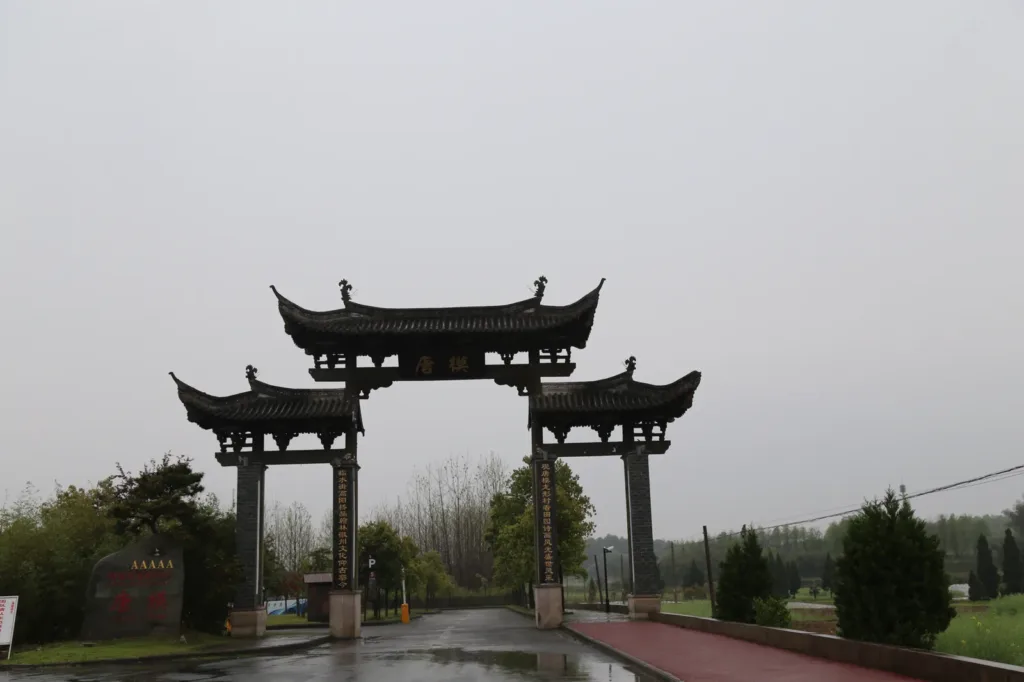
- The signposted entrance archway to Tangmo village, with the village name 唐模 on the tablet, seen on the approach road. Photo: 江上清风1961(Panoramio 用户,经 Panoramio upload bot 上传至 Wikimedia Commons)Photo: CC BY 3.0