


Get to know Tumxuk
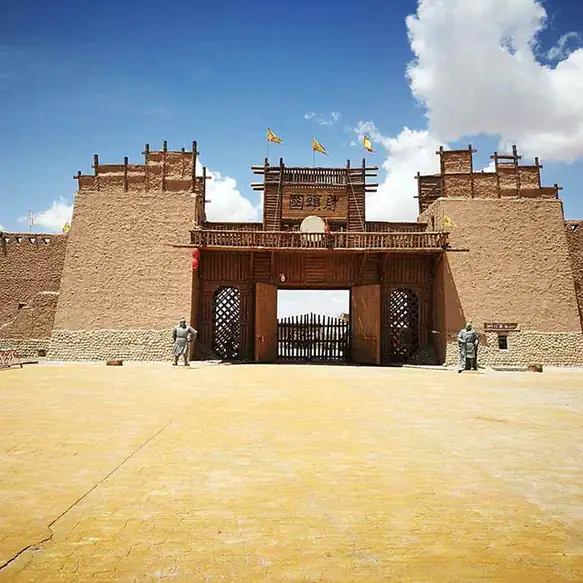
Photo adjustments
EXIF orientation normalized; resized without changing aspect ratio; converted to WebP. No subject edits.
- Administrative area
- County-level city · 县级市
- Part of
- Xinjiang
- Chinese name
- 图木舒克市
- Local areas
- County-level city guide
Area & population
- Area in the source
- 1,927.00 km²
- Population · 2020
- 263,245
- Administrative seat
- Jinxiu Subdistrict
Source: cited geographic source, as of the dates shown.
Setting and landscape
The Xiaohaizi (小海子水库), Yong'anba (永安坝水库) and Qianjin (前进水库) reservoirs lie within the city and together form the nature reserve for the wetlands of the middle and lower Yarkand River. Yong'anba, in the southwest of the city, was built from 1979 and filled in 1983; it draws water from the lower Yarkand and the Xiaohaizi reservoir and is split by a road into a deep southern basin and a shallow, reedy northern one. The Southern Xinjiang Railway passes close to the city.
History
In 1950 Tumxuk was the third district of Maralbexi County (巴楚县). In 1969 the Tumxuk general farm and the Xiaohaizi reservoir were handed to the 3rd Agricultural Division, and the city was created on 17 September 2002. Land from several Kashgar and Kizilsu counties has since been added, and in April 2026 the separate city of Caohu (草湖市) was set up, with its government at Caohu town in the 41st Regiment, formerly part of Tumxuk.
What to see
Tangwangcheng (唐王城) is the ruin of Weitou (尉头州), a Tang-dynasty prefectural town, a little over 10 kilometres north of the city at the southern tip of the Darwaz Tagh (代热瓦孜塔格山). Its Uyghur name, Tokkuz Sarai (托库孜萨来), means "nine post stations" or "nine beacon towers"; the Chinese name came after woodcutters picked up Tang-dynasty Kaiyuan Tongbao (开元通宝) coins there. Earth-and-stone walls survive in three rings, and finds taken by Paul Pelliot in 1906 are in the Musée Guimet in Paris. It became a national key protected site in 2001.
The Ministry of Culture and Tourism lists the Yong'anba ecological tourism area (永安坝生态旅游区), which covers Yong'an Lake (永安湖), the Butterfly Desert (蝴蝶沙漠), Daban Mountain (达坂山) and wetlands and is a stopover for migrating birds. Next to it, the Haishitu scenic area (海师图景区) mixes sand, open water, tamarisk and desert poplar. A CCTV report also mentions a pottery museum (土陶馆) and boardwalks built around the lake from 2016.
Highlights
- Tangwangcheng ruins 唐王城: Ruins of the Tang town of Weitou; national key protected site since 2001.
- Yong'anba ecological tourism area 永安坝生态旅游区: Lake, desert, mountain and wetland used as a stopover by migrating birds.
- Haishitu scenic area 海师图景区: Sand, water, tamarisk and desert poplar beside the Yong'anba south reservoir.
Sources for this guide
图木舒克市 - 维基百科 · Wikipedia (Chinese) · CC BY-SA 4.0
唐王城 - 维基百科 · Wikipedia (Chinese) · CC BY-SA 4.0
天山南北奏响青春之歌 · CCTV
永安坝水库 - 维基百科 · Wikipedia (Chinese) · CC BY-SA 4.0
新疆生产建设兵团 乡村旅游精品线路 · Ministry of Culture and Tourism of the PRC
Original English written from the listed sources and checked sentence by sentence against quoted extracts by a separate reviewer. Updated 2026-09-25.
Explore Tumxuk
Core places to explore, with English and Chinese names.
Local life & food
Tumxuk local specialties
图木舒克市特色美食 · 9 specialties to discover
 Grilled Lamb 烤羊肉
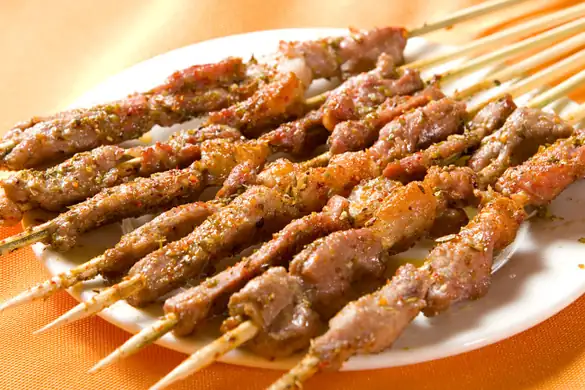
Grilled Lamb (烤羊肉) is listed among the local specialties of Karamay, Xinjiang. The name includes 羊肉 (lamb or mutton). 烤 describes roasting or grilling.
Read the dish guide →Photo adjustments
EXIF orientation normalized; resized without changing aspect ratio; converted to WebP. No subject edits.
 Polo rice 抓饭
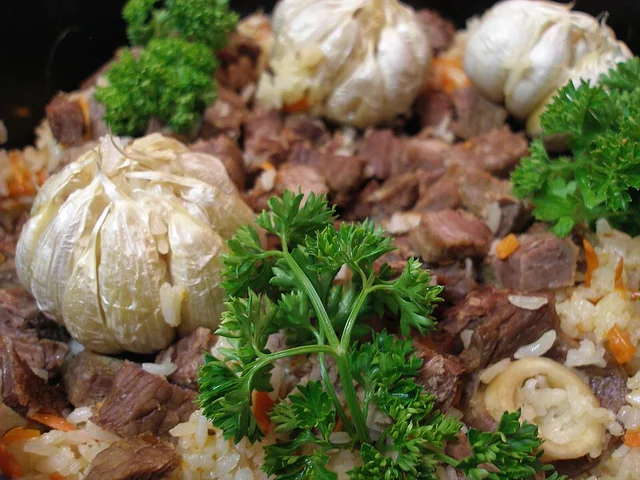
The rice is rich and separate-grained, with sweet carrot, savory meat and occasional fruit sweetness rather than a sticky porridge texture.
Source ↗Read the dish guide →
Photo adjustments
EXIF orientation applied where present; resized proportionally to at most 640 px on the long edge and encoded as WebP. No crop, retouching, recoloring or subject changes.
 Baked samsa buns 烤包子
The shell is crisp and firm, while the center is juicy, onion-sweet and richly savory.
Source ↗Read the dish guide →
Photo adjustments
EXIF orientation applied where present; resized proportionally to at most 640 px on the long edge and encoded as WebP. No crop, retouching, recoloring or subject changes.
 Nang bread 馕
Thin nang is crisp, while thicker bread has a soft, chewy center and toasted crust. Fresh warmth brings out the wheat and topping aromas.
Source ↗Read the dish guide →
Photo adjustments
EXIF orientation applied where present; resized proportionally to at most 640 px on the long edge and encoded as WebP. No crop, retouching, recoloring or subject changes.
 Hand-Pulled Mixed Noodles 拌面
Hand-Pulled Mixed Noodles (拌面) is listed among the local specialties of Karamay, Xinjiang. The term 面 points to noodles or flour-based food.
Read the dish guide →
Photo adjustments
EXIF orientation normalized; resized without changing aspect ratio; converted to WebP. No subject edits.
 Sheep Offal Soup 羊杂碎AI illustration · AI 示意图(仅供参考,非实拍)
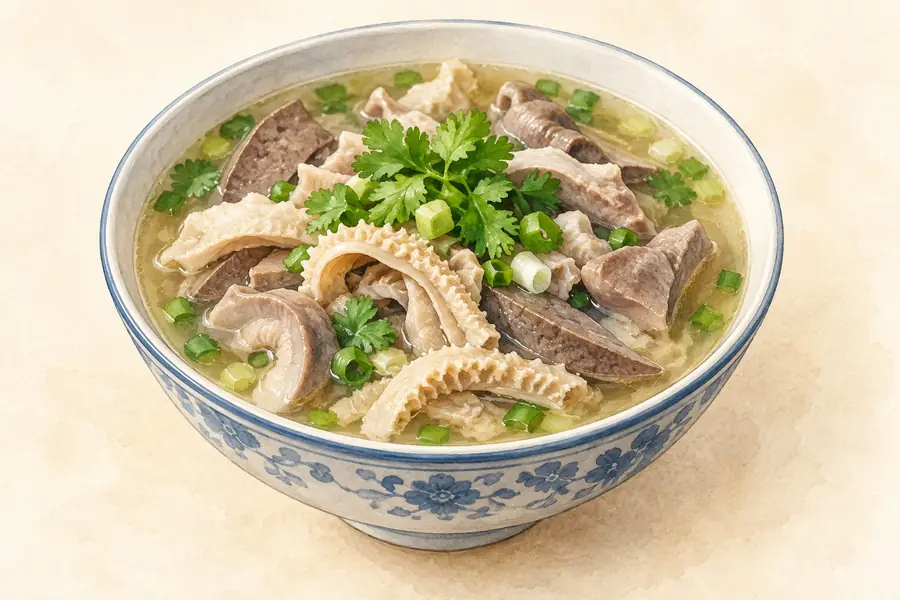
Sheep Offal Soup (羊杂碎) is listed among the local specialties of Ürümqi, Xinjiang. The name includes 羊杂 (sheep offal).
Read the dish guide → Thin-skinned steamed dumplings 薄皮包子AI illustration · AI 示意图
The skin is delicate and lightly chewy, surrounding a succulent center with lamb richness and sweet onion aroma.
Source ↗Read the dish guide → Red Jujube Pilaf 红枣抓饭AI illustration · AI 示意图(仅供参考,非实拍)
Red Jujube Pilaf (红枣抓饭) is listed among the local specialties of Tumxuk, Xinjiang. The name includes 红枣 (jujubes).
Read the dish guide →More dishes from across Xinjiang are in the Xinjiang food guide.
Plan your visit
Getting there
Search for 图木舒克市 in a map app to find stations and your accommodation.
Where to stay →More in Xinjiang
Sources & geographic information
Administrative names and parent areas: Official geographic directory · Reference date 2026-09-06.
Some facts checked against 图木舒克市 — Wikipedia contributors, CC BY-SA 4.0.
Some facts checked against 唐王城 — Wikipedia contributors, CC BY-SA 4.0.
Some facts checked against 永安坝水库 — Wikipedia contributors, CC BY-SA 4.0.
Map data © OpenStreetMap contributors. Pins mark approximate centres, not entrances or boundaries.