


Get to know Xinxing

- Administrative area
- County-level city · 县级市
- Part of
- Xinjiang
- Chinese name
- 新星市
- Local areas
- County-level city guide
Area & population
- Area in the source
- 539.00 km²
- Population · 2021
- 44,700
- Administrative seat
- Huangtian Town (Huangtian Farm)
Source: cited geographic source, as of the dates shown.
History
A Corps civil affairs team studied the proposed city in September 2018, and on 4 February 2021 the Xinjiang government announced that the State Council had approved it. The city government sits at the Huangtian Farm (黄田农场). Each of the three towns shares its administration with a Corps farm: Erdaohu (二道湖镇) with Hongxing No. 1 Farm (红星一场), Luoyi (骆驿镇) with Hongxing No. 4 Farm (红星四场), and Huangtian (黄田镇) with Huangtian Farm.
Getting oriented
The Thirteenth Division places Huangtian Farm 20 kilometres east of Hami and 10 kilometres east of Hami airport, with the Lianyungang-Khorgas Expressway (连霍高速) and National Highway 312 to the north and the Lanzhou-Xinjiang high-speed railway (兰新高铁) and conventional railway to the south. Hongxing No. 1 Farm, 8 kilometres east of Hami, lists several railways among its transport links, including the Hami-Lop Nur (哈罗铁路) and Hami-Ruoqiang (哈若铁路) railways, and G312 crosses it. Hongxing No. 4 Farm, 50 kilometres east of Hami, calls itself the first Corps regiment a traveller reaches on entering Xinjiang from inner China.
What to see
The division lists the Badashi (八大石) and Miao'ergou (庙尔沟) scenic spots at Huangtian Farm, and describes the Miao'ergou scenic area as part of the Dunhuang-Hami-Turpan tourism route. Hongxing No. 4 Farm names the Bamudun altar ruins (巴木墩祭坛遗址) and the Hongxing No. 4 canal (红星四渠) among its sights, with the Tashui River (塔水河) and Mazong Mountain (马鬃山) as its natural landmarks. Hongxing No. 1 Farm is known as the cradle of Hami's military-reclamation culture.
Food and local products
Huangtian Farm grows cotton, grapes, jujubes, watermelons and walnuts. Hongxing No. 1 Farm's pollution-free vegetables are well known across the Hami area, and Hongxing No. 4 Farm's beef and mutton are known in and beyond Xinjiang. The Thirteenth Division as a whole names organic Hami melons (哈密瓜), "dancing grapes" and Hami jujubes (哈密大枣) among its nationally known fruit brands.
Highlights
- Miao'ergou scenic area 庙尔沟风景区: At Huangtian Farm; described by the division as part of the Dunhuang-Hami-Turpan tourism route.
- Badashi 八大石: One of the two scenic spots of Huangtian Farm named by the division.
- Bamudun altar ruins 巴木墩祭坛遗址: A historic site at Hongxing No. 4 Farm.
Sources for this guide
新星市 - 维基百科,自由的百科全书 · Wikipedia · CC BY-SA 4.0
带你了解大美十三师黄田农场-第十三师新星市 · Thirteenth Division (Xinxing City) of the Xinjiang Production and Construction Corps
带你了解大美十三师红星一场-第十三师新星市 · Thirteenth Division (Xinxing City) of the Xinjiang Production and Construction Corps
带你了解大美十三师红星四场-第十三师新星市 · Thirteenth Division (Xinxing City) of the Xinjiang Production and Construction Corps
一分钟带你领略兵团十三师-第十三师新星市 · Thirteenth Division (Xinxing City) of the Xinjiang Production and Construction Corps
Original English written from the listed sources and checked sentence by sentence against quoted extracts by a separate reviewer. Updated 2026-09-25.
Explore Xinxing
Core places to explore, with English and Chinese names.
Local life & food
Xinxing local specialties
新星市特色美食 · 7 specialties to discover
 Hami Mutton with Braised Flatbread 哈密羊肉焖饼
Hami Mutton with Braised Flatbread (哈密羊肉焖饼) is a dish of mutton braised under layers of paper-thin, hand-rolled flatbread, from Hami (哈密) in Xinjiang.
Read the dish guide →Photo adjustments
EXIF orientation normalized; resized without changing aspect ratio; converted to WebP. No subject edits.
 Barkol Flaky Baked Bread 巴里坤油酥馍AI illustration · AI 示意图(仅供参考,非实拍)
Barkol Flaky Baked Bread (巴里坤油酥馍) is a round, flaky baked bread from Barkol Kazakh Autonomous County (巴里坤哈萨克自治县) in Hami (哈密), Xinjiang.
Read the dish guide →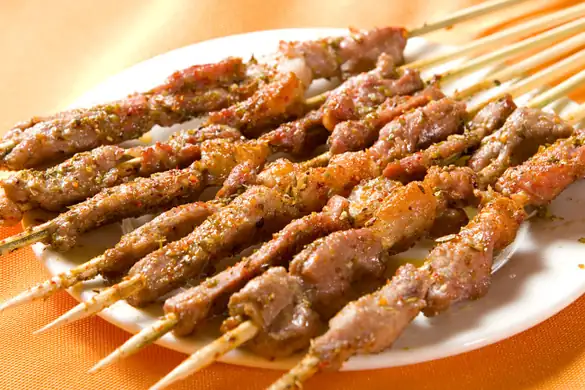 Grilled Lamb 烤羊肉
Grilled Lamb (烤羊肉) is listed among the local specialties of Karamay, Xinjiang. The name includes 羊肉 (lamb or mutton). 烤 describes roasting or grilling.
Read the dish guide →Photo adjustments
EXIF orientation normalized; resized without changing aspect ratio; converted to WebP. No subject edits.
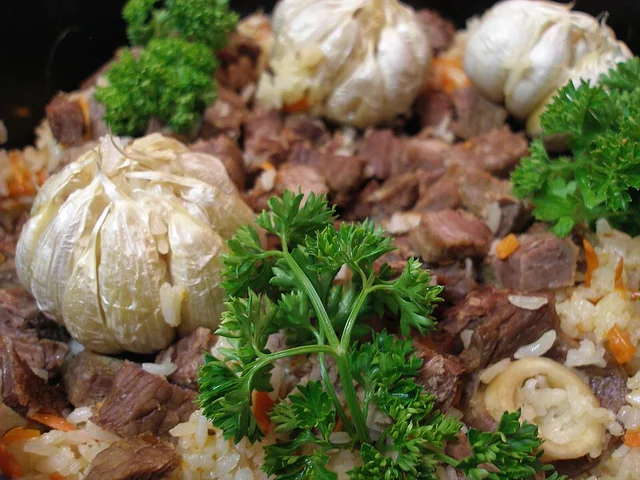 Polo rice 抓饭
The rice is rich and separate-grained, with sweet carrot, savory meat and occasional fruit sweetness rather than a sticky porridge texture.
Source ↗Read the dish guide →
Photo adjustments
EXIF orientation applied where present; resized proportionally to at most 640 px on the long edge and encoded as WebP. No crop, retouching, recoloring or subject changes.
 Nang bread 馕
Thin nang is crisp, while thicker bread has a soft, chewy center and toasted crust. Fresh warmth brings out the wheat and topping aromas.
Source ↗Read the dish guide →
Photo adjustments
EXIF orientation applied where present; resized proportionally to at most 640 px on the long edge and encoded as WebP. No crop, retouching, recoloring or subject changes.
 Baked samsa buns 烤包子
The shell is crisp and firm, while the center is juicy, onion-sweet and richly savory.
Source ↗Read the dish guide →
Photo adjustments
EXIF orientation applied where present; resized proportionally to at most 640 px on the long edge and encoded as WebP. No crop, retouching, recoloring or subject changes.
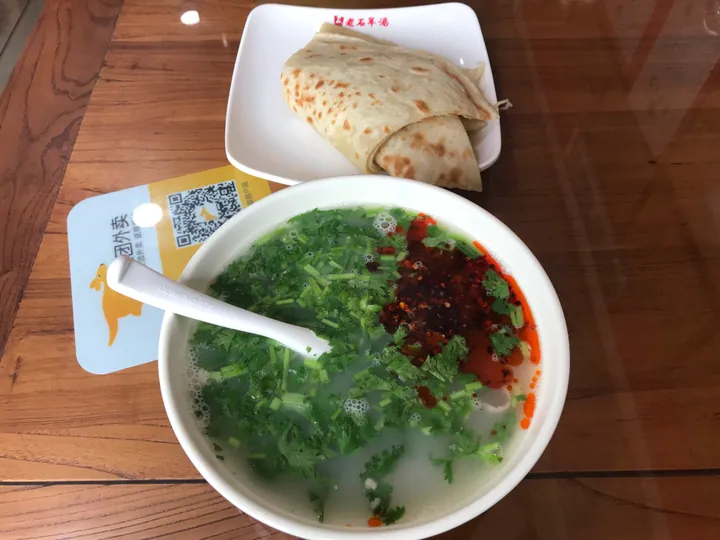 Sheep Offal Soup 羊杂汤
Sheep Offal Soup (羊杂汤) is listed among the local specialties of Karamay, Xinjiang. The name includes 羊杂 (sheep offal). The term 汤 points to soup.
Read the dish guide →
Photo adjustments
Full frame retained; proportionally resized and converted to WebP. No retouching or changes to the photographed subject. Card displays may crop the view.
More dishes from across Xinjiang are in the Xinjiang food guide.
Plan your visit
Getting there
Search for 新星市 in a map app to find stations and your accommodation.
Where to stay →More in Xinjiang
Sources & geographic information
Administrative names and parent areas: Official geographic directory · Reference date 2026-09-06.
Some facts checked against 新星市 — Wikipedia contributors, CC BY-SA 4.0.
Map data © OpenStreetMap contributors. Pins mark approximate centres, not entrances or boundaries.