


Get to know Longhua District
- Administrative area
- District · 市辖区
- Part of
- Shenzhen
- Chinese name
- 龙华区
- Local areas
- District guide
Area & population
- Area
- 176.00 km²
- Population · 2020
- 2,528,872
Source: English Wikipedia, as of the dates shown.
Longhua is best explored by clusters: a connected urban transit spine around Shenzhen North Station and Longhua, and a distinct Guanlan area of Hakka village streets, printmaking studios and art spaces. The old villages and museums are separate destinations, not one walkable attraction.
A district with more than one center
Longhua is a Shenzhen district rather than a single visitor site. Metro Lines 4, 5 and 6 all serve Shenzhen North Station; Line 4 continues north through Longhua and Qinghu to Guanlan, Mission Hills and Niuhu. This makes the southern transit corridor useful for city connections, while Guanlan is a separate outing rather than an add-on to a short central-Shenzhen walk.
For a first visit, choose one area as the focus. Use the Shenzhen North–Longhua–Qinghu corridor for metro connections or urban errands. Set aside a separate visit for Guanlan’s historic village and art sites. Longhua’s older villages are scattered across several subdistricts, including Guanlan, Dalang, Guanhu and Fucheng; do not plan them as a single compact heritage quarter.
Guanlan: Hakka village fabric and printmaking
Guanlan Printmaking Village (观澜版画村), formerly Dashuitian Village (大水田村), is a Hakka settlement reworked as the China Guanlan Original Printmaking Base. Its most legible details are the close-set row houses, ancestral spaces, wells, ponds and watchtowers; look at how the watchtowers’ overseas influences sit within Lingnan-style village buildings. The restored lanes also contain printmaking workshops and artist spaces, so the visit combines village architecture with contemporary production rather than presenting an untouched settlement.
The printmaking base grew from a 2006 collaboration to develop a cultural site in the home area of printmaker Chen Yanqiao (陈烟桥). The Longhua government describes it as free to enter and records its preservation of the old village fabric. Free entry to the grounds does not establish that a workshop, class or temporary exhibition is open on the day, so treat those as separate activities to confirm.
Keep the China Printmaking Museum (中国版画博物馆) distinct from the village and its studios. The district lists it as a separate cultural venue in the Guanlan cluster; check its own current exhibition and opening information before making it the reason for the trip.
Other nearby village-art destinations, including Aohu Art Village (鳌湖艺术村), are separate places, not alternative names for Guanlan Printmaking Village. The district describes Guanlan Printmaking Village, Guanlan Ancient Market, Aohu Art Village and other heritage sites as a dispersed group of destinations. Pick one or two around a clear theme instead of assuming that all lie within one easy walking loop.
Getting there and back
Use Shenzhen Metro Line 4 for the district’s north–south visitor spine. Its stations include Shenzhen North Station (深圳北站), Longhua (龙华), Qinghu (清湖), Guanlan (观澜), Mission Hills (观澜湖) and Niuhu (牛湖). Lines 5 and 6 also serve Shenzhen North Station, providing connections across the district; these are station and line references, not a claim that every village is beside a metro entrance.
For Guanlan Printmaking Village, an official Shenzhen tourism guide identifies Niuhu Station on Line 4 as the metro approach. From there, use a taxi or ride-hailing car for the last leg and enter 观澜版画村 as the destination; the village is in Guanlan’s Dashuitian community. Older official route descriptions mention different Line 4 stations and bus links, but I could not verify a current bus route and stop, so this guide does not prescribe one. Return to the station by taxi and take Line 4 back along the route; check current service notices before setting out. No single taxi drop-off point applies to the whole district.
An older local visitor-service page said foreign visitors could register at the printmaking base with a passport. I could not confirm that the passport-registration or advance-booking procedure remains current from an official, up-to-date visitor notice. Carry your passport and confirm entry arrangements with the venue before travelling; do not assume that a domestic-ID booking page alone proves how overseas passports are handled.
Guide sources
- Guanlan Cultural Town and its dispersed heritage and visitor destinations
- Guanlan Printmaking Village and Longhua's village revitalization
- Shenzhen Metro lines and stations
- Guanlan Printmaking Village
- Old villages worth visiting in Longhua
- How older visitors and foreign visitors were advised to enter Guanlan Printmaking Village
- Planning Your Day at Guanlan Printmaking Village
Explore Longhua District
Core places to explore, with English and Chinese names.
Places to explore around Longhua District
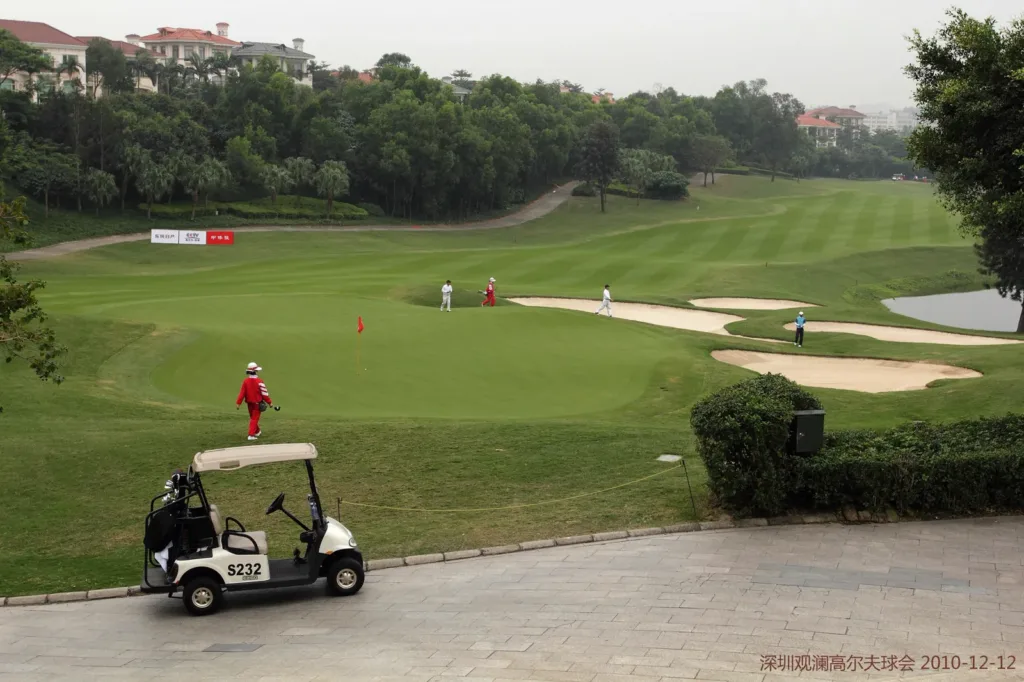 A golf hole at Mission Hills Guanlan in Shenzhen, photographed on 12 December 2010. The course, bunkers, golfers and a golf cart are visible; this historical view should not be taken as a depiction of current conditions. Photo: wanghongliu · CC BY-SA 3.0
Shenzhen Mission Hills Resort Area深圳观澜湖旅游休闲度假区
A Shenzhen-side cluster of craft workshops, an outdoor sports park, golf, hotels and shopping near the Dongguan boundary; choose a specific venue rather than treating it as one all-access attraction.
Read the place guide → Hakka-style row houses and a watchtower in Guanlan Printmaking Village, Shenzhen, photographed on 30 October 2017. Photo: Liuzhongyou · CC BY-SA 4.0
Guanlan Printmaking Village观澜版画村
A former Hakka settlement in Longhua where row houses, ancestral halls and watchtowers sit alongside printmaking studios and galleries.
Read the place guide →Plan your visit
Getting there
Longhua District is about 15 km (straight-line distance) from central Shenzhen. Search for 龙华区 in a map app to find stations and your accommodation.
Where to stay →Build your route
Shenzhen Mission Hills Resort Area and Guanlan Printmaking Village are both listed here. The linked place guides have entrance and visit details.
Continue with Shenzhen →More in Shenzhen
Sources & geographic information
Administrative names and parent areas: Official geographic directory (dmfw.mca.gov.cn) · Reference date 2026-09-06.
Background text adapted from Longhua, Shenzhen — Wikipedia contributors, under CC BY-SA 4.0. Text has been shortened and reorganized; source revision 1366138933.
Map data © OpenStreetMap contributors. Pins mark approximate centres, not entrances or boundaries.
Image credits & notes (1)
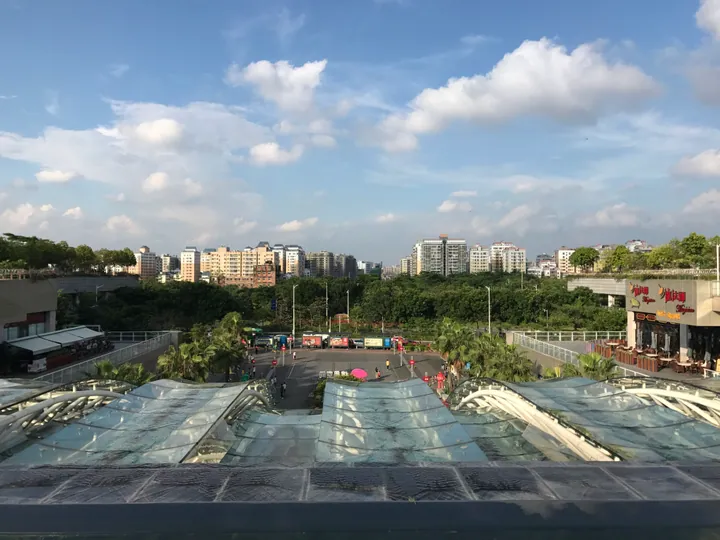
- The plaza in front of the west entrance of Shenzhen North railway station, Longhua District · 深圳北站西广场,龙华区Photo: そらみみ · CC BY-SA 4.0 · taken 2017-09-10Resized for the web; the photo itself has not been edited. Thumbnails may show a cropped view.
