

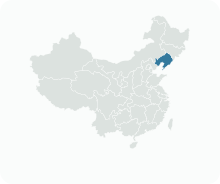
Get to know Xinbin Manchu Autonomous County
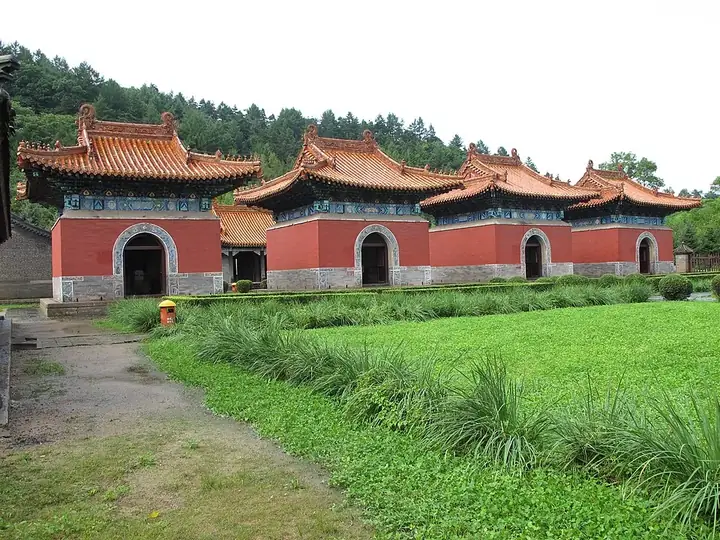
Photo adjustments
Full frame retained; resized proportionally to a maximum dimension of 960 pixels and converted to WebP quality 88. No crop, retouch, generated elements, or subject alteration. Final website rendition: full frame retained, proportionally resized to at most 720 pixels and converted to WebP. No additional retouching or subject alteration. Card displays may crop the view.
- Administrative area
- Autonomous county · 自治县
- Part of
- Fushun
- Chinese name
- 新宾满族自治县
- Local areas
- Autonomous county guide
Area & population
- Area in the source
- 4,285.00 km²
- Population · 2020 census
- 217,259
- Administrative seat
- Xinbin Town
Source: cited geographic source, as of the dates shown.
History
Nurhaci built Fe Ala (佛阿拉城), a walled town in three rings, in 1587, and was granted the title of Dragon-Tiger General by the Ming here in 1595. The county government notes that remains such as the Khan's hall can still be seen at the site.
Construction of Hetu Ala (赫图阿拉城) began in 1603. In 1616 Nurhaci was enthroned as khan there and founded the state known to history as the Later Jin, and in 1634 Hong Taiji (皇太极) honoured the town as Xingjing. In 1985 the State Council approved Xinbin as the first Manchu autonomous county in China.
What to see
Hetu Ala, whose Manchu name means 'horizontal ridge', lies in Yongling town (永陵镇) and is a national protected site and a 4A scenic area. Its buildings include the Khan's great yamen, the Khan's sleeping palace, the Khan's well, Nurhaci's birthplace, the Plain White Banner office, a Confucian temple and a Guandi temple, with a Manchu folk-customs museum on site. The county government records that the Kangxi, Qianlong, Jiaqing and Daoguang emperors made nine eastern tours between them and came to worship at its temples.
The Qing Yongling Mausoleum (清永陵) stands about one kilometre northwest of Yongling town, on the southern slope of Qiyun Mountain (启运山). It holds Nurhaci's sixth-generation ancestor Mengtemu (孟特穆), his great-grandfather Fuman (福满), grandfather Giocangga (觉昌安), father Taksi (塔克世) and two uncles. The side-by-side stele pavilions for four emperors and four empresses in the front court are an exception among Qing imperial tombs, and the county government says the carved 'seated dragon' on the pavilions is found at no other Qing imperial tomb. It became a national protected site in 1988 and a World Heritage site on 1 July 2004.
Food and local products
At Hetu Ala the county government highlights the Manchu speciality food known as 'eight plates and eight bowls' (八碟八碗) alongside Manchu song, dance and folk performances. Chinese Wikipedia lists Fushun hashima (抚顺哈什蚂), a national geographical-indication product, among the county's specialities.
Highlights
- Hetu Ala 赫图阿拉城: Begun in 1603; Nurhaci was enthroned here in 1616 as khan of the Later Jin.
- Qing Yongling Mausoleum 清永陵: Ancestral tomb of the Qing imperial house, on the World Heritage list since 2004.
- Fe Ala 佛阿拉城: Three-ringed town built by Nurhaci in 1587, known to the Ming as the old Jianzhou camp.
Sources for this guide
新宾县政府 新宾满族自治县人民政府 · Xinbin Manchu Autonomous County People's Government
新宾县政府 新宾满族自治县人民政府 · Xinbin Manchu Autonomous County People's Government
新宾县政府 新宾满族自治县人民政府 · Xinbin Manchu Autonomous County People's Government
新宾满族自治县 - 维基百科,自由的百科全书 · Wikipedia (Chinese) · CC BY-SA 4.0
Original English written from the listed sources and checked sentence by sentence against quoted extracts by a separate reviewer. Updated 2026-09-25.
Explore Xinbin Manchu Autonomous County
Core places to explore, with English and Chinese names.
Places to explore around Xinbin Manchu Autonomous County
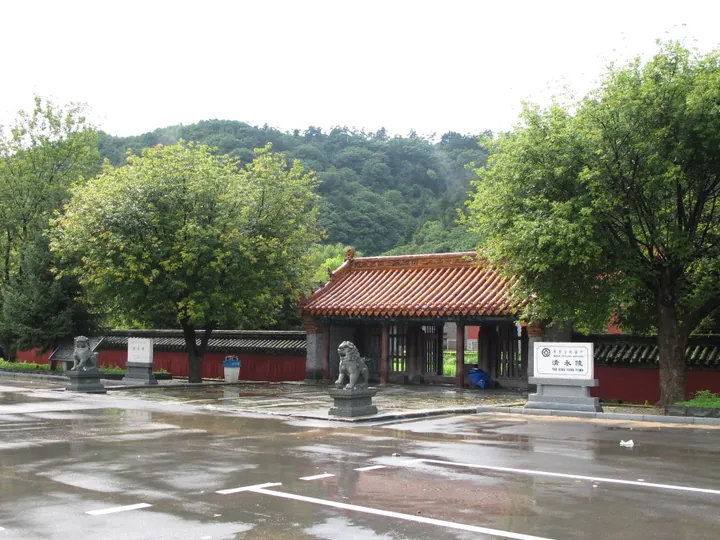 Entrance gate of the Qing Yongling Mausoleum in Xinbin Manchu Autonomous County, Liaoning · 清永陵大门,辽宁省新宾满族自治县 Source-recorded photograph date: 2010-08-21.
Qing Yongling Mausoleum清永陵
Qing Yongling in Xinbin Manchu Autonomous County is the ancestral burial complex associated with Nurhaci’s forebears.
Read the place guide → Hetu Ala · 赫图阿拉城
Hetu Ala赫图阿拉城
Hetu Ala was Nurhaci's early capital before the Later Jin court moved west towards Liaoyang and Shenyang. Its position on a ridge between waterways explains the Manchu name, often translated as a horizontal ridge. The inner and…
Read the place guide →Plan your visit
Getting there
Xinbin Manchu Autonomous County is about 90 km in a straight line from central Fushun. Search for 新宾满族自治县 in a map app to find stations and your accommodation.
Where to stay →Build your route
Qing Yongling Mausoleum and Hetu Ala are both listed here. The linked place guides have entrance and visit details.
Continue with Fushun →More in Fushun
Sources & geographic information
Administrative names and parent areas: Official geographic directory · Reference date 2026-09-06.
Some facts checked against 新宾满族自治县 — Wikipedia contributors, CC BY-SA 4.0.
Photo: Qing Yongling Mausoleum · Shallowell · CC BY-SA 3.0. Full frame retained; proportionally resized and converted to WebP. No retouching or changes to the photographed subject. Card displays may crop the view.

Photo: Hetu Ala · Source photographer · License not provided. EXIF orientation normalized; resized without changing aspect ratio; converted to WebP. No subject edits.
Map data © OpenStreetMap contributors. Pins mark approximate centres, not entrances or boundaries.