


Get to know Minhang District
- Administrative area
- District · 市辖区
- Part of
- Shanghai
- Chinese name
- 闵行区
- Local areas
- District guide
Area & population
- Area
- 371.70 km²
- Population · 2020
- 2,653,489
Source: English Wikipedia, as of the dates shown.
Minhang is one of Shanghai’s 16 districts and lies in the municipality’s southwest. Its visitor map is best read as several distinct clusters, rather than a single loop: Qibao’s historic commercial lanes, a park-and-museum day around Wuzhong and Xinzhen roads, and the river landscapes of Pujiang. The official district feature itself sets out separate itineraries for Qibao, the museum cluster and other leisure destinations.
Qibao: a compact canal-town walk
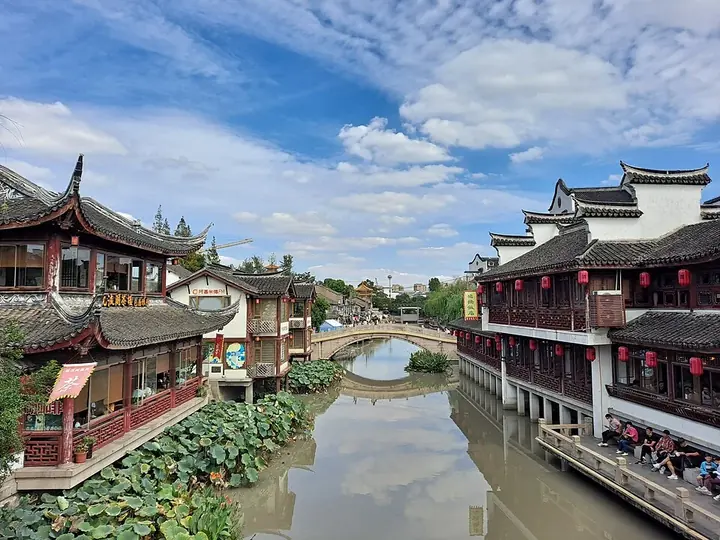
Qibao is the most legible first outing if you want historic streets and a short sequence of cultural stops. Follow the official route through Qibao Old Street’s South Street and North Street → Puhuitang Bridge → Qibao Temple. South Street is the snack-focused stretch; North Street leans toward handicrafts and cultural shops. Pause at the bridge to take in the waterway and the tightly spaced, traditional-style shopfronts, then continue to the temple rather than treating the old street as only a food lane.
Start by pinning Qibao Old Street (七宝老街) in your map app, then follow the named landmarks in that order. The official route does not give a current metro exit, admission charge or reservation rule. Do not assume that every interior or activity is free just because the lanes are open as a district route; check the specific venue before planning around a paid visit.
A separate culture day: garden paths and local history
For a quieter change of pace, pair Minhang Cultural Park with the Minhang Museum and nearby art venues as a separate outing. The official district itinerary groups Minhang Cultural Park, Minhang Museum, Haipai Art Museum and Powerlong Museum as a park-and-museums day. Treat that as a cluster to map out, not a promise that every stop shares one entrance or can be covered on foot.
The park is a landscape visit: seasonal flower beds, water, tree-lined paths and its distinctive blue-domed Huiyin Blue House are more useful reasons to go than expecting a formal historic garden. The city’s park guide gives its address as No. 2019 Wuzhong Road. Its published station and bus directions were last updated in October 2025, so confirm the live route before setting out.
At Minhang Museum, No. 1538 Xinzhen Road, look for local history and the district’s archaeological record alongside displays of traditional Chinese instruments. The museum’s permanent-exhibition description highlights Liangzhu finds from Minhang, the history of Shanghai County, and a collection of more than 200 traditional instruments, including the many-gonged yunluo. That makes it a useful context-setting stop before or after the park, rather than another generic art gallery.
Pujiang: make the river the route
Pujiang Country Park is a different, more open-ended day. Its 5.3-kilometre riverside walkway links countryside recreation with Huangpu River views. One published route begins from Fengshou village near Chunjian Bridge on Qushui Road, continues toward the native-ecology education base, and then returns to the waterfront for Duhang Pier. At the ecology base, the emphasis is on Shanghai’s native plants and animals and nature education, not a manicured flower display.
Choose one section rather than trying to cover every listed activity. If the ferry is part of your plan, Duhang Pier connects across the river to Wujing Park on the Du-Wu line, but the cited feature does not provide a current sailing timetable. Confirm service on the day and keep a land-based return plan.
Getting around and planning
Use exact pins—Qibao Old Street, Minhang Cultural Park, Minhang Museum or Duhang Pier—instead of routing to “Minhang District.” These are separate outings; do not combine Qibao, the Wuzhong/Xinzhen museum-and-park cluster and Pujiang into one walking itinerary.
As checked on 21 October 2026, the official pages reviewed here establish the route sequence and the park and museum addresses, but do not establish current general admission prices, booking rules or full visitor hours for all these places. The museum page’s general visitor information was last updated in November 2025, and the park’s access listing in October 2025; those older details should not be treated as current operating guarantees. Verify any time-sensitive arrangements with the venue before travel.
Explore Minhang District
Core places to explore, with English and Chinese names.
Places to explore around Minhang District
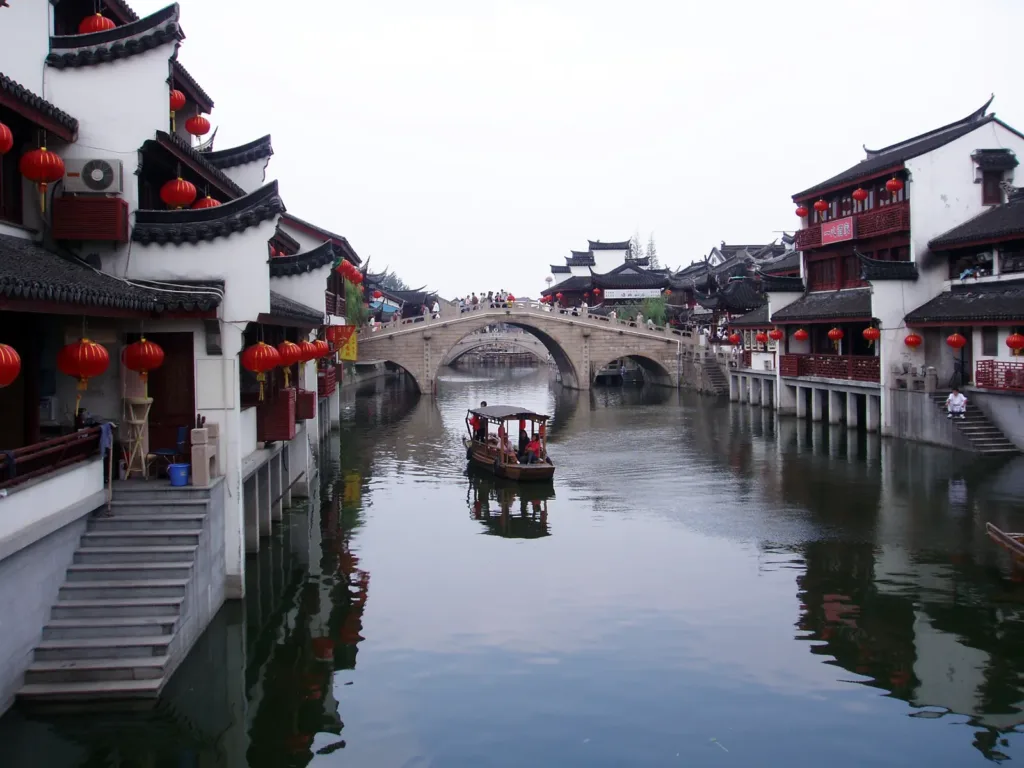 Arch bridge at Nanxi Street over Puhuitang River. The streetscape may have changed since the photograph. Photo: Taken by Fanghong · CC BY 2.5
Qibao七宝
Qibao Old Town is the historic core of Qibao in Minhang, where riverside lanes and bridges meet a busy food-and-shop street. Use Puhuitang as your orientation point, then follow the town’s layered cultural trail: the wartime Taiyuanxiang site, the Zhang Chongren memorial and, when programmed, local craft demonstrations. Metro Line 9’s Qibao station is the established rail approach; check venue notices before planning around an indoor stop.
Read the place guide → The simulator shown in this archival photograph is a museum exhibit; it is not a real Metro train cab. Photo: Ilovechinarailways · CC BY-SA 4.0
Shanghai Metro Museum上海地铁博物馆
At Shanghai Metro Museum, the city’s daily transport system becomes a hands-on story of engineering and urban life. Compare full-size pre-service Line 21 and Line 22 train samples, look closely at a giant shield-tunnelling machine model, then try the recreated tunnel and train-driving simulator.
Read the place guide →Plan your visit
Getting there
Minhang District is about 15 km (straight-line distance) from central Shanghai. Search for 闵行区 in a map app to find stations and your accommodation.
Where to stay →Build your route
Qibao and Shanghai Metro Museum are about 2 km apart (straight-line distance). The linked place guides have entrance and visit details.
Continue with Shanghai →More in Shanghai
Sources & geographic information
Administrative names and parent areas: Official geographic directory (dmfw.mca.gov.cn) · Reference date 2026-09-06.
Background text adapted from Minhang, Shanghai — Wikipedia contributors, under CC BY-SA 4.0. Text has been shortened and reorganized; source revision 1355569045.
Map data © OpenStreetMap contributors. Pins mark approximate centres, not entrances or boundaries.
Image credits & notes (1)
- The Puhui River waterfront in Qibao Old Town, Minhang District, Shanghai. Photo: 2022-09-24.Photo: 钉钉 · CC BY-SA 4.0Resized for the web; the photo itself has not been edited. Thumbnails may show a cropped view.
