

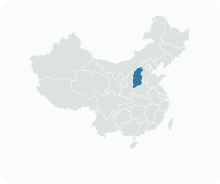
Get to know Hongtong County

Photo adjustments
Full frame retained; proportionally resized and converted to WebP. No retouching or changes to the photographed subject. Card displays may crop the view.
- Administrative area
- County · 县
- Part of
- Linfen
- Chinese name
- 洪洞县
- Local areas
- County guide
Area & population
- Area in the source
- 1,494.00 km²
- Population · 2019
- 766,579
Source: cited geographic source, as of the dates shown.
Setting and history
The name comes from the 'Hong' cliff (洪崖) south of the town and the 'ancient cave' (古洞) to its north. The county's highest point is Laoyeding (老爷顶) on Mount Huo, at 2,347 metres, and the Huo Spring (霍泉) at Guangsheng Temple is the largest karst spring in the county. The area was Yang County (杨县) under the Qin and was renamed Hongtong in the second year of the Sui Yining (义宁) era. In 1954 it merged with Zhaocheng (赵城) County as Hongzhao County, which took back the name Hongtong in 1958. On 17 September 1303 a magnitude-8 earthquake struck Hongtong. The county government notes that early Zhou oracle-bone inscriptions found at Fangdui (坊堆) were the first of their kind discovered in China.
What to see
The Big Locust Tree Ancestral Park (大槐树寻根祭祖园), northwest of the county town, marks the site from which migrants were sent out in the Ming dynasty. It is a national 5A scenic area, and its ancestor-worship custom was placed on the national intangible heritage list in 2008. Its ancestral hall holds tablets for 1,230 migrant surnames.
Guangsheng Temple (广胜寺), 15 kilometres from the county town at the southern foot of Mount Huo, was among the first national heritage sites. The county dates its founding to AD 147 and its present name to a rebuild ordered by the Tang emperor Daizong. It has an Upper Temple, a Lower Temple and a Water God Temple, and is known for the Flying Rainbow Pagoda (飞虹塔), the Zhaocheng Jin Tripitaka (赵城金藏) and Yuan-dynasty murals of drama.
In the town, the Ming county prison, built in 1369, is called the Su San Prison (苏三监狱) after Su San (苏三), who was wrongly held there in the Zhengde reign; the county describes it as a complete surviving county-yamen prison. The Guandi Temple where she is said to have made her vow dates from 1306. Mount Li (历山), with its temple to the sage-king Shun, lies 20 kilometres west of town. The Wen family compound (温家大院) at Baishi (白石) was the home of the 1911 revolutionary Wen Shouquan (温寿泉), and the 'Song of the Guerrillas' (《游击队歌》) was written there.
Getting oriented
The Datong–Xi'an high-speed railway, the southern Tongpu Railway (南同蒲铁路), the Datong–Yuncheng Expressway and National Highway 108 run through the county from north to south.
Highlights
- Big Locust Tree Ancestral Park 洪洞大槐树寻根祭祖园: National 5A scenic area at the Ming migration site; its ancestor-worship custom is national intangible heritage (2008).
- Guangsheng Temple 广胜寺: Among the first national heritage sites; Flying Rainbow Pagoda, Zhaocheng Jin Tripitaka and Yuan drama murals.
- Ming county prison (Su San Prison) 明代监狱(苏三监狱): Built in 1369; a complete surviving county-yamen prison.
- Wen family compound 白石温家大院: Home of Wen Shouquan at Baishi, where the 'Song of the Guerrillas' was written.
Sources for this guide
洪洞概况 · Hongtong County People's Government
人文旅游 · Hongtong County People's Government
洪洞大槐树 · Linfen Municipal People's Government
洪洞县 · Chinese Wikipedia · CC BY-SA 4.0
市情概况 · Linfen Municipal People's Government
Original English written from the listed sources and checked sentence by sentence against quoted extracts by a separate reviewer. Updated 2026-09-26.
Explore Hongtong County
Core places to explore, with English and Chinese names.
Places to explore around Hongtong County
Guangsheng Temple and Feihong Pagoda · 广胜寺 Photograph date recorded by the source: 2013-02-27 04:27:37.Guangsheng Temple广胜寺
Guangsheng Temple occupies the slopes of Mount Huo northeast of Hongdong. Its upper and lower compounds should be understood as separate parts of a hillside ensemble. The upper temple is dominated by Feihong Pagoda, whose…
Read the place guide →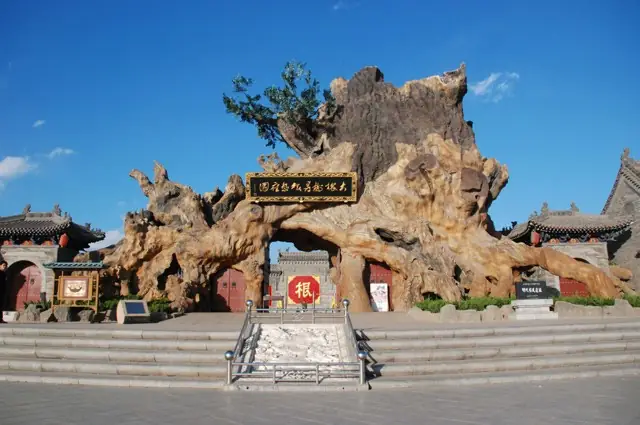 Hongtong Great Pagoda Tree Ancestral Memorial Garden · 洪洞大槐树寻根祭祖园
Hongtong Great Pagoda Tree Ancestral Memorial Garden洪洞大槐树寻根祭祖园
Hongtong's Great Pagoda Tree Ancestral Memorial Garden commemorates migration from Shanxi and the ancestral traditions associated with the old pagoda-tree site.
Read the place guide →Plan your visit
Getting there
Hongtong County is about 25 km in a straight line from central Linfen. Search for 洪洞县 in a map app to find stations and your accommodation.
Where to stay →Build your route
Guangsheng Temple and Hongtong Great Pagoda Tree Ancestral Memorial Garden are both listed here. The linked place guides have entrance and visit details.
Continue with Linfen →More in Linfen
Sources & geographic information
Administrative names and parent areas: Official geographic directory · Reference date 2026-09-06.
Some facts checked against 洪洞县 — Wikipedia contributors, CC BY-SA 4.0.
Photo: Guangsheng Temple · Artsxiang · CC BY-SA 3.0. Full frame retained; proportionally resized and converted to WebP. No retouching or changes to the photographed subject. Card displays may crop the view.

Photo: Hongtong Great Pagoda Tree Ancestral Memorial Garden · Source photographer · License not provided. EXIF orientation normalized; resized without changing aspect ratio; converted to WebP. No subject edits.
Map data © OpenStreetMap contributors. Pins mark approximate centres, not entrances or boundaries.