

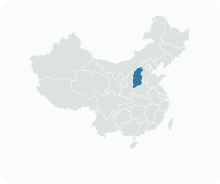
Get to know Hejin

Photo adjustments
EXIF orientation normalized; resized without changing aspect ratio; converted to WebP. No subject edits.
- Administrative area
- County-level city · 县级市
- Part of
- Yuncheng
- Chinese name
- 河津市
- Local areas
- County-level city guide
Area & population
- Area in the source
- 593.10 km²
- Population · 2017
- 401,000
- Administrative seat
- Chengqu Subdistrict (城区街道)
Source: cited geographic source, as of the dates shown.
Setting and landscape
The Lüliang Mountains (吕梁山) close the city to the north, tableland separates it from Wanrong (万荣) to the south, and to the east it borders Jishan (稷山). The Yellow River runs 29.5 km along its western edge. The city government calls Longmen, at Yumenkou (禹门口), the last mountain gate of the Yellow River's Jin–Shaanxi gorge and the setting of the legends of Yu the Great cutting through the mountain and of carp leaping the Dragon Gate.
History
The city government writes that the Shang king Zu Yi (祖乙) made his capital here under the name Geng (耿), that the Qin set up Pishi County (皮氏县), and that the area was renamed Hejin in 1120 after the Yellow River and Yumenkou. It became a city in 1994. People it counts among its natives include Confucius's disciple Bu Zixia (卜子夏), the historian Sima Qian (司马迁), the poet Wang Bo (王勃) and the Tang general Xue Rengui (薛仁贵). A Song–Jin kiln site here was named one of China's ten major archaeological finds of 2016.
What to see
The Yellow River Longmen scenic area (黄河龙门景区), a national 4A site since 2022, lies on the east bank at Yumenkou, where the old Longmen ferry was once a transfer point for goods from five provinces and regions. It has a street of Ming–Qing style shops with the Longmen Mountain gate tower, the base of a former Yu the Great temple, cliff inscriptions, old trenches and bunkers, a haulers' towpath and seven bridges side by side. Two battles were fought at Yumenkou during the War of Resistance against Japan. The shop street doubles as a food street for Hejin dishes such as Yellow River carp, whole lamb, maoerduo pasta (猫耳朵), fermented rice wine (醪糟) and shizi mo (石子馍), literally "pebble bread".
In the Longmen gorge beside the upper mouth of Longmen, the Yellow River Datiziya scenic area (黄河大梯子崖景区), also 4A, is built around a cliff stairway of 365 steps that the city government dates to the Northern Wei, about 1,600 years ago; it adds a peach-blossom valley and the partly rebuilt hilltop site of Yiticheng (倚梯城).
The Zhenwu Temple (真武庙), locally called the Nine Dragon Temple, dates from the late Yuan or early Ming. Its buildings climb a hill site of about 34,000 square metres with 34 viewing points, and it has been a Shanxi provincial protected site since 2004.
Highlights
- Yellow River Longmen scenic area 黄河龙门景区: National 4A site at Yumenkou, at Longmen, the last mountain gate of the Jin–Shaanxi gorge.
- Yellow River Datiziya scenic area 黄河大梯子崖景区: National 4A site around a 365-step cliff stairway dated to the Northern Wei.
- Zhenwu Temple 真武庙: Hillside temple complex from the late Yuan or early Ming, provincially protected since 2004.
Sources for this guide
河津简介 · Hejin Municipal People's Government
河津市黄河龙门景区(国家AAAA级旅游景区) · Hejin Municipal People's Government
河津市黄河大梯子崖景区(国家AAAA级旅游景区) · Hejin Municipal People's Government
真武庙简介 · Hejin Municipal People's Government
Original English written from the listed sources and checked sentence by sentence against quoted extracts by a separate reviewer. Updated 2026-09-26.
Explore Hejin
Core places to explore, with English and Chinese names.
Plan your visit
Getting there
Hejin is about 70 km in a straight line from central Yuncheng. Search for 河津市 in a map app to find stations and your accommodation.
Where to stay →More in Yuncheng
Sources & geographic information
Administrative names and parent areas: Official geographic directory · Reference date 2026-09-06.
Map data © OpenStreetMap contributors. Pins mark approximate centres, not entrances or boundaries.