


Get to know Mangshi
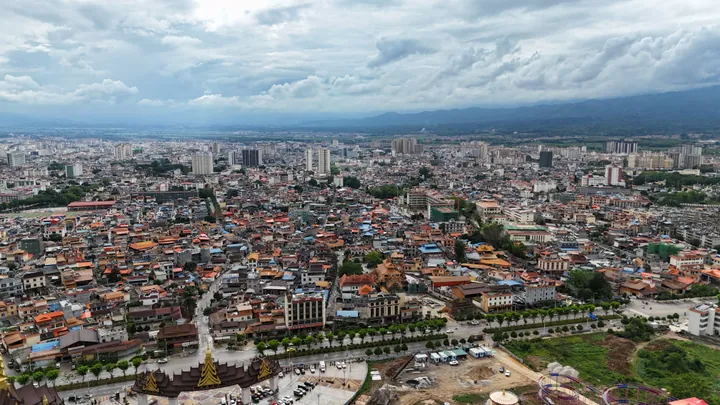
Photo adjustments
Full frame retained; proportionally resized and converted to WebP. No retouching or changes to the photographed subject. Card displays may crop the view.
- Administrative area
- County-level city · 县级市
- Part of
- Dehong Dai and Jingpo Autonomous Prefecture
- Chinese name
- 芒市
- Local areas
- County-level city guide
Area & population
- Area in the source
- 2,900.91 km²
- Population · 2020 census
- 439,931
- Administrative seat
- Menghuan Subdistrict
Source: cited geographic source, as of the dates shown.
Setting and landscape
Mountains make up 90.7 percent of the land and flat basins (坝子) the rest; a local saying sums the terrain up as "eight parts mountain, two parts basin; three ranges, two basins and one river". The Mangshi River (芒市河) rises in neighbouring Longling (龙陵), crosses the Mangshi basin and Santaishan (三台山) and joins the Longchuan River (龙川江) in the Zhefang (遮放) basin. Most of the city drains to the Irrawaddy, and the rest to the Nu River (怒江), which forms the border with Myanmar in Zhongshan township (中山乡).
Mangshi lies on the southern edge of the Tengchong volcanic area and has many hot springs; developed ones include Fapa (法帕), Bazhuhe (坝竹河) and the Yaochi spring at Zhefang (遮放瑶池温泉).
History
The area was once divided among three hereditary chieftaincies, Mangshi, Zhefang and Mengban (勐板). The name Mangshi grew out of "Mangshi" (茫施), an old name for the ancestors of the De'ang (德昂族) people. In 1934 Republican-era Yunnan set up the Luxi (潞西) administrative bureau, named "west of the Lu River", Lu being a local name for the Nu. A county followed in 1949 and a city in 1996, and on 12 July 2010 the State Council approved the change of name from Luxi to Mangshi.
The Mangshi section of the Burma Road (滇缅公路) opened in early August 1938. From 14 to 18 December 1956 the city hosted the China-Burma border people's gathering, attended by Zhou Enlai and the Burmese prime minister Ba Swe.
What to see
Theravada Buddhism reached the area around the mid-15th century. The oldest temples are Wuyun Temple (五云寺), built in 1665, and Puti Temple (菩提寺), built in 1681. Among the well-known pagodas is the Tiecheng pagoda, also called the Tree-Wrapped Pagoda (树包塔). The Menghuan Great Golden Pagoda (勐焕大金塔) was rebuilt in 2007 and is described on Chinese Wikipedia as the largest hollow pagoda in Asia; the Menghuan Silver Pagoda (勐焕银塔) stands in the same city.
As of 2019 the Mengbanaxi garden (勐巴娜西珍奇园) was the city's only 4A-rated scenic area. Santaishan is the only De'ang ethnic township in China. The Water-Splashing Festival (泼水节) and the Jingpo Munao Zongge festival (目瑙纵歌节) are the festivals that draw the most outside visitors.
Food and local products
Well-known dishes include the Dai sapie (撒撇) and pineapple rice (菠萝饭), and the Jingpo green-leaf banquet (绿叶宴) and "ghost chicken" (鬼鸡). Zhefang town is called the "home of tribute rice": Zhefang tribute rice (遮放贡米) was designated as tribute rice in 1623, at the end of the Ming.
Highlights
- Menghuan Great Golden Pagoda 勐焕大金塔: Rebuilt in 2007; described on Chinese Wikipedia as Asia's largest hollow pagoda.
- Tree-Wrapped Pagoda 树包塔: The Tiecheng pagoda, one of Mangshi's well-known Buddhist pagodas.
- Puti Temple 菩提寺: Theravada temple built in 1681.
- Mengbanaxi garden 勐巴娜西珍奇园: The city's only 4A-rated scenic area as of 2019.
- Zhefang tribute rice 遮放贡米: Rice from Zhefang designated as tribute rice in 1623.
Sources for this guide
芒市概况 · Mangshi Municipal People's Government
芒市 - 维基百科,自由的百科全书 · Wikipedia (Chinese) · CC BY-SA 4.0
Original English written from the listed sources and checked sentence by sentence against quoted extracts by a separate reviewer. Updated 2026-09-25.
Explore Mangshi
Core places to explore, with English and Chinese names.
Places to explore around Mangshi
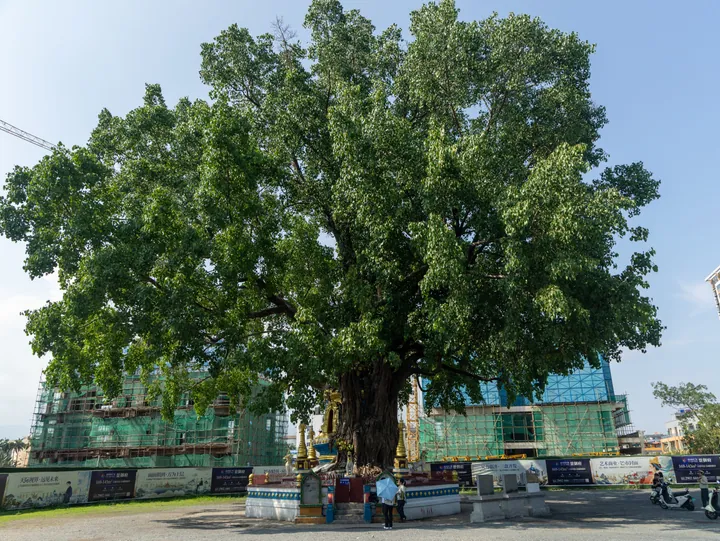 The banyan tree enveloping the stupa at Shubaota (Tree-Wrapped Stupa), Mangshi · 德宏傣族景颇族自治州芒市树包塔,古榕树包裹佛塔 Source-recorded photograph date: 2025-05-14 16:28:48.
Tree-Wrapped Pagoda树包塔
Shubaota (树包塔, 'the tree-wrapped pagoda') is a Buddhist pagoda in Mangshi, Dehong Dai and Jingpo Autonomous Prefecture, Yunnan, now largely enveloped by the roots and canopy of a banyan tree that took root in its brickwork.
Read the place guide →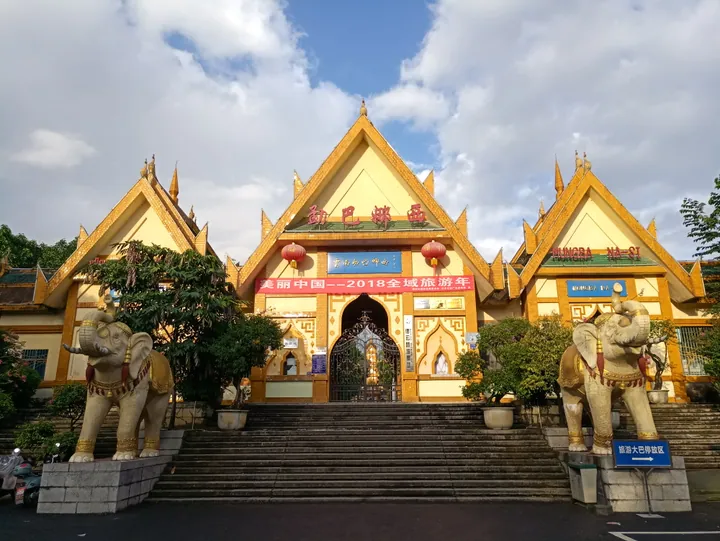 Main entrance of Mengbanaxi Park, Mangshi, Dehong · 德宏芒市勐巴娜西珍奇园正门 Source-recorded photograph date: 2018-06-22 19:05:49.
Mengbanaxi Rare Plant Garden勐巴娜西珍奇园
Garden in Mangshi, Dehong, with old trees, themed plant gardens, petrified wood and a 1956 Zhou Enlai memorial pavilion; a national 4A scenic area.
Read the place guide → Menghuan Golden Pagoda and Silver Pagoda · 勐焕大金塔与银塔
Menghuan Golden Pagoda and Silver Pagoda勐焕大金塔与银塔
Menghuan Golden Pagoda and Silver Pagoda (勐焕大金塔与银塔) are two large Buddhist pagodas on facing hills above Mangshi, Dehong Dai and Jingpo Autonomous Prefecture, Yunnan, standing about a kilometre apart.
Read the place guide →Local life & food
Mangshi local specialties
芒市特色美食 · 1 specialties to discover
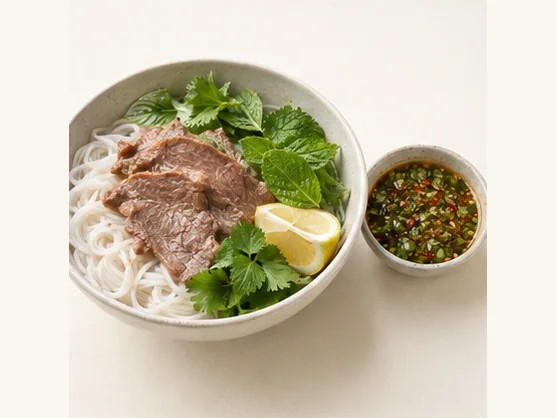 Dai-style lemon sa with rice noodles 傣味柠檬撒AI dish illustration / AI 菜品示意图
Expect a sharp citrus taste, fresh herbs and chilli, with soft noodles carrying the dressing. The mixture can be intense, so a little dip may season more noodles than its small bowl suggests.
Source ↗Read the dish guide →All dish names · 全部菜名 (1)
More dishes from across Yunnan are in the Yunnan food guide.
Plan your visit
Getting there
Mangshi covers the centre of Dehong Dai and Jingpo Autonomous Prefecture. Search for 芒市 in a map app to find stations and your accommodation.
Where to stay →Build your route
Tree-Wrapped Pagoda and Mengbanaxi Rare Plant Garden are both listed here. The linked place guides have entrance and visit details.
Continue with Dehong Dai and Jingpo Autonomous Prefecture →More in Dehong Dai and Jingpo Autonomous Prefecture
Sources & geographic information
Administrative names and parent areas: Official geographic directory · Reference date 2026-09-06.
Some facts checked against 芒市 — Wikipedia contributors, CC BY-SA 4.0.
Photo: Tree-Wrapped Pagoda · 瑞丽江的河水 · CC BY-SA 4.0. Full frame retained; proportionally resized and converted to WebP. No retouching or changes to the photographed subject. Card displays may crop the view.

Photo: Mengbanaxi Rare Plant Garden · 瑞丽江的河水 · CC BY-SA 4.0. Full frame retained; proportionally resized and converted to WebP. No retouching or changes to the photographed subject. Card displays may crop the view.

Photo: Menghuan Golden Pagoda and Silver Pagoda · Source photographer · License not provided. EXIF orientation normalized; resized without changing aspect ratio; converted to WebP. No subject edits.
Map data © OpenStreetMap contributors. Pins mark approximate centres, not entrances or boundaries.