


Get to know Anning
- Administrative area
- County-level city · 县级市
- Part of
- Kunming
- Chinese name
- 安宁市
- Local areas
- County-level city guide
Area & population
- Area
- 1,301.00 km²
- Population · 2020
- 483,753
Source: English Wikipedia, as of the dates shown.
A county-level city with a river-valley rhythm
Anning is not a Kunming neighbourhood but a county-level city within Kunming’s administrative area. The municipal government places it about 32 kilometres southwest of Kunming, at an average elevation of about 1,800 metres, and describes it as a long-established route towards western Yunnan. Its visitor character is consequently different from central Kunming: the useful unit is a set of connected landscapes, not a single pedestrian old town.
The most distinctive thread is the Tanglang River valley. The Wenquan (Hot Spring) area lies north of Anning’s urban centre, between Longshan and Fengshan, while the city’s riverfront and nearby parks give the central area an everyday, local scale. Anning’s own tourism material presents the hot springs, Tanglang River, mountains and cultural sites as one slow-travel landscape rather than as separate headline attractions.
What to look for
Wenquan and the hot-spring tradition. Anning Hot Springs are the city’s best-known reason to stay overnight. Local government material traces their documented development to the Han period and identifies the area with the “Tianxia Di Yi Tang” (“the First Hot Spring under Heaven”) name. In practical terms, choose a specific hotel or bathing venue rather than treating “Anning Hot Springs” as one single public pool: admission, bathing arrangements and opening hours belong to each operator.
Caoxi Temple (曹溪寺). On the wooded side of the Wenquan valley, Caoxi Temple gives the hot-spring visit a historical counterpoint. It was built during the Dali Kingdom in the Southern Song period, entered Yunnan’s provincial protected-relics list in 1965 and became a Major Historical and Cultural Site Protected at the National Level in 2006. The temple is a place of worship as well as a heritage site: dress and behaviour should remain quiet, and photography should follow posted rules. A 2019 report recorded free admission for domestic and overseas visitors from October that year; that historical notice is not a guarantee of today’s opening or ticket policy, so check before setting out.
The riverfront and central landmarks. Anning’s central experience is best taken slowly. The city’s cultural-tourism office describes a 7.983-kilometre Tanglang riverside walking system linking riverside parks, Caoxi Temple, the hot-spring town and the cliff-inscription area. Treat this as a useful route idea, not as a promise that every segment or facility will be open on a particular day. In the built-up centre, look for Yaocen Tower (遥岑楼) and Yong’an Bridge (永安桥), two local landmarks associated with the old route through Anning; local reporting describes their night-time lighting and their role in the city’s memory.
Qinglong Gorge (青龙峡) and the wooded outskirts. Qinglong Gorge lies in Anning’s Qinglong area, away from the central streets. It is the place to choose for forest, water and mountain-valley scenery rather than for monuments. The city’s English-language tourism feature lists it alongside the hot springs and Caoxi Temple as one of Anning’s defining landscapes, and a 2025 government response mentions forest-wellness improvements and visitor support at the scenic area. Keep this as a separate outing: the gorge, the Wenquan valley and central Anning are not interchangeable entrances.
Anning is a useful stop for travellers who prefer a warm pool, a short riverside walk and a quiet temple to a dense checklist. It also works as a pause before travelling west from Kunming. Seasonal flower displays, events and countryside programmes are not fixed daily performances; confirm dates locally instead of building a trip around an undated promotion.
Getting there and moving around
There is no confirmed metro station in Anning in the sources used here. The practical public-transport gateway is Anning Passenger Station (安宁客运站), followed by a local taxi or ride-hailing car to the particular neighbourhood or attraction.
- K1 links Anning (理工) with Kunming’s Desheng Bridge (得胜桥), with stops including Anning Passenger Station. The published stop list is useful for orientation, but it is not a live timetable.
- K12 links Anning Passenger Station with Kunming South Railway Station (昆明南站). This is the clearest connection when arriving by high-speed rail; verify the current departure pattern before relying on it.
- K13 links Anning Passenger Station with Kunming Changshui International Airport (昆明长水国际机场). The same published notice listed a fare, but airport services and schedules should be checked again for the travel date.
- A separate 2024 announcement described a Mianshan–Anning Wenquan sightseeing line running to a countryside venue in Wenquan, with the route described as taking about one hour and sold as a package including return transport, lunch and insurance. It was introduced as a tourism product to be adjusted with demand, not as a permanent city bus; do not assume it is operating daily.
For Wenquan or Caoxi Temple, give the driver the Chinese destination 安宁温泉 Ānníng Wēnquán or 曹溪寺 Cáoxī Sì and confirm the visitor entrance. For the gorge, use 青龙峡风景区 Qīnglóng Xiá Fēngjǐngqū and arrange the return before leaving the city; a current public route and final transfer were not sufficiently documented in the sources reviewed. The 2025 intercity-bus information is useful for reaching Anning, but it does not prove a current timetable, attraction opening, ticket, or last-mile connection.
Guide sources
- Anning Municipal People’s Government homepage
- Anning Hot Springs: integrating nature and culture
- Caoxi Temple in Anning to open free of charge
- Reasons to stay in Anning
- Anning culture and tourism bureau response
- Kunming sightseeing bus Hot Spring tourism line
- Anning–Kunming bus routes and operating information
- Kunming opens stop-based bus routes to Anning, Chuxiong and Dali
Explore Anning
Core places to explore, with English and Chinese names.
Places to explore around Anning
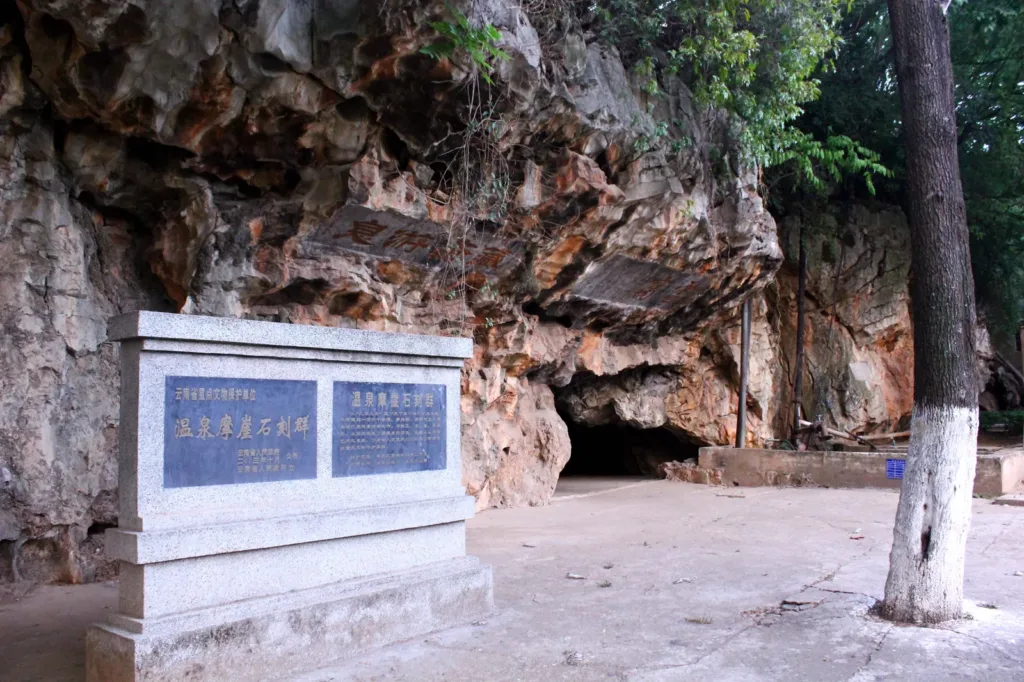 Wenquan Cliff Inscriptions at Anning Hot Springs, Anning City, Yunnan, China; the Yunwo carvings and a site marker are visible. Photo: Zhangmoon618 · CC BY-SA 3.0
Anning Hot Springs安宁温泉
Anning Hot Springs is a spring town in Wenquan Subdistrict of Anning, where 42–45°C bicarbonate calcium-magnesium water, a Tanglang River valley, national-level cliff inscriptions and Caoxi Temple make a more layered visit than a hotel soak alone.
Read the place guide → AI illustration · AI 示意图(仅供参考,非该地点实拍)
Qinglong Gorge青龙峡
Qinglong Gorge is a forested gorge scenic area in Qinglong Subdistrict, Anning, within Kunming’s wider municipal area. Its 19-square-kilometre park combines a rafting zone, water-side valley scenery and seasonal countryside experiences.
Read the place guide →Plan your visit
Getting there
Anning is about 25 km (straight-line distance) from central Kunming. Search for 安宁市 in a map app to find stations and your accommodation.
Where to stay →Build your route
Anning Hot Springs and Qinglong Gorge are both listed here. The linked place guides have entrance and visit details.
Continue with Kunming →More in Kunming
Sources & geographic information
Administrative names and parent areas: Official geographic directory (dmfw.mca.gov.cn) · Reference date 2026-09-06.
Background text adapted from Anning, Yunnan — Wikipedia contributors, under CC BY-SA 4.0. Text has been shortened and reorganized; source revision 1353485317.
Map data © OpenStreetMap contributors. Pins mark approximate centres, not entrances or boundaries.
Image credits & notes (1)
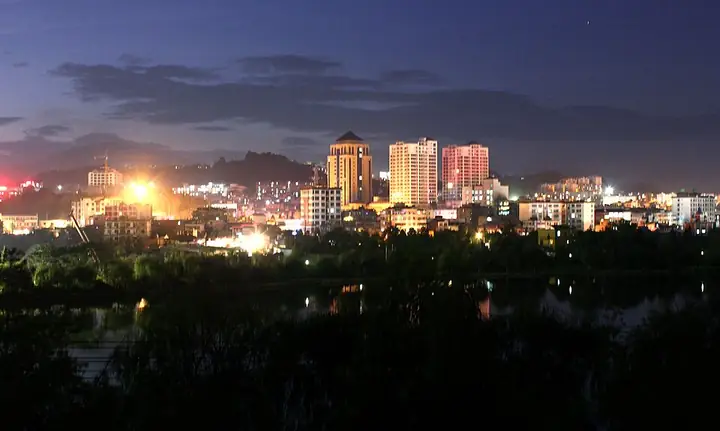
- Anning at night, viewed from the Tanglangchuan Bridge.Photo: Zhangmoon618 · CC BY-SA 3.0 · taken 2011-10-21Resized for the web; the photo itself has not been edited. Marks added by the source remain. Thumbnails may show a cropped view.
