

Photo adjustments
Full frame retained; proportionally resized and converted to WebP. No retouching or changes to the photographed subject. Card displays may crop the view.
Explore the region
About Hangzhou
Causeways divide the water into changing views, and Baochu Pagoda gives the northern skyline a slender landmark. The Grand Canal adds a separate working-waterway history to the city’s former role as a capital. Start with a focused lakeside circuit before adding the canal or Liangzhu: these belong to a wider destination and should not be compressed into a single short walk.
Human activity in the area extends back about eight thousand years, as represented by the Kuahuqiao site (跨湖桥遗址). The later Liangzhu culture developed jade carving and early urban settlements. The name Hangzhou appeared under the Sui dynasty, when it became a prefectural seat in 589; city walls followed two years later. The Grand Canal (京杭大运河) reached its full length by 609.
The city later served as the capital of the Wuyue kingdom and the Southern Song dynasty. It is among China's first designated Historical and Cultural Cities (历史文化名城). Three World Heritage properties are represented within its territory: the West Lake Cultural Landscape (杭州西湖文化景观), the Grand Canal and the Archaeological Ruins of Liangzhu City (良渚古城遗址). The West Lake landscape was inscribed on 24 June 2011.
What to look for
- West Lake’s causeways organize views between open water, islands and hills.
- Baochu Pagoda marks the northern hill landscape above the lake.
The surrounding area
Provincial capital and base for West Lake, tea country and a separate Liangzhu visit.
Location & getting there
Getting to Hangzhou
Hangzhou East railway station provides a major intercity arrival point with metro connections. Continue to the West Lake area using the current urban network, choosing the shore nearest the first stop.
Combine your visit
A suggested sequence linking the specific features of this visit.
-
West Lake西湖
Begin with the city’s characteristic lake and causeway landscape.
-
Baochu Pagoda保俶塔
Add the northern hillside landmark if the climb suits the visit.
This order is editorial. Confirm access and any transfers between stops; it does not establish a walking route, same-day connection or common admission ticket.
Find Hangzhou overview
杭州 · 杭州市
The pin marks the area, not the entrance.
More places nearby
Approximate straight-line distances between map pins, not travel distances.
West Lake 西湖
2 km awayWest Lake is a landscape of open water, planted causeways and low hills beside Hangzhou’s older centre. Baochu and Leifeng pagodas mark opposite sides, while Gushan brings gardens and cultural sites into the lake itself. The…
View guide →Hefang Street 河坊街
3 km awayHefang Street’s historic shopping section lies below Wu Hill, where older commercial lanes meet Middle Zhongshan Road. Traditional medicine businesses, food shops and craft stores give the street its particular character. Hu…
View guide →Lingyin Temple 灵隐寺
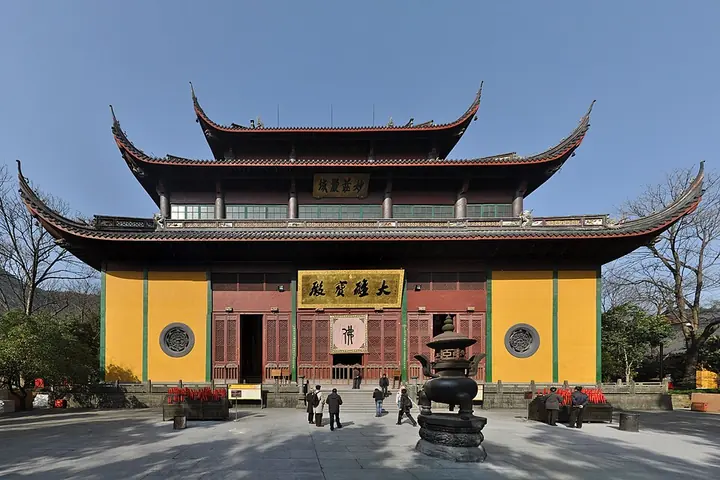
6 km awayLingyin climbs the wooded hillside behind Feilai Feng through a succession of Buddhist halls. The Hall of Heavenly Kings introduces the temple’s large sculptural figures; beyond it, the Mahavira Hall shelters a towering gilded…
View guide →Sources & visit information
The linked encyclopedia sources support background and place descriptions. Current opening hours, ticket prices, booking rules and transport schedules have not been independently verified for this guide. Confirm them with the venue or operator before travelling.
- Hangzhou ↗
- Chinese Wikipedia: 杭州市 (revision 94228857, 2026-09-07) ↗
- English Wikipedia: Hangzhou (revision 1370215783, 2026-08-19) ↗
Visitor information adapted and edited from Wikipedia contributors, “Hangzhou” · CC BY-SA 4.0. Source revision 1370215783.
Background paragraphs translated and condensed from Wikipedia contributors, "杭州市", Chinese Wikipedia · CC BY-SA 4.0. Source revision 94228857.
Background paragraphs condensed from Wikipedia contributors, "Hangzhou", English Wikipedia · CC BY-SA 4.0. Source revision 1370215783.