


Get to know Haining
- Administrative area
- County-level city · 县级市
- Part of
- Jiaxing
- Chinese name
- 海宁市
- Local areas
- County-level city guide
Area & population
- Area
- 700.50 km²
- Population · 2020 census
- 1,076,199
Source: English Wikipedia, as of the dates shown.
Two landscapes, one city
Haining is better planned as a city-region than as a single old-town entrance. The southern Qiantang riverside and Yanguan sit apart from the Xiashi urban core, so a useful visit chooses one area as its main focus rather than treating the whole city as a walkable ancient town. The distinction also explains why Haining feels different from a single water-town postcard: the tide, seawall and open river are one experience, while the city centre is a lived-in network of lanes, shops and canals.
At Yanguan, the Qiantang River tide is the organising event. The operator’s website publishes date-specific tide information and asks visitors to arrive at least 40 minutes before the expected tide, so this is a calendar-and-weather visit rather than a guaranteed daily spectacle. Use the managed tide-watching park or other signed observation areas, follow barriers and staff instructions, and do not approach a closed or unmanaged riverbank.
Xiashi offers the quieter urban counterpoint. Nanguanxiang Historical and Cultural District (南关厢历史文化街区) lies along the Luotang River and preserves a short, roughly 350-metre group of lanes with shop-houses, small bridges, stone paving and the “front shop, back river” pattern of a Jiangnan market town. The district’s buildings range from the Qing period to the Republican era, while the restored lanes now combine residences, small cultural venues and contemporary shops. Walk slowly enough to notice the river-facing backs of the buildings, not only the street façades.
The area’s most distinctive craft is Xiashi lanterns (硖石灯彩), a national intangible cultural heritage project associated with Haining’s Xiashi area. The official heritage record describes paper, bamboo and wire frames, with techniques including drawing, bending, carving, tying, pasting and needle-punched patterns. If a display or workshop is open, look closely at how the pierced surface turns light into a patterned image; do not assume that a festival display or demonstration runs every evening.
Haining’s city page also lists Xu Zhimo Former Residence (徐志摩故居) as a separate Xiashi cultural stop. Treat it as a distinct small venue, not as part of the Yanguan tide park or as a second name for Nanguanxiang, and check its own current opening information before making it the reason for a trip.
How to plan the visit
A practical first visit is to make one slower walk in Xiashi, centred on Nanguanxiang and the nearby old-city lanes, then plan Yanguan as a separate outing whose timing is set by the official tide notice. This keeps the historic street, riverfront craft and tide-watching landscape legible instead of turning them into a rushed list. The city-region also contains rural riverfront areas beyond these two anchors; they should be treated as separate destinations with their own entrances and transport, not as automatic extensions of either attraction.
Events in Nanguanxiang and tide conditions in Yanguan are not interchangeable with ordinary opening hours. Check the current programme, weather and operator notices on the day. In residential lanes and around religious or memorial buildings, keep voices low, ask before photographing people or private interiors, and leave closed spaces alone.
Getting there and getting back
Rail is useful, but the station name on the ticket matters. The Hangzhou–Haining Intercity Railway is documented as an operating city-region line with 12 stations, including Haining West, Yanguan, Leather City, Haichang Road and Zhejiang University International Campus. Yanguan Station (盐官站) is the relevant rail stop for the Yanguan area, but it is not the entrance to every old-town or tide-watching facility; arrange the final local transfer from the current scenic-area notice.
Do not treat Haining Station (海宁站) and Haining West Station (海宁西站) as interchangeable names. A local travel information page explicitly warns that they are different stations. Use the exact station shown on the ticket, then search the Chinese name of the destination rather than relying on “Haining” alone.
For the Xiashi core, use 南关厢历史文化街区 Nánguānxiāng Lìshǐ Wénhuà Jiēqū or the published address 浙江省海宁市人民路158号 in a Chinese map or ride-hailing app. For Yanguan, use the current official scenic-area name and confirm the visitor entrance, any traffic controls and the return connection before setting out. No fixed fare, journey time or bus departure is stated here because the pages read for this district do not provide a sufficiently current, date-specific final-transfer timetable.
Explore Haining
Core places to explore, with English and Chinese names.
Places to explore around Haining
 A tidal bore of the Qiantang River at Old Yanguan Town in Haining, photographed during a public viewing. Photo: EditQ · CC BY-SA 4.0
Yanguan Ancient City and Tide-Watching Park盐官古城与观潮公园
Yanguan combines a restored historic town in Haining with the Qiantang River’s managed tide-viewing park: walk the old streets and riverside heritage line, then look for the fish-scale seawall and Ming-era Zhan’ao Pagoda before the tidal bore arrives.
Read the place guide → Detail of the main entrance to Xu Zhimo Former Residence in Haining, showing the arched brick doorway and gate inscription. Photo: 猫猫的日记本 · CC BY-SA 4.0
Xu Zhimo Former Residence徐志摩故居
Xu Zhimo Former Residence (徐志摩故居), now referred to in heritage records as Xu Zhimo Old Residence (徐志摩旧居), is a 1926 two-storey brick-and-timber villa in Haining where the poet and Lu Xiaoman briefly lived after their wedding. Its appeal is tangible: a Chinese-Western house with Jin Yong’s inscription, Qi Gong’s “Anya Hall,” restored rooms and a rear-garden well called “Spring of Love.”
Read the place guide →Plan your visit
Getting there
Haining is about 25 km (straight-line distance) from central Jiaxing. Search for 海宁市 in a map app to find stations and your accommodation.
Where to stay →Build your route
Yanguan Ancient City and Tide-Watching Park and Xu Zhimo Former Residence are about 20 km apart (straight-line distance). The linked place guides have entrance and visit details.
Continue with Jiaxing →More in Jiaxing
Sources & geographic information
Administrative names and parent areas: Official geographic directory (dmfw.mca.gov.cn) · Reference date 2026-09-06.
Background text adapted from Haining — Wikipedia contributors, under CC BY-SA 4.0. Text has been shortened and reorganized; source revision 1372072003.
Map data © OpenStreetMap contributors. Pins mark approximate centres, not entrances or boundaries.
Image credits & notes (1)
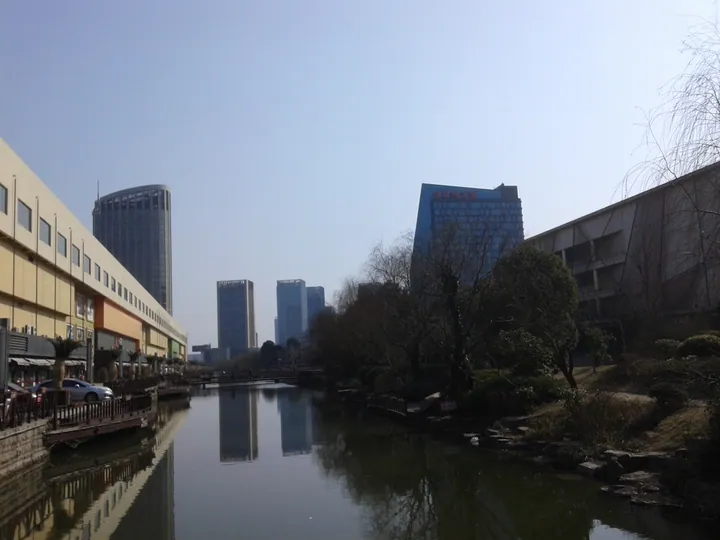
- A canal in Haining with the city's high-rise buildings reflected in the water · 海宁市河道,高楼建筑倒映水中 Source-recorded photograph date: Taken on 7 February 2016.Photo: Foxy Who \(^∀^)/ · CC BY-SA 3.0Resized for the web; the photo itself has not been edited. Thumbnails may show a cropped view.
