


Get to know Pinghu
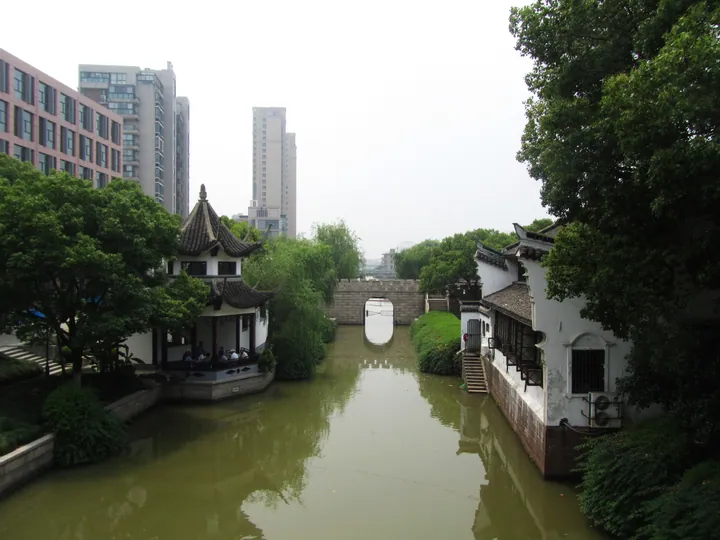
- Administrative area
- County-level city · 县级市
- Part of
- Jiaxing
- Chinese name
- 平湖市
- Local areas
- County-level city guide
Area & population
- Area
- 536.00 km²
- Population · 2019
- 703,500
Source: English Wikipedia, as of the dates shown.
Pinghu is not simply another ticketed water-town resort. The centre around Danghu is organised by waterways that radiate towards East Lake, while the wider municipality reaches from farmland and village leisure areas to the south-coast landscape around Jiulongshan. That changing scale is the reason to come: you can spend a morning looking closely at a compact late-Qing residence, then see how a living Jiaxing county-level city opens into fields, ports and coastal recreation rather than a single preserved old town.
Start in the Danghu area for the historic and everyday side of the city. Nanhetou Historic and Cultural District provides the setting for Mo Family Manor, and the surrounding streets and water edges are more useful for a slow walk than for ticking off a long list of attractions. Outside the centre, choose one wider theme—rural food and village scenery, or the mountain-and-sea leisure area—rather than assuming every part of Pinghu belongs to one walkable visitor zone.
Mo Family Manor and Nanhetou
Mo Family Manor (莫氏庄园) is the clearest single place to understand Pinghu’s local architectural character. Construction began in 1897, and the residence housed three generations of Mo Fangmei’s family. It is an enclosed late-Qing domestic compound, not a palace: three building groups run through four courtyards, with halls, living spaces and three gardens arranged along the axes. Look closely at the carved beams and eaves, corridor hangings, brick carving, wall paintings, roof-ridge sculpture, furniture and household objects rather than trying to see the whole building in one glance.
The manor is a protected historic building and a managed museum site. A 2025 account of a heritage-survey activity describes staff-led interpretation inside the manor, while the city museum’s 2025 budget identifies the museum as responsible for the manor’s management, opening and conservation work. Keep to signed visitor routes, do not touch carved surfaces or furnishings, and follow staff instructions if a courtyard or interior is closed. The surrounding Nanhetou district and the enclosed manor are related but not the same visit: walking the public historic streets does not mean every room inside the protected compound is open.
A city beyond one old town
Pinghu’s official planning material describes nine major water systems radiating from East Lake, and identifies the central area around Danghu as the city’s main urban core. In practical terms, this is a place to notice bridges, water edges, public parks and ordinary neighbourhood movement between heritage stops—not a themed ancient-town circuit. A 2023 Ministry of Culture and Tourism route also places Pinghu’s visitor offer across agricultural villages, a rowing town, a coastal resort and rural scenery. Those are different settings with different last-mile needs, so check the individual venue before making a day route.
Try a Pinghu specialty
Pinghu wine-lees preserved eggs (平湖糟蛋) are made by treating duck eggs with fermented rice-wine lees. The traditional process includes selecting, washing, drying, carefully cracking, fermenting, lees-curing and sealing; after several months the shell loosens, the white becomes tender and gel-like, and the yolk turns orange and sandy. The usual tasting advice is to open the thin membrane carefully, try a little yolk first, then the white. The aroma is deliberately strong and wine-like, so order a small portion and ask about the preparation if you avoid alcohol, eggs or fermented foods; no visual appearance can guarantee an allergy-safe or vegetarian dish.
Getting there and back
For a road approach from Jiaxing, a Ministry of Culture and Tourism route gives Jiaxing–Pinghu as about 27 km and roughly 40 minutes by car under its stated conditions; treat that as a route example, not a live journey time. For the manor, keep the Chinese destination name 莫氏庄园 Mòshì Zhuāngyuán and add 平湖市、人民西路、南河头 Pínghú Shì, Rénmín Xī Lù, Nánhétóu in the map search. Public pages currently show inconsistent street-number details, so confirm the live visitor entrance before setting off rather than relying on an old pin or an English-only search.
If you arrive at Hangzhou Xiaoshan International Airport, the airport’s official coach guide lists a Pinghu service to Pinghu Passenger Transport Center (平湖客运中心), but warns that services and routes change and notes exceptions on the displayed runs. Check the same-day listing and ask at the ticket counter about the return before leaving the airport; at Pinghu, confirm the last suitable connection back at the passenger centre before entering the manor. From the passenger centre, use a taxi or ride-hail to the Chinese venue name and confirm that the driver is taking you to the visitor entrance, not merely the wider Nanhetou area.
Do not book a ticket to “Pinghu Railway Station” on the basis of a planning map. The official planning documents I could read describe a Pinghu station and Shanghai–Pinghu intercity rail as planned or being advanced, not as a verified current passenger station. If your train ticket is for Jiaxing, Shanghai or another active station, treat the final road transfer as a separate leg and check the current coach or taxi connection and the return before visiting.
Opening hours, admission, reservation procedure and passport-specific entry rules were not confirmed by a current official visitor notice in the sources available for this guide. Check the museum or venue’s current notice before travelling, especially around public holidays or temporary conservation work.
Guide sources
- Pinghu City Territorial Spatial Master Plan (2021–2035)
- Comprehensive Urban Design of Pinghu City
- Zhejiang: Water-town Leisure in Golden Pinghu
- 2025 Budget of Pinghu Museum
- Pinghu Mo Family Manor Holds a Young Heritage Surveyor Activity
- Pinghu Fire and Rescue Brigade Conducts a Fire-Safety Inspection of Historic Buildings
- Pinghu Mo Family Manor Exhibition Hall
- Revealing Pinghu Wine-Lees Preserved Eggs: Reviving a Time-Honoured Brand
- Zhejiang Propaganda: A Wine-Lees-Flavoured Delicacy
- Intangible-Heritage Food Culture Enriches Summer Life
- Hangzhou Xiaoshan International Airport: Coach Station Guide
- Pinghu Mo’s Manor Tickets and Visitor Information
Explore Pinghu
Core places to explore, with English and Chinese names.
Places to explore around Pinghu
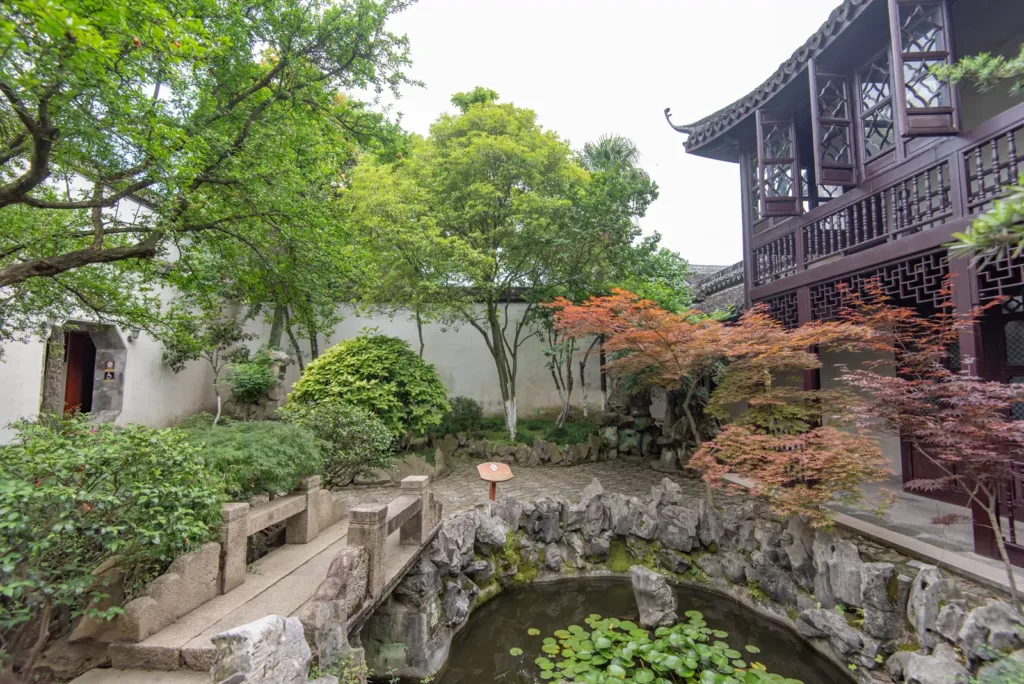 Garden courtyard with rockery, pond and timber gallery at Mo Family Manor, Pinghu, Jiaxing, photographed on 12 June 2021. Photo: Siyuwj · CC BY-SA 4.0
Plan your visit
Getting there
Pinghu is about 25 km (straight-line distance) from central Jiaxing. Search for 平湖市 in a map app to find stations and your accommodation.
Where to stay →Build your route
Start with Mo Family Manor. The linked place guides have entrance and visit details.
Continue with Jiaxing →More in Jiaxing
Sources & geographic information
Administrative names and parent areas: Official geographic directory (dmfw.mca.gov.cn) · Reference date 2026-09-06.
Background text adapted from Pinghu — Wikipedia contributors, under CC BY-SA 4.0. Text has been shortened and reorganized; source revision 1373140739.
Map data © OpenStreetMap contributors. Pins mark approximate centres, not entrances or boundaries.
Image credits & notes (1)
- The First Bridge of Danghu with the old water gate in Pinghu · 平湖市当湖第一桥及水门Photo: 猫猫的日记本 · CC BY-SA 4.0 · taken 2014-06-07Resized for the web; the photo itself has not been edited. Thumbnails may show a cropped view.
