

Special Diets in China: Vegetarian, Halal and Allergies
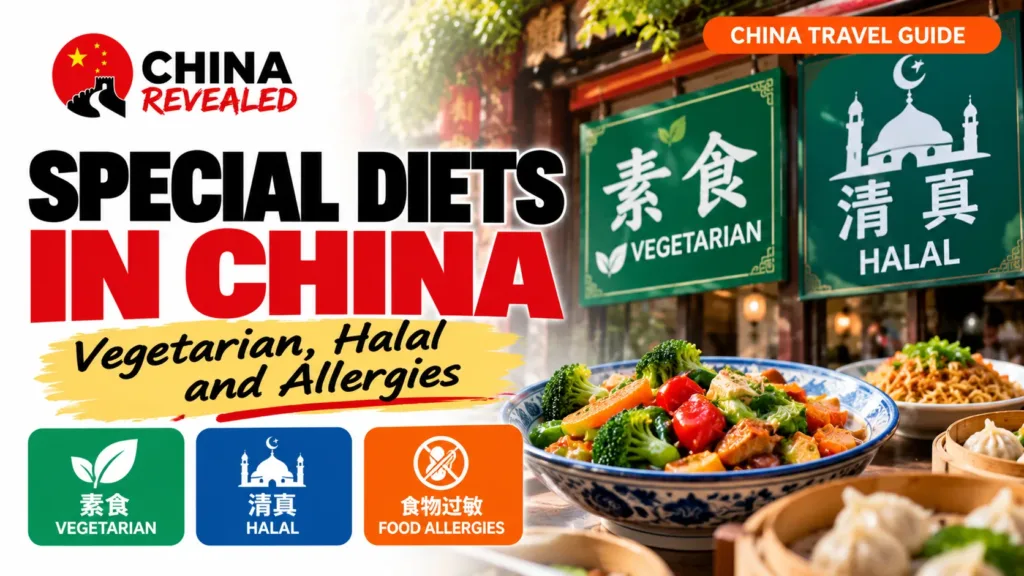
Managing special diets in China starts with choosing the right restaurant and explaining exactly what you cannot eat—not just pointing at a vegetable dish. Dedicated vegetarian restaurants and shops marked 清真 are useful starting points; food allergies need a separate conversation about ingredients and how the kitchen handles them.
The useful local habit is to be specific. Say whether eggs and dairy are acceptable, ask about the soup and cooking oil, and show your requirements before ordering. For serious allergies, speak to someone who can check with the kitchen rather than relying on a menu photo or an order-note box.
Quick takeaways
- Vegetarian is not the same as vegan. “素食” is a useful search word, but eggs, dairy, stock and sauces still need checking.
- Look for 清真 when searching for halal food. Then confirm the actual branch, meat source and preparation practices that matter to you.
- A vegetable, tofu or noodle dish can contain animal ingredients. Stock, lard, oyster sauce, dried shrimp and chicken seasoning are the common things to ask about.
- For food allergies, name the exact allergen and discuss cross-contact. Picking out peanuts or removing a garnish does not solve that problem.
- Save a Chinese food card and carry your prescribed emergency medication. For a suspected severe allergic reaction in mainland China, call 120 immediately.
In this guide
- Find suitable restaurants before you get hungry
- Vegetarian and vegan food: what to order and what to check
- Finding halal food in China
- Food allergies: the kitchen conversation matters
- Chinese cards to show before ordering
- Breakfast, tours and travel days
- What to do in a severe allergic reaction
- The simplest routine for eating well
Find suitable restaurants before you get hungry
Save a couple of realistic options near your hotel and another near the area you will visit. It is much easier to check ingredients in advance than to negotiate a complicated meal at a crowded counter when everyone is hungry.
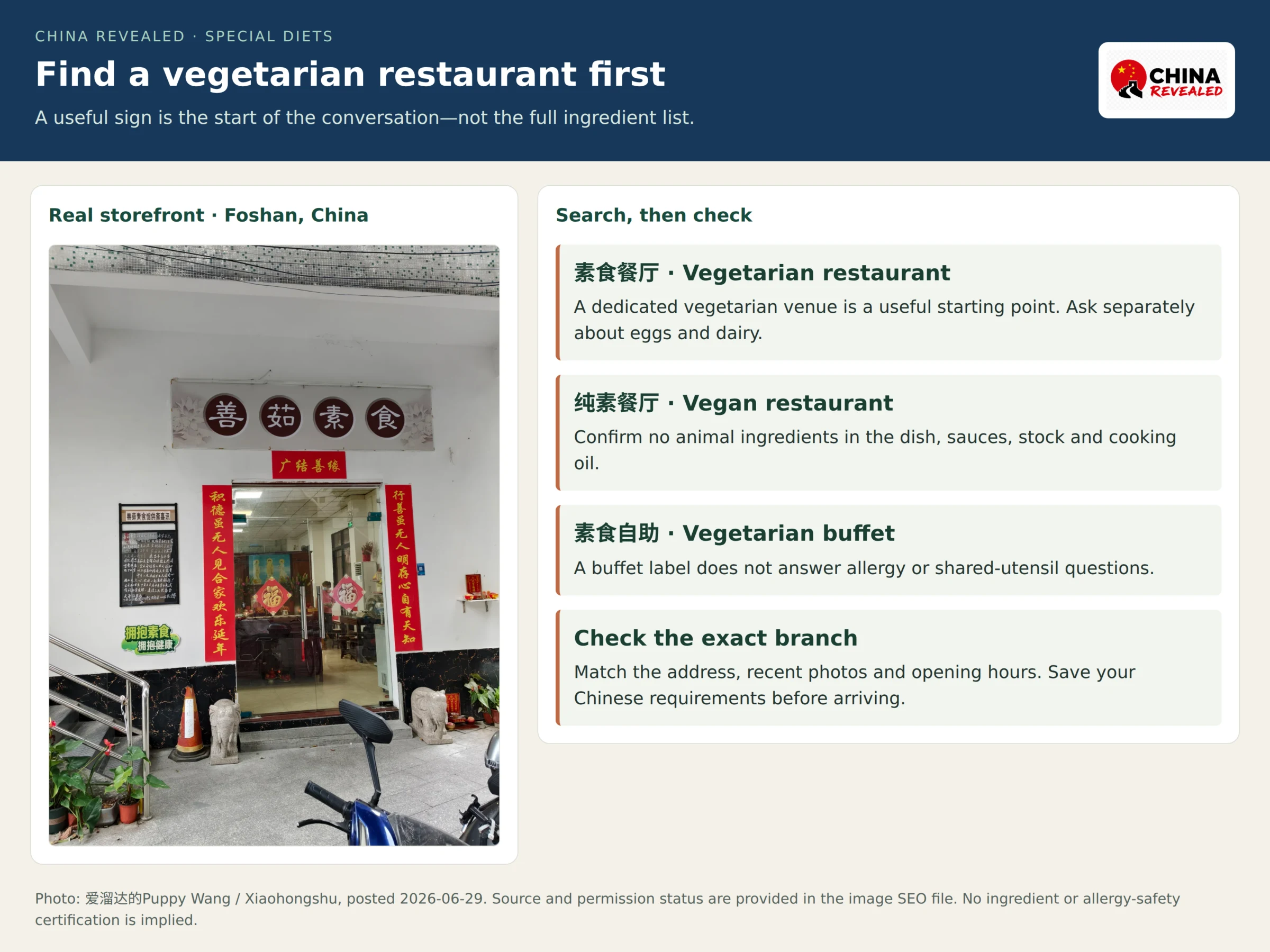
For vegetarian or vegan food, start with 素食餐厅 (vegetarian restaurant) and 纯素餐厅 (vegan restaurant). 素食自助 finds vegetarian buffets. HappyCow’s China directory is useful for an initial shortlist; compare its vegan, vegetarian and veg-options categories rather than treating them as interchangeable.
For halal food, try 清真餐厅 or 清真牛肉面. Add your city, district or nearby subway station. Search in Amap or Dianping, then check recent storefront and menu photos, the exact address and opening hours. Our Dianping guide for foreign visitors explains how to find the right branch and read restaurant listings.
Use reviews to find candidates, not to approve your meal. A reviewer’s “vegetarian-friendly” tag may mean one vegetable dish; a photo of a halal sign does not answer questions about every ingredient. Contact the restaurant with your Chinese card when your requirements are strict. A local hotel receptionist or guide can help with a phone call.
Vegetarian and vegan food: what to order and what to check
Say which kind of vegetarian you are
Vegetarian normally excludes meat, poultry, fish and seafood. If you eat eggs and dairy, say 蛋和奶可以—“eggs and dairy are okay.” This is more useful than leaving the kitchen to guess.
Vegan also excludes eggs, dairy, honey and other animal-derived ingredients. Use 纯素 and explain the exclusions. 我不吃肉 (“I don’t eat meat”) is too short for this job: it may not communicate your requirements for seafood, soup stock or cooking fat.
A Buddhist or temple-associated restaurant can be a good place to look, but 斋, 斋饭 and 素食 are not interchangeable with a checked vegan ingredient list. Ask about eggs and milk even when the setting looks reassuring. Likewise, mock meat—素肉—can use soy or wheat and needs its own ingredient check.
Start with simpler dishes, then check the recipe
In an ordinary restaurant, plain rice with a freshly cooked vegetable or mushroom dish is often a more straightforward order than a complex sauce-heavy dish. Point to a suitable item and ask for plant oil with no meat stock or animal seasonings. 清炒青菜 means lightly stir-fried greens; the cooking request still matters.
Tofu is not automatically vegetarian. Ordinary 麻婆豆腐 (mapo tofu) can contain minced beef or pork, and 肉末茄子 explicitly means eggplant with minced meat. A vegetarian restaurant may make its own plant-based version; a normal restaurant’s standard recipe is a different question. Fried rice can include eggs or meat, and vegetable dumplings need both the filling and wrapper checked.
The hidden ingredients to ask about are:
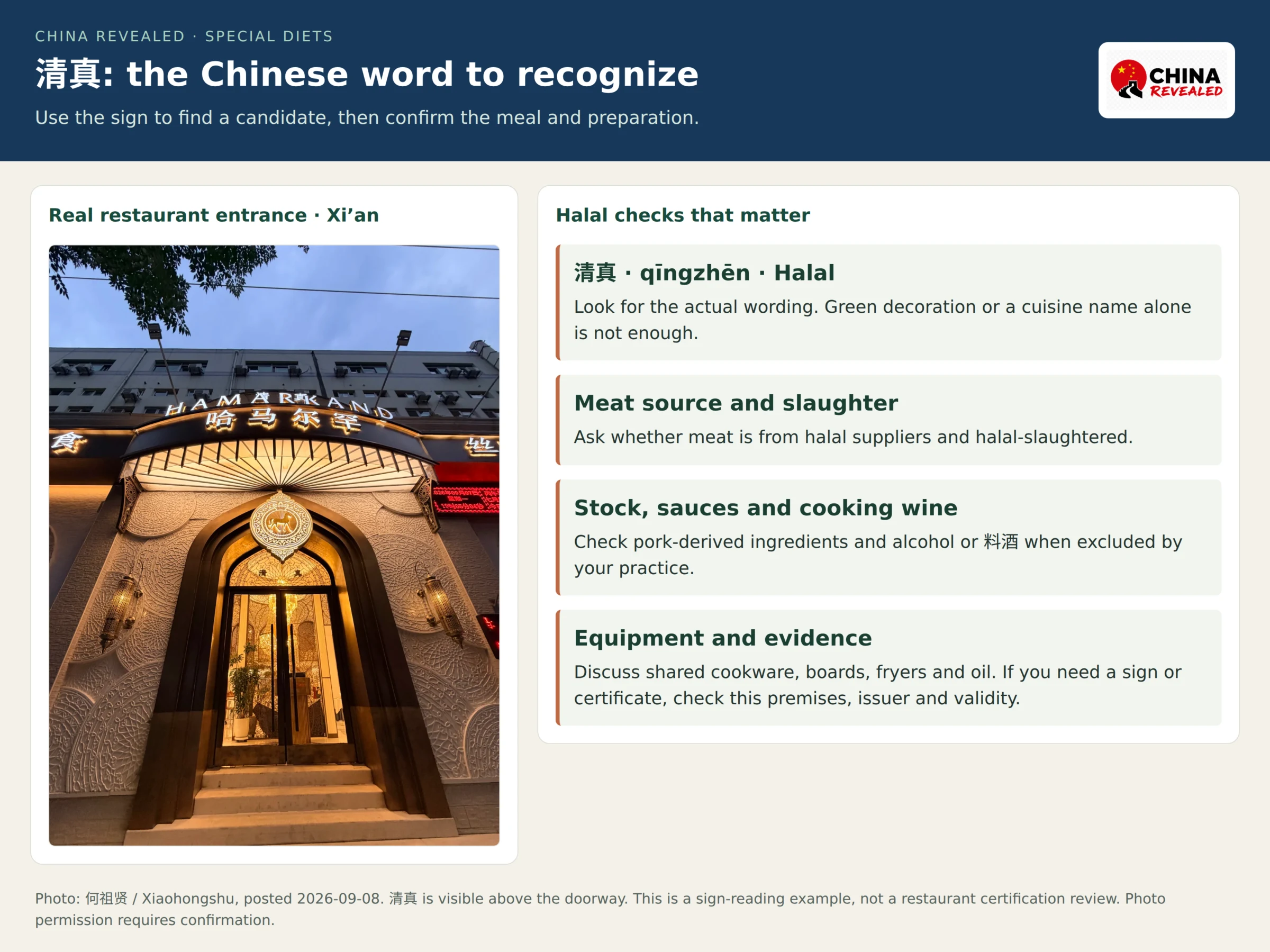
- 汤底 / 高汤 / 肉汤: broth base, stock or meat broth. Clear-looking soup can still be meat-based.
- 猪油 / 牛油 / 鸡油: lard, beef fat or chicken fat. Request 植物油, plant oil.
- 蚝油 / 鱼露 / 虾米: oyster sauce, fish sauce and dried shrimp. Ordinary oyster sauce contains oyster ingredients; a specifically plant-based alternative is different.
- 鸡精 / 鸡粉: chicken-style seasoning or chicken powder. Formulas vary and can contain animal ingredients; ask to omit them or check the actual product.
- 蛋 / 奶 / 黄油 / 蜂蜜: eggs, dairy, butter and honey, especially in bread, pastries, desserts, sauces and drinks.
Do not mistake 味精 (MSG) for a synonym for chicken powder. They are different products; neither name tells you everything else in the dish.
Finding halal food in China
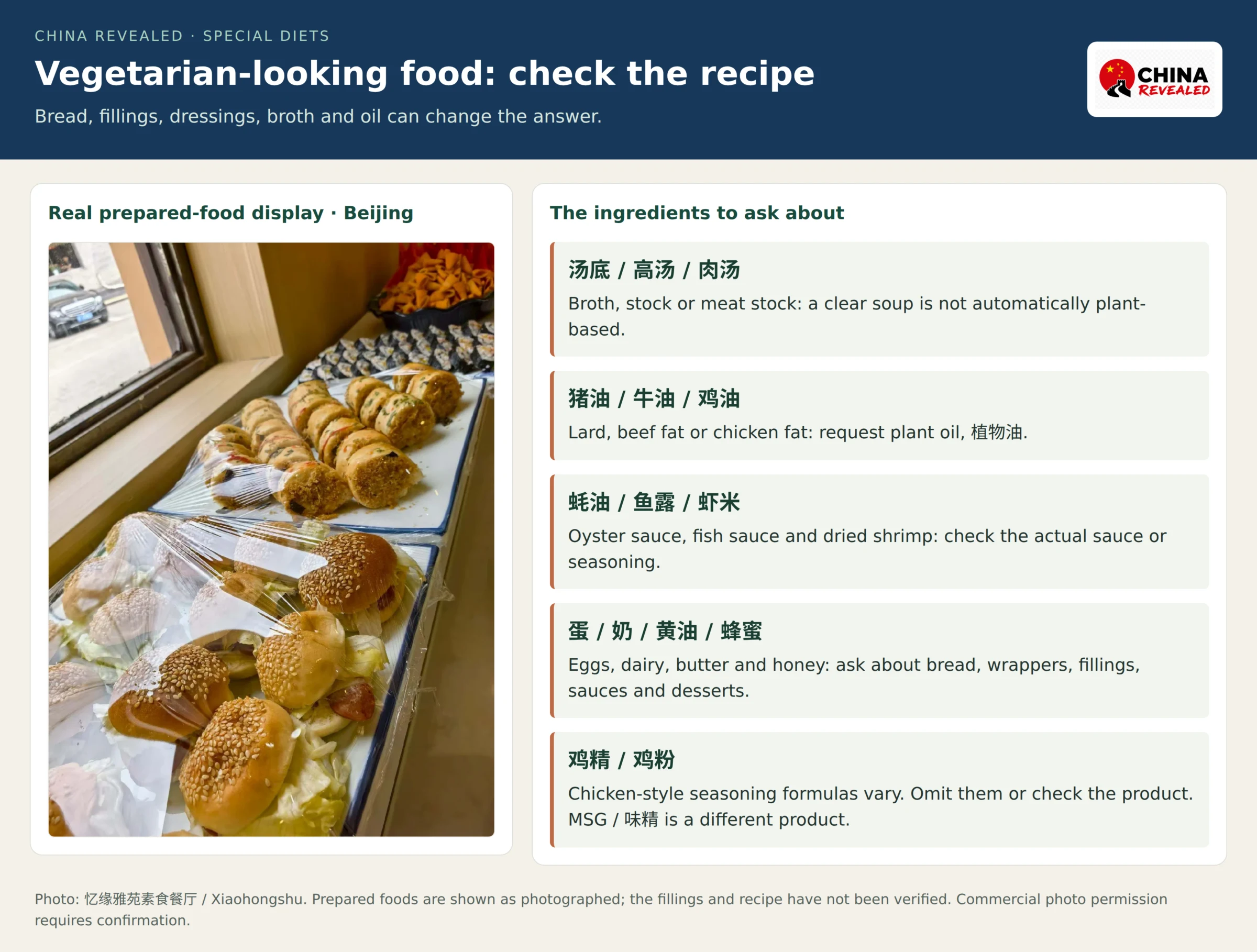
The two Chinese characters to recognize are 清真 — qīngzhēn. They appear on restaurant signs, menus and food packaging. “HALAL” may also be shown.
Lanzhou beef-noodle shops and Hui or Uyghur restaurants are useful places to look. 新疆菜 (Xinjiang food) is another discovery term, but a cuisine name is not the same as a halal claim. Neither green decoration nor Arabic-looking lettering should replace the actual 清真/HALAL wording and a conversation with the restaurant. A nearby mosque or local Muslim community can also help you find suitable places.
Once you have found a candidate, confirm the parts that matter to your practice:
- Meat: is it from a halal supplier, and can the restaurant explain its sourcing and halal slaughter?
- Other ingredients: check pork, lard, pork stock and animal-derived ingredients in soups, sauces and processed foods.
- Cooking wine and alcohol: ask about 料酒, rice wine, beer and alcoholic seasonings if you exclude them.
- Preparation: ask about cookware, cutting boards, fryers and oil shared with non-halal food when separation is important to you.
Local sign and registration systems vary. If you need documentary evidence, ask to see the current sign or certificate for this premises, including its issuer and applicable address. Do not expect one identical nationwide consumer certificate at every restaurant.
A vegetarian meal can reduce the meat-sourcing questions, but it does not automatically settle alcohol, sauces or equipment questions. Explain your own standard rather than asking staff to guess it. If the answers do not meet your requirements, choose another meal or restaurant.
Food allergies: the kitchen conversation matters
Explain an allergy, not just a dislike
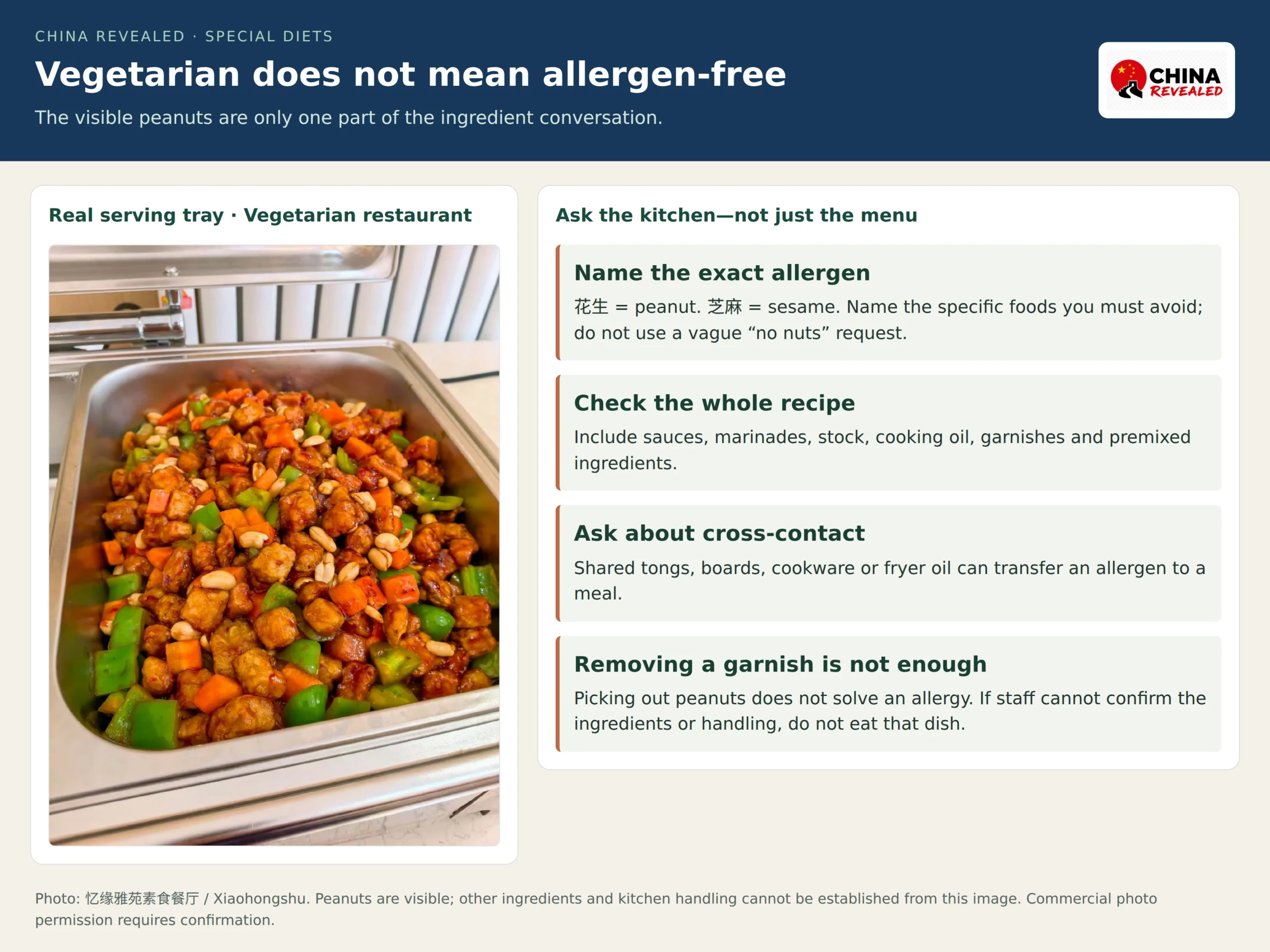
Use 过敏 (allergy), not only 不吃 (don’t eat) or 不要 (don’t add). Name the exact food. “No nuts” can be too vague when your list concerns peanuts, cashews or walnuts specifically. Fish, shrimp and shellfish also need the correct individual names.
Give the card to a manager or staff member who can speak to the chef. Ask about the entire recipe: sauces, marinades, stock, frying oil, garnishes and premixed ingredients. For severe allergies, ask how they prevent cross-contact—an allergen getting into your meal through shared utensils, surfaces, oil or equipment.
Removing peanuts from a finished dish does not turn it into an allergy-safe dish. Neither does cooking it hotter. If staff cannot check the ingredients or preparation, do not eat that item. Your backup meal is more useful than a vague “probably fine.”
Be especially deliberate around shared buffet tongs, hot-pot sauce stations, bakery counters and kitchens using the same fryer. This is a handling issue, not a judgement about the cuisine or the restaurant’s general cleanliness.
Read the whole packaged-food label
Find 配料表 (ingredients), 含有 (contains) and 可能含有 (may contain). Translate the full panel, not just the product name. Keep the Chinese original available for staff to read, including the name of a sauce or seasoning the kitchen uses.
As of October 2026, China’s newer prepackaged-food labeling rules are still in transition; their scheduled effective date is March 16, 2027. Even under the new rules, precautionary cross-contact warnings are encouraged rather than universally mandatory. No “may contain” warning is not proof of no cross-contact. These packaged-food rules are not a requirement for every restaurant to provide an allergen menu.
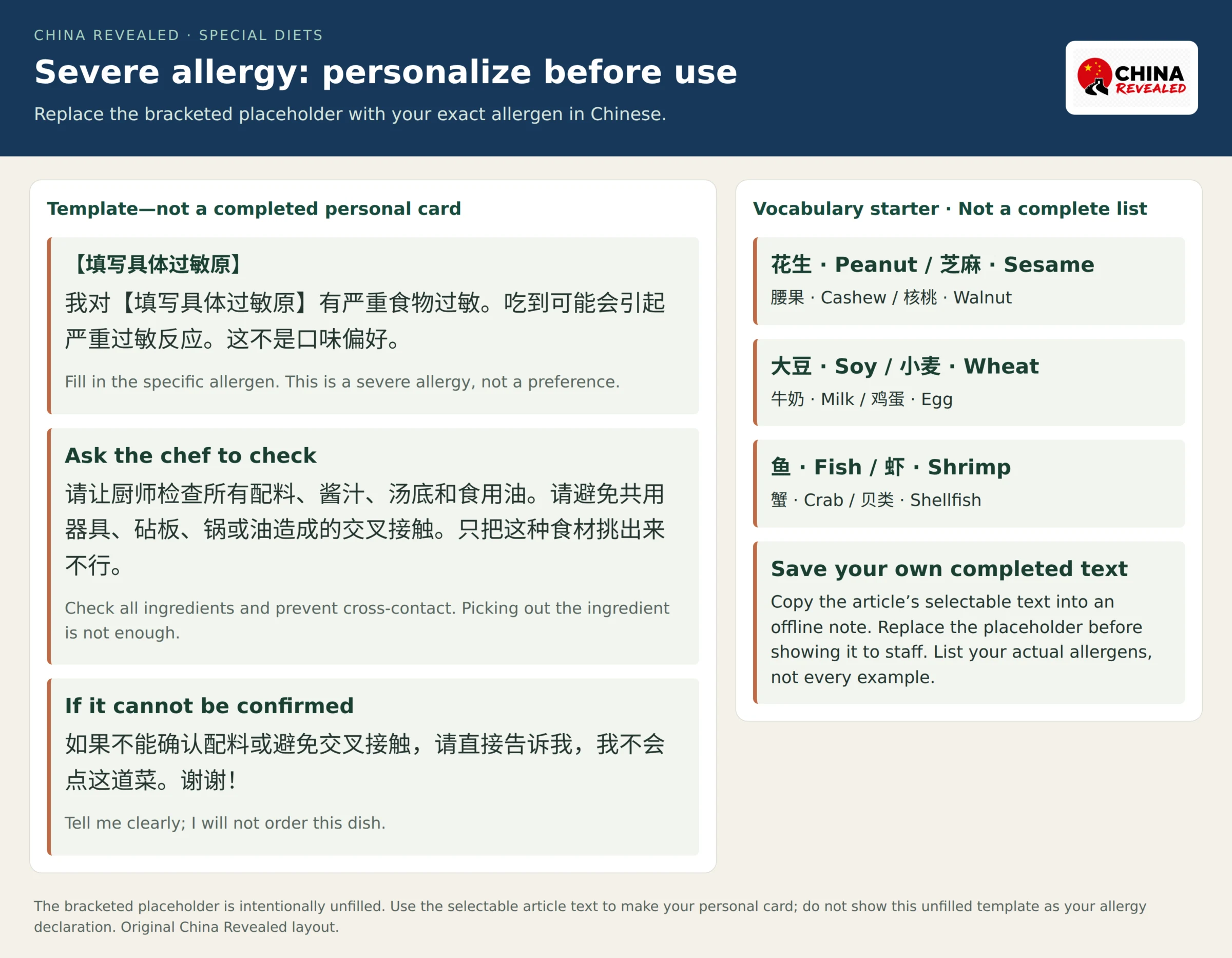
Useful names include 花生 (peanut), 芝麻 (sesame), 腰果 (cashew), 核桃 (walnut), 大豆 (soy), 小麦 (wheat), 牛奶 (milk), 鸡蛋 (egg), 鱼 (fish), 虾 (shrimp), 蟹 (crab) and 贝类 (shellfish). This is a vocabulary starter, not a complete allergen list; use the exact Chinese names relevant to you.
Wheat allergy, coeliac disease and lactose intolerance are different conditions. If you need gluten-free food, explain 无麸质 and the grains you must avoid. Rice noodles are not enough by themselves: soy sauce, seasoning and shared preparation can still matter. Milk allergy also needs a different explanation from lactose intolerance; “lactose-free” does not mean free of milk proteins.
Chinese cards to show before ordering
Save the card that matches your needs. Keep it in an offline phone note as selectable text and, for allergies, carry a printed copy too. A screen or printout should be easy for staff to take to the kitchen.
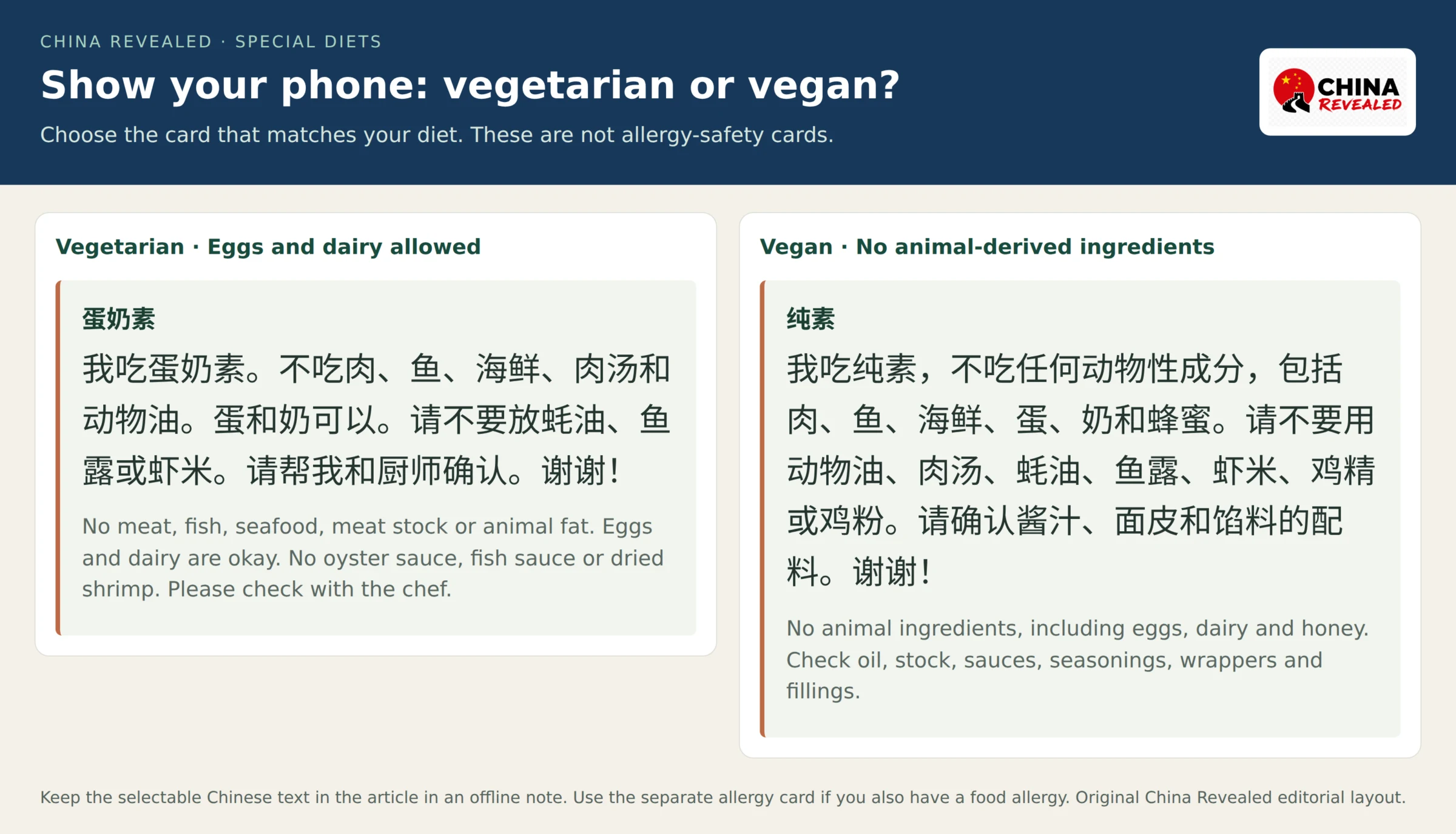
Vegetarian: eggs and dairy allowed
我吃蛋奶素。不吃肉、鱼、海鲜、肉汤和动物油。蛋和奶可以。请不要放蚝油、鱼露或虾米。请帮我和厨师确认。谢谢!
Meaning: I am vegetarian and eat eggs and dairy. I do not eat meat, fish, seafood, meat stock or animal fat. Please do not add oyster sauce, fish sauce or dried shrimp. Please check with the chef. Thank you.
Vegan: no animal-derived ingredients
我吃纯素,不吃任何动物性成分,包括肉、鱼、海鲜、蛋、奶和蜂蜜。请不要用动物油、肉汤、蚝油、鱼露、虾米、鸡精或鸡粉。请确认酱汁、面皮和馅料的配料。谢谢!
Meaning: I am vegan and do not eat animal-derived ingredients, including meat, fish, seafood, eggs, dairy or honey. Please do not use animal fat, meat stock, oyster sauce, fish sauce, dried shrimp, chicken seasoning or chicken powder. Please check the sauces, wrappers and fillings. Thank you.
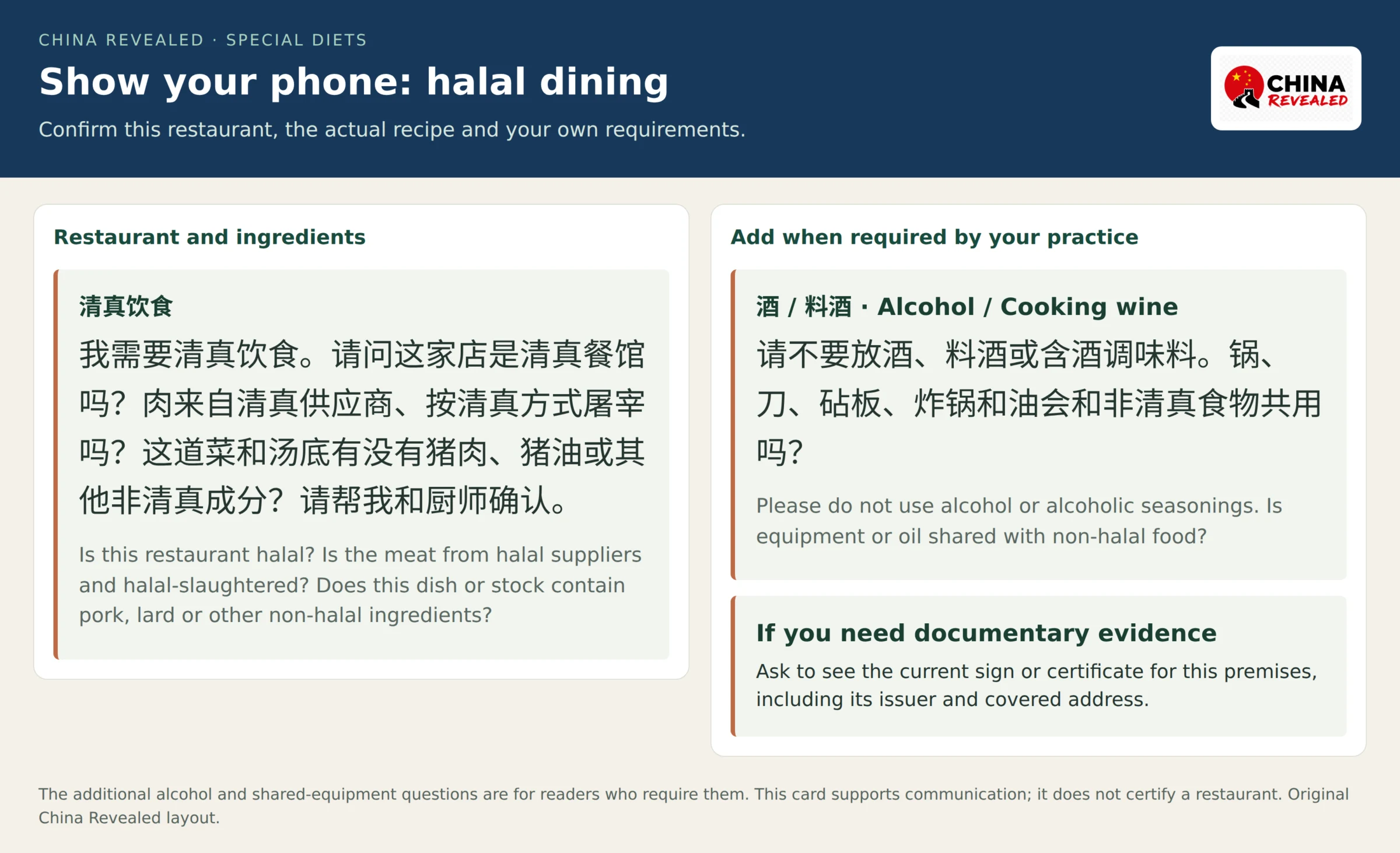
Halal: confirm the restaurant and recipe
我需要清真饮食。请问这家店是清真餐馆吗?肉来自清真供应商、按清真方式屠宰吗?这道菜和汤底有没有猪肉、猪油或其他非清真成分?请帮我和厨师确认。
Meaning: I need halal food. Is this a halal restaurant? Is the meat from a halal supplier and halal-slaughtered? Does this dish or stock contain pork, lard or other non-halal ingredients? Please check with the chef.
If you exclude cooking wine and require separation, add:
请不要放酒、料酒或含酒调味料。锅、刀、砧板、炸锅和油会和非清真食物共用吗?
Meaning: Please do not add alcohol, cooking wine or alcoholic seasonings. Are the cookware, knives, cutting boards, fryer or oil shared with non-halal food?
Severe food allergy: fill in your own allergen first
Replace the brackets with your specific allergen or allergens in Chinese before using this template. Do not show staff an unfilled card or a list of every food you are not actually allergic to. FARE offers official chef-card templates, including simplified Chinese, if you prefer a dedicated printable format.
我对【填写具体过敏原】有严重食物过敏。吃到可能会引起严重过敏反应。这不是口味偏好。
请让厨师检查所有配料、酱汁、汤底和食用油。请避免共用器具、砧板、锅或油造成的交叉接触。只把这种食材挑出来不行。
如果不能确认配料或避免交叉接触,请直接告诉我,我不会点这道菜。谢谢!
Meaning: I have a severe food allergy to [specific allergen]. Eating it may cause a severe allergic reaction; this is not a preference. Please have the chef check all ingredients, sauces, stock and oil, and prevent cross-contact from shared utensils, boards, cookware or oil. Simply removing the ingredient is not enough. If you cannot confirm the ingredients or prevent cross-contact, tell me and I will not order the dish.
Book hotels, flights, train tickets, attractions and other travel services on Trip.com.
Breakfast, tours and travel days
Hotel breakfast is worth checking before booking. Ask about the dishes you actually want, their stock and cooking oil, and how buffet utensils are handled. Congee can contain meat or seafood; bread, buns and pastries can contain dairy or eggs. Plain rice or a visibly simple dish is still not an allergy clearance.
Tell a tour company or guide your exact requirements before paying for a trip that includes meals. Ask whether the included restaurant can accommodate them, whether you can choose another meal, and whether carrying your own verified food is practical. “We have vegetables” does not answer a vegan or severe-allergy request.
On flights, request the correct special meal directly with the airline where offered, check its advance-request deadline and confirm your reservation. A vegetarian special meal may contain eggs and dairy, while a vegan meal is a different category. Neither is necessarily free of your allergens. Short domestic flights and train services should not be your only food plan.
Carry a backup of foods whose ingredients you have already checked, and allow time to eat before a long journey. Check China’s entry rules before bringing food from home. For longer stays with strict requirements, accommodation with a usable kitchen can make daily meals much easier.
Use our translation-app guide to read menus and prepare short questions. DeepSeek or Doubao can help explain unfamiliar dish names, but an AI answer or food photograph cannot verify the kitchen’s actual recipe or allergen handling. For ordinary ordering and paying the bill, the basic Mandarin phrases guide is the companion to this article.
What to do in a severe allergic reaction
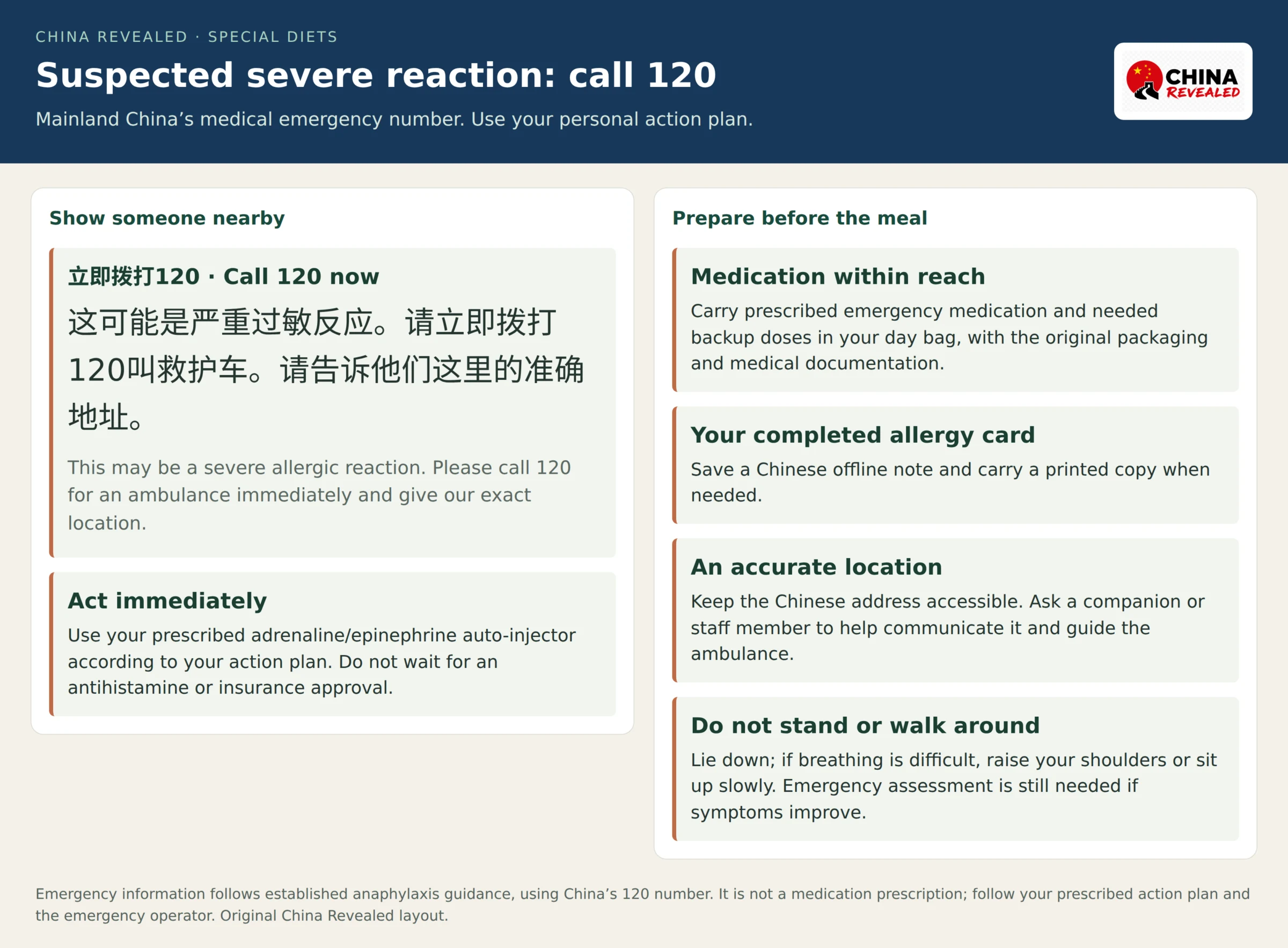
Before departure, review your action plan with your clinician and carry the prescribed emergency medication and backup doses you need. Keep adrenaline/epinephrine auto-injectors immediately accessible in your day bag, not in checked luggage or locked in a hotel room. Carry the original packaging and a prescription or medical letter; check the entry and airline requirements for your medication.
Sudden breathing difficulty, throat or tongue swelling, or faintness after eating can mean a severe allergic reaction. Use your prescribed adrenaline auto-injector immediately according to your action plan and call 120 for an ambulance in mainland China. Do not wait for an antihistamine to work or for an insurance approval.
Do not stand up or walk around. Lie down; if breathing is difficult, raise your shoulders or sit up slowly. Follow your action plan for further medication and the emergency operator’s instructions. You still need emergency medical assessment even if symptoms improve.
Show someone nearby:
这可能是严重过敏反应。请立即拨打120叫救护车。请告诉他们这里的准确地址。
Meaning: This may be a severe allergic reaction. Please call 120 for an ambulance immediately and give them our exact location.
Ask a companion or staff member to communicate the Chinese address and guide the ambulance to the entrance. Keep your hotel address, current location and emergency contact accessible offline. A serious reaction needs emergency care—not a detour to find a pharmacy.
The simplest routine for eating well
Find the right place, show your requirements, and confirm the dish before ordering. For vegetarian or halal travel, that turns a vague request into a practical meal discussion. For allergies, add a clear ingredient and cross-contact check—and keep a verified backup meal available.
China has far more to offer than eating plain rice throughout your trip. The useful preparation is not memorizing a long list of supposedly safe dishes. It is learning a few specific Chinese terms, saving the right card, and choosing restaurants that can answer your questions.
About China Revealed
China Revealed is an independent English-language travel guide dedicated to China.
We bring together China travel guides, destination information, local insights and practical travel resources in one place.
Our travel database covers China's provinces, cities, famous attractions, hidden gems, local cuisine, transportation, accommodation, visa requirements, digital payments, mobile connectivity and the other practical details travelers need to explore China.
We focus on depth, careful research and accuracy. Our guides combine official sources, detailed destination data, local knowledge and regularly updated information to give reliable, practical travel advice.
Whether you're visiting China for the first time or exploring beyond the popular destinations, China Revealed is an all-in-one resource for discovering the real China.
China Revealed — Your practical guide to China.
Some links on China Revealed, such as Trip.com booking links, are affiliate links. If you book through them, we may earn a commission at no extra cost to you. This does not change what we recommend.