

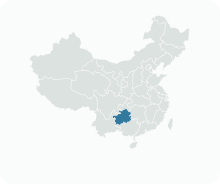
Get to know Jianhe County

- Administrative area
- County · 县
- Part of
- Qiandongnan Miao and Dong Autonomous Prefecture
- Chinese name
- 剑河县
- Local areas
- County guide
Area & population
- Area
- 2,176.00 km²
- Population · 2010
- 180,544
- Administrative seat
- Gedong
Source: English Wikipedia, as of the dates shown.
Jianhe County is a mountain-and-river county in the middle of Qiandongnan Miao and Dong Autonomous Prefecture, Guizhou—not a suburb of Guiyang and not one walkable scenic park. The land rises on the northeastern side of the Leigong Mountains and falls toward the Qingshui River system. Its identity is unusually concentrated in four different kinds of experience: a radon-sulphur hot spring, a Cambrian fossil site, a large reservoir landscape and Miao tin embroidery. Plan by named destinations and allow for road travel between them.
Why Jianhe is distinctive
Jianhe is a place where geology and living culture sit close together. The county’s official natural-geography account describes a subtropical monsoon climate, a generally highland-to-valley relief and the Qingshui, Nanshao and Liudong rivers. Rain is concentrated from April to August, while November to March is the drier season; that matters for steep roads, outdoor fossil interpretation and any lake or village detour. These are useful planning seasons, not a promise that a particular activity runs on a fixed calendar.
The county’s strongest visitor story is the contrast between deep time and present-day craft. At Balang, a boundary marker in the Wuliu–Zengjiaya section records a global Cambrian standard associated with fossils about 508 million years old. In villages and public cultural settings, Jianhe Miao tin embroidery turns dark-blue cotton, counted-thread patterns, tin wire and coloured silk into a bright, metallic-looking surface. The two experiences reward close looking: compare a fossil-bearing rock section with a textile whose pattern is built stitch by stitch, rather than treating either as a generic “ethnic” display.
Places to build a visit around
Yang'asha Hot Spring Town (剑河仰阿莎温泉小镇/剑河温泉) is in Wenquan Village, Cengsong Town, about 7 km north-east of the county town. The county government describes it as a national 4A scenic area built around indoor and outdoor hot-spring facilities, a water park and Miao-Dong cultural design. The official page currently available to visitors is an older tourism notice: it lists historical hours and prices and says that the water-park area is not open in winter unless the scenic area announces otherwise. Do not carry those old prices or hours into a future trip; confirm the current opening, admission, payment and accepted identification with the operator.
Balang Cambrian fossil site (八郎寒武纪古生物化石群遗址) is in Balang Village. A Xinhua report describes the Wuliu–Zengjiaya profile, the 2018 international designation, a fossil exhibition room, science murals and a supervised fossil-collection experience. The place is best approached as a geology and conservation visit: look for the explanation of the boundary, the fossil displays and the relationship between the village and the protected landscape. Never remove material from an exposed site, and do not assume that the exhibition room, guided interpretation or hands-on area is open on your date. Search the exact Chinese name 八郎寒武纪古生物化石群 Bā Láng Hánwǔjì Gǔ Shēng Wùhuà Shí Qún in Amap and confirm the practical visitor entrance and return transport locally.
Yang'asha Lake (仰阿莎湖) is the reservoir landscape created by the Sanbanxi hydropower project. It is a county-scale setting rather than a single guaranteed cruise or ticketed waterfront. The county’s current planning document treats the lake as a core resource for future tourism and low-altitude projects, but that is not evidence of a present-day sightseeing flight, boat timetable or public landing. Use it for the landscape context, and check any specific lakeside activity separately before travelling.
For Jianhe Miao tin embroidery (剑河苗绣/苗族锡绣), the national intangible-heritage record places the craft mainly in Nanzhai, Mindong and Guanme areas. Artisans first lay out traditional patterns on dark-blue cotton, add metal tin strips and fill the gaps with black, red, blue and green silk. The result can look silver-like beside traditional silver headwear and jewellery. Look for a documented public exhibition or cultural activity rather than assuming that every textile sold in the county is traditional tin embroidery; the national record does not establish a particular shop’s current hours or authenticity.
Local food cues
Food is best handled as a question of what is actually being cooked that day, not as a restaurant ranking. The county’s 2026–2030 plan identifies Jianhe sour-soup fish (剑河酸汤鱼), Jianhe Baixiang pig (剑河白香猪) and Jianhe rice-field carp (剑河稻花鲤) among its characteristic food and agricultural products. Recipes and supply vary: ask which fish or pork is being used, how spicy or sour the broth is, and whether the dish is available that day. These names describe local food leads, not a promise that every menu carries them.
To find nearby options, search the exact Chinese name in Meituan (美团) or Amap/Gaode Maps (高德地图). Compare the displayed menu with recent reviews, current opening information and same-day supply. Platform order, ratings and advertising language do not establish “the most authentic” place, so this is a checking method rather than an endorsement of any shop, brand, address or route.
Practical planning and access
Jianhe County is an administrative area, not one venue with a county-wide ticket, opening timetable or passport-reservation system. Hot-spring entry, a fossil-site visit, a village exhibition and any lake activity can each have different operators. The sources checked here do not establish a general foreign-passport booking or entry rule. Ask the individual operator about passport acceptance, reservation, payment, identification and the visitor entrance instead of transferring a domestic-ID instruction from another site. Future festivals, performances, water-park dates, cruises and outdoor activities remain unconfirmed until the organiser publishes them.
There is no useful metro access for this mountain county. For the hot spring, a Jianhe County government tourism page published in 2021 recorded direct tourist-coach links from Kaili Ximahe Bus Station (凯里洗马河汽车站), Kaili South Railway Station (凯里南站) and Sansui South Railway Station (三穗南站) to Jianhe Hot Spring Town. Treat this as a route lead, not a current timetable: check the operator or the “贵州好行” channel before departure and confirm the return leg. The same page described a Guiyang Longdongbao Airport (贵阳龙洞堡机场) → Sansui → hot-spring transfer pattern, but it did not establish a current international-arrival or seasonal schedule.
For self-driving, the county government says the Jianhe–Rongjiang Expressway (剑榕高速) begins in Jianhe by connecting with the Shanghai–Kunming Expressway (沪昆高速) and continues toward Rongjiang, and the county’s 2026 plan records the Jianli and Jianrong expressway network as part of the county’s improved external connections. Use Amap with the exact Chinese destination—剑河县 Jiàn hé Xiàn, 剑河温泉城 Jiàn hé Wēn Quán Chéng or 八郎寒武纪古生物化石群 Bā Láng Hánwǔjì Gǔ Shēng Wùhuà Shí Qún—rather than treating the county name as an entrance. The Amap web view is a search tool, not proof of a fixed bus, taxi fare, last departure or road condition, so check the live route and return plan on the day.
High-speed rail planning should be date-specific. The official China Railway 12306 portal provides the live train, station, ticket, service and delay queries; the sources checked here do not prove a railway station at every Jianhe destination or a universal onward connection. Keep the exact Chinese name of your accommodation and destination for the final road leg, and arrange the return before entering a rural village or leaving an evening activity.
Explore Jianhe County
Core places to explore, with English and Chinese names.
Places to explore around Jianhe County
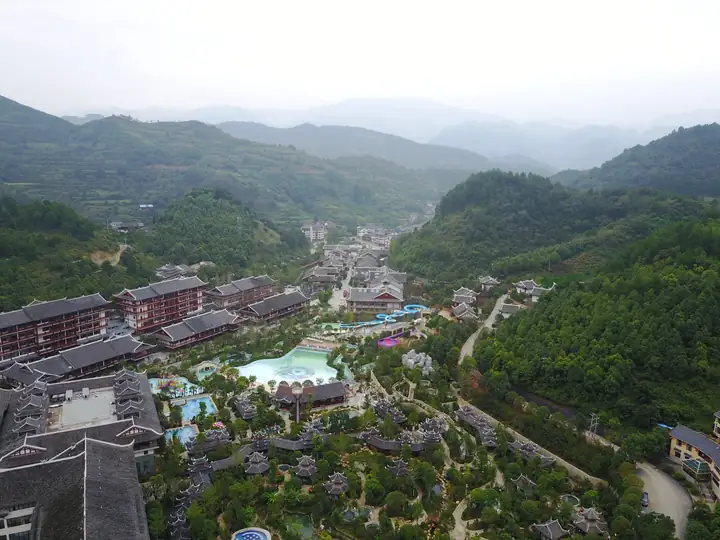 Jianhe Hot Spring ·
Plan your visit
Getting there
Jianhe County is about 50 km (straight-line distance) from central Qiandongnan Miao and Dong Autonomous Prefecture. Search for 剑河县 in a map app to find stations and your accommodation.
Where to stay →Build your route
Start with Jianhe Hot Spring. The linked place guides have entrance and visit details.
Continue with Qiandongnan Miao and Dong Autonomous Prefecture →More in Qiandongnan Miao and Dong Autonomous Prefecture
Sources & geographic information
Administrative names and parent areas: Official geographic directory (dmfw.mca.gov.cn) · Reference date 2026-09-06.
Background text adapted from Jianhe County — Wikipedia contributors, under CC BY-SA 4.0. Text has been shortened and reorganized; source revision 1295779915.
Photo: Jianhe Hot Spring · gz.cnr.cn. Resized for the web; the photo itself has not been edited.
Map data © OpenStreetMap contributors. Pins mark approximate centres, not entrances or boundaries.
Image credits & notes (1)
- Representative view in Jianhe County · 剑河县代表景观。夜间灯光中的县城街区Photo: Francois Xavier WATEL · CC BY-SA 3.0Resized for the web; the photo itself has not been edited.
