

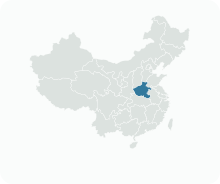
Get to know Shunhe Hui District
- Administrative area
- District · 市辖区
- Part of
- Kaifeng
- Chinese name
- 顺河回族区
- Local areas
- District guide
Area & population
- Area
- 88.00 km²
- Population · 2019
- 249,900
Source: English Wikipedia, as of the dates shown.
Shunhe Hui District is a broad urban district in north-eastern Kaifeng, not a single attraction with one entrance. The Huiji River runs through it from north to south, and the district has long been one of the main residential areas of Kaifeng’s Hui community. Its name combines that river with the community’s presence.
The reason to visit is the way several layers of Kaifeng meet in a relatively compact part of the city: a Northern Song glazed-brick pagoda, a major Chinese mosque, restored traditional lanes, and living craft and food traditions. The district government lists five National Key Cultural Relics Protection Units here, including the Iron Pagoda, Kaifeng Dongda Mosque, the former Henan Preparatory School for Study in Europe and America, the former residence of Liu Qingxia, and the former Henan Catholic Seminary. You do not need to treat these as a checklist. Choose one or two precise destinations and allow time for the streets between them.
A heritage walk with different kinds of history
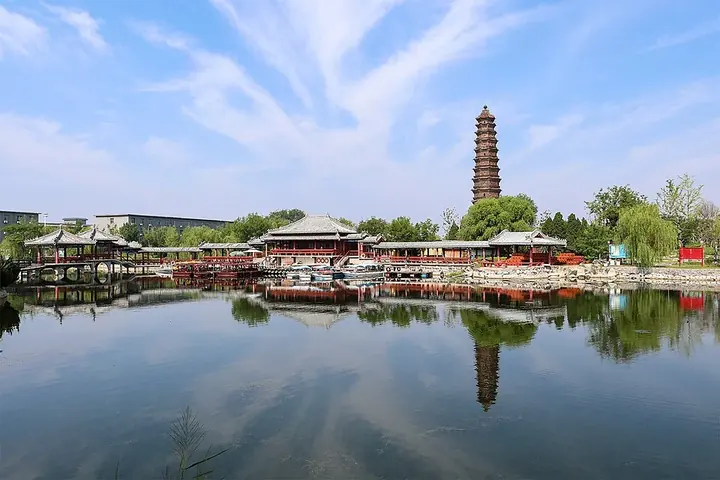
Start with the Iron Pagoda (铁塔), formally the Youguo Temple Pagoda (祐国寺塔), in Iron Pagoda Park. The pagoda was built in 1049 under the Northern Song. Its brown glazed bricks resemble iron from a distance; the official district account records an octagonal, thirteen-storey structure 55.08 metres high, with glazed relief decoration and a national protection designation dating from 1961. The park is a 4A scenic area. Look up rather than only photographing the silhouette: the surface decoration and the gradual taper of the tower are part of what makes it different from an ordinary brick pagoda. The park is an outdoor visit, so weather and any seasonal programme can affect the experience.
Kaifeng Dongda Mosque (开封东大寺) offers a very different encounter. The district government places it on Qingping South–North Street and describes its present layout as a west-facing-to-east-facing, three-courtyard complex. It was rebuilt at the present site in 1407 and retains the scale and style of the 1847 reconstruction; it was designated a National Key Cultural Relics Protection Unit in 2006. This is a living religious site, not simply a photo stop. Dress and behave respectfully, do not assume that every room is open to visitors, and ask before photographing people or worship spaces. Opening hours, prayer-time access and any visitor restrictions should be checked locally on the day.
Shuanglong Lane (双龙巷) is a different kind of heritage experience. The historic and cultural block preserves traditional courtyard-house patterns and was designated both a provincial historic and cultural block and a provincial tourism and leisure street. The district’s account describes its main east–west street as about 590 metres long and presents the area as a mixed space of homes, heritage courtyards, craft displays, food and small businesses. Walk slowly and treat it as a neighbourhood with visitors, rather than as a fully staged museum. Courtyards may have residents or private areas behind them; keep voices low and do not photograph people or interiors without permission.
The district’s intangible heritage adds a practical, hands-on layer. Official district material describes Bian embroidery (汴绣), including seed-knot stitching, the Zhang family lantern-making tradition known as “Lantern Zhang of Bianjing” (汴京灯笼张), and stone-lock lifting (撂石锁). It also records a seventh-generation Zhang family exhibition hall on Lishiting Street, but a workshop or exhibition is not guaranteed to be open whenever you pass. Check a current notice or the venue itself rather than planning around an assumed demonstration.
Food and how to look for it
Food here is best approached as local tradition, not as a list of recommended businesses. The district’s official intangible-heritage page records the Dongda Mosque Jingtang banquet (东大寺经堂席) as a district-level item added in 2023, but it does not provide a standing public menu or visitor venue. It also describes Kaifeng Chen Family Cuisine (开封陈家菜), a provincial intangible-heritage tradition, and its associated dish Taosibao (套四宝). The dish is made by nesting four ingredients; the official account specifically names chicken, pigeon and quail among them.
For a meal, search the exact Chinese names 东大寺经堂席 Dōng Dà Sì Jīng Táng Xí, 开封陈家菜 Kāi Fēng Chén Jiā Cài or 套四宝 Tào Sì Bǎo in Meituan (美团) or Amap/Gaode Maps (高德地图). Use the results only to find nearby possibilities. Read the current menu, recent reviews and opening information, then confirm that the dish is actually being supplied that day. The described Taosibao contains poultry, so it should not be treated as vegetarian or as free of stock and other ingredients; ask about the recipe if you have allergies or dietary restrictions. Platform ranking is not proof of authenticity, and this guide does not endorse a particular shop or brand.
Getting oriented and getting back
Because this is an administrative district, enter a specific Chinese destination into your map app rather than searching for a district “entrance”. The official Kaifeng tourism route lists the Iron Pagoda scenic area as 河南省开封市顺河回族区北门大街210号, and places Shuanglong Lane near 解放路与双龙巷步行交叉口北40米路东. Amap’s current place card lists Dongda Mosque at 开封市顺河回族区清平街道清平南北街4号.
For rail travel, check China Railway 12306 for the train and date that suit you. Amap identifies Kaifeng North (开封北站) as a railway station near Sijie in Longting District; from there, route to the exact sight rather than to the district pin. The city’s published bus list records Route 21 running from Kaifeng North through Dongsi Gate (东司门), Academy Gate (学院门) and Bianjing Bridge (汴京桥), useful approach points for the historic eastern city. The same list shows Routes 1 and 3 linking Kaifeng Railway Station (开封站) with the Iron Pagoda Park · Bus Company 1 (铁塔公园·公交一公司) terminus or stop. The published list is an older municipal reference and routes can be altered by works or traffic conditions, so check the live direction, stop and last service before boarding.
Amap supports driving, public transport, walking and cycling route planning, and its own help page advises checking the live result because bus plans can differ from actual operations. Use the full Chinese place name, save the route to the precise entrance or street, and reverse the route from that same specific stop when returning. The district has no single visitor gate, and the sources checked here do not establish a single current metro connection or a universal taxi fare. Festival performances and autumn displays mentioned in past city tourism notices are date-specific; do not assume a future seasonal programme is running without a current announcement.
Explore Shunhe Hui District
Core places to explore, with English and Chinese names.
Shunhe Hui District 顺河回族区
Plan your visit
Getting there
Shunhe Hui District covers the centre of Kaifeng. Search for 顺河回族区 in a map app to find stations and your accommodation.
Where to stay →More in Kaifeng
Sources & geographic information
Administrative names and parent areas: Official geographic directory (dmfw.mca.gov.cn) · Reference date 2026-09-06.
Background text adapted from Shunhe, Kaifeng — Wikipedia contributors, under CC BY-SA 4.0. Text has been shortened and reorganized; source revision 1361654660.
Map data © OpenStreetMap contributors. Pins mark approximate centres, not entrances or boundaries.
Image credits & notes (1)
- Iron Pagoda and its park in Shunhe Hui District, Kaifeng. Photo: 2025-06-22 11:59:35.Photo: Windmemories · CC BY-SA 4.0Resized for the web; the photo itself has not been edited. Thumbnails may show a cropped view.
