


Get to know Jianye District
- Administrative area
- District · 市辖区
- Part of
- Nanjing
- Chinese name
- 建邺区
- Local areas
- District guide
Area & population
- Area
- 82.00 km²
- Population · 2020 census
- 534,257
Source: English Wikipedia, as of the dates shown.
Jianye is the flat land between the outer Qinhuai River (外秦淮河) and the Yangtze, the part of Nanjing that locals call 河西 — "west of the river", meaning west of the Qinhuai, not of the Yangtze. Its northern edge is 汉中门大街 (Hanzhongmen Avenue), its southern edge the 秦淮新河 (Qinhuai New River), and the Yangtze island of Jiangxinzhou (江心洲) belongs to it as well. The district covers 81.75 sq km, of which 58.29 sq km is land; the ground lies only 4–10 m above sea level, and the riverside flats and the island sit below Yangtze flood level behind dykes.
Two different Nanjings share the district. In the north-east corner, around Mochou Lake (莫愁湖) and the 1980s housing estates of Nanhu (南湖) and Chanan (茶南), the scale is small: a free lakeside park, wet-market snack streets, and a brocade museum. Everything west and south of that is Hexi New Town, Nanjing's modern half — the Olympic sports complex, the Grand Theatre, the Expo Centre, the shopping cluster at 元通, and a chain of riverside parks that runs down to 鱼嘴, the point where the Qinhuai New River meets the Yangtze.
The name is older than the district. In AD 212 Sun Quan renamed Moling (秣陵), today's Nanjing, 建业, "to build a great enterprise"; in 282 the Jin dynasty rewrote the second character as 邺, the Henan city the ruling Sima family came from, which is where 建邺 comes from. The modern district was named in August 1955, was called 红卫区 from 1967, and took its name back in December 1973. The decisive change came in October 2002, when Nanjing redrew its districts: 朝天宫 and 止马营 went to Qinhuai, Jiangxinzhou and parts of 沙洲 and 双闸 came in, and Jianye left the old city to become the core of Hexi. Its six subdistrict offices today are 莫愁湖, 兴隆, 南苑, 沙洲, 双闸 and 江心洲, with about 550,000 residents by the district government's current figure — its own older profile still says 458,900, and the 2020 census counted 534,257.
The north-east corner: one lake, one museum, two food streets
莫愁湖公园 Mochou Lake Park
The district's profile calls Mochou Lake the first of the Forty-Eight Views of Jinling, and it is the one place in Jianye that older Nanjing still treats as a classical garden. It has been free to enter since 1 January 2022, when the ¥35 ticket was dropped; the park opens 07:00–21:00 daily, while its halls keep shorter hours (08:30–17:00, closed Mondays except public holidays).
Inside, the buildings are the point rather than the lake alone: the 胜棋楼 (Shengqi Tower, a city-level protected building), 郁金堂及水院, the provincial-protected 粤军阵亡将士墓, 华严庵, the chess and Ming–Qing furniture halls and the 抱月楼 by the water. The 2018–19 renovation added 2.9 km of paths, about 1.4 km of it circling the lake, and rebuilt the south gate rockery. Spring is when locals come for the begonia — the park's annual 海棠花会 is a Nanjing fixture — and summer for the lotus displays.
One warning: the park announced a wall-removal upgrade that will open the lake towards 汉中门大街, 水西门大街 and 莫愁湖西路 so that people leaving the Line 2 and Line 7 stations walk straight to the water; the work is due to finish before January 2027, and the district ran a public consultation on the public-space redesign in April 2026. Expect sections to be fenced while it is under way.
Getting there: 莫愁湖站 (Mochouhu) is an interchange of Metro Line 2 and Line 7; the city's English park list points to Line 2 Exit 1. The address is 水西门大街132号 (No. 132, Shuiximen Street).
云锦 Yunjin brocade and its museum
Jianye's own profile names 云锦, one of China's "three famous brocades", among its heritage assets, and the trade is still practised here. The 南京云锦博物馆 at 茶亭东街240号 is free, opens daily 09:30–17:00 including public holidays, and admits visitors who swipe an ID card at the ground-floor gate or scan a booking code; exhibits cover the drawloom technology and Ming–Qing brocade, and the district's feature on the craft describes apprentices training on the museum's 大花楼 drawlooms. Metro Line 2, 云锦路站 Exit 2, is the stop the city's English list gives for it.
A much larger replacement is on the way: the new museum, about 90,000 sq m inside the 云锦城 development in the 江东商贸区, was scheduled to open in the second half of 2026, but as of late August 2026 the operator still had not fixed a date. Check the museum's WeChat account before planning a visit around it.
南湖 and 茶南: the district's eating streets
Nanhu is the district's old working neighbourhood, roughly the block bounded by 湖西街, 水西门大街, the Qinhuai and 集庆门大街. It was built to rehouse people cleared from the old city and returning sent-down youth; 南湖新村 was completed on 28 December 1985 as the largest and best-equipped new estate in Jiangsu at the time. Chanan, less than a kilometre west, takes its name from 大士茶亭, a Ming-era tea shelter by a Guanyin temple, and today means the T-junction of 福园街 and 茶南大街.
For food, the district government's own feature names 胖子砂锅, 南湖炸串, 杨记面馆 and 李荣兴锅贴 in Nanhu, and puts the real concentration at 茶南农贸市场, about 700 m west along 南湖东路: Nanjing roast duck, 赤豆小元宵, soup dumplings and small wontons, at wet-market prices — the same 2025 article quotes 7 yuan for a bowl of wontons, 1.8 yuan for a vegetable bun and 5 yuan for a portion of pan-fried buns. The 南湖记忆 renewal programme has been reshaping 南湖东路 since September 2021; its third phase opened in late September 2025 around 南湖东路 and 文体路, about 16,200 sq m, with the 光阴里 block built inside the former 南湖一中 science building (1985, vacated 2019) — 1980s interiors, a small life museum, cafés and snack counters.
Metro Line 7 has stations at 南湖 and 大士茶亭, both inside the neighbourhood; Line 2's 云锦路 and 莫愁湖 stops are a short walk from its edges.
侵华日军南京大屠杀遇难同胞纪念馆 The Memorial Hall of the Victims in Nanjing Massacre by Japanese Invaders
This is the district's most visited site, on 水西门大街418号 at 江东门 — one of the burial places of the 1937 massacre. The hall was first built on the site in 1985, has been enlarged since, and holds the archives that UNESCO added to the Memory of the World register in 2015.
It is free, and it is one of the few major sites in Nanjing where booking rules genuinely matter. Opening hours are 08:30–17:30 with the last entry at 16:30; the hall closes on Mondays except on statutory holidays. Every visitor, including children and those entitled to preferential treatment, must book by real name through the hall's official WeChat account, one to seven days ahead — tickets are released at 08:00 each day — and a passport is an accepted document. Its three exhibition venues are booked separately, each visitor may enter once on the day booked and may book only once a month, and a missed slot that is not cancelled affects future bookings. The English notice asks for quiet, suitable dress and no food in the halls, and offers a free WeChat audio guide. Free strollers and wheelchairs (500 yuan deposit plus ID) and luggage storage (3 yuan an item) are available until 17:00.
Getting there: Metro Line 2 to 云锦路站 (Yunjinlu), Exit 2, then Gate 1 — Exit 3 is used instead on statutory holidays and at peak times. Twenty-two bus routes stop at the memorial, among them 7, 37, 61 and 63. Cars enter the underground "三个必胜" car park from 水西门大街 at 江东中路, from 汉中门大街 at 江汊路, or from 江东北路/江东中路.
Allow two to three hours, and pair it with the brocade museum or Mochou Lake: the three are within two stops of each other on Line 2.
The riverside belt: 绿博园, 南京眼, 鱼嘴
Almost the whole river front of the district is parkland, run by one municipal company whose portfolio here reads 万景园, 绿博园, 南京眼旅游区, 鱼嘴湿地公园, 滨河公园, 河西中央公园, 国际友谊公园 and 鱼背公园. Treat the belt as one long walk or ride rather than separate attractions.
绿博园 Green Expo Garden. Free, 08:30–17:30, at 扬子江大道288号; Metro Line 10, 绿博园站 Exit 2, is the closest station. It was the site of China's first green expo and is described as the largest city garden along the Yangtze; the children's sand-play area and the Holland Friendship Park are the set pieces.
南京眼 Nanjing Eye. A 827.5 m pedestrian bridge with two elliptical towers, spanning the 夹江 — the side channel between Hexi and Jiangxinzhou — and the first pedestrian bridge over the Yangtze in Nanjing. It was finished for the 2014 Youth Olympics and named by public competition that year. The surrounding 南京眼旅游区 covers about 60.9 ha on both banks: on the Hexi side the 南京奥林匹克博物馆, the riverside planning exhibition centre, a sculpture garden and a wetland garden; on the island side 青奥森林公园, the Jiangsu worthies' grove, riverside dawn-redwood stands and a musical fountain. The district's own guide says the bridge is where people come to watch the sun go down.
鱼嘴湿地公园 Yuzui Wetland Park. The southern tip of the district, where the Yangtze, the 夹江 and the Qinhuai New River meet: about 640,000 sq m, free and open at all hours, address 扬子江大道888号. It is in three parts — the extreme-sports area left over from the Youth Olympics (climbing, roller-skating, skateboarding), a wetland of about 280,000 sq m with 2 km of channels and 5 km of boardwalks, and 白鹭广场 with a viewing platform and the navigation beacon tower that everyone photographs; a 5 km riverside greenway runs through, and the view takes in the Third Yangtze Bridge and the Beijing–Shanghai high-speed rail bridge.
To reach 鱼嘴, Metro Line 2 ends at 鱼嘴站 and the tram's 鱼嘴 stop meets it there. The city's English park list, written while the tram's last two stops were out of service, still suggests getting off at 天保街 and walking about 2 km; the full line was restored on 15 September 2024, so the walk is now shorter.
Hexi New Town: stadium, theatre, malls
The district government describes Hexi as the first part of Nanjing to be planned as a whole before it was built, and the results are what you see from the metro: the north finished around 2000, the middle around the 2005 National Games and the fourth World Urban Forum, the south opened up around the 2014 Youth Olympics. Jianye has hosted the 10th National Games, the Asian Youth Games, the Summer Youth Olympic Games, three state memorial ceremonies for the Nanjing Massacre, the Nanjing Marathon and the world roller speed skating championships.
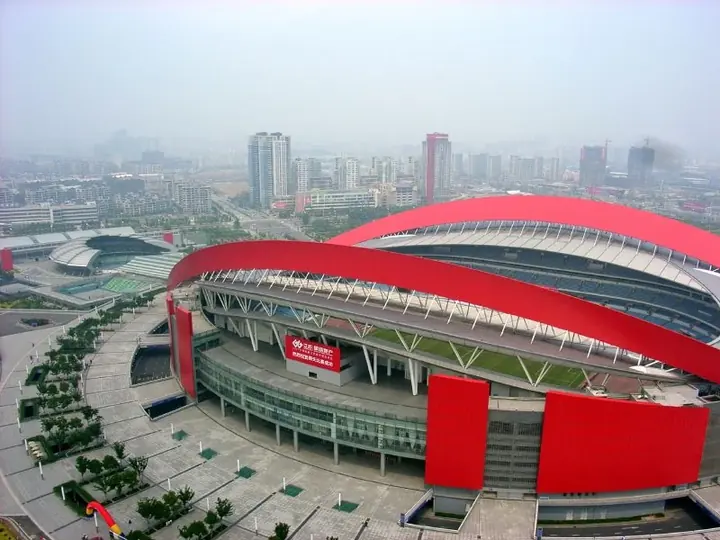
南京奥林匹克体育中心 Olympic Sports Centre. The stadium and arena complex built for the 2005 National Games and reused for the Youth Olympics; Metro Line 2's 奥体东站, Line 10's 奥体中心站 and the tram's 奥体中心东门 stop all serve it.
江苏大剧院 Jiangsu Grand Theatre. Listed by the district among its cultural assets and standing on the same sports-and-culture axis. Line 9, still under construction with a planned opening in 2027, will terminate at 江苏大剧院·宪法公园站, and 绿博园站 will become a Line 9/Line 10 interchange.
元通 Yuandong. The retail core and the Line 2/Line 10 interchange: the Expo Centre, 华采天地, 南京ifc, 河西中央公园 and more sit within a few minutes of the station. Since 5 December 2025 you can tap into and out of 元通 station free within ten minutes (metro app or Alipay, exits 1–6, twice a day per account) to move between the malls underground, and an underground link project is due to finish in 2026.
金鹰世界 Golden Eagle World. At 应天大街888号, a triple-tower complex of 918,000 sq m opened in November 2017 with more than 400 brands — the largest single shopping centre in Nanjing. Four malls in the district — 金鹰世界, IFC, 金陵天地 and 万达 — can handle departure tax refunds for foreign shoppers, and 金鹰世界 has a central refund counter.
江心洲 Jiangxinzhou
About 15 sq km of island in the Yangtze, administered as 江心洲街道, and since a 2008 Jiangsu–Singapore agreement developed as the Sino-Singapore Nanjing Eco Hi-Tech Island — the district's profile simply says it is being built with Singapore as an eco hi-tech island. Only part of it is buildable, and the island has become a test bed: driverless shuttle buses and delivery vehicles run here, and low-altitude drone businesses have moved in.
Getting there is easy: Metro Line 10 has a station on the island (江心洲站) between 绿博园 and the Pukou side, and the 南京眼 footbridge crosses to it on foot from Hexi.
The reason to come is the 22.4 km cycling loop along the island's 江堤路, with the city towers on one side and open Yangtze water on the other. The district and the traffic police have set rules: 30 km/h for the whole loop, 15 km/h through the crowded stretches by the 夹江 bank and the flower fields, counter-clockwise riding on the right, no informal races, helmets and lights recommended. Timing points every 5 km feed the 江岛智慧赛道 mini-programme, where each kilometre ridden earns a point.
On the bridge side of the island, 青奥森林公园 mixes lawns, reed beds, a lake and stands of dawn redwood and ginkgo, and connects directly to the island greenway — the district's own autumn guide calls it the prettiest walk of the season. There is also a riverside lighthouse café and the iMO 江岛新天地 complex for a break.
Getting there and around
Jianye has no single entrance, and no single drop-off point — give a driver the name of the site you want, not the district.
Metro. Four lines cross the district. Line 2 runs from 莫愁湖 in the north-east to 鱼嘴 at the southern tip, with 云锦路 (memorial, brocade museum), 集庆门大街, 兴隆大街, 奥体东, 元通, 雨润大街, 螺塘路, 青莲街 and 天保街 along the way. Line 7 runs 莫愁湖, 大士茶亭, 南湖, 应天大街, 梦都大街东, 新城科技园, 中胜, 嘉陵江东街, 永初路, 太清路 and 螺塘路. Line 10 runs 奥体中心, 梦都大街, 绿博园 and 江心洲 before crossing the Yangtze to Pukou. S3 (the 宁和城际) has 永初路, 平良大街 and 吴侯街 in the south-west and runs to 南京南站. Interchanges inside the district: 莫愁湖 (2/7), 螺塘路 (2/7), 元通 (2/10), 中胜 (7/10), 永初路 (7/S3).
Under construction. Line 9 will end at 江苏大剧院·宪法公园站 and add a 绿博园 interchange with Line 10; the district reported in April 2025 that all station structures were complete, and the current construction plan points to a 2027 opening. Until then, 绿博园 and the Grand Theatre are reached by Line 10 and Line 2 respectively.
Tram. The 河西有轨电车 1号线 is 7.76 km and 13 stops from 奥体中心东门 (interchange with Line 2's 奥体东) to 鱼嘴 (interchange with Line 2), calling at 元通 (Line 2/10), 博览中心东门, 江山大街 and the 河西南 stops. From 8 April 2026 it runs on a fixed 30-minute pattern: weekdays 鱼嘴 06:30–19:00 and 奥体中心东门 07:00–19:30, an hour later at each end on weekends and holidays. Arrive five minutes early; tickets are bought on board and have matched the city's air-conditioned bus fare.
Bus, taxi, driving. Twenty-two bus routes serve the memorial's stop, among them 7, 37, 61 and 63. For a taxi or ride-hailing car, type the Chinese name: 侵华日军南京大屠杀遇难同胞纪念馆, 莫愁湖公园, 云锦博物馆, 绿博园, 南京眼步行桥, 鱼嘴湿地公园, 江苏大剧院 or 河西金鹰世界. If you drive, the memorial has an underground car park entered from 水西门大街/江东中路 or 汉中门大街/江汊路.
On foot and by bike. The riverside parks and the island loop are the cycling parts of the district; the metro and tram handle the rest. The main artery, 江东北路–江东中路, was widened from a 4 m concrete lane in 1987 to a ten-lane road with a 6 m planted median, and Hexi was built at that scale — the distance between two landmarks on a map is usually a metro hop, not a walk.
How to put a visit together
- North-east half day (Line 2/Line 7). Mochou Lake in the morning, the Yunjin museum at midday, then Nanhu and Chanan for lunch or an early dinner; 莫愁湖, 云锦路, 大士茶亭 and 南湖 stations keep it all on two lines.
- The memorial (book first). Two to three hours; it is free, but entry depends on a WeChat booking made one to seven days ahead, and Mondays are closed except on public holidays. Combine it with the brocade museum or Mochou Lake on the same Line 2 stretch.
- Riverside afternoon into sunset. Green Expo Garden (Line 10, 绿博园站), then follow the greenway south on foot or by bike towards 南京眼 and on to 鱼嘴, where Line 2 ends; or start on the island at 青奥森林公园 and walk the bridge into Hexi.
- A day on the island. Line 10 to 江心洲站, rent a bike for the 22.4 km loop, and keep the 30 km/h limit and counter-clockwise rule in mind.
- Hexi evening. 元通 for the malls and the Expo Centre, then the tram or Line 2 for the Olympic centre and the Grand Theatre; the whole run sits inside the CBD skyline.
Two practical notes. The district is flat — 4–10 m above sea level, with the riverside land below Yangtze flood level behind dykes — and the river belt and island are open and exposed, so plan around summer heat and check notices after heavy rain. And Mochou Lake's wall-removal works, due to finish before January 2027, may close parts of that park while you are there.
Where to stay. The Hexi CBD around 元通 and the Olympic centre is where the international hotels are: Andaz Nanjing Hexi, for example, has 356 rooms, sits next to IFC and is near the Expo Centre, with Lines 2 and 10 and the tram at 元通. Staying on Jiangxinzhou is quieter and greener but adds a Line 10 hop to everything; staying in the north-east near Mochou Lake puts the memorial, the brocade museum and the Nanhu food streets within a couple of stops.
Guide sources
- 走进建邺 — 南京市建邺区人民政府
- 自然地理 — 南京市建邺区人民政府
- 建邺概况 — 南京市建邺区人民政府
- 历史沿革 — 南京市建邺区人民政府
- 古今交融的建邺蜕变 — 扬子晚报·紫牛新闻(2026-02-06)
- 建邺区 — 维基百科(中文)
- 南京莫愁湖公园将从2022年元旦起免费开放 — 中国网(2021-12-29)
- Parks — Nanjing Municipal Bureau of Culture and Tourism(英文官网,2024-05-11)
- 莫愁湖公园重装亮相 多方面优化提升迎游客 — 国际在线江苏频道(2019-08-02)
- 莫愁湖公园即将焕新升级 — 南京日报/紫金山新闻(凤凰网转载,2026-09-30)
- 关于公开征集南京莫愁湖景区公共空间改造提升意见建议的公告 — 建邺区人民政府(2026-04-29)
- Museums & Galleries — Nanjing Municipal Bureau of Culture and Tourism(英文官网,2024-05-11)
- 参观指南 — 南京云锦博物馆官网
- 在建邺,千年云锦“正青春” — 建邺区人民政府(2025-06-16)
- 南京云锦博物馆新馆今年投用 — 建邺区人民政府(2026-02-09)
- 锦泓集团:云锦博物馆新馆计划于2026年下半年正式开业(投资者关系答复,2026-08-26) — 证券之星
- 南湖,还是茶南? — 建邺区人民政府(2025-06-03)
- “南湖记忆”三期开街啦 — 建邺区人民政府(2025-09-28)
- 参观须知 — 侵华日军南京大屠杀遇难同胞纪念馆官网
- Notices for Visitors — Memorial Hall of the Victims in Nanjing Massacre(官网英文页)
- Memorial Hall of the Victims in Nanjing Massacre — China Discovery(英文旅行指南)
- 南京滨江公园管理有限公司(下属公园名录)
- 南京眼旅游区简介 — 南京滨江公园管理有限公司
- 建邺这个森林公园,赏秋正当时 — 建邺区人民政府(2025-12-08)
- 鱼嘴湿地公园 — 南京滨江公园管理有限公司
- 南京地铁2号线 — 维基百科(中文)
- 南京有轨电车 — 维基百科(中文)
- 南京地铁7号线 — 维基百科(中文)
- 南京地铁10号线 — 维基百科(中文)
- 南京地铁S3号线 — 维基百科(中文)
- 南京地铁 — 维基百科(中文)
- 探秘地铁9号线 — 建邺区人民政府(2025-04-02)
- 元通地铁站,10分钟内可免费通行 — 建邺区人民政府(2025-12-03)
- 国际嘉宾走进河西金鹰世界 体验南京国际化消费新场景 — 扬子晚报(2026-10-16)
- 江心洲,也是“科技岛” — 建邺区人民政府(2025-06-12)
- Singapore Nanjing Eco Hi-tech Island — SNEI(官方英文页)
- 南京江心洲:智慧守护江岛绿道 文明骑行绘就新风景 — 新华网江苏频道(2025-04-18)
- 南京河西线有轨电车改为30分钟定点发车 — 扬子晚报(2026-04-09)
- Andaz Nanjing Hexi — Hyatt(官方酒店页)
Explore Jianye District
Core places to explore, with English and Chinese names.
Places to explore around Jianye District
 Memorial Hall Of The Victims In Nanjing Massacre ·
Plan your visit
Getting there
Jianye District is about 8 km (straight-line distance) from central Nanjing. Search for 建邺区 in a map app to find stations and your accommodation.
Where to stay →Build your route
Start with Memorial Hall of the Victims in Nanjing Massacre by Japanese Invaders. The linked place guides have entrance and visit details.
Continue with Nanjing →More in Nanjing
Sources & geographic information
Administrative names and parent areas: Official geographic directory (dmfw.mca.gov.cn) · Reference date 2026-09-06.
Background text adapted from Jianye, Nanjing — Wikipedia contributors, under CC BY-SA 4.0. Text has been shortened and reorganized; source revision 1329661563.
Photo: Memorial Hall of the Victims in Nanjing Massacre by Japanese Invaders · 董辰兴 · CC BY-SA 4.0. Wikimedia Commons image, fitted to the card frame.

Map data © OpenStreetMap contributors. Pins mark approximate centres, not entrances or boundaries.
Image credits & notes (1)
- The main gymnasium of Nanjing Olympic Sports Center in Jianye District. Photograph date recorded by the source: 2007-05-03 13:39.Photo: JunChen Wu from Nanjing, China · CC BY-SA 2.0Resized for the web; the photo itself has not been edited. Thumbnails may show a cropped view.
