

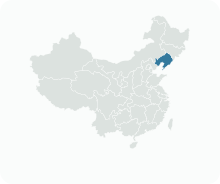
Get to know Haicheng

Photo adjustments
Full frame retained; proportionally resized and converted to WebP. No retouching or changes to the photographed subject. Card displays may crop the view.
- Administrative area
- County-level city · 县级市
- Part of
- Anshan
- Chinese name
- 海城市
- Local areas
- County-level city guide
Area & population
- Area in the source
- 2,576.00 km²
- Population · 2020 census
- 1,067,905
- Administrative seat
- Haizhou Subdistrict (海州街道)
Source: cited geographic source, as of the dates shown.
History
Chinese Wikipedia names two prehistoric sites: the Palaeolithic cave at Xiaogushan (小孤山) and the Neolithic stone-shed (dolmen) burial site at Ximu (析木). The name goes back to the Liao dynasty, which set up Haizhou (海州) here. In 1376 the Ming placed the Haizhou Guard (海州卫) at what is now Niuzhuang (牛庄), and in 1653 the Qing turned Haizhou into Haicheng County.
In 1975 a magnitude 7.3 earthquake struck Haicheng and killed 1,328 people. The county became a county-level city in January 1985.
Haicheng stilt yangge (海城高跷) was placed on the first national intangible-heritage list in 2006. The heritage register traces its performers by generation from 1820 and describes a style built on four techniques: twisting, swaying, teasing and posing. In 1988 Haicheng stilt yangge won a national contest for folk square dances.
Haicheng laba opera (海城喇叭戏), listed nationally in 2008, first took shape around Niuzhuang in the west of Haicheng. It is named after the suona horn, locally called the laba, that leads its music. Under the Qing Tongzhi and Guangxu reigns it joined the stilt troupes, and actors began performing plays on stilts. More than forty traditional plays survive, among them "Wang Po Scolds the Chicken" (《王婆骂鸡》); the heritage register says they have simple plots and plain language and mostly depict the lives of working people.
Food and local products
Known local products include the Nanguo pear (南果梨) and Niuzhuang meat pies (牛庄馅饼). Strawberries from Tengao (腾鳌) carry a national geographical-indication label; they are grown using waste heat from the local hot springs. Haicheng is also a mining area, with magnesite and talc among the more than 40 minerals found here, and the Xiliu (西柳) clothing market is known in China and abroad.
Highlights
- Haicheng stilt yangge 海城高跷: Stilt dance on the first national intangible-heritage list (2006).
- Haicheng laba opera 海城喇叭戏: Suona-led folk opera from the Niuzhuang area, listed nationally in 2008.
- Niuzhuang meat pies 牛庄馅饼: One of Haicheng's best-known local foods.
- Tengao hot-spring strawberries 腾鳌温泉草莓: Geographical-indication strawberries grown with hot-spring waste heat.
Sources for this guide
海城市 - 维基百科,自由的百科全书 · Chinese Wikipedia · CC BY-SA 4.0
高跷(海城高跷) - 中国非物质文化遗产网·中国非物质文化遗产数字博物馆 · China Intangible Cultural Heritage Network (ihchina.cn)
海城喇叭戏 - 中国非物质文化遗产网·中国非物质文化遗产数字博物馆 · China Intangible Cultural Heritage Network (ihchina.cn)
Original English written from the listed sources and checked sentence by sentence against quoted extracts by a separate reviewer. Updated 2026-09-25.
Explore Haicheng
Core places to explore, with English and Chinese names.
Plan your visit
Getting there
Haicheng is about 35 km in a straight line from central Anshan. Search for 海城市 in a map app to find stations and your accommodation.
Where to stay →More in Anshan
Sources & geographic information
Administrative names and parent areas: Official geographic directory · Reference date 2026-09-06.
Some facts checked against 海城市 — Wikipedia contributors, CC BY-SA 4.0.
Map data © OpenStreetMap contributors. Pins mark approximate centres, not entrances or boundaries.