


Get to know Kamba County
- Administrative area
- County · 县
- Part of
- Xigazê
- Chinese name
- 岗巴县
- Local areas
- County guide
Area & population
- Area
- 4,204.00 km²
- Population · 2020
- 11,276
Source: English Wikipedia, as of the dates shown.
What makes Kamba different
岗巴县 is not one compact scenic site. Its strongest experience is the long approach across a high plateau to small, widely separated cultural and geological subjects. The county guide places Naiqiaqiemu Caves (乃甲切木石窟) on a conglomerate cliff north of the Yeru Tsangpo (叶茹藏布) and south of Naijia Village (乃加村). Five south-facing entrances sit more than ten metres above the ground; two caves retain Buddhist images and clay relief figures of Buddhas, bodhisattvas and animals.
The National Cultural Heritage Administration lists 乃甲切木石窟 in Kamba County as a Song-period national key cultural relic. A secondary description records five caves arranged along the cliff and identifies the best-preserved fourth cave with a Vajradhatu mandala theme. Read the cliff from below and notice how the openings, river valley and village relate to one another. Do not treat a heritage listing as proof that every chamber is currently open to visitors.
The same county guide identifies an earth-forest formation west of Chorten Nyima, about 1.2 kilometres long and shaped by running-water erosion. This is best understood as a landscape stop rather than a guaranteed, ticketed attraction: ask locally which ground is safe and permitted, and do not cross fragile formations or enter an unmanaged slope. The county’s appeal is the contrast between carved religious space and exposed, eroded plateau, not a checklist of large facilities.
How to look and behave
At the caves, begin with the safe ground-level view. Look for the south-facing openings, the height of the cliff and the surviving painted or clay imagery described in the sources. Never climb the cliff, touch reliefs, or enter a chamber unless a local authority or guide confirms that access is permitted. If a monastery or religious object is part of the approved stop, ask before photographing; the current visitor page does not establish a public opening schedule for the objects it mentions. Keep the visit quiet and leave village paths, livestock areas and watercourses unobstructed.
For the earth forest, use any marked or locally approved approach and observe the channels cut by water, the changing shadows on the soft-looking ridges and the way the land opens toward the river system. Avoid making a close-up walk the goal when the surface is unstable. Weather, road checks and altitude can change the usable route; a local guide’s same-day instruction takes priority over an old itinerary.
Entry and permissions
Foreign passport holders need a permit for Tibet through a specialist travel agent in China and must travel on an organised tour, according to current UK government travel advice. Permit issuance or regional access can change without notice, so have the approved route checked before booking transport. Travellers using mainland, Hong Kong or Macao resident documents, or Taiwan-related documents, should confirm their own document route separately rather than assuming that the foreign-passport rule is interchangeable.
Border excursions inside Kamba need separate attention. A 2025 Xizang tourism department guide specifically says that the Qudeng Nima glacier-lake route in Kamba requires a border pass and warns of changeable weather and cold conditions. That statement is specific to the glacier-lake route; it is not evidence that every road or every village in the county has identical requirements. Ask the tour operator and the relevant local authority which township, checkpoint and permit apply to the exact approved itinerary. For remote high-altitude extensions, do not walk into closed, protected or unmanaged ground, and do not assume that a passport or an ordinary domestic reservation is enough.
Getting there and getting back
Plan Kamba as a road itinerary from Shigatse (日喀则), not as a rail or walk-up attraction. The sources reviewed here do not establish a named railway station or a current direct public-coach timetable for the county, so do not invent one. For Naiqiaqiemu Caves, the practical sequence is an approved vehicle from Shigatse to Kamba County, then onward to Changlong Township (昌龙乡) and Naijia Village (纳加村). Confirm the exact road, checkpoint procedure, cave approach and same-day conditions with the approved operator before departure. A secondary listing gives an approximate 23-kilometre road link from the county centre to the caves, but the route and timing are not independently confirmed here and are not promised.
Agree the return before leaving Kamba County. Keep the same pre-arranged vehicle for the return to the county seat or the next approved overnight stop, and allow a buffer for checks, weather and slow mountain roads. Do not rely on finding a same-day public bus at Naijia Village. The Qudeng Nima glacier-lake line is a different, border-controlled extension and should not be added to a cave visit without its own permit and route confirmation.
Practical checks before departure
Save the Chinese names 岗巴县, 昌龙乡 and 纳加村 in the map app used by your driver, but treat the map pin as a navigation aid rather than proof of an entrance. Reconfirm the cave’s visitor status, any protection-zone instructions, the earth-forest approach, the exact permits and the return vehicle shortly before setting out. Pack warm layers, water and sun protection for remote plateau travel, and turn back if the approved guide or local checkpoint closes the route.
Entry & permits for Tibet (Xizang)
Foreign tourists need Tibet entry approval, commonly called a Tibet Travel Permit, and an organised visit arranged through a specialist travel agency in China. Confirm your approved route before booking transport. Requirements differ for Taiwan residents and for travellers using mainland or Hong Kong/Macao Chinese resident documents; check the document guide before you book.
Check the travel-document requirements →Policy scope verified: 2026-09-06. UK FCDO: China regional travel advice ↗ State Council Taiwan Affairs Office: Tibet entry approval ↗ Xizang Department of Culture and Tourism: Medog border permit notice ↗
Explore Kamba County
Core places to explore, with English and Chinese names.
Kamba County 岗巴县
Plan your visit
Getting there
Kamba County is about 115 km (straight-line distance) from central Xigazê. Search for 岗巴县 in a map app to find stations and your accommodation.
Where to stay →More in Xigazê
Sources & geographic information
Administrative names and parent areas: Official geographic directory (dmfw.mca.gov.cn) · Reference date 2026-09-06.
Background text adapted from Kamba County — Wikipedia contributors, under CC BY-SA 4.0. Text has been shortened and reorganized; source revision 1288826797.
Map data © OpenStreetMap contributors. Pins mark approximate centres, not entrances or boundaries.
Image credits & notes (1)
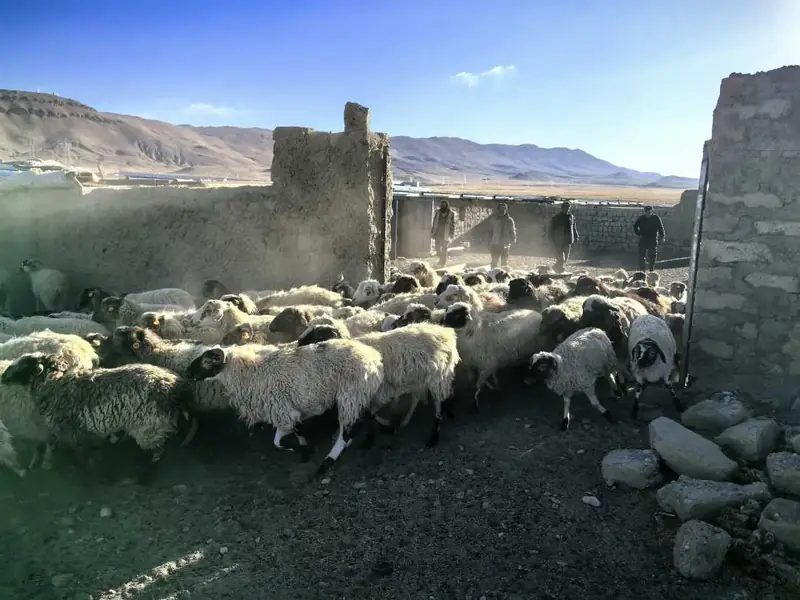
- Representative view in Kamba County · 岗巴县代表景观。村落石墙旁聚集的羊群Photo: politics.gmw.cnResized for the web; the photo itself has not been edited.