


Get to know Lhazê County
- Administrative area
- County · 县
- Part of
- Xigazê
- Chinese name
- 拉孜县
- Local areas
- County guide
Area & population
- Area
- 4,488.70 km²
- Population · 2020
- 56,355
Source: English Wikipedia, as of the dates shown.
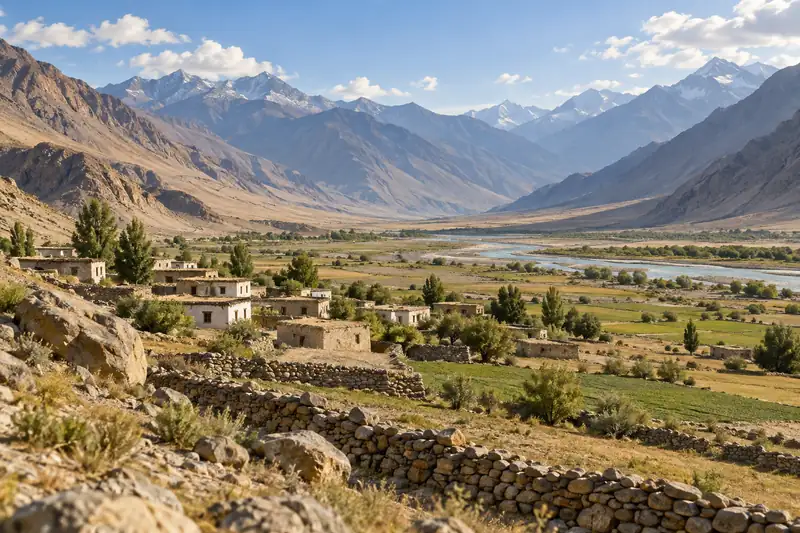
Lhazê is not a compact sightseeing town. Read the county as a cultural landscape: plan one named monastery visit, leave time for the road and river-valley setting, and treat a workshop or performance as something to arrange rather than something guaranteed every day. The current county guide identifies Lhatse Chode Monastery (曲德寺) as its core place, while the county government’s recent notice shows that 拉孜堆谐 is still being taught and supported locally.
What to look for
拉孜藏刀 (Lhazê Tibetan knives) are not just souvenirs. The documented hand process includes quenching, hammering, grinding and polishing. The steel blade is paired with a decorated sheath made from white copper and finished with a bright silver surface; the object can be practical, such as for cutting meat, as well as ornamental.
If an artisan workshop is open to visitors, look first at the separation between blade and sheath, then at the marks left by hammering, grinding and hand engraving. Ask before photographing people, tools or unfinished work. Do not assume that a public demonstration, a particular maker or a purchase-and-carry arrangement is available; No fixed visitor workshop schedule is given here, so arrange access in advance rather than relying on a spontaneous stop.
拉孜堆谐 (Lhazê duixie) joins singing, dancing, recitation and instrumental playing. The current description mentions a six-string instrument, while a 2025 county cultural notice records the distribution of costumes and 扎念琴 to school arts teams in support of this national-level intangible cultural heritage. A performance may be solo, paired or group work, but a school activity or festival notice is not proof of a daily tourist show.
When a rehearsal or public performance is explicitly open, listen for the 扎念琴 and watch how the performer carries the sung and spoken lines into movement. Ask permission before filming, keep clear of performers and residents, and watch as a cultural event rather than treating people as a staged photo opportunity.
A focused architectural stop: Lhatse Chode Monastery
曲德寺 (Lhatse Chode Monastery) is a Gelug monastery in old Lhatse, described in the county guide as founded by the Fifth Dalai Lama and situated below the ruined Lhatse Dzong near the Yarlung Tsangpo. Its mural hall is the reason to slow down inside rather than treating the stop as a quick exterior photograph.
This is an active religious site, not a generic museum. Follow the monastery’s current instructions, ask before taking photographs, and do not enter rooms or touch ritual objects unless invited. Because current opening hours, ticketing, reservation rules and the exact visitor entrance are not listed here, confirm them with the approved local operator before putting the monastery into a fixed timetable.
Entering, moving and returning
Foreign-passport visitors must arrange Tibet approval and an organised itinerary through a specialist travel agency in China. The approved route and document requirements can vary by passport or other travel document; confirm that Lhazê and the planned monastery stop are explicitly covered before booking transport. If the itinerary continues into a border area or another restricted site, confirm any additional permission separately. The UK travel advice likewise says that a permit and organised tour are required, and that authorities can change access without notice.
The available passenger rail connection ends at 日喀则站 (Shigatse Railway Station), in Jicuo Xiong Township of Sangzhuzhi District and the terminus of the Lari Railway; Lhazê therefore needs a further road leg. Older transport guidance names 日喀则汽车客运站 (Shigatse Bus Passenger Transport Station) on 解放中路, near Shanghai Square, as a point for county services including 拉孜. Its listed departures, fares and journey times date from 2016 and are not a current timetable. Check the station or your approved operator on the travel day, and arrange the return from 拉孜县城 before leaving; do not assume a late bus or an empty-seat departure.
For 曲德寺, give the driver the Chinese name and confirm the current gate and pickup point from Lhazê. Because a current last-mile travel time, gate number and return shuttle are not confirmed, this guide gives none. Metro travel is not applicable here. Keep a confirmed road connection for the return, especially if the visit is part of a longer westbound route.
High-plateau conduct
Build the stop into a gradual high-plateau itinerary rather than arriving and immediately planning a strenuous walk. Carry water, sun and wind protection, and ask the operator or a clinician for advice if you have a health condition or feel unwell. Keep your passport and approved travel documents available for checks. Conditions, road services and site access can change, so confirm the route, weather and return connection close to departure. Ask before photographing in Buddhist monasteries.
Entry & permits for Tibet (Xizang)
Foreign tourists need Tibet entry approval, commonly called a Tibet Travel Permit, and an organised visit arranged through a specialist travel agency in China. Confirm your approved route before booking transport. Requirements differ for Taiwan residents and for travellers using mainland or Hong Kong/Macao Chinese resident documents; check the document guide before you book.
Check the travel-document requirements →Policy scope verified: 2026-09-06. UK FCDO: China regional travel advice ↗ State Council Taiwan Affairs Office: Tibet entry approval ↗ Xizang Department of Culture and Tourism: Medog border permit notice ↗
Explore Lhazê County
Core places to explore, with English and Chinese names.
Places to explore around Lhazê County
 Lhatse Chode Monastery ·
Plan your visit
Getting there
Lhazê County is about 75 km (straight-line distance) from central Xigazê. Search for 拉孜县 in a map app to find stations and your accommodation.
Where to stay →Build your route
Start with Lhatse Chode Monastery. The linked place guides have entrance and visit details.
Continue with Xigazê →More in Xigazê
Sources & geographic information
Administrative names and parent areas: Official geographic directory (dmfw.mca.gov.cn) · Reference date 2026-09-06.
Background text adapted from Lhatse County — Wikipedia contributors, under CC BY-SA 4.0. Text has been shortened and reorganized; source revision 1330745611.
Photo: Lhatse Chode Monastery · baike.baidu.com. Resized for the web; the photo itself has not been edited.
Map data © OpenStreetMap contributors. Pins mark approximate centres, not entrances or boundaries.