


Get to know Sa'gya County
- Administrative area
- County · 县
- Part of
- Xigazê
- Chinese name
- 萨迦县
- Local areas
- County guide
Area & population
- Area
- 5,748.81 km²
- Population · 2020
- 48,766
Source: English Wikipedia, as of the dates shown.
Sa'gya County is a high-altitude historical county whose defining experience is the fortress-like Sakya Monastery: a working centre of the Sakya school of Tibetan Buddhism, with mural art, ritual spaces and a major manuscript collection rather than a generic sightseeing stop.
Sa'gya is best understood through the monastery that gave the county its name. The southern complex sits in the county seat, while the older northern site lies across the Chongqu River on Benbori Mountain. The southern monastery was expanded in the 13th century; the complex is also associated with more than 84,000 volumes of Tibetan manuscripts, so a visit rewards slow looking at painted walls, libraries and courtyards rather than a quick photograph at the gate.
The county is also a high plateau landscape. From Chongla Mountain Viewing Platform (冲拉山观峰台), about 15 km from the county seat at an elevation reported as 4,500 m, clear weather can open a view towards the eastern side of Mount Everest and its characteristic banner cloud. Visibility is weather-dependent, and the platform should be treated as a guided vehicle stop, not as an unplanned hike.
What to see
Sakya Monastery (萨迦寺)
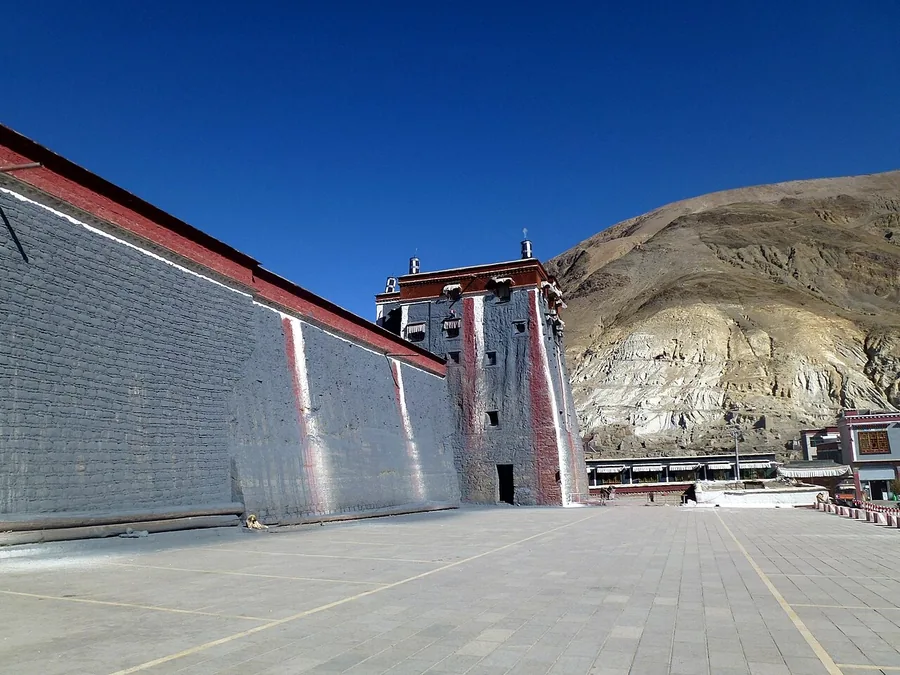
Begin with the southern monastery in Sakya town. Its grey-white and dark-red walls, compact courtyards and dense religious decoration make the building itself the first thing to study. Then look for the difference between a living monastery and a museum: worshippers may be praying, chapels may have restricted areas, and a mural or manuscript is not a prop. Keep voices low, follow staff and no-photography signs, and do not touch paintings, books or ritual objects.
The northern monastery is a separate historical site across the river, not an extra hall inside the southern complex. The surviving structures and ruins are useful for understanding the earlier layout, but I did not find a current, readable official visitor notice that confirms a public route or opening arrangement for the northern site. Ask your guide before going beyond the southern monastery; do not assume that a map pin means an open entrance.
A third-party English guide lists 09:00–18:30 and a CNY 50 admission fee, but those details were not confirmed against a current official notice. Check the entrance on the day, including whether payment, photography and access to individual halls differ from the general visit.
Chongla Mountain Viewing Platform (冲拉山观峰台)
The Chinese name to show a driver is “冲拉山观峰台”. The platform is reported to be about 15 km from the county seat and at 4,500 m. On a clear day, use it for a wide mountain view rather than expecting Mount Everest to be visible every time. Cloud, snow and road conditions can change the experience quickly.
No current public timetable, confirmed entrance arrangement, road condition notice or return transport was available in the sources I could read. Arrange it as part of the approved itinerary with a vehicle and guide, carry the Chinese name, and return before weather or light deteriorates. Do not walk onto unmarked slopes or treat the viewpoint as an unmanaged trekking route.
How to plan the visit
Entry and permits
Sa'gya is in the Xizang Autonomous Region, so an international visitor must settle Tibet entry requirements before booking the county as an independent add-on. A permit guide updated 12 August 2026 says international travellers need a Tibet Travel Permit and that Sakya Monastery is among the Shigatse destinations for which an Alien’s Travel Permit may be required. The same guide says the itinerary and permits are arranged through a tour operator. This is a travel-agency guidance page, not a substitute for a current government decision: ask a licensed Tibet operator to put Sa'gya County, Sakya Monastery, the northern site if intended, and Chongla Mountain on the written itinerary, and confirm every permit before departure.
The county is not a place to improvise around checkpoints, monastery closures or border-sensitive roads. A normal passport or an attraction ticket is not proof that an international traveller may enter every part of the county. Do not continue towards restricted or border areas unless the operator and local authorities have confirmed the required permission.
Getting there and back
Use these Chinese names in Amap (高德地图) or with your driver: “萨迦县” for the county seat, “萨迦寺” for the southern monastery and “冲拉山观峰台” for the viewpoint. A travel guide reports buses from “Shigatse Station” to Sakya Monastery, but it does not identify the station precisely enough to establish whether this means the coach station or railway station, and I could not confirm a current departure, fare, arrival stop or return timetable. Do not book a same-day return around that report.
For a foreign visitor, the practical plan is a pre-arranged overland leg from Shigatse with the approved itinerary, then a vehicle transfer between Sakya town and any outlying viewpoint. Keep the return connection flexible and confirm the exact boarding point in Chinese before leaving Shigatse. No rail service to Sa'gya County, metro stop, verified local shuttle or fixed taxi fare was established by the sources read for this guide.
Altitude and pace
The monastery guide reports an altitude of 4,316 m for Sakya Monastery, while the viewing platform is reported at 4,500 m. Plan a short first visit, drink water, avoid rushing up steps and stop if you develop severe headache, breathlessness, confusion or unusual weakness. Seek medical help rather than trying to “push through” symptoms.
Entry & permits for Tibet (Xizang)
Foreign tourists need Tibet entry approval, commonly called a Tibet Travel Permit, and an organised visit arranged through a specialist travel agency in China. Confirm your approved route before booking transport. Requirements differ for Taiwan residents and for travellers using mainland or Hong Kong/Macao Chinese resident documents; check the document guide before you book.
Check the travel-document requirements →Policy scope verified: 2026-09-06. UK FCDO: China regional travel advice ↗ State Council Taiwan Affairs Office: Tibet entry approval ↗ Xizang Department of Culture and Tourism: Medog border permit notice ↗
Explore Sa'gya County
Core places to explore, with English and Chinese names.
Places to explore around Sa'gya County
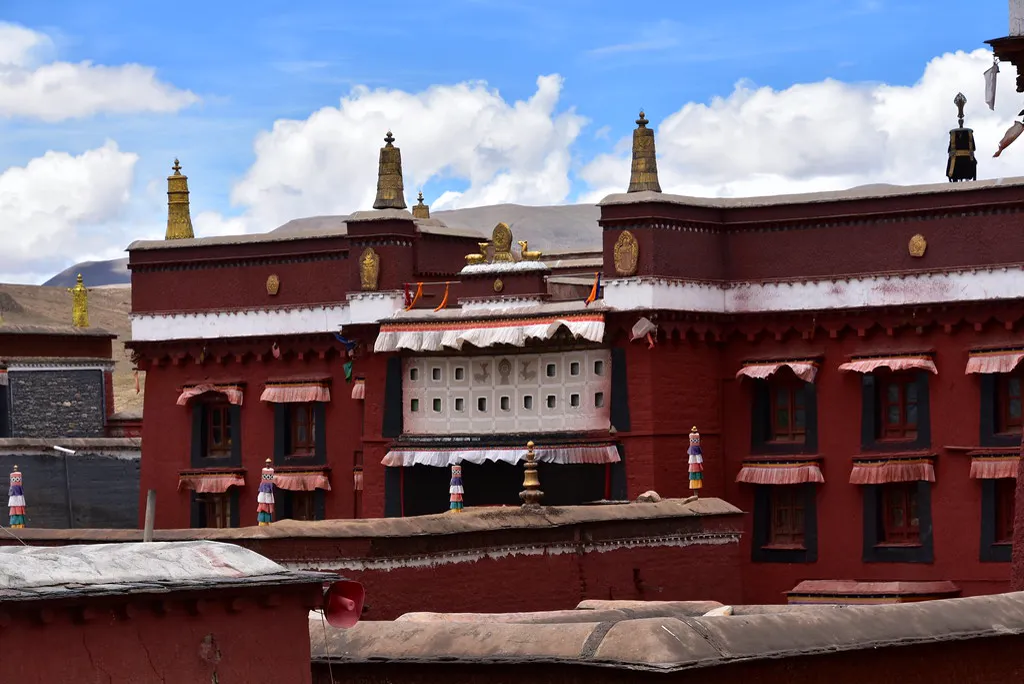 A red-walled hall at Sakya Monastery with gold roof finials and the high plateau behind it. Photo: Richard Mortel · CC BY 2.0
Plan your visit
Getting there
Sa'gya County is about 90 km (straight-line distance) from central Xigazê. Search for 萨迦县 in a map app to find stations and your accommodation.
Where to stay →Build your route
Start with Sakya Monastery. The linked place guides have entrance and visit details.
Continue with Xigazê →More in Xigazê
Sources & geographic information
Administrative names and parent areas: Official geographic directory (dmfw.mca.gov.cn) · Reference date 2026-09-06.
Background text adapted from Sa'gya County — Wikipedia contributors, under CC BY-SA 4.0. Text has been shortened and reorganized; source revision 1353075002.
Map data © OpenStreetMap contributors. Pins mark approximate centres, not entrances or boundaries.
Image credits & notes (1)
- The exterior wall and tower of Sakya's southern monastery complex in Tibet; photograph date unknown. Shown locality: Sakya Monastery (萨迦寺), Sa'gya County (萨迦县).Photo: Hiroki Ogawa · CC BY 3.0Resized for the web; the photo itself has not been edited.
