


Get to know Fenghua District

- Administrative area
- District · 市辖区
- Part of
- Ningbo
- Chinese name
- 奉化区
- Local areas
- District guide
Area & population
- Area
- 1,249.00 km²
Source: English Wikipedia, as of the dates shown.
Fenghua is an administrative district of Ningbo, not one compact old town with a single visitor entrance. Its public-facing experiences are spread across the district: the urban area in the east, the town of Xikou, Tengtou Village, and the mountain visitor system beyond Xikou. The Fenghua government lists Xikou as one of the district’s towns, while the scenic operator gives Xikou–Tengtou its own visitor centre and address.
The reason to make time for Fenghua is the way these places sit together without becoming the same attraction. In Xikou, the Shanxi River, historic streets and Chiang family-era buildings make a walk through the town legible; beyond it, Xuedou Mountain changes the day to waterfalls, forest paths, Xuedou Temple and the mountain transport system. Tengtou is a separate village-based ecological visit rather than an extension of the old town. Treat the names as connected in one district, but plan each entrance and ticket boundary separately.
Food and seasonal life are part of the district’s identity. Look for Fenghua taro and honey peaches when in season, and the crisp, layered Xikou thousand-layer cake as a local baked snack rather than a generic “Ningbo pastry.” A 2015 People’s Daily report describes the cake’s dough as combining wheat flour and taro flour with sugar, salt, oil, sesame and seaweed before the thin layers are folded and cut. Fenghua cloth dragon is another local marker: the national intangible-heritage record describes more than 800 years of history, over forty traditional routines and a fast, tightly coiled style. Performances are event-dependent, so do not assume a daily show.
Planning a visit
There is no district-wide admission ticket. Tickets and reservations belong to the individual scenic products. The current visitor listing for Xikou–Tengtou gives seasonal opening windows, says advance reservation is required, and separates the Xikou historic-area and Xuedou Mountain operating details; its notices also show that sightseeing trains, cableway maintenance and weather closures can affect a particular day. Check the operator’s live notice and confirm how a ticket handles scenic buses or other internal transport before paying. The published concession table is framed around Chinese identity documents and selected local categories; passport holders should confirm the accepted document and booking route directly with the operator rather than infer eligibility from an ID-based discount table.
For the Xikou cluster, use these Chinese destinations in a map or ride-hailing app: 溪口-滕头游客中心北 Xīkǒu–Téngtóu Yóukè Zhōngxīn Běi for the main visitor-centre stop, or 浙江省宁波市奉化区溪口镇武岭东路39号 for the scenic operator’s listed address. Once in Xikou, the visitor guidance describes green tourist buses linking the Xikou bus station, Wuling Gate and the visitor centre, with a separate scenic-bus connection into the Xuedou Mountain system.
Getting there and back
- Rail and bus: Arrive at Fenghua Railway Station 奉化站, then take current Ningbo Bus 230 towards 溪口-滕头游客中心北 Xīkǒu–Téngtóu Yóukè Zhōngxīn Běi. The published route lists the station and visitor-centre stop in both directions, so keep the reverse destination 奉化火车站 Fènghuà Huǒchēzhàn for the return. This is the most useful public-transport chain for a Xikou visit; it is not a train arriving at the mountain entrance.
- Metro: Ningbo Metro Line 3 runs south to Jinhai Road 金海路, in Fenghua’s urban area. Take the train in the 金海路 Jinhai Road direction if that is your destination, then continue by road transport; the metro does not take you directly to Xikou or Xuedou Mountain. The operator’s own passenger-service site confirms Line 3 as an operating line, while the line description identifies Jinhai Road as its Fenghua terminus.
- Taxi or ride-hailing: Use the Chinese visitor-centre name or the operator’s full Wuling East Road address above. Do not enter only “Fenghua District”: that describes the administrative area, not the correct entrance. For a return, book back to 奉化火车站 Fènghuà Huǒchēzhàn or 奉化市区 Fènghuà shìqū only after checking the last local bus or railway connection.
Fenghua works best as a full-day or overnight district visit. Keep the historic Xikou walk, Tengtou’s village landscape and the Xuedou Mountain day as clearly labelled parts of the same wider district, rather than promising that one ticket or one short walk covers all three.
Explore Fenghua District
Core places to explore, with English and Chinese names.
Places to explore around Fenghua District
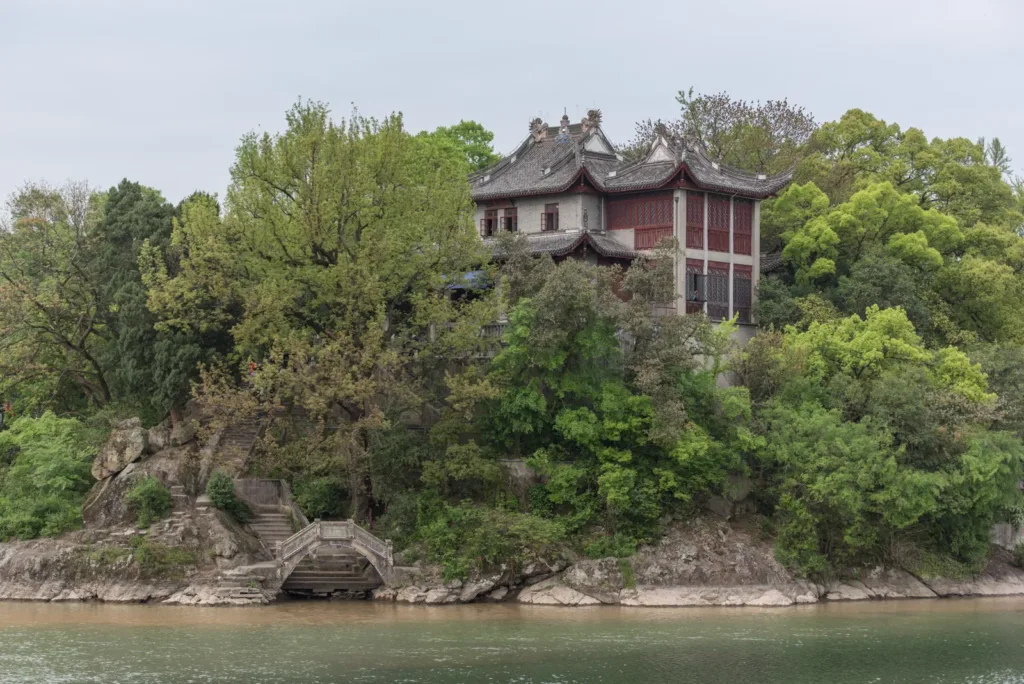 Wenchang Pavilion beside the water in Xikou, Fenghua, Ningbo. Photo: Siyuwj · CC BY-SA 4.0
Xikou–Tengtou Tourism Area溪口滕头旅游景区
Xikou–Tengtou is a large, two-part scenic destination in Fenghua District: Xikou combines a historic town and Xuedou Mountain, while Tengtou is a separate village-based ecological area. It is worth visiting for the contrast between Republican-era heritage, waterfalls and temple landscapes, and a more managed rural setting—but it is not a single walkable attraction.
Read the place guide →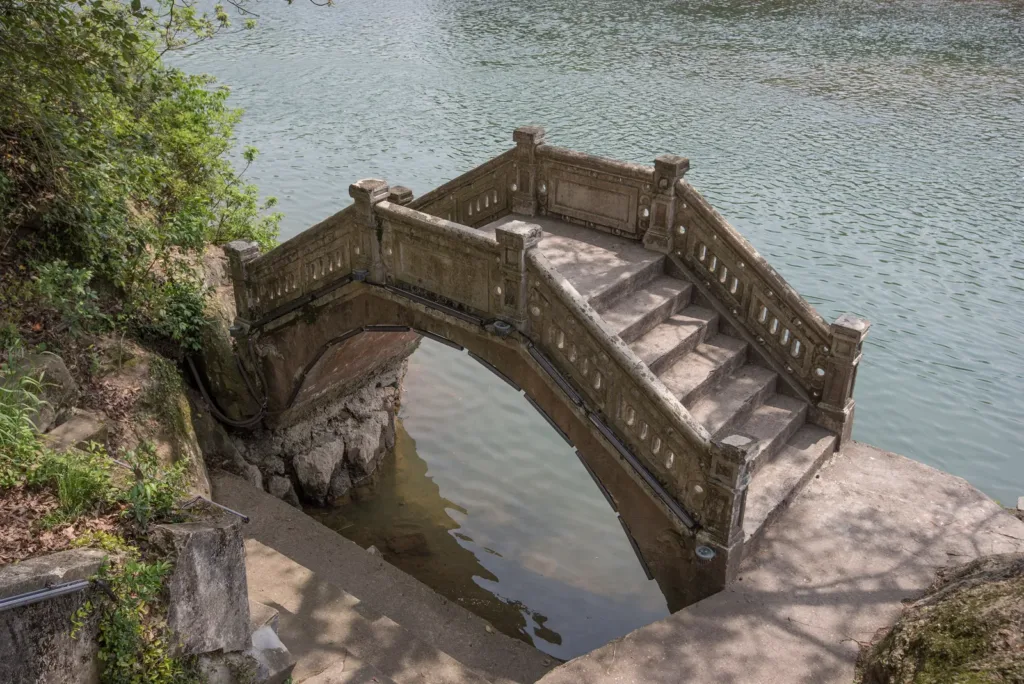 The waterside bridge at Wenchang Pavilion in Xikou, part of the distributed Chiang Family Hometown heritage cluster. Photo: Siyuwj · CC BY-SA 4.0
Xikou Chiang Family Hometown溪口蒋氏故里
Xikou Chiang Family Hometown is a walkable group of eight historic buildings and sites in Xikou’s old town, rather than one isolated former residence. Its most legible sequence runs from Wuling Gate and the stream-side Wenchang Pavilion and Small Western-style House to Fenggao House and Yutai Salt Shop. The cluster is valuable because it lets you compare Qing-period fabric, 1929 expansion, a 1930 Western-style house, and a 1946 rebuilding within a lived riverside town.
Read the place guide →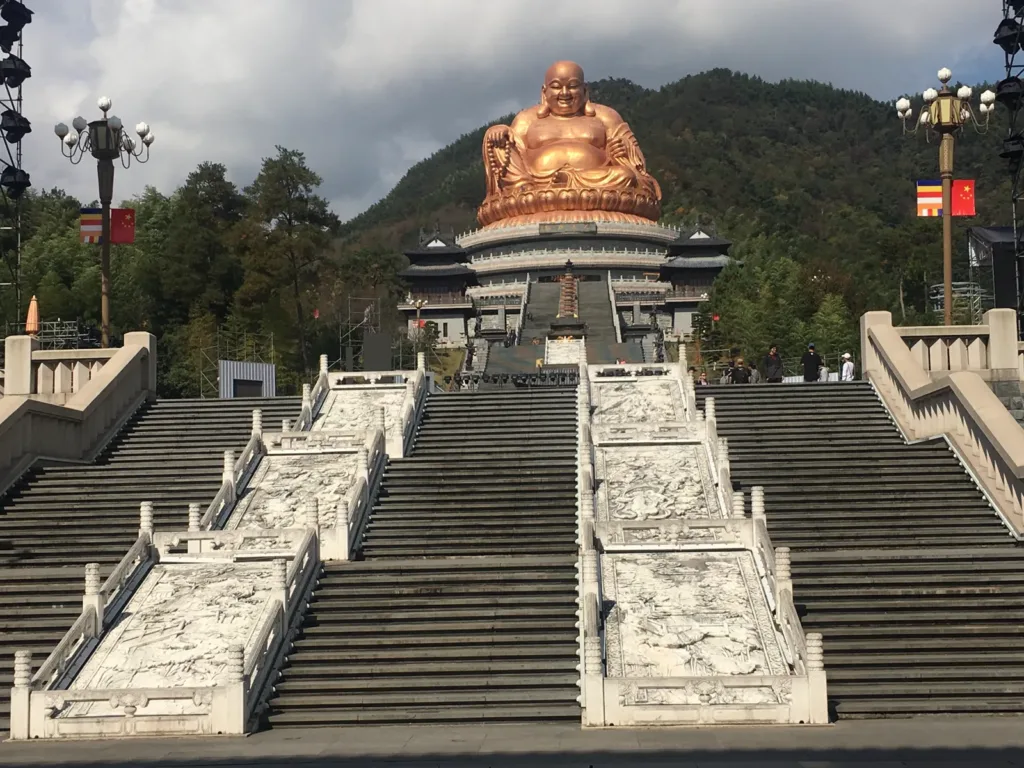 The Giant Buddha at Xuedou Temple in Xikou, Fenghua District, Ningbo, photographed in November 2018. Photo: Szalai.laci · CC BY-SA 4.0
Xuedou Mountain雪窦山
Xuedou Mountain is a large mountain scenic area in Xikou Town, Fenghua District, where waterfalls, steep viewpoints and Xuedou Temple’s Maitreya tradition share one visit. Its unusual character is the combination of the Qianzhangyan and Xufuyan falls, the three pools of Sanyintan, Miaogao Terrace and a major Buddhist site linked to Fenghua’s Budai (布袋) tradition.
Read the place guide →Plan your visit
Getting there
Fenghua District is about 30 km (straight-line distance) from central Ningbo. Search for 奉化区 in a map app to find stations and your accommodation.
Where to stay →Build your route
Xikou–Tengtou Tourism Area and Xikou Chiang Family Hometown are about 2 km apart (straight-line distance). The linked place guides have entrance and visit details.
Continue with Ningbo →More in Ningbo
Sources & geographic information
Administrative names and parent areas: Official geographic directory (dmfw.mca.gov.cn) · Reference date 2026-09-06.
Background text adapted from Fenghua, Ningbo — Wikipedia contributors, under CC BY-SA 4.0. Text has been shortened and reorganized; source revision 1336875805.
Map data © OpenStreetMap contributors. Pins mark approximate centres, not entrances or boundaries.
