


Get to know Zhenhai District
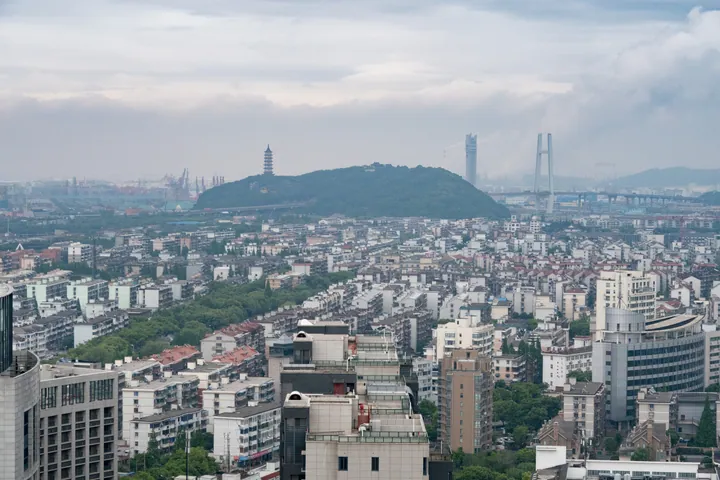
- Administrative area
- District · 市辖区
- Part of
- Ningbo
- Chinese name
- 镇海区
- Local areas
- District guide
Area & population
- Area
- 237.06 km²
- Population · 2020
- 510,500
Source: English Wikipedia, as of the dates shown.
Why visit
Zhenhai District sits at the mouth of the Yongjiang River, facing the Hangzhou Bay and the Zhoushan Archipelago. Its most rewarding visitor area is not a single pedestrian centre but the historic waterfront and the Zhaobao Mountain area, where the river, sea approach, port activity and coastal defence history meet.
Zhaobao Mountain is the district’s clearest starting point. The paid scenic area combines a hill walk with a sequence of things to look at rather than one isolated monument: the “First Mountain” stele marks the old path, Weiyuan Fort crowns the hill, and Aozhu Pagoda, Buddhist buildings and old inscriptions add religious and literary layers. At the foot and along the surrounding route, Anyuan Battery and other defence remains make the estuary’s military position legible; from higher ground, the view is part of the experience, not just a backdrop.
The old riverfront offers a different pace. Zhenhai Ferry Landing retains its older dock form, and a 2025 report describes its former waiting hall being reused as the Zhenhai Memory café within a renewed streetscape. Walk this area for the contrast between a working river edge, small food and retail spaces, and the historic line toward Weiyuan Fort and Anyuan Battery. The redevelopment report does not establish a current passenger-ferry timetable, so treat the landing as a riverside stop unless you have checked a current operator notice.
Zhenhai’s maritime identity also has a documentary side. A district-government report describes a Ming-period county notice addressed to the Japanese envoy Sakugen Shūryō, concerning the envoy’s request to enter the port; the document is held in Japan’s Imperial Household Archives collection. It is a useful reminder that the forts and river mouth were part of regulated overseas contact, not only a scenic setting.
Planning the visit
The practical anchor for a first visit is Zhaobao Mountain Scenic Area (招宝山旅游风景区), at No. 10 Zhaobaoshan Road, Zhenhai District, Ningbo. The scenic area is ticketed: the operator lists a standard ticket of CNY 60 and a concession ticket of CNY 30. Opening hours are 05:00–16:30 from May to September and 05:30–16:00 from October to April; Aozhu Pagoda has separate hours. The operator says all visitors, including concession visitors and companions, must make a real-name reservation. Non-mainland visitors may book and pass the gate with a passport, and must bring the original document used for the booking to the main entrance. Use the official “招宝山” mini-program or the operator’s current notice rather than an unverified ticket reseller.
China Air Defence Expo Park is listed separately by the operator, with separate opening hours and notices; do not assume it is included in the standard mountain visit or open whenever the mountain is open. Weather, maintenance and exhibition arrangements can change access, so check the operator’s live announcement before setting out.
For public transport, take Ningbo Rail Transit Line 2 to Zhaobaoshan Station (招宝山站). The station is at the Chenghe West Road–Shengli Road junction and has A, B and D exits; because the station has no internal cross-passage, use the exit that matches your side of the road rather than following an invented exit instruction. From the station, continue locally to the named scenic-area entrance. The operator also lists buses 27, 341, 351, 372, 373, 374, 375, 376, 385, 387, 392, 396, 541, 778 and 827 to Zhaobaoshan (招宝山) bus stop.
If you arrive by intercity train at Ningbo Railway Station (宁波站), Line 2 provides the onward connection toward Honglian (红联) and Zhaobaoshan Station; for the return, reverse the connection and follow the platform’s current destination display. A taxi or ride-hail driver should be given “招宝山旅游风景区,浙江省宁波市镇海区招宝山路10号”. Return by the same metro or bus connection, or by taxi; do not count on the old ferry crossing without a current service confirmation.
Guide sources
- Zhenhai district — Information Office of Ningbo Municipal People's Government
- 招宝山 — Ningbo Zhenhai Zhaobao Mountain Scenic Area Development Management Co., Ltd.
- 威远城 — Ningbo Zhenhai Zhaobao Mountain Scenic Area Development Management Co., Ltd.
- 票价及优惠政策 — Ningbo Zhenhai Zhaobao Mountain Scenic Area Development Management Co., Ltd.
- 浙江宁波镇海区政协助力老城复兴 — Zhejiang CPPCC
- 我区研究人员发现一明代公文 — Zhenhai District Government
- 交通指引 — Ningbo Zhenhai Zhaobao Mountain Scenic Area Development Management Co., Ltd.
- 宁波轨道交通2号线二期后通段12月1日开通运营 — Zhejiang Online
- 国家4A级旅游景区:镇海招宝山旅游风景区游览全攻略 — Ningbo Tourism
Explore Zhenhai District
Core places to explore, with English and Chinese names.
Zhenhai District 镇海区
Plan your visit
Getting there
Zhenhai District is about 15 km (straight-line distance) from central Ningbo. Search for 镇海区 in a map app to find stations and your accommodation.
Where to stay →More in Ningbo
Sources & geographic information
Administrative names and parent areas: Official geographic directory (dmfw.mca.gov.cn) · Reference date 2026-09-06.
Background text adapted from Zhenhai, Ningbo — Wikipedia contributors, under CC BY-SA 4.0. Text has been shortened and reorganized; source revision 1305851194.
Map data © OpenStreetMap contributors. Pins mark approximate centres, not entrances or boundaries.
Image credits & notes (1)
- Aerial view over the urban core of Zhenhai District · 镇海城区鸟瞰Photo: Siyuwj · CC BY-SA 4.0 · taken 2015-05-09Resized for the web; the photo itself has not been edited. Thumbnails may show a cropped view.
