

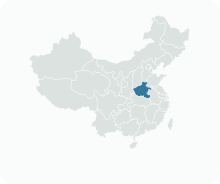
Get to know Fengquan District
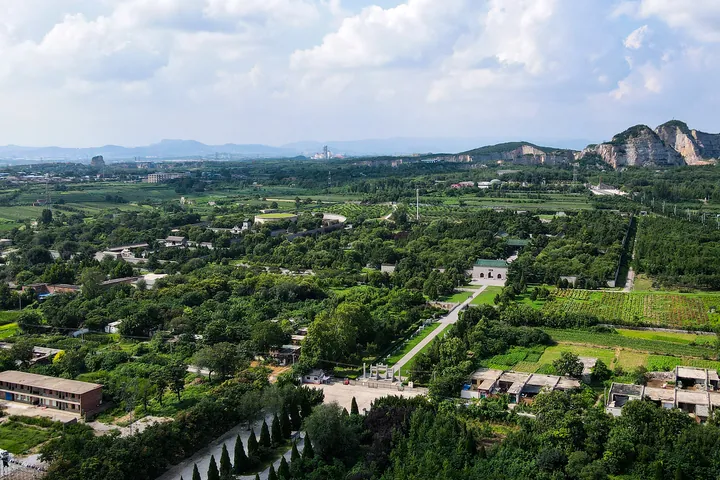
Photo adjustments
Full frame retained; proportionally resized and converted to WebP. No retouching or changes to the photographed subject. Card displays may crop the view.
- Administrative area
- District · 市辖区
- Part of
- Xinxiang
- Chinese name
- 凤泉区
- Local areas
- District guide
Area & population
- Area in the source
- 115.00 km²
- Population · 2019
- 158,400
Source: cited geographic source, as of the dates shown.
Setting and landscape
The district is roughly square and slopes from north to south: low hills reach down from the north in a tongue-shaped strip, while the south is flat and tilts gently to the south-east. Heights range from 68.9 to 292.7 metres. Weihui lies to the north-east, Huixian to the north-west and Xinxiang County to the west. The name joins "feng" from Fenghuang Mountain and "quan" from Yugong Spring (愚公泉).
History
In 1969 Luwangfen (潞王坟) station, whose name means "Prince Lu's grave", was renamed Xinxiang North, and the local commune took the station's name. A Beizhan ("North Station") District was created in 1982 and renamed Fengquan on 1 January 2004, when Dakuai town (大块镇) was also transferred in from Xinxiang County. Remains of the Longshan culture at Lubao (鲁堡) and the Yangshao culture at Hetun (何屯) lie within its boundaries, as does a site linked to the Battle of Muye (牧野大战).
What to see
The Tomb of Prince Jian of Lu (潞简王墓), also known as Lu Wang Ling (潞王陵), sits on the southern slope of Fenghuang Mountain at Fenshang village (坟上村). It holds Zhu Yiliu (朱翊镠), Prince Jian of Lu, and, in a separate western precinct, his secondary consort Zhao. Built in the Wanli period in imitation of the Wanli Emperor's Dingling tomb in Beijing, it has a spirit way, groups of stone figures, a three-arched bridge, gate towers, a sacrificial hall, a stele tower and a mound enclosure, inside an outer wall of bluestone 324 metres long. Chinese Wikipedia describes it as the best-preserved and largest Ming prince's tomb in China. In 1656 a monk named Zhenxi (真息) bought the site for 480 taels of silver and turned the prince's tomb into a Buddhist hall and the consort's into a nunnery; from 1953 to 2005 the consort's tomb served as a prison. It became a Henan provincial protected site in 1986 and a national key protected site in 1996, and it is a national 4A scenic area.
Highlights
- Tomb of Prince Jian of Lu 潞简王墓: Wanli-period tomb modelled on the Dingling; national key protected site since 1996.
- Fenghuang Mountain 凤凰山: Taihang spur that gives the district the "feng" in its name; the Lu tomb is on its southern slope.
- Yugong Spring 愚公泉: Spring that supplies the second half of the district's name.
Sources for this guide
地理概况 - 凤泉区人民政府官网 · Fengquan District People's Government
历史沿革 - 凤泉区人民政府官网 · Fengquan District People's Government
潞简王墓 - 维基百科 · Wikipedia (Chinese) · CC BY-SA 4.0
凤泉区 - 维基百科 · Wikipedia (Chinese) · CC BY-SA 4.0
Original English written from the listed sources and checked sentence by sentence against quoted extracts by a separate reviewer. Updated 2026-09-24.
Explore Fengquan District
Core places to explore, with English and Chinese names.
Places to explore around Fengquan District
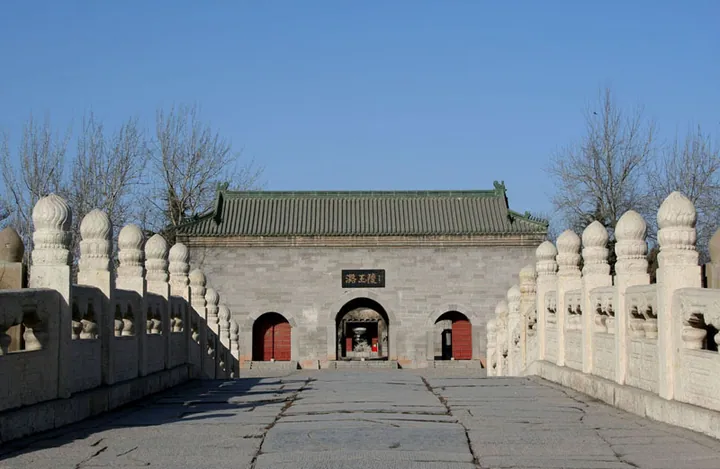 The gate hall of the Mausoleum of Prince Jian of Lu (Mausoleum of Prince Lu), Fengquan District, Xinxiang ·
 Plan your visit
Getting there
Fengquan District is about 10 km in a straight line from central Xinxiang. Search for 凤泉区 in a map app to find stations and your accommodation.
Where to stay →Build your route
Start with Mausoleum of Prince Lu. The linked place guides have entrance and visit details.
Continue with Xinxiang →More in Xinxiang
Sources & geographic information
Administrative names and parent areas: Official geographic directory · Reference date 2026-09-06.
Some facts checked against 潞简王墓 — Wikipedia contributors, CC BY-SA 4.0.
Some facts checked against 凤泉区 — Wikipedia contributors, CC BY-SA 4.0.
Photo: Mausoleum of Prince Lu · 新乡日报-李宝忠 · CC BY 3.0. Full frame retained; proportionally resized and converted to WebP. No retouching or changes to the photographed subject. Card displays may crop the view.

Map data © OpenStreetMap contributors. Pins mark approximate centres, not entrances or boundaries.