

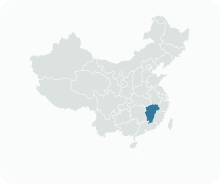
Get to know Yugan County
- Administrative area
- County · 县
- Part of
- Shangrao
- Chinese name
- 余干县
- Local areas
- County guide
Area & population
- Area
- 2,336.00 km²
- Population · 2018
- 1,090,000
Source: English Wikipedia, as of the dates shown.
Yugan is best understood as a county of water and working landscapes, not as a compact old town. The Xin River runs through the county, while Poyang Lake brings broad embankments, reeds and exposed shallows whose appearance changes with the season. A 2018 account of the Kangshan embankment describes wide lake views and reed beds in the dry season, with only reed tops visible when the water is higher.
The county town makes a useful first orientation, but it is not a substitute for the rest of Yugan. Pipa Lake curves around Dongshan Ridge, and a short walk near the lake and Ganyue Pavilion gives you a feel for the town’s relationship with water. The scene is most rewarding as a slow morning or evening walk: look for the changing line between streets, low hills and water rather than expecting a single monumental viewpoint.
Beyond town, distances become part of the experience. Kangshan is reached as a lakeside and embankment landscape, with the historic Zhongchen Temple at Kanglang Mountain adding a human layer to the Poyang Lake story. A contemporary account links the site to Zhu Yuanzhang’s campaign against Chen Youliang and to the temple built afterward for the fallen commanders. Baihezhou, in the Kangshan reclamation area, is a different kind of place: a winter wetland where the attraction is watching birds feed and move across open fields, not walking through a built scenic park.
Winter is the clearest season for this wider landscape. Reporting from Baihezhou describes more than ten standard birding platforms, three routes and trained bird guides, while an earlier report records an observation gallery at Chiqizhou and sightings of white cranes, swans, grey cranes and geese. Use platforms and managed viewing lines, keep away from fields and wetland edges, and do not treat a particular species or large flock as guaranteed on every visit.
Yugan’s agricultural character is visible alongside the water. Xinhua photographed pepper harvests in greenhouses at Yanhe Village and identifies Yugan chilli as a Chinese geographical-indication product. A grower quoted by China National Radio described the local pepper as thin-skinned and “辣嘴不辣心”—hot on the lips but not harsh in the mouth. Look for the Chinese name 余干辣椒 Yúgān Làjiāo when asking about local produce; it is a county-linked ingredient, not a claim that every pepper dish is unique to Yugan.
Getting around a spread-out county
The practical rail arrival is 余干站 (Yugan Railway Station). China National Radio reported that the Hangchang high-speed railway’s Huangshan–Nanchang section opened at the end of 2023, bringing Yugan into the high-speed network and putting the new station into use. The station is a county gateway, not an entrance to every lake, village or temple. From there, keep the exact Chinese destination—琵琶湖 Pípá Hú, 康山忠臣庙 Kāngshān Zhōngchén Miào or 白鹤洲 Báihè Zhōu—ready for a road transfer and confirm the return plan before setting out.
An operator notice records a dedicated winter birding service from Yugan Railway Station to Baihezhou for December 2025 to March 2026. That dated notice does not establish a 2026–27 service, timetable, fare or return frequency, so verify the current winter arrangement before relying on it. For Kangshan and smaller rural sites, plan a road journey rather than assuming that the birding shuttle or a local boat continues to the next destination. There is no useful metro segment for this county-scale visit, and no current county bus or water route is stated here as a guaranteed visitor connection.
Explore Yugan County
Core places to explore, with English and Chinese names.
Yugan County 余干县
Plan your visit
Getting there
Yugan County is about 125 km (straight-line distance) from central Shangrao. Search for 余干县 in a map app to find stations and your accommodation.
Where to stay →More in Shangrao
Sources & geographic information
Administrative names and parent areas: Official geographic directory (dmfw.mca.gov.cn) · Reference date 2026-09-06.
Sources and licences for the original area background:
Transport
Chinese Wikipedia: 余干县 (revision 90828456, 2025-12-25)
Adapted from Wikipedia contributors, "余干县", Chinese Wikipedia · CC BY-SA 4.0. Translated into English and condensed from the cited revision; figures and dates as stated there. Not independently verified.
Background text adapted from Yugan County — Wikipedia contributors, under CC BY-SA 4.0. Text has been shortened and reorganized; source revision 1336928661.
Map data © OpenStreetMap contributors. Pins mark approximate centres, not entrances or boundaries.
Image credits & notes (1)
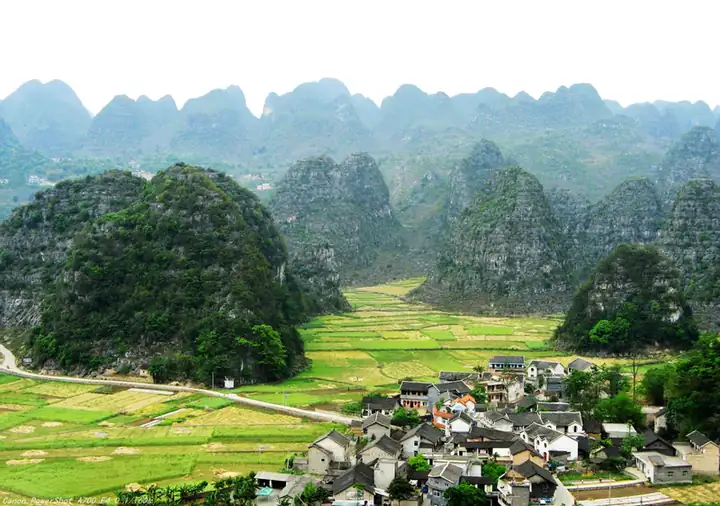
- Representative view in Yugan County · 余干县代表景观。余干县乡村山地代表景观Photo: zh.wikipedia.orgResized for the web; the photo itself has not been edited.