

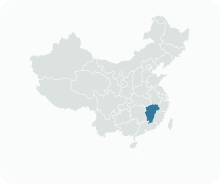
Get to know Yiyang County

- Administrative area
- County · 县
- Part of
- Shangrao
- Chinese name
- 弋阳县
- Local areas
- County guide
Area & population
- Area
- 1,580.00 km²
- Population · 2019
- 428,000
Source: English Wikipedia, as of the dates shown.
Yiyang is best understood as a county with several different travel scales. The county-town area sits in the middle reaches of the Xin River and carries the older cultural layer: Dieshan Academy is associated with the Song-dynasty poet Xie Fangde, while the county is also the place named in the national listing for Yiyang opera (弋阳腔). The southern side of the county is a different experience, shaped by the red-rock peaks and water of Guifeng. The contrast matters: a visit here is not a walk between attractions in one compact centre, but a sequence of county-town and countryside spaces.
Yiyang opera is worth approaching as a living theatrical tradition, not as a decorative label. The voice grew in Yiyang from the meeting of southern drama with local speech, music and custom, and the State Council’s first national intangible-cultural-heritage list records 弋阳腔 under Jiangxi’s Yiyang County. A local cultural report describes old stages in villages and the county’s efforts to take performances into rural areas, but it does not establish a daily public show. If you want to hear it, ask the current cultural venue or event organiser about that day’s programme; do not assume that a village stage or a festival photograph means a performance will be running when you arrive.
Guifeng and the county’s red-rock landscape
Guifeng is the county’s main geological anchor. Its Danxia formations repeat turtle-like outlines across peaks, cliffs and stone shapes; it is part of the China Danxia World Natural Heritage property and is presented in current reporting as a national 5A scenic area. Walk slowly enough to compare the silhouettes rather than photographing only the first viewpoint. Cliff inscriptions, narrow passages, wooded paths and the changing relationship between rock and water give the place more depth than a quick “red mountains” stop. The best route depends on weather, daylight and which paths or add-on activities are operating.
Recent reporting shows that Guifeng is adding water activities, a double-decker tourism bus, a night route and other resort-style projects alongside the daytime mountain visit. These are operational products, not permanent features of the landscape: the same report describes a summer water programme and a night experience, so check the current date, ticket combination, last admission and return transport before paying for an add-on. No current source read for this guide establishes a single year-round price or a passport-specific reservation rule.
The county-town side is useful before or after the mountain. Dieshan Academy and the stories of Xie Fangde and Fang Zhimin provide a literary and revolutionary counterpoint to Guifeng’s geology. Treat these as separate stops, not as facilities inside the Guifeng ticketed area. If you continue into smaller villages or to a historic stage, go to observe respectfully: residents are living in these places, not performing on demand, and photography should not turn private life into a tourist display.
Eating Yiyang
The clearest food marker is Yiyang rice cake, also called Yiyang Dahe rice cake (弋阳大禾米粿). Reports from Xinhua and CCTV identify Dahe rice as the base and describe the characteristic “three steamings and two hundred poundings” process: steamed rice is repeatedly pounded until the cake becomes pale, supple and smooth rather than crumbly. The product is protected as a Chinese geographical-indication product, but that status does not mean every shop uses the same recipe or serves it in the same form.
At a market or meal, look for the plain steamed cake first, then compare sliced or shaped versions. Local reporting also describes pan-fried, stir-fried and other preparations; heat and oil put a browned surface around the soft, chewy centre, while steaming keeps the rice aroma and pliability most obvious. The same name may refer to a packaged product, a festival demonstration or a cooked dish, so ask whether it is ready to eat and whether the day’s supply is fresh. Rice-based does not by itself guarantee a dish is vegetarian, allergen-free or free of added cooking wine.
Search for “弋阳年糕” on Meituan (美团) or Amap / Gaode Maps (高德地图) to find nearby places serving this dish. Check menus, recent reviews, opening information and today’s availability before choosing.
Planning the county journey
A practical first visit is one full day for Guifeng with a separate county-town stop, or two days if you want to slow down, eat locally and leave room for a cultural venue or a rural detour. Do not use the county centre as a single “entrance” to every attraction. Guifeng is a distinct scenic-area visit, while the riverfront, academy, memorial sites and outlying villages require their own road connections.
There is no useful metro network for this county trip. The dependable long-distance anchor is Yiyang Station (弋阳站), which handles passenger services on the Shanghai–Kunming high-speed railway and the older Shanghai–Kunming railway. Use China Railway 12306 for the train you actually need and for the return ticket, because service patterns and stopping trains change. From the station, arrange a taxi or a currently operating scenic-area connection rather than assuming that a city bus will cover the whole county.
A recent report says Guifeng has connected with high-speed-rail hubs, introduced a double-decker tourism bus and offered a direct bus service from Shangrao high-speed station to Guifeng. It does not publish a stable route number, timetable or a clear statement that every departure starts at Yiyang Station. Treat that as useful current evidence of a connection, not as a promise of a particular departure. Before leaving the station, confirm the day’s departure point, last return and whether the bus is an event or seasonal service.
For a taxi, give the Chinese destination 弋阳龟峰景区游客中心 Yìyáng Guīfēng Jǐngqū Yóukè Zhōngxīn and ask to be taken to the current official visitor-centre entrance, not to an unnamed trailhead. Amap’s live listing places the scenic area along 龟峰大道 Guīfēng Dàdào, inside Yiyang Guifeng Scenic Area; the listing is useful for copying the Chinese place name but should still be checked against the operator’s current entrance information. Keep the Chinese name saved for the return journey. For county-town and rural stops, book or negotiate each road leg separately; do not assume that a Guifeng transfer also serves Dieshan Academy or a village stage.
Before setting out, verify scenic-area opening, admission, any separate boat, shuttle, water-world or night-tour charge, and the final return connection. The sources used here do not establish current foreign-passport booking or entry rules, so an international visitor should confirm those specific requirements with the venue or ticket channel rather than infer them from domestic ID instructions. Mountain paths, cliff edges and water activities also need ordinary site signage and weather judgement; stay on open, managed routes.
Explore Yiyang County
Core places to explore, with English and Chinese names.
Places to explore around Yiyang County
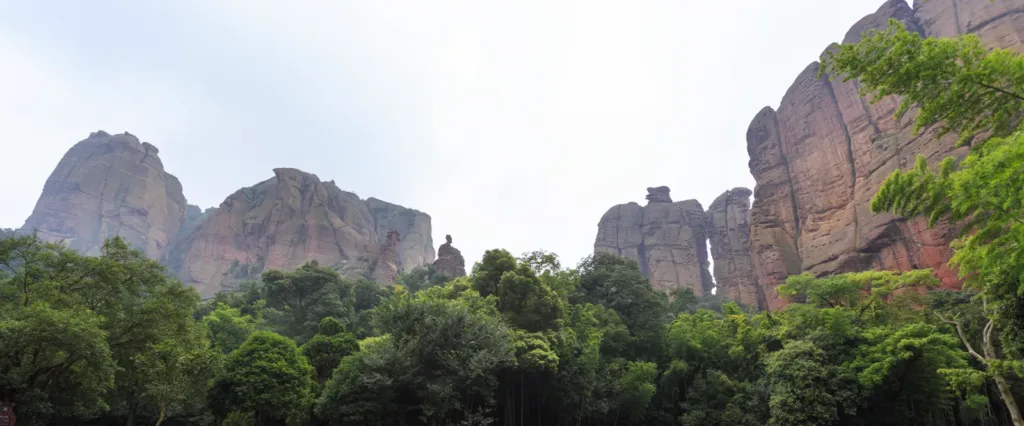 Danxia rock walls and pillars rising above the forest at Guifeng Scenic Area, Yiyang County, Jiangxi. Photo: Zhangzhugang · CC BY-SA 4.0
Plan your visit
Getting there
Yiyang County is about 50 km (straight-line distance) from central Shangrao. Search for 弋阳县 in a map app to find stations and your accommodation.
Where to stay →Build your route
Start with Guifeng. The linked place guides have entrance and visit details.
Continue with Shangrao →More in Shangrao
Sources & geographic information
Administrative names and parent areas: Official geographic directory (dmfw.mca.gov.cn) · Reference date 2026-09-06.
Background text adapted from Yiyang County, Jiangxi — Wikipedia contributors, under CC BY-SA 4.0. Text has been shortened and reorganized; source revision 1331073054.
Map data © OpenStreetMap contributors. Pins mark approximate centres, not entrances or boundaries.
Image credits & notes (1)
- Cliff inscriptions beside the path at Guifeng in Yiyang, Jiangxi, July 2015. Shown locality: Guifeng (龟峰), Yiyang County (弋阳县).Photo: Zhangzhugang · CC BY-SA 4.0Resized for the web; the photo itself has not been edited.
