

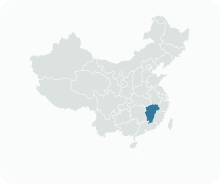
Get to know Yushan County

- Administrative area
- County · 县
- Part of
- Shangrao
- Chinese name
- 玉山县
- Local areas
- County guide
Area & population
- Area
- 1,728.00 km²
- Population · 2018
- 594,800
- Administrative seat
- Bingxi town
Source: English Wikipedia, as of the dates shown.
Yushan is not a single compact attraction. The county lies in the middle of the Zhejiang–Jiangxi corridor, where the Huaiyu Mountains meet the outlying ranges of the Wuyi Mountains. Its official geography divides the landscape into north-western mid- and low mountains, south-eastern low hills, and a central belt of hills, river valleys and plains. The county seat is in Bingxi Subdistrict, while the county’s best-known mountain landscape is far to the north-west.
That spread gives Yushan a different rhythm from a city sightseeing stop. A short urban visit can focus on the examination hall and the river-valley county seat. A second outing can reach Guanxi in Xianyan Town for clan architecture. Sanqing Mountain and the Huaiyu Mountain area need their own road day, with weather and trail conditions checked before departure. The county government places Sanqing Mountain about 50 km from the county seat and describes Huaiyu Mountain as adjoining the scenic area.
Bingxi: the county-town cultural core
Use Bingxi as a practical base, not as a claim that the whole county can be explored on foot. The county seat gives the administrative centre a clear starting point, and the central valley helps explain why the county’s cultural sites and everyday services do not all sit beside the mountain entrances.
The most legible historical stop is Yushan Examination Hall (玉山考棚). The Qing complex began in 1792, consists of four buildings, and was designed to accommodate 100 candidates. The county government describes it as the only fully preserved county-level examination venue of its kind and a national key protected cultural site. Look at the repeated examination cells and the axial courtyard layout rather than treating it as a generic old hall: the architecture makes the bureaucracy of the imperial examination system visible at room scale.
The hall is a heritage site, not a promise of a fixed visitor programme. Confirm current opening hours, interpretation, repairs and any reservation or identity requirements before setting out. An attractive historic façade should not be taken as proof that every room is open.
Xianyan and Guanxi: clan architecture in a lived community
Guanxi Hu Clan Hall (官溪胡氏宗祠) stands in Guanxi Community of Xianyan Town, away from the Bingxi centre. It is one of Yushan’s two national key protected sites named by the county government. A 2018 on-site report describes the historical sequence of entrance hall, central hall, rear hall and side wings, with a pond, screen wall, Wenchang Pavilion and bridge in front. Those relationships are more useful to observe than the promotional nickname sometimes attached to the hall: they show how a clan institution arranged ritual, education and movement along one axis.
Guanxi is also a community rather than a theme-park set. Keep the visit to the protected architecture and public paths, ask before photographing people or homes, and do not expect a scheduled daily performance. Check whether the hall is open and whether conservation work affects access on the day.
The north-west mountains: Sanqing and Huaiyu
Sanqing Mountain (三清山) is the county’s large-scale natural counterpoint to its examination and clan buildings. UNESCO describes the World Heritage property as a 22,950-hectare park in the Huaiyu range, with 48 granite peaks and 89 granite pillars, forests, waterfalls, lakes and springs. Its 1,817-metre summit and concentrated granite forms are the reason to walk the managed trails slowly and watch how rock, forest and cloud alter the view, not merely to collect a summit photograph.
The property is managed as a protected mountain landscape. Use the scenic area’s designated visitor facilities and suspended walking trails, and do not substitute an unmarked ridge or a closed path for an entrance. UNESCO notes that visitor access has to be balanced with conservation, while the county overview places the mountain well outside the county-town core.
Huaiyu Mountain (怀玉山) gives the wider northern area a different focus. The county government links it to the Fang Zhimin memorial landscape, including the Qingpin Garden and sites associated with the Red Army’s northward anti-Japanese expedition. This is a place for a quieter historical visit and mountain scenery, not a reason to collapse every north-western site into the Sanqing Mountain ticketed area.
How to plan the county
For a compact first visit, stay in or near Bingxi and reserve time for Yushan Examination Hall. Add Guanxi only as a separate road excursion. Give Sanqing Mountain or Huaiyu Mountain a full additional day; the county’s size and the mountain access roads make a single “county highlights” loop unrealistic. Weather, trail conditions, conservation work and the return connection matter more in the mountains than a nominal distance from the county seat.
There is no useful metro leg for this county-scale itinerary. The practical arrival points are railway stations followed by a road transfer to the county seat or to the specific mountain or village destination. Do not assume that a train station is an entrance to Sanqing Mountain, or that a county-town bus continues to a mountain trailhead without a current timetable.
Rail and road arrival
Yushan South Railway Station (玉山南站) is the county’s high-speed arrival point. A 2024 county government reply records that the station has operated since 10 December 2014 and that its station facilities are open to the public during operating hours. From there, arrange a local road transfer to Bingxi, Guanxi Hu Clan Hall or the designated Sanqing Mountain visitor facility; the station page does not establish a fixed fare, journey time or current shuttle schedule.
Yushan Railway Station (玉山站) is the conventional-rail station listed for the county alongside Yushan South on the Shanghai–Kunming railway and high-speed line. Check the actual train date in 12306 before relying on it, then confirm the onward road connection rather than treating the station as a walkable county-tourism gateway.
For road travel, the county transport overview lists the Shanghai–Kunming Expressway (G60), Dezhou–Shangrao Expressway (G0321) and National Highway 320. In a map app, keep the Chinese destination names 玉山考棚 Yùshān Kǎopéng, 官溪胡氏宗祠 Guānxī Hú Shì Zōngcí and the exact current 三清山景区 Sānqīng Shān Jǐngqū visitor facility supplied by the operator. A return plan is especially important for Guanxi and the mountain areas.
No current local bus route number, terminal relationship or mountain shuttle timetable is stated here without a directly readable operator notice. Recheck the day’s bus and coach information at the station or local transport terminal, and confirm the last return before leaving the county town. Do not use an old seasonal shuttle or an online ranking as proof of present service.
Explore Yushan County
Core places to explore, with English and Chinese names.
Yushan County 玉山县
Plan your visit
Getting there
Yushan County is about 40 km (straight-line distance) from central Shangrao. Search for 玉山县 in a map app to find stations and your accommodation.
Where to stay →More in Shangrao
Sources & geographic information
Administrative names and parent areas: Official geographic directory (dmfw.mca.gov.cn) · Reference date 2026-09-06.
Background text adapted from Yushan County — Wikipedia contributors, under CC BY-SA 4.0. Text has been shortened and reorganized; source revision 1331074366.
Map data © OpenStreetMap contributors. Pins mark approximate centres, not entrances or boundaries.
Image credits & notes (1)
- Riverside promenade along the old city wall of Yushan County · 玉山县城墙及滨河景观带Photo: Zhangzhugang · CC BY-SA 4.0 · taken 2018-01-03Resized for the web; the photo itself has not been edited. Thumbnails may show a cropped view.
