


Get to know Pujiang County
- Administrative area
- County · 县
- Part of
- Chengdu
- Chinese name
- 蒲江县
- Local areas
- County guide
Area & population
- Area
- 580.00 km²
- Population · 2020 census
- 255,563
- Administrative seat
- Heshan Subdistrict
Source: English Wikipedia, as of the dates shown.
A county of separate landscapes
Pujiang is a county administered by Chengdu, adjoining the neighboring prefecture-level areas of Meishan and Ya’an. Its present townships are Heshan and Shou’an subdistricts and Chengjia, Xilai, Datang, Ganxi, Daxing and Chaoyang Lake towns. The administrative centre is Heshan, but the county’s visitor experiences are scattered across these townships; a county name is not a single attraction or entrance.
The county’s identity is strongly agricultural. “Pujiang Que She” is a locally recognized tea product, while citrus and other farm production shape the surrounding countryside. The most rewarding way to understand this landscape is to pair a town or village visit with time outdoors, rather than expect a concentrated chain of urban sights.
Where to go
Heshan, the county seat (鹤山街道), is the practical base for services and onward connections. Its streets, markets and civic centre are useful for seeing everyday county-town life, but the seat is not a substitute for the outlying villages. The county government’s published address, Government Street 31 (政府街31号), is an administrative reference point, not a visitor entrance for the whole county.
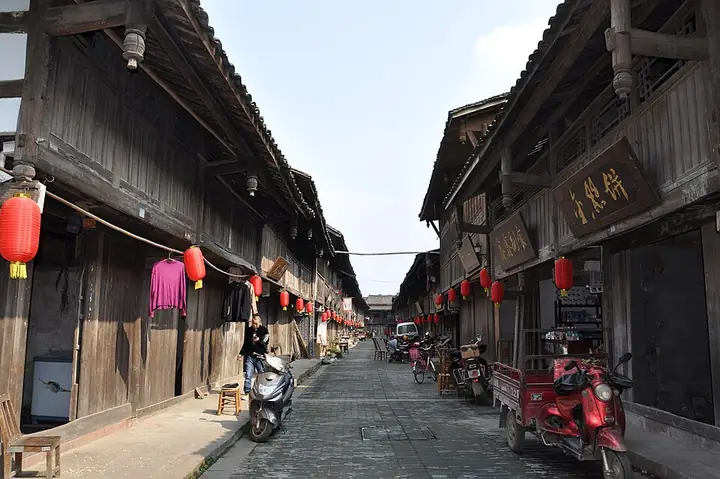
Xilai Ancient Town (西来古镇), in Xilai Town, rewards a slow walk rather than a checklist. Look for the old street’s timber-and-tile vernacular shopfronts, the coloured Wenfeng Pagoda (文峰塔), and the cluster of old banyan trees beside the Linxi River (临溪河). These features place local religious and literacy traditions, trading streets and the river edge in one walkable setting. It remains a lived-in town, not a purpose-built theme street; be considerate around homes and businesses, and do not assume every interior or tower is open to enter.
Mingyue Village (明月村), in Ganxi Town (甘溪镇), is a working rural community with tea groves and bamboo landscapes alongside small creative businesses. A reported village visit can combine a countryside walk with a pottery or plant-dye workshop, a café or reading space; those are separate businesses and activities, not guaranteed daily programming or a single ticketed attraction. Ask each venue about opening, booking and workshop charges before making a special trip.
Chengjia (成佳) and the tea-growing countryside are a different outing: the point is the productive landscape and local tea culture, not a museum-style display. Visit with a farm, tea business or rural venue that is actually open; seasonal agricultural work and visitor activities vary. The county identifies Pujiang Que She as a notable local product, but recipes, processing and tastings vary by producer.
The Chaoyang Lake area (朝阳湖) is a separate lakeside and foothill destination west of the county seat. It is not interchangeable with the Chaoyang Lake railway station, whose train service must be checked independently. Confirm the current condition of the chosen lakeside venue and how to reach its visitor access before setting out; the official county transport notice says some rural-service routes have changed, and the 2025 route notice specifically excluded the scenic-area road section from one service.
Getting there and getting around
There is no Chengdu Metro station within Pujiang County. One useful public-transport connection shown in the published county route notice is bus 950 between Pujiang Passenger Transport Centre (蒲江客运中心站) and Xinping Metro Station (新津新平地铁站); Xinping is on Metro Line 10. This links the county with the urban rail network, but the published bus timetable is dated 1 March 2025 and the county transport bureau reported further route additions and adjustments in June 2026. Recheck the current schedule and stop pattern before relying on it.
The same 2025 notice lists county buses 4/5 between the county-seat area and Ganxi, with a stop named Mingyue Village (明月村站), and route 1 connecting the passenger centre with Chaoyang Lake and Chengjia. These are useful route leads, not a promise of current service: schedules and service patterns may have changed. The notice also records that one rural service did not run along the Chaoyang Lake scenic-area road, so do not assume a bus stop at the attraction entrance.
For intercity rail, use the exact train and operating station shown in China Railway 12306 for your travel date. A September 2024 report said passenger trains were temporarily moved from Pujiang Station (蒲江站) to Chaoyang Lake Station (朝阳湖站) during Pujiang Station’s expansion works, and the county has since publicized rail-project construction. The material available for this check does not establish which stations have passenger service on 21 October 2026; do not travel to either station on the basis of an old timetable or forecast.
A countywide taxi destination does not exist. For the county seat, 蒲江县鹤山街道政府街31号 is a verified street address, but it identifies the county-government office rather than a tourist entrance. For Xilai, Mingyue Village or a lakeside venue, give the driver the exact Chinese place or business name and request its signed public parking or visitor drop-off; do not ask to be left on a highway shoulder or assume an unverified gate. There is no single metro exit or last walk that serves the county’s dispersed sites. Individual attraction ticketing and reservation arrangements are venue-specific, not a countywide pass.
Guide sources
- Pujiang County Government: County Overview
- Sichuan Provincial Local Chronicles Office: Pujiang County Gazetteer
- Xinhua: Pujiang’s Mingyue Village and Rural Tourism
- Sichuan Provincial Local Chronicles Office: Xilai Ancient Town
- Pujiang Transport: Bus and Rural Passenger Routes from 1 March 2025
- Chengdu Airport: Metro Connections and Line 10 to Xinping
- Jiemian: Pujiang Station Renovation and Temporary Train Rerouting
- Pujiang County Government: Transport Bureau Service Update
- Pujiang County Government Office: Office Profile
Explore Pujiang County
Core places to explore, with English and Chinese names.
Places to explore around Pujiang County
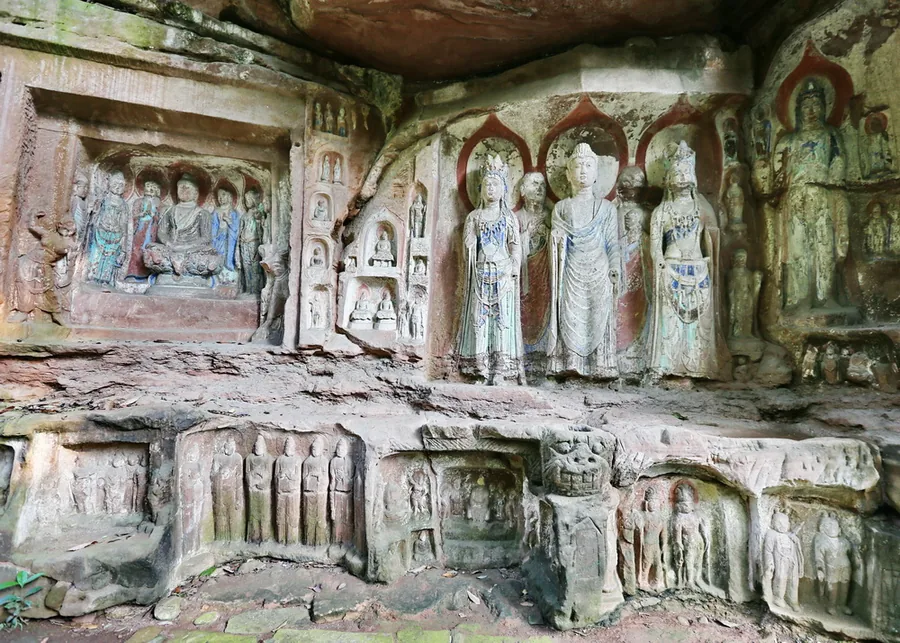 Buddhist rock-carved figures at the Feixiange Grottoes, Pujiang County, Sichuan; 15 August 2015.
Feixiange Grottoes飞仙阁摩崖造像
A riverside group of small Buddhist and Daoist cliff niches in Pujiang County, notable for Tang and Five Dynasties carvings, including imagery and inscriptions from the Wu Zhou era. Access is partial or otherwise not confirmed for every area; check locally before travelling.
Read the place guide → Chengjia Tea Country · 成佳茶乡
Chengjia Tea Country成佳茶乡
In Pujiang County, Chengjia is a working tea-growing landscape where visitors can walk among broad tea fields, learn about Pujiang tea, and seek out rural footpaths including the historic Chenyaoyan Tea-Horse Road. Visit planning centers on the town, tea fields and walking routes rather than assuming one ticketed gate.
Read the place guide →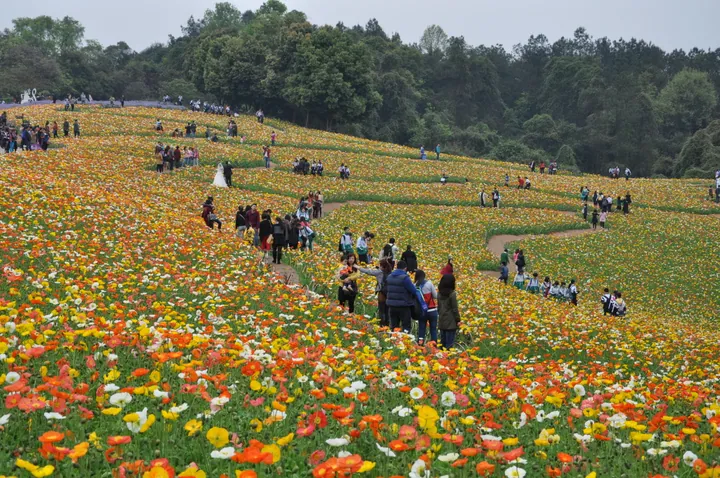 Tulip fields in bloom at Shixiang Lake scenic area, Pujiang County · 蒲江县石象湖景区郁金香花海 Source-recorded photograph date: Taken on 4 April 2014.
Shixiang Lake石象湖
Shixiang Lake in Pujiang County is a former lake-and-flower scenic attraction, but a January 2025 report quoting Pujiang’s culture and tourism bureau said it had been closed since May 2021. A current booking listing still labels it permanently closed; do not plan a visit until reopening and visitor access are confirmed directly.
Read the place guide →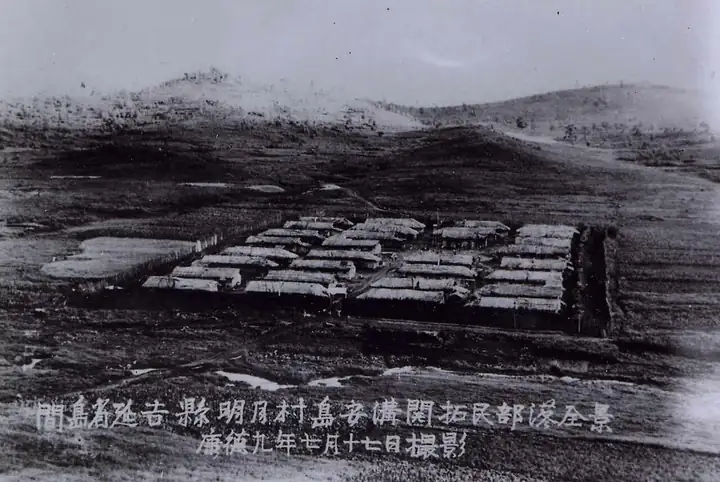 Mingyue Village · 明月村
Mingyue Village明月村
A working village in Pujiang where tea-and-bamboo landscapes meet pottery, plant-dye and other rural creative practices. Walk its public lanes and green paths, then check locally which studios or activities are welcoming visitors that day.
Read the place guide →Plan your visit
Getting there
Pujiang County is about 75 km (straight-line distance) from central Chengdu. Search for 蒲江县 in a map app to find stations and your accommodation.
Where to stay →Build your route
Feixiange Grottoes and Chengjia Tea Country are about 6 km apart (straight-line distance). The linked place guides have entrance and visit details.
Continue with Chengdu →More in Chengdu
Sources & geographic information
Administrative names and parent areas: Official geographic directory (dmfw.mca.gov.cn) · Reference date 2026-09-06.
Background text adapted from Pujiang County, Sichuan — Wikipedia contributors, under CC BY-SA 4.0. Text has been shortened and reorganized; source revision 1365833969.
Photo: Feixiange Grottoes · Nekitarc · CC BY-SA 4.0. Resized for the web; the photo itself has not been edited.

Photo: Chengjia Tea Country · sannong.cntv.cn. Resized for the web; the photo itself has not been edited.
Photo: Shixiang Lake · liuzusai刘祖赛 · CC BY 3.0. Resized for the web; the photo itself has not been edited. Thumbnails may show a cropped view.

Photo: Mingyue Village · Unknown author Unknown author · Public domain. Resized for the web; the photo itself has not been edited.

Map data © OpenStreetMap contributors. Pins mark approximate centres, not entrances or boundaries.
Image credits & notes (1)
- A street in Xilai Ancient Town, Pujiang County, Sichuan. Source-recorded photograph date: Taken on 4 April 2014.Photo: liuzusai刘祖赛 · CC BY 3.0Resized for the web; the photo itself has not been edited. Marks added by the source remain. Thumbnails may show a cropped view.
