

Air Quality in China: Checking AQI and When It Matters
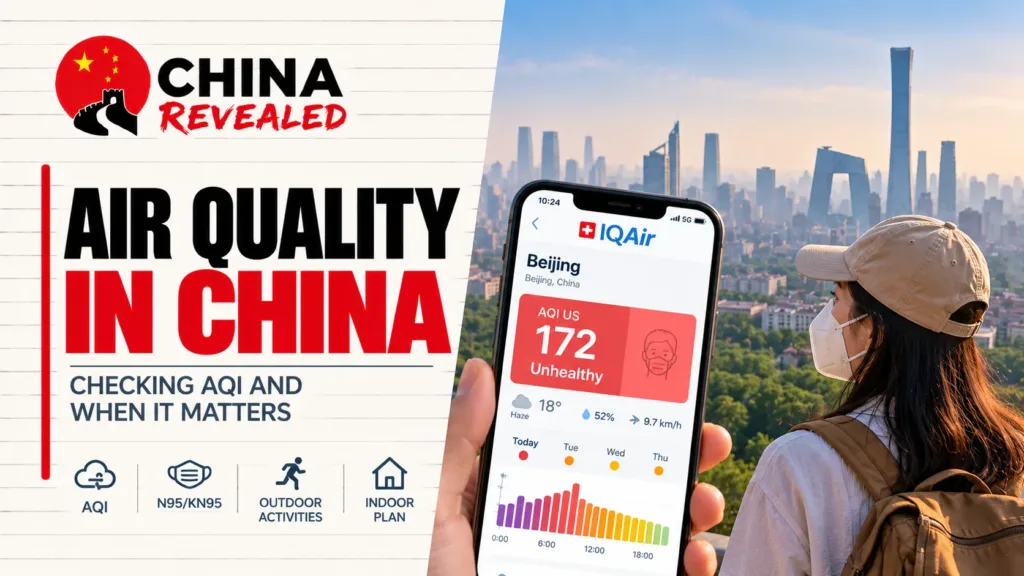
Air quality in China varies by city, season and hour. Most days in most tourist cities are fine for sightseeing, but northern cities can have bad-air days in winter. Check the local AQI (Air Quality Index) on IQAir before a long walk, hike or run, and use the table below to decide whether to change your plans.
Tap any red Chinese text to hear it in Mandarin.
Quick takeaways
- Worst time: the winter heating season (roughly November to March) in northern cities such as Beijing, Xi’an and Harbin. Spring can bring dust storms to the north.
- How to check: IQAir or WAQI, set to US AQI, for your city and the latest update time.
- When to act: above 150, cut back long or strenuous outdoor activity. Above 100, children, older travellers and people with asthma should take it easier.
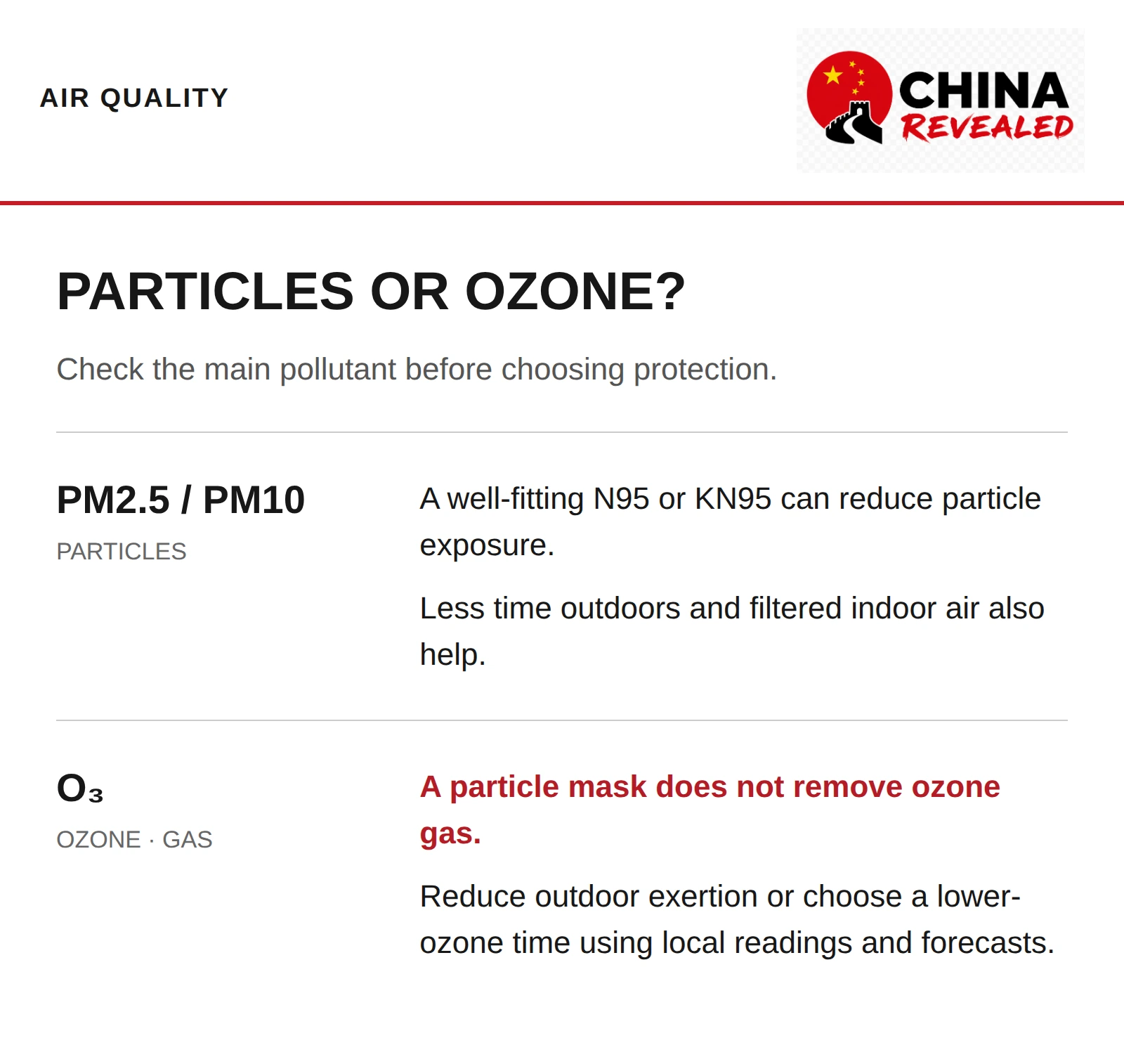
- Masks: a well-fitting N95 or KN95 helps with particle pollution, but not ozone.
When and where air quality is worst
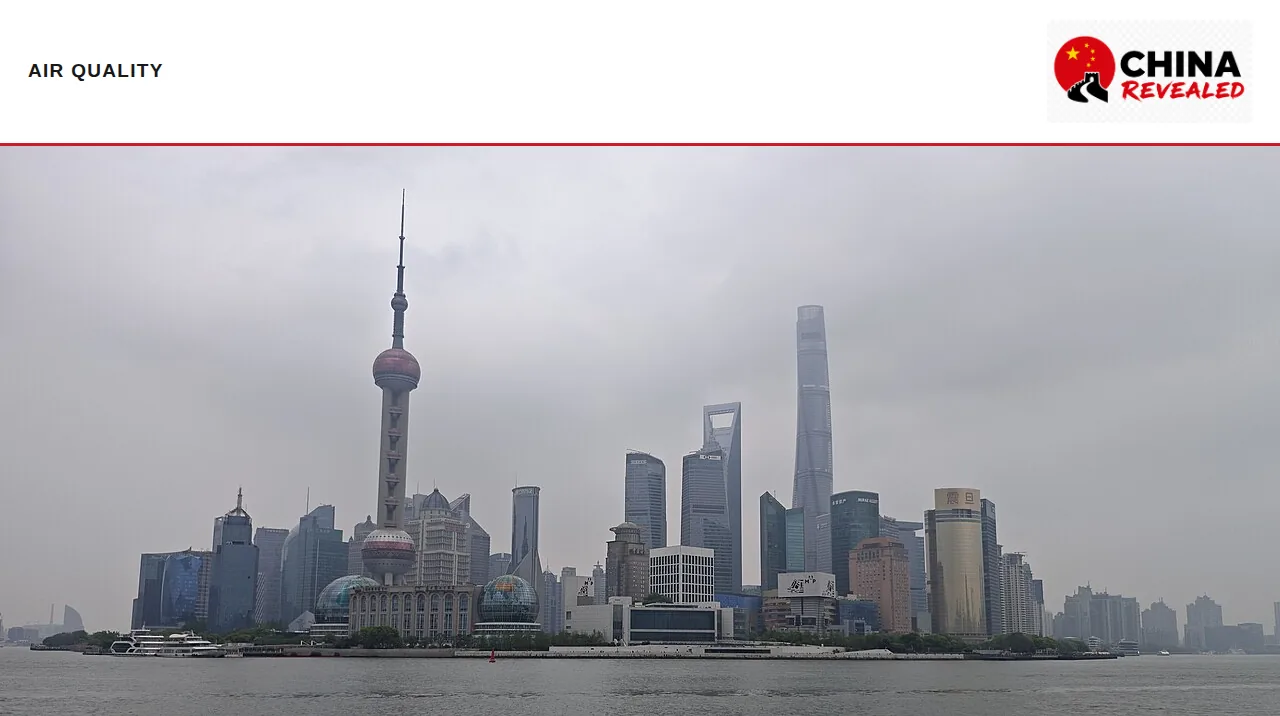
Air in Chinese cities is much cleaner than it was a decade ago, and many trips pass without a single bad day. The risk is not even across the year or the country:
- Winter in the north: coal and heating push up particle pollution (PM2.5) from about November to March in cities such as Beijing, Xi’an and Harbin. Still, cold days often bring clear blue skies after wind.
- Spring dust: from March to May, sand and dust storms can blow into northern China for a day or two at a time.
- Summer ozone: on hot, sunny days, ozone can build up in the afternoon, including in southern and coastal cities.
- Usually better: the south, the coast and high, windy places such as Yunnan.
If air quality worries you, autumn is usually the best season to visit northern China.
How to check AQI in English
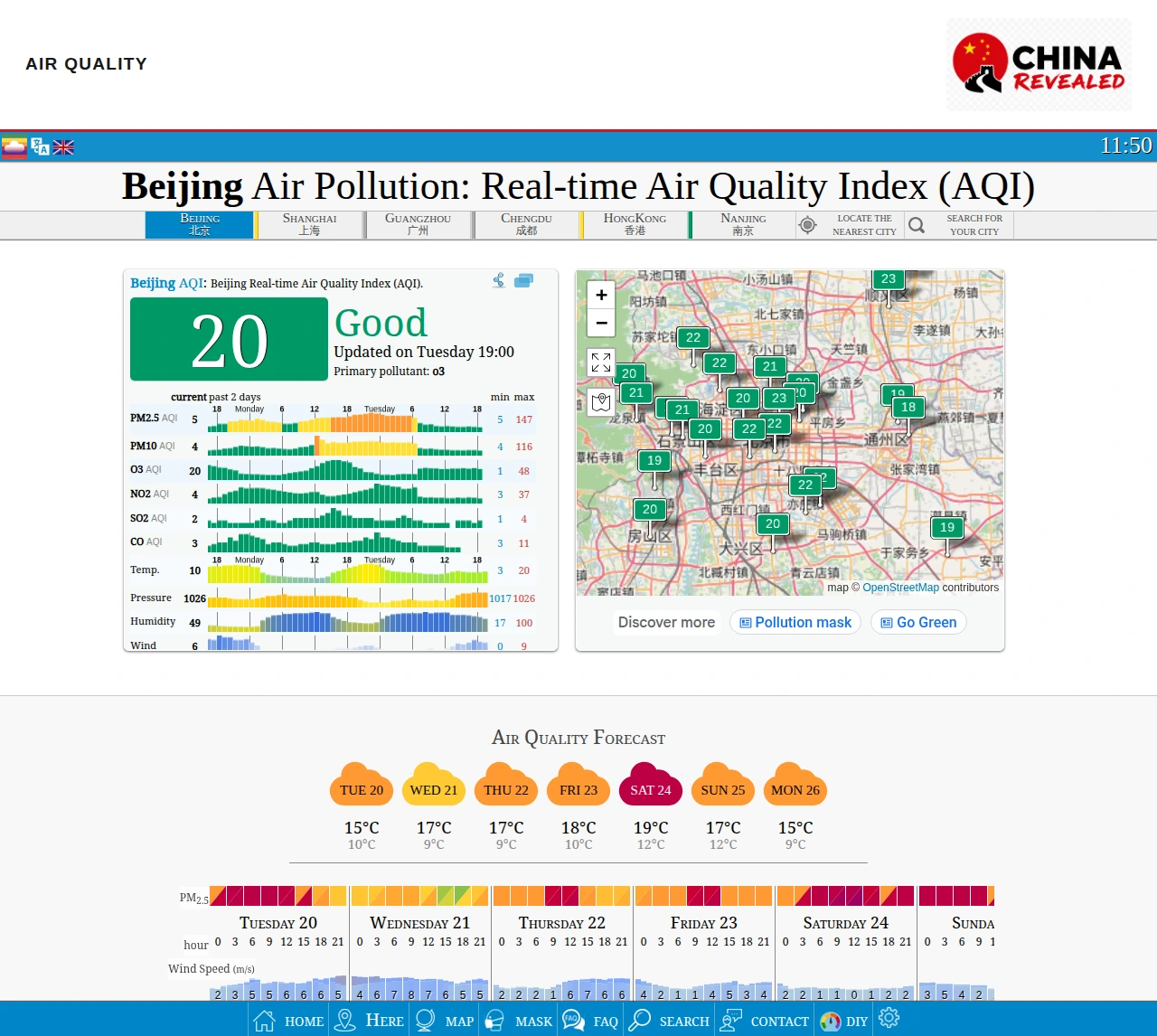
Open IQAir’s Beijing page or Shanghai page, or search another city. No account is needed.
- Pick the right place. Choose a station near the area you will visit; large cities have many.
- Check the update time. An old reading is not much use.
- Make sure it says US AQI. If you see CN AQI, switch to US AQI before using the table below.
- Use the forecast to plan tomorrow, and the current reading for today.
If IQAir will not load, use WAQI’s China map or its Beijing and Shanghai pages.
Weather apps that show AQI too
For a quick daily look, the weather app on your phone is often enough. Just remember that most of them use China’s scale, not US AQI.
- Apple Weather (iPhone): add your Chinese city and scroll to the Air Quality card; tap it for the main pollutant and a map. In mainland China the data comes from QWeather and official monitoring stations, and it works without a VPN. It also shows Chinese severe weather alerts.
- Android phones: the built-in weather apps on Huawei, Xiaomi, OPPO and similar phones show AQI next to the forecast. Google’s weather features need a VPN in China.
- IQAir AirVisual app: the app version of IQAir, with US AQI, a weather forecast and alerts for saved cities.
- Chinese weather apps: 彩云天气 (Caiyun Weather, also called ColorfulClouds) is popular for minute-by-minute rain forecasts and shows AQI; 墨迹天气 (Moji Weather) adds an hourly AQI forecast. Both are mainly in Chinese.
Why two apps show different numbers
China’s official AQI and the US AQI use different thresholds, and apps use different stations and update times. The Chinese number is lower once pollution rises: PM2.5 at 75 µg/m³ is about 100 on China’s scale but about 160 US AQI, already “Unhealthy”. Use US AQI with the table below. Also note that PM2.5: 40 µg/m³ is a concentration, not “AQI 40”.
What AQI means for your plans
Based on AirNow’s US AQI guidance:
| US AQI | What to do |
|---|---|
| 0–50 · Good | Normal sightseeing and outdoor plans. |
| 51–100 · Moderate | Fine for most people. If you are very sensitive to pollution, go lighter if symptoms appear. |
| 101–150 · Unhealthy for Sensitive Groups | Sensitive travellers should shorten exertion and take breaks. |
| 151–200 · Unhealthy | Everyone should cut back long or strenuous outdoor activity. Sensitive travellers should avoid it. |
| 201–300 · Very Unhealthy | Avoid long outdoor activity; choose indoor plans. |
| 301+ · Hazardous | Everyone should avoid outdoor activity. Stay indoors in filtered air. |
Sensitive travellers include children, older adults, pregnant travellers and anyone with asthma, lung or heart conditions. If you have a condition, follow your doctor’s action plan.
A short walk to lunch is not the same as an afternoon climbing steps or cycling. On an Unhealthy day, move the long outdoor trip to another day and visit a museum instead. One bad-air day is no reason to change your whole itinerary.
When to check
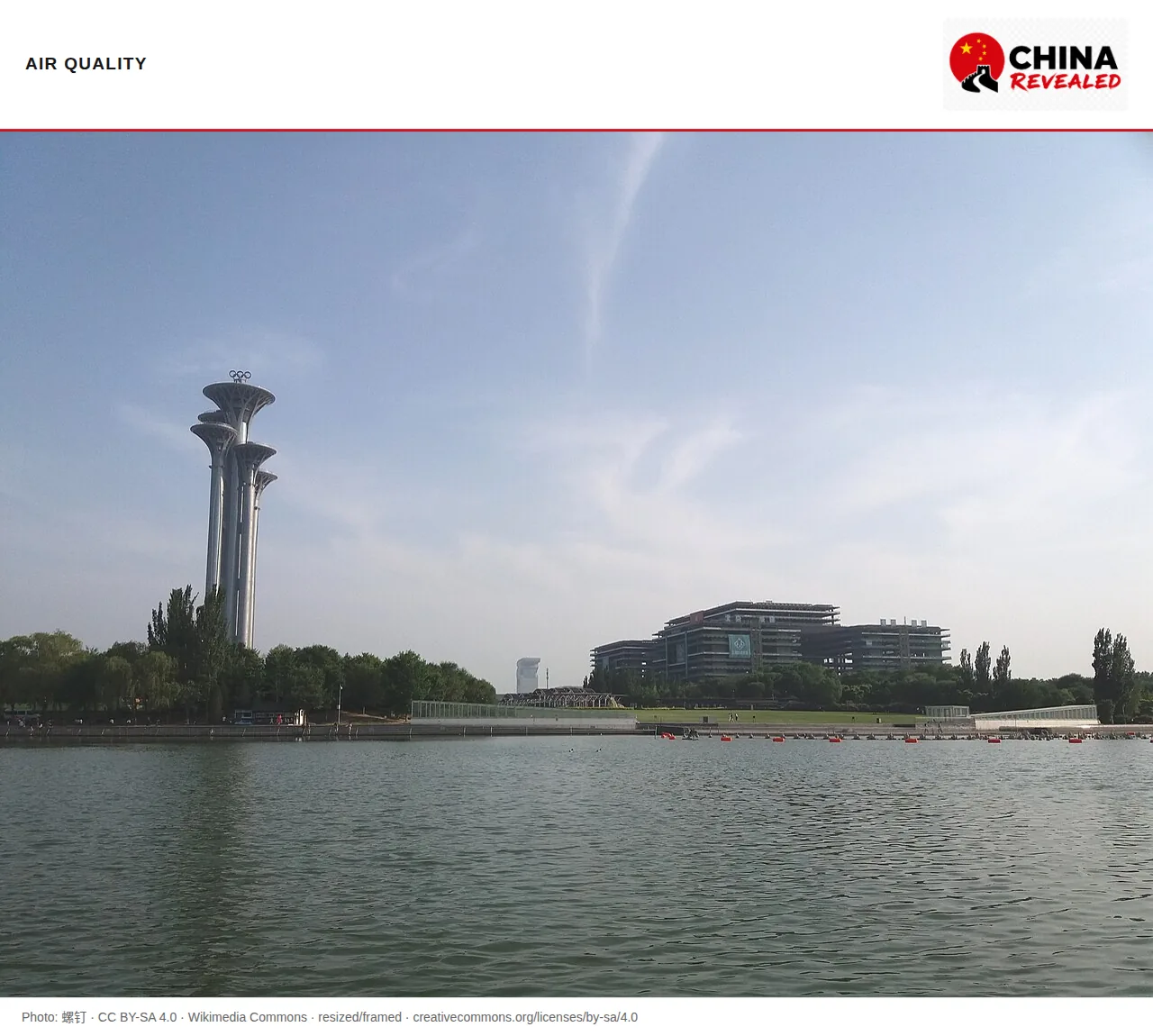
Check in the morning, and again before running, cycling, a long walk or a steep outdoor sight. Also look at the main pollutant: PM2.5 is fine particles; O₃ is ozone, which peaks on hot afternoons, so an earlier start helps on those days. Do not judge by the sky: ozone is invisible, and humid fog can look like smog.
Compare hotels that accept foreign passports on Trip.com and check the room facilities and recent reviews before you book.
Masks and indoor plans
For particle pollution, wear a genuine, well-fitting N95 or KN95 outdoors. It must seal around your nose and mouth; cloth and loose surgical masks do much less. Adult masks do not fit children, so bring child sizes if needed. Pharmacies and convenience stores in China sell KN95 masks.
Masks do not filter ozone. On a high-ozone day, shorten or reschedule outdoor exertion instead.
On a bad particle day, spend more time in air-conditioned museums, malls or your hotel room with the windows shut. Many hotels have a HEPA air purifier on request, and some rooms have one built in. Avoid smoky rooms.

Two useful phrases:
有空气净化器吗?
Yǒu kōngqì jìnghuàqì ma?
Do you have an air purifier?哪里可以买口罩?
Nǎlǐ kěyǐ mǎi kǒuzhào?
Where can I buy face masks?
About China Revealed
China Revealed is an independent English-language travel guide dedicated to China.
We bring together China travel guides, destination information, local insights and practical travel resources in one place.
Our travel database covers China's provinces, cities, famous attractions, hidden gems, local cuisine, transportation, accommodation, visa requirements, digital payments, mobile connectivity and the other practical details travelers need to explore China.
We focus on depth, careful research and accuracy. Our guides combine official sources, detailed destination data, local knowledge and regularly updated information to give reliable, practical travel advice.
Whether you're visiting China for the first time or exploring beyond the popular destinations, China Revealed is an all-in-one resource for discovering the real China.
China Revealed — Your practical guide to China.
Some links on China Revealed, such as Trip.com booking links, are affiliate links. If you book through them, we may earn a commission at no extra cost to you. This does not change what we recommend.