

Does Google Work in China? What Works and What Doesn’t

Google in China is blocked on ordinary mainland SIM data and local Wi-Fi. So are Gmail, YouTube, WhatsApp, Instagram and most other overseas apps. To keep using them, set up one of two things before you fly: a China travel eSIM with an international data route, or a VPN that works in mainland China.
Quick takeaways
- Short answer: on a normal Chinese connection, Google, Gmail, YouTube, WhatsApp, Instagram and Facebook do not work.
- Two fixes: a China travel eSIM with international routing, or a China-compatible VPN. You only need one of them.
- Hotel Wi-Fi does not use your eSIM’s route. On Wi-Fi, switch back to eSIM data or turn on the VPN.
- Set it up at home. Buying and installing a VPN or eSIM after you land is much harder.
- ChatGPT depends on the exit region: it works when your eSIM or VPN connects through a supported country such as the US, UK, Japan or Singapore, but not through Hong Kong.

Read this before you fly
Want Google, WhatsApp and Instagram to keep working in China?
- VPN setup guide: choose a VPN that works in mainland China, install the app and set up a subscription client before you leave.
- eSIM guide: compare a China travel eSIM with a local SIM, and find plans that keep overseas apps working on mobile data.
Set this up at home: app stores and sign-up pages can be hard to reach after you land.
What works and what does not
On an ordinary mainland SIM or local Wi-Fi, assume overseas apps will not work. With a working eSIM or VPN route, most of them behave as they do at home.
| App | Mainland SIM / local Wi-Fi | With an eSIM or VPN |
|---|---|---|
| Google Search, Maps, Translate | Blocked | Works |
| Gmail, Google Drive | Blocked | Works |
| YouTube | Blocked | Works |
| Blocked | Works | |
| Instagram, Facebook, X | Blocked | Works |
| ChatGPT | Blocked | Works (pick a supported region, not Hong Kong) |
| WeChat, Alipay, AMap | Works | Works |
The fix: an eSIM or a VPN
For a short trip, the easiest option is a China travel eSIM whose plan explicitly says it supports overseas apps, often described as international routing. Install it before departure and switch to it when you land. Check the exact plan: a locally routed eSIM behaves like a Chinese SIM and will not reach Google.
Most travel eSIMs are data-only, so keep your home number available for bank and account verification codes. Our China SIM vs eSIM guide compares the plans.
A VPN is the other route, and the one to choose if you want overseas apps on hotel Wi-Fi or a local Chinese SIM. Buy it, install the genuine app and sign in before you fly, because VPN websites and app-store pages are hard to reach from China. Pick a service that currently states mainland China support. Our VPNs in China guide walks through the setup.
China restricts unauthorized VPN services, and tourist status is not an exemption. For a work device, use the setup your employer approves.
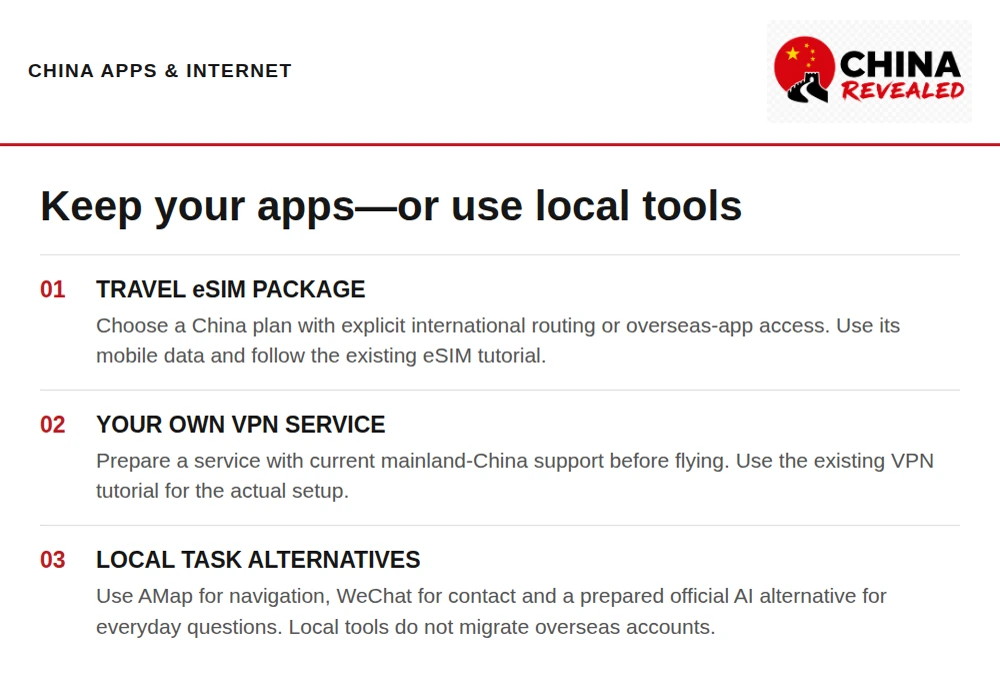
If an app works on mobile data but stops on hotel Wi-Fi
Wi-Fi does not use your eSIM’s route. Turn Wi-Fi off and use eSIM data, or turn on your VPN. There is no need to reinstall the app.
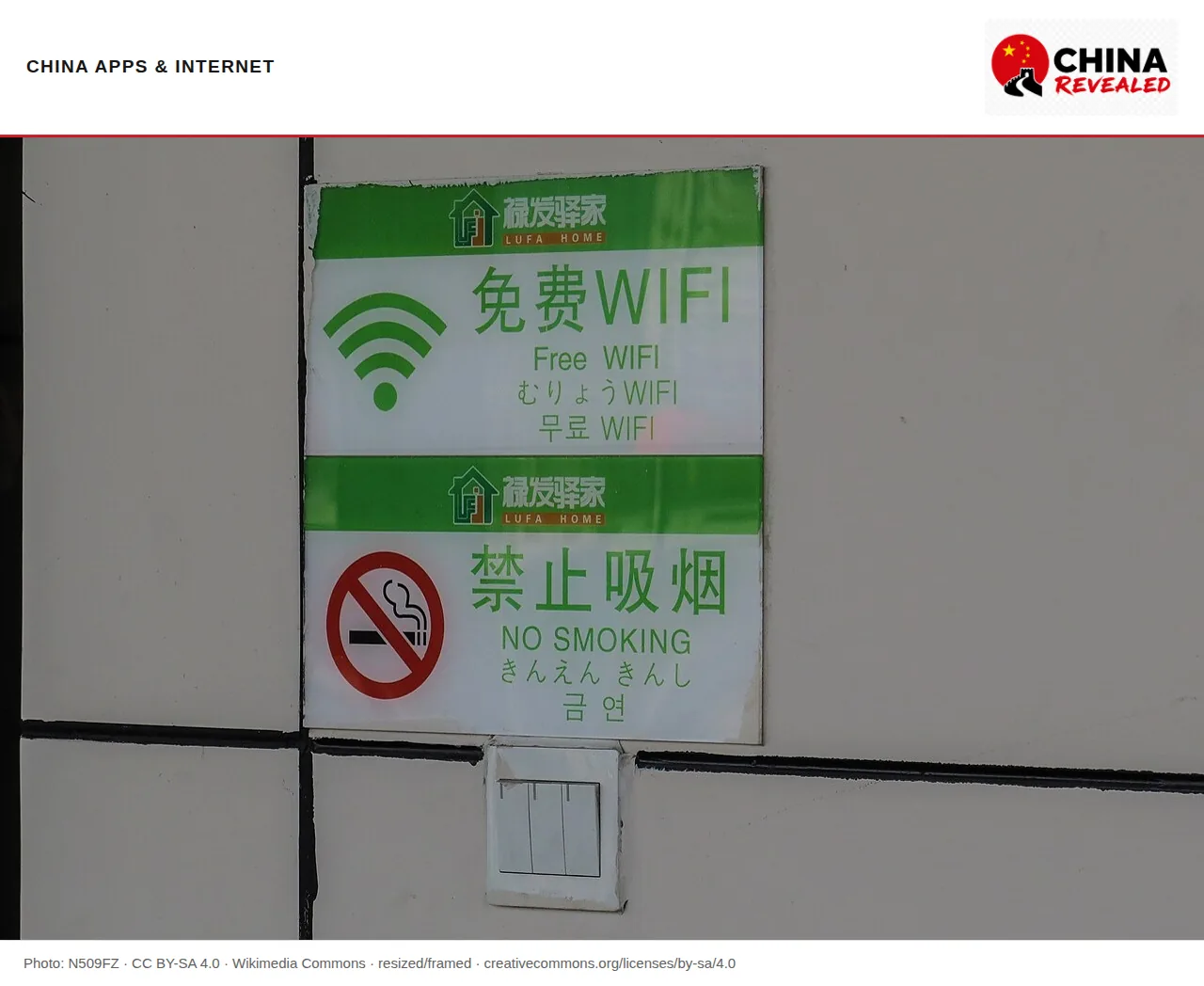
Use local apps for local tasks
Even with a working eSIM or VPN, Chinese apps do some jobs better inside China:
- Maps: use AMap (高德地图) instead of Google Maps for addresses, public transport and station entrances. Google pins can appear offset in China. Our AMap guide for foreigners in China explains the setup.
- Messaging: install WeChat before you fly and add your hotel, guide or local contacts. Few people in China use WhatsApp.
- Payments: Alipay and Weixin Pay are how most people pay, from metro tickets to street food.
- Rides: book a taxi with DiDi, or through the ride option inside Alipay or AMap.
- Translation: download English and Simplified Chinese for offline use in Google Translate, or use a translation app that works in China. A few basic phrases also help.
- Restaurants: use Dianping or rednote (小红书/Xiaohongshu) instead of Google reviews or Instagram.
- Search: Bing works for English searches; Baidu is better for Chinese place names.

Save your files offline
Anything stored only in Gmail or Google Drive is out of reach if your connection fails. Save hotel and train confirmations, insurance details and a passport copy as PDFs or screenshots on your phone. Add the Chinese name and address of every hotel so you can show it to a driver.
Also prepare a backup way into your accounts: a second email address such as Outlook.com, up-to-date recovery numbers, and backup codes for your Google and Apple accounts.
ChatGPT in China: pick the right VPN region
ChatGPT works in China through an eSIM or VPN, as long as the connection exits in a country on OpenAI’s supported-location list, such as the US, UK, Japan or Singapore. Avoid Hong Kong and Macao servers: they are not on the list. Many China travel eSIMs route data through Hong Kong by default, so if ChatGPT will not load, check your plan’s exit location or switch your VPN to another region.
DeepSeek, a Chinese AI chat, works on ordinary Chinese connections without a VPN, so it makes a useful backup; Qwen’s global chat is another option. Do not paste passport scans, bank details or work files into any AI chat.
Compare hotels that accept foreign passports, flights and train tickets on Trip.com, then save each confirmation on your phone for offline use.
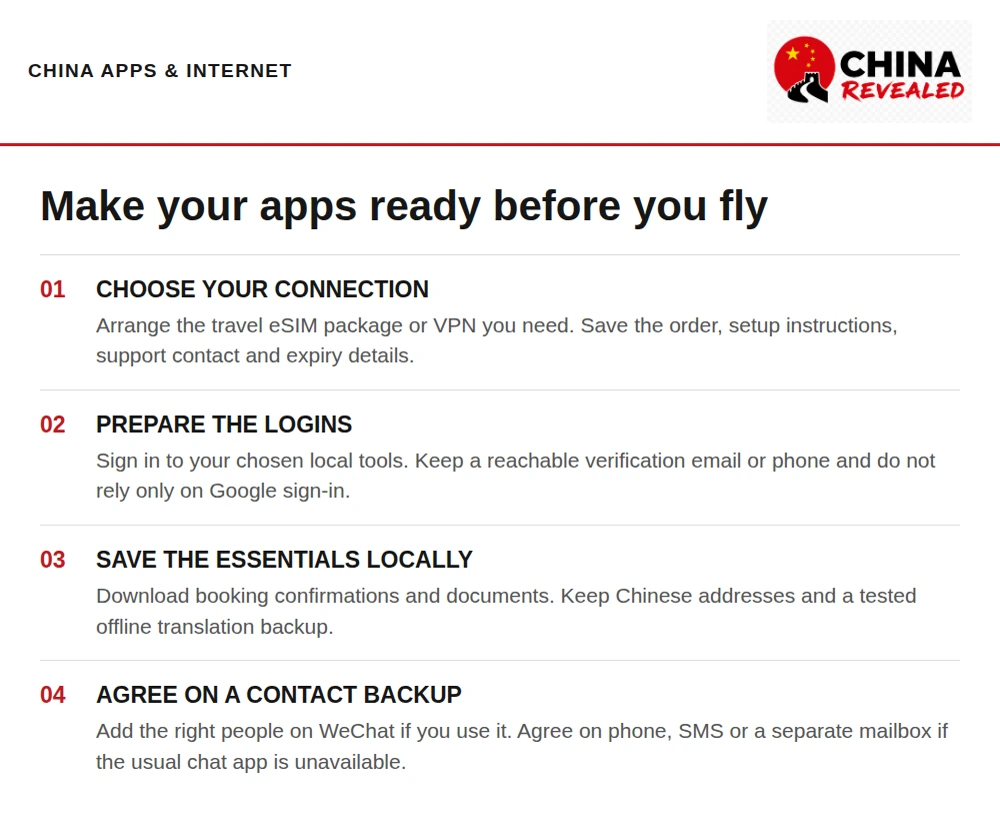
Quick checklist before you fly
- Install your China travel eSIM or VPN and test it at home.
- Install AMap, WeChat, Alipay and a translation app, and sign in to each.
- Download offline translation languages and save key bookings as PDFs.
- Save Chinese names and addresses for your hotels and stations.
- Keep your home number able to receive verification codes.
- After landing, check which line is giving you data, then send one test message.
For the arrival day itself, see our guide to your first day in China.
About China Revealed
China Revealed is an independent English-language travel guide dedicated to China.
We bring together China travel guides, destination information, local insights and practical travel resources in one place.
Our travel database covers China's provinces, cities, famous attractions, hidden gems, local cuisine, transportation, accommodation, visa requirements, digital payments, mobile connectivity and the other practical details travelers need to explore China.
We focus on depth, careful research and accuracy. Our guides combine official sources, detailed destination data, local knowledge and regularly updated information to give reliable, practical travel advice.
Whether you're visiting China for the first time or exploring beyond the popular destinations, China Revealed is an all-in-one resource for discovering the real China.
China Revealed — Your practical guide to China.
Some links on China Revealed, such as Trip.com booking links, are affiliate links. If you book through them, we may earn a commission at no extra cost to you. This does not change what we recommend.