

Luggage Storage in China: Stations, Hotels and Shipping

Luggage storage in China is easiest at your own hotel for a few hours, at a staffed storage point or locker when it fits your onward route, and through a courier when you want a large suitcase sent to another city. I would choose the location around the journey—not drag a case across town to save a few yuan.
For a high-speed-train trip, make that decision before departure day. Station storage only holds a bag temporarily; SF Express sends it separately. Neither a large locker nor a luggage-handling service changes the railway’s carry-on size limit.
Quick takeaways
- Ask your hotel first. Same-day guest storage is often the simplest option before check-in or after check-out; confirm the collection time.
- Check the exact station and access. A shop “near Shanghai Railway Station” is not inside Shanghai Hongqiao, and a locker beyond security may be awkward to retrieve later.
- Measure a big suitcase. On high-speed EMU trains, each item’s outside dimensions must total no more than 130 cm; the ordinary adult free allowance is 20 kg in total.
- Keep the collection proof. Save the order, bag tag or locker code, the location and the latest pickup time—not just a payment receipt.
- Send nonessential luggage ahead only with a buffer. Both hotels must agree, and the actual courier product must arrive in time for your stay.
In this guide
- Choose storage or shipping for your actual day
- Taking a suitcase on a high-speed train
- Find and use a station luggage-storage point
- Using a self-service luggage locker
- Leave bags at your hotel
- Use a third-party luggage-storage shop
- What luggage storage costs
- Send a suitcase to your next hotel with SF Express
- Railway luggage services: handling versus forwarding
- When the locker, payment or collection goes wrong
- Chinese phrases to show staff
- Three luggage plans that work with the itinerary
Choose storage or shipping for your actual day
A checkout morning, a stopover and a multi-city trip need different solutions. The useful question is: where will you next need the case?
| Your day | My first choice | What to settle first |
|---|---|---|
| Arrive before the room is ready | The hotel you are checking into | Guest storage, cost and reception hours |
| Check out, sightsee, then leave that evening | Your hotel if returning is convenient; otherwise storage on the departure route | Latest collection and time to reach the train or airport |
| Visit a city between two trains | A suitable station-area point, preferably accessible without entering the departure hall | Correct station, access, suitcase fit and pickup hours |
| Change hotels in the same city | Drop bags at the new hotel if it agrees | Whether it will accept them before check-in |
| Make a side trip before reaching another city | Forward the nonessential case; travel with a small bag | Receiving hotel permission and a workable courier arrival estimate |
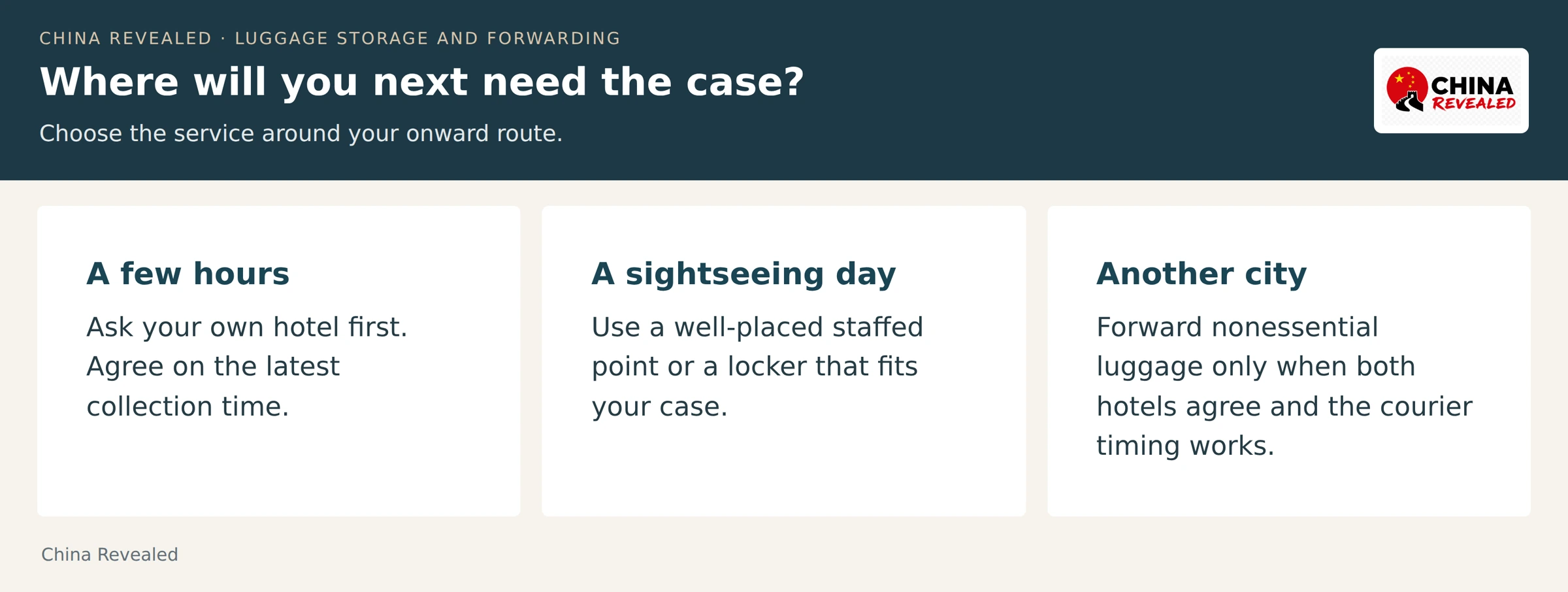
For an evening flight, I would not leave luggage at a railway station just because storage is available there. Put the collection point on the route to the airport. Returning to a hotel or station on the wrong side of town can cost more time and taxi money than the storage fee itself.
For a red-eye departure, the crucial number is the last collection time, not the advertised daily price. A shop closing at 22:00 is no use for a midnight collection. Collect earlier, or choose a hotel or point that explicitly agrees to the late handover.
Taking a suitcase on a high-speed train
The published allowance is smaller than many travelers expect
China’s high-speed trains have luggage racks, but that does not create an airline-style checked-bag allowance. You normally bring your own permitted bags aboard and look after them yourself.
| Mainland railway rule | Published limit |
|---|---|
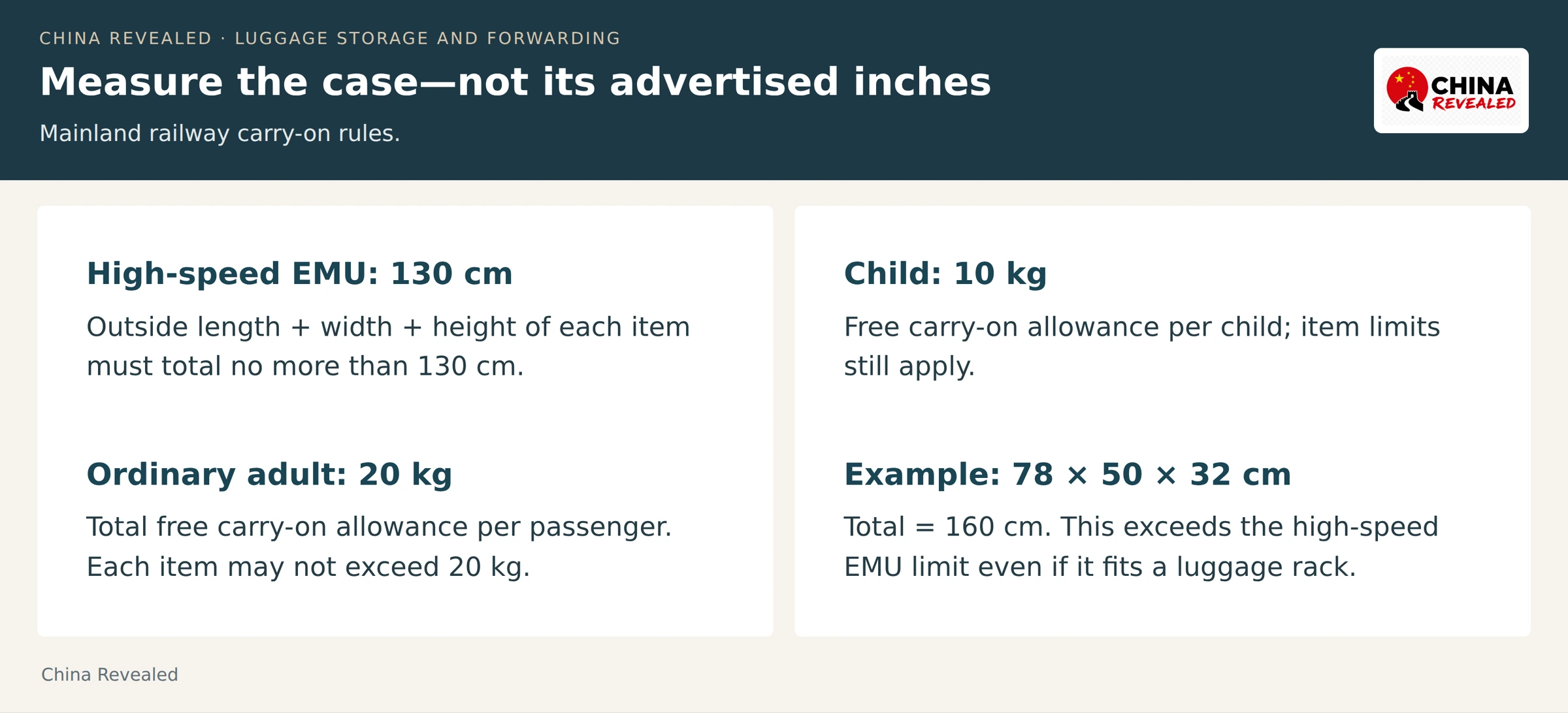
| Ordinary adult free carry-on weight | 20 kg per passenger in total |
| Child free carry-on weight | 10 kg per child |
| Weight of each item | No more than 20 kg |
| High-speed EMU item size | Outside length + width + height no more than 130 cm |
| Ordinary-train item size | Outside length + width + height no more than 160 cm; the separate 200 cm rule is for rod-shaped items, not suitcases |
Use the actual outer measurements, including protruding wheels and handles, rather than the suitcase’s advertised inch size. A case measuring 78 × 50 × 32 cm totals 160 cm: that exceeds the 130 cm high-speed limit even if the case is light or you have seen similar luggage in a train photograph.
Large cases are common in travel photos and traveler accounts. That is not a size exemption. If yours is over the published limit, I recommend arranging forwarding or asking the railway about an appropriate transport option before the trip. Do not leave the decision to the last few minutes at security, or assume buying first class gives you a larger allowance. The official railway carry-on rules are the place to check unusual items.
Make the station journey manageable
Keep the original booked passport, phone and ticket details in a small accessible bag. At security, lift the suitcase onto the scanner as directed, complete any inspection and count all bags when you collect them. A bottle, jacket or small shoulder bag can easily be left behind while dealing with a heavy case.
For a first journey, I would arrive at the railway station about 60 minutes before departure, with more time for holiday crowds or a storage collection. If you need to retrieve luggage, finish that errand before the station-arrival buffer starts. The train’s departure time is not the boarding-gate cutoff.
Use a lift where available. For the city approach, choose a route with fewer transfers and check the usable entrance rather than only the nearest map pin. Our metro and city-transport guide explains the route and exit checks; the high-speed-train boarding guide takes you through passport channels, the platform and your carriage.
Where the suitcase goes on board
Use an overhead rack for a bag you can lift and place securely. A permitted larger case can go in the designated luggage area near a carriage end where provided; under-seat storage works only if the bag actually fits. Rack layouts differ by train.
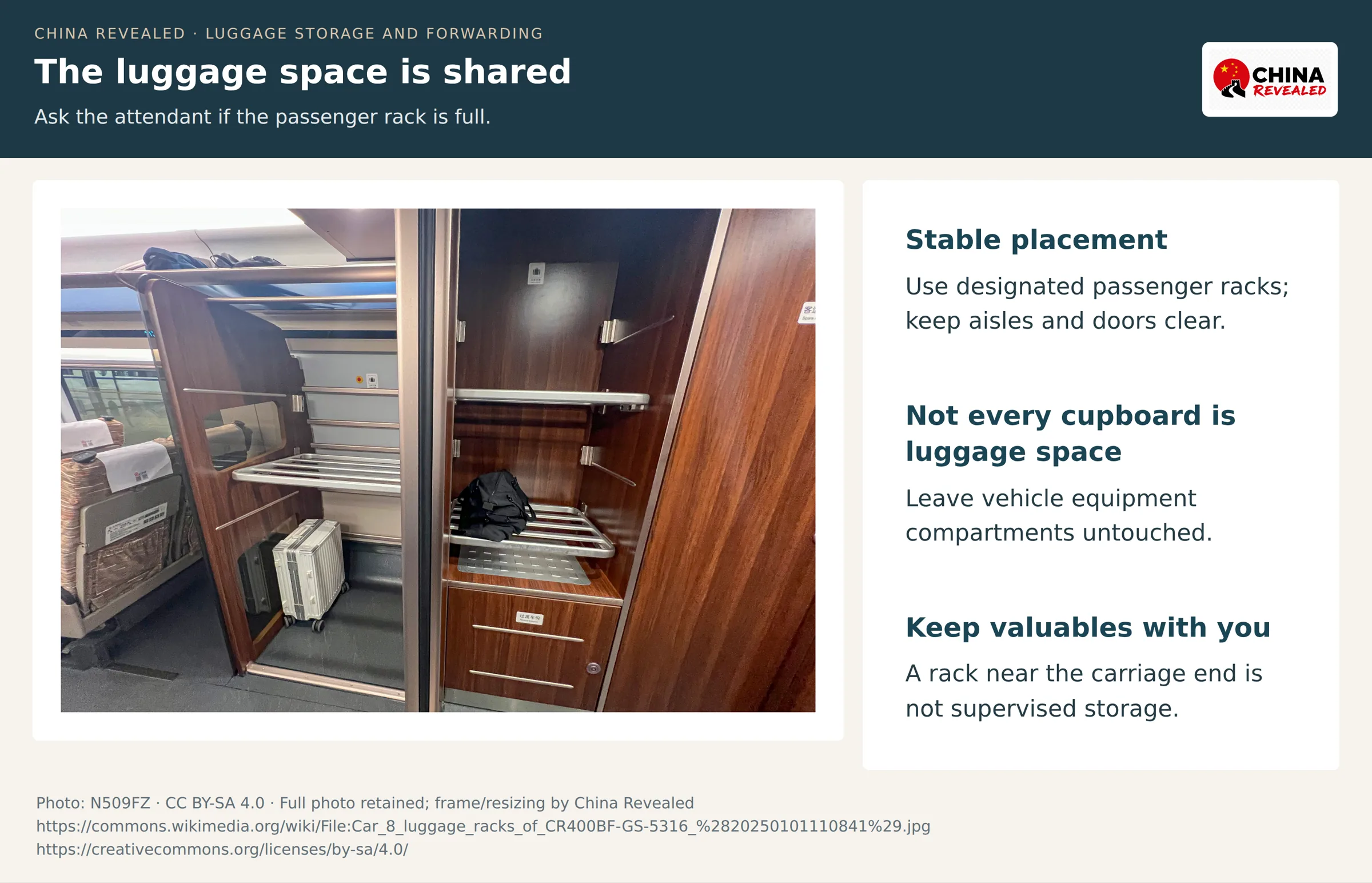
A carriage-end rack is shared space, not a reserved compartment attached to your seat. If it is full, ask the attendant where to put the case. Do not block the aisle, doors, emergency equipment or another passenger’s feet, and do not force a heavy, unstable case onto the overhead rack.
Retract handles and position the case so it cannot roll or fall. Keep valuables with you, and collect the case before your stop rather than wrestling it out while other passengers are trying to leave. Storage on the train remains your responsibility.
Find and use a station luggage-storage point
There is no single nationwide railway-locker system. At a large station you might find a staffed luggage room, commercial lockers in the arrival concourse, or a shop just outside. A smaller station may have none that suits your bag or collection time.
Start with the full Chinese station name in your map, then search 行李寄存 or 寄存柜. Useful signs include 行李寄存, 小件寄存, 寄存处, Left Luggage and Luggage Deposit. Ask the information desk if the map results are unclear. Confirm that a result belongs to the station you are using—not another station with a similar name.
Before handing anything over, ask four practical questions: Is it before or after security? Can you retrieve it after leaving the station? When does collection close? Can this actual case be accepted?
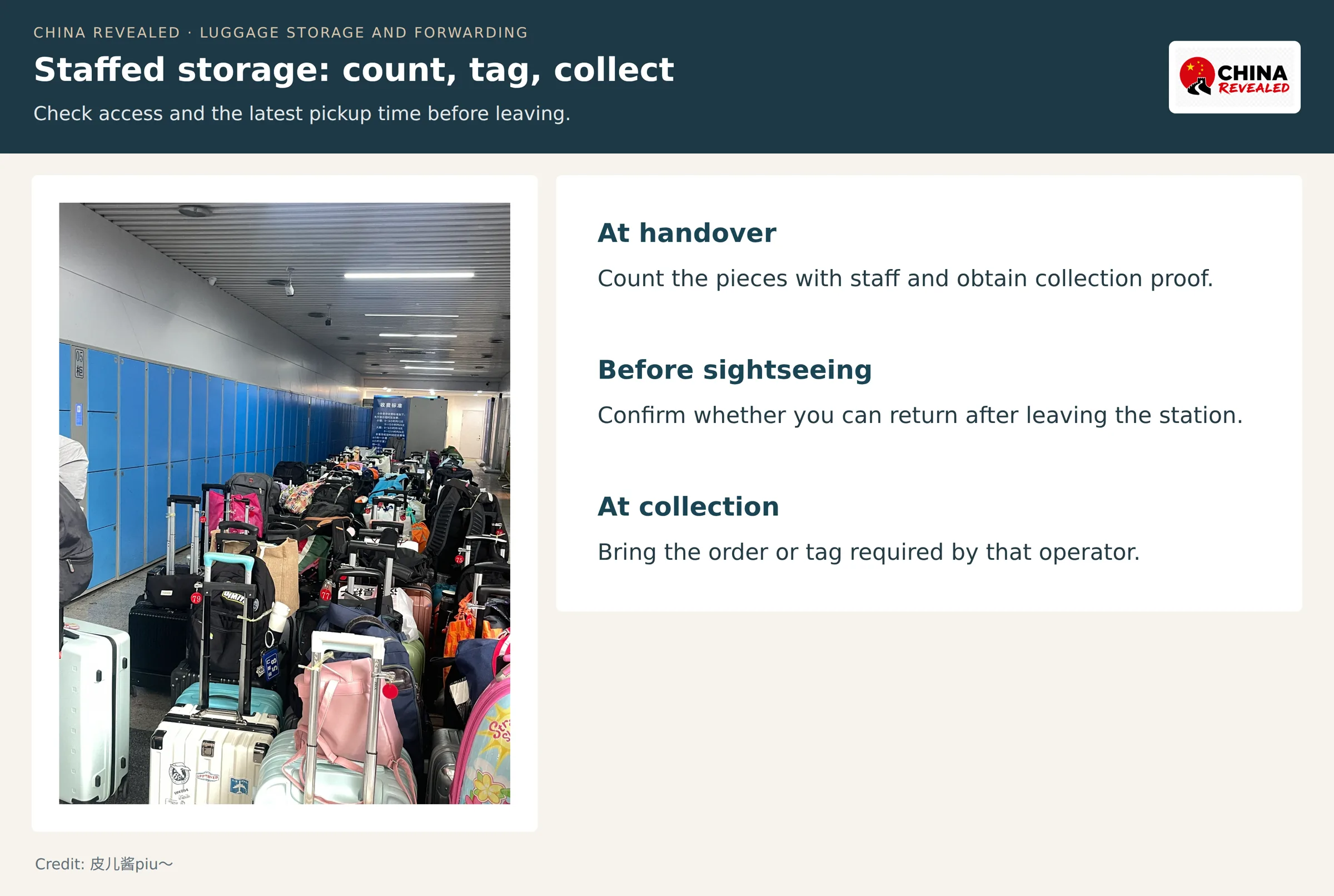
A concrete example: Beijing South
Beijing‘s station-area authority lists a luggage-storage facility on the north side of Beijing South’s waiting level, operating 07:00–19:00. Its published conditions require a same-day ticket and an identity card. With a foreign passport, ask station staff to confirm the document procedure and access before relying on it for a sightseeing stopover.
The published medium-cabinet charge is ¥15 within 7 hours or ¥20 within 12 hours; the large-cabinet charge is ¥20 within 7 hours or ¥30 within 12 hours. The authority does not publish internal cabinet measurements on that page. “Large” is not enough to know whether an expanded 28- or 30-inch case fits.
The 19:00 collection limit matters more than the 12-hour tariff. Do not read a longer price band as permission to collect after closing; the page says overdue belongings will be cleared. Confirm arrangements at the counter and collect within its hours.
Do not store a sightseeing bag somewhere you cannot re-enter
An arrival exit, a railway departure hall and a metro paid area are different places. If a facility is beyond security or within a paid area, establish how you will return before leaving the bag. A storage receipt is not automatically a railway entry ticket.
If you must enter the railway departure area again, expect the station’s ticket/identity requirements and security procedure. For a visit between trains, an accessible station-area shop can be more practical than a point inside the waiting hall. For a short connection, do not leave the station to store a bag at all.
Using a self-service luggage locker
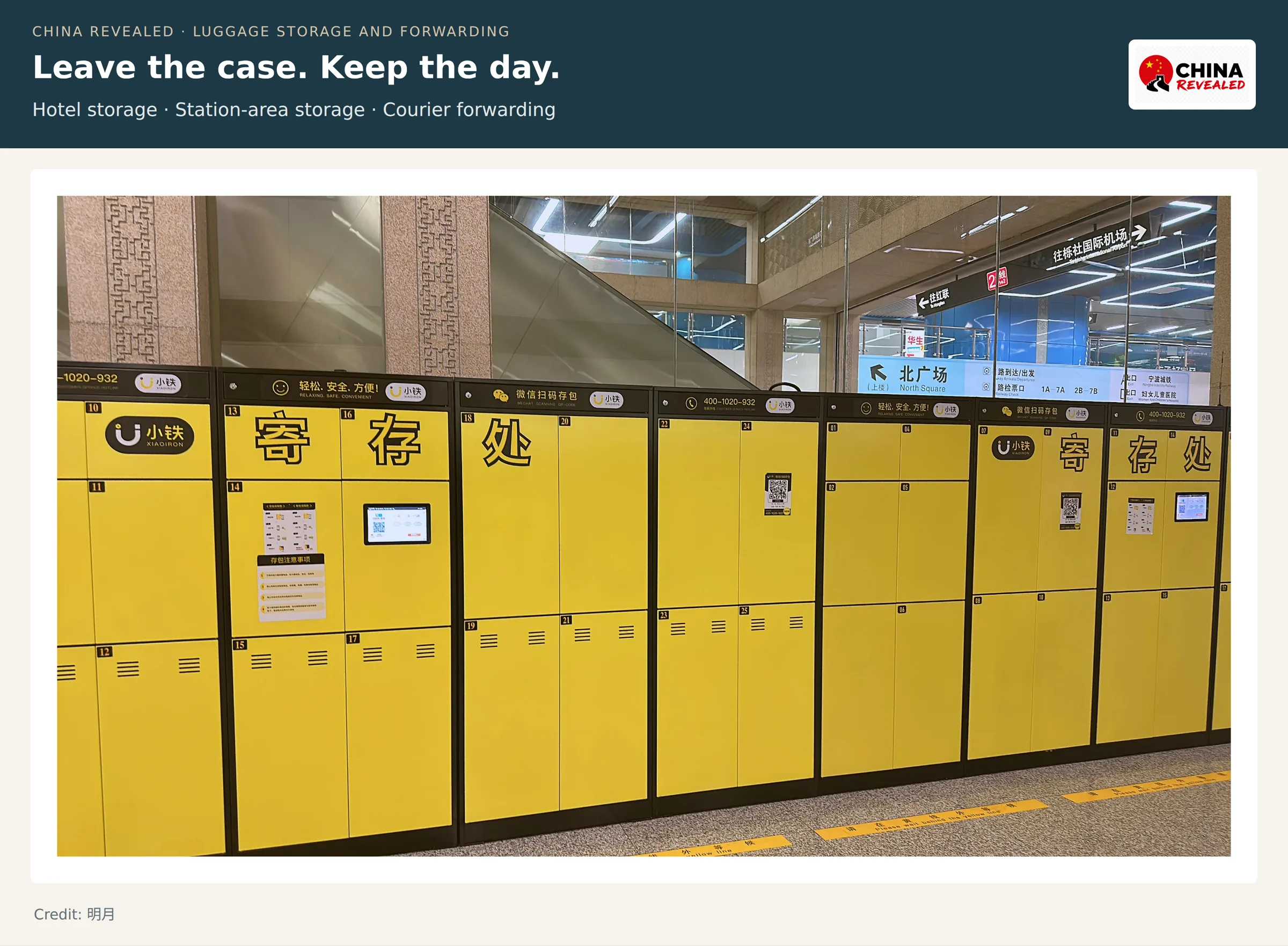
A locker is convenient when you have a working phone and payment method, the compartment fits, and the building will remain open for collection. The cabinet’s electronics may work all night while the station or mall doors do not.
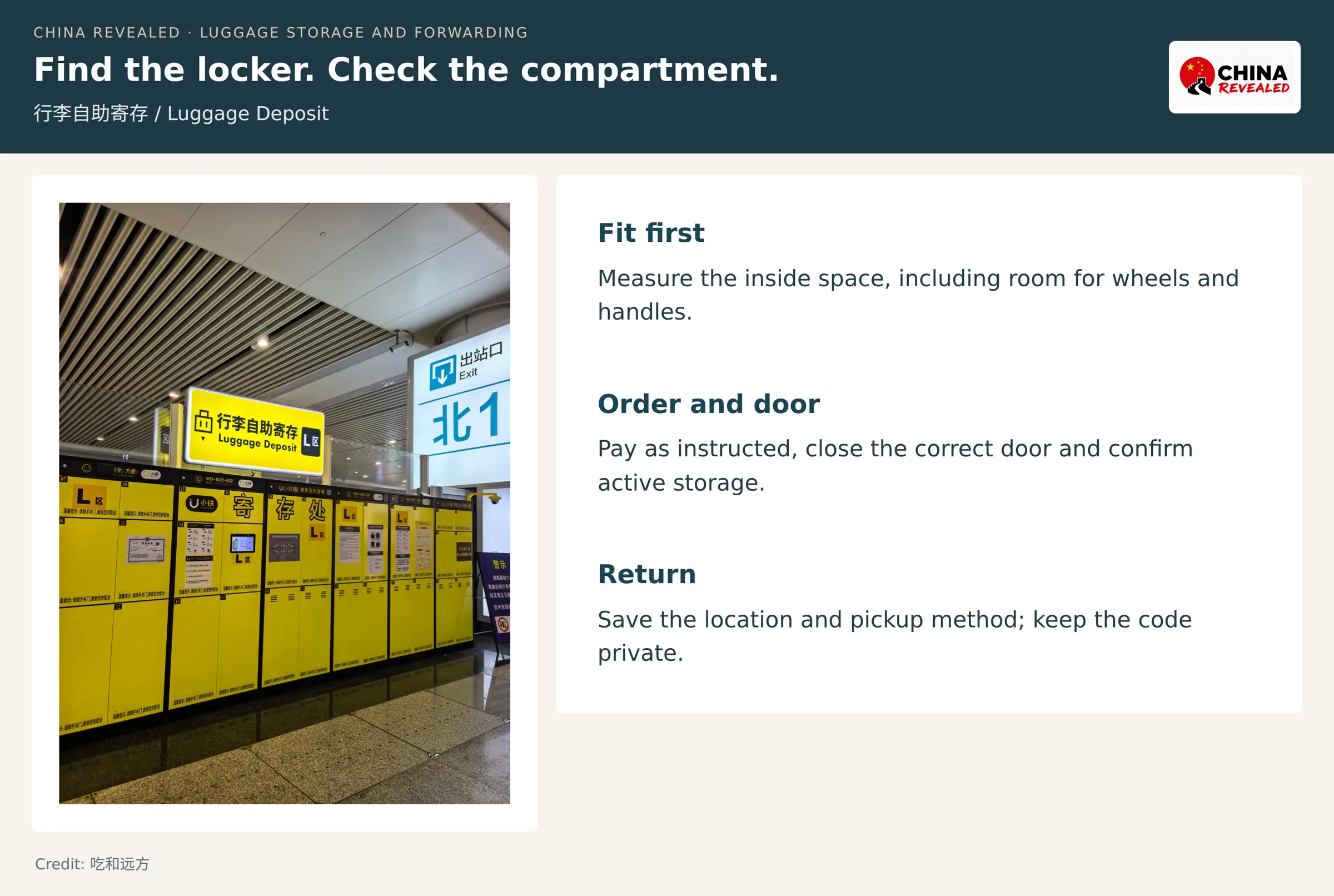
- Read the operator and rules at the cabinet. Check the hourly or daily rate, minimum charge, cap, extra fees, access hours and forbidden contents.
- Check an available compartment’s internal dimensions. Allow for wheels, handles and an expanded case. Do not force the door shut or assume every “large” cabinet is the same.
- Scan the cabinet’s official QR code in the supported app. Common routes use WeChat or Alipay; follow that operator’s instructions. Select the location, compartment and storage option shown.
- Complete payment and put the bag in the correct opened compartment. Keep your phone outside. Close the door and confirm the app shows an active storage order and collection method.
- Save the cabinet bank, compartment number and operator’s help contact. Keep the collection code private. A photograph of the surrounding signs is more useful than a close-up of an indistinguishable yellow door.
- Return through the order or the cabinet’s collection flow. Scan again or enter the pickup code as directed, settle any remaining charge, remove everything and check that the storage session has ended.
Some systems collect payment before opening; others calculate a balance at collection or take a deposit. Follow the actual screen. Opening the door during storage may finish the session, so check before returning just to take a jacket out.
A foreign card working in Alipay or WeChat does not guarantee that every storage mini program will accept it. Likewise, a data-only eSIM does not provide an SMS number. If the locker requires a phone format or identity option you cannot use, switch to a staffed point rather than trying borrowed identity details.
Book hotels, flights, train tickets, attractions and other travel services on Trip.com.
Leave bags at your hotel
For a few hours, your own hotel is my first choice. You already have a reservation or have just checked out, staff can identify you, and there is usually less app setup than at a locker.
Ask reception or the concierge about storage before check-in or after check-out. Same-day guest storage is common, often without an extra charge, but overnight storage and bags left for a later return stay are separate requests. A self-check-in apartment may have no staffed luggage room.
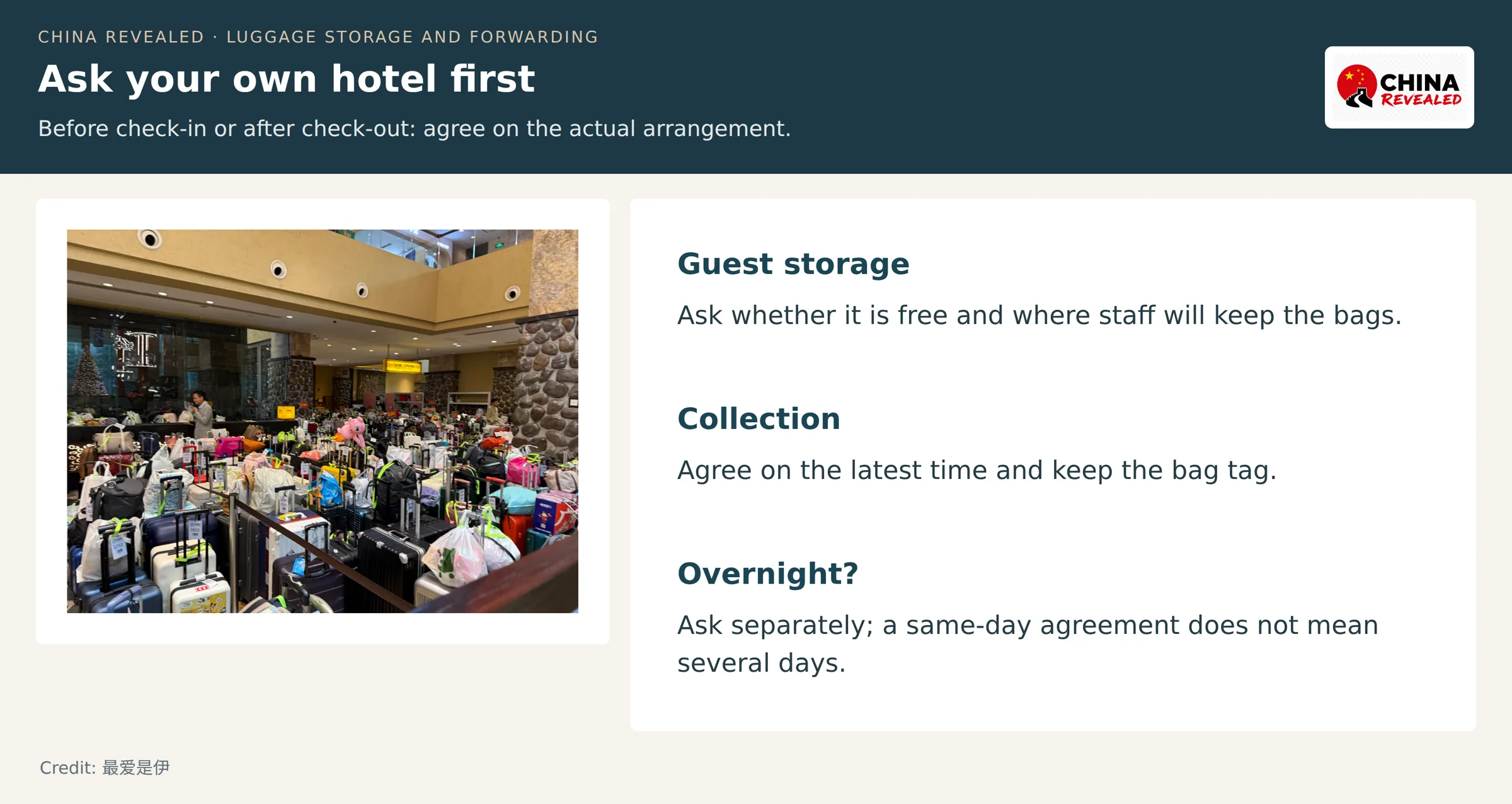
Guangzhou Chimelong’s official hotel information, for example, lists free luggage storage for hotel guests. That is a useful example of a guest service, not a promise from every hotel or an invitation to use any luxury hotel’s lobby without a booking.
Before leaving the bags, agree on the number of pieces, price if any, and the latest collection time. Tell reception if the case will remain overnight or if someone else will collect it. Ask for a bag tag or receipt and photograph the case’s condition. Keep the guest name or reservation reference available when you return.
For an early arrival, use this message:
Hello. I have a reservation under [name] for [date]. Can I leave [number] bags before check-in, from about [time]? Is there a charge, and where should I bring them?
For a checkout day:
Can you hold [number] bags after checkout until [time today]? Please confirm the latest collection time and any fee.
If you leave for a two-night side trip and return to the same hotel, say so explicitly. Ask whether it will hold the case for the full period and how to label it against the return reservation. Do not assume “you can leave it at reception” means several days.
Our hotel-booking guide explains how to save the exact Chinese branch name and contact the property. That same branch check matters when arranging luggage storage or a courier delivery.
Use a third-party luggage-storage shop
For an all-day sightseeing stop, a staffed shop can be easier than a large locker. These points are often partner convenience stores, souvenir shops or other businesses—not railway-operated luggage rooms.
Search for 存知己 / CunZhiJi or 途简单 / TooJianDan in WeChat, or use the operator’s official app or website. Choose the city, the exact station or area, and the intended storage and collection dates. Read the point’s opening hours, bag category and directions before paying.
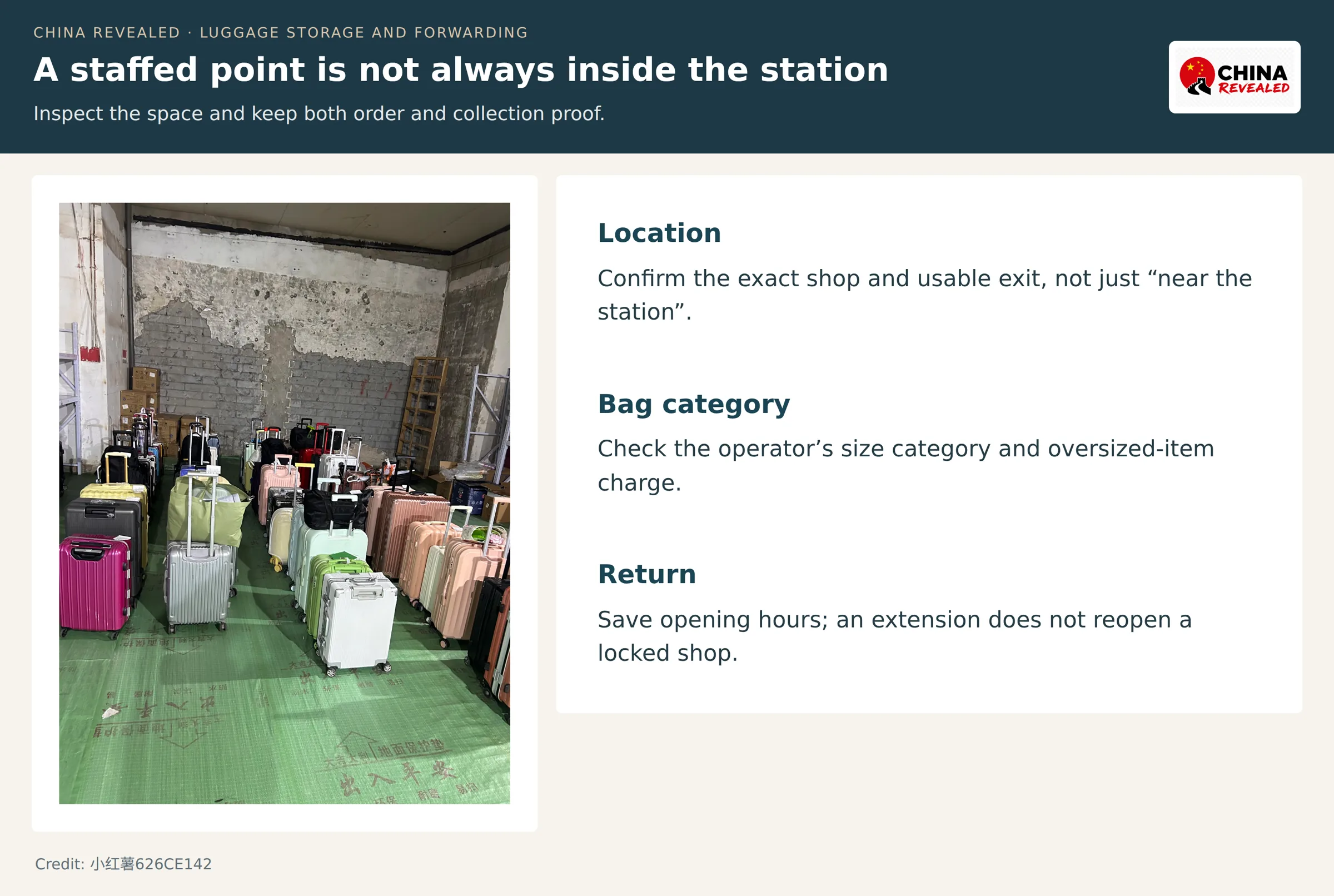
A current Shanghai Railway Station example
CunZhiJi’s Shanghai Railway Station South Square partner shop lists 07:30–22:00, ¥20 per suitcase per day and ¥10 per small bag per day. Its page places it about 150 metres from the south railway entrance and 50 metres from Metro Exit 3.
This is near Shanghai Railway Station, not inside it—and not at Shanghai Hongqiao. The full address and phone are supplied after booking. Check the public map and access notes first; if you cannot establish where you will be walking with the case, ask the operator before committing. The official point page is a useful example of what a listing should tell you.
The suitcase category includes 13–30-inch cases and certain larger bags. An oversized case or unusually shaped item needs separate confirmation. The point lists a daily rate, but does not define that as any rolling 24-hour period: enter the actual dates and ask how crossing midnight is charged.
Book, hand over, keep the proof
CunZhiJi’s guide requires booking information for drop-off; do not assume you can arrive without an order. At the shop, show the correct order, count the pieces with staff and make sure each bag is identified with a tag or storage number. Keep both the platform order and the point’s collection proof—its rules can require both for retrieval.
Look at where the bag will be stored and read the prohibited-item and liability terms. A CCTV sign or “insured” badge is not a reason to leave cash, a passport or a laptop. This Shanghai point specifically excludes valuables, including computers and cash.
What luggage storage costs
Storage is usually a relatively small travel expense. The total depends on the specific point, size category and billing period; an hourly cabinet is not automatically cheaper than a staffed daily-rate shop.
| Verified example | Published charge | Practical condition |
|---|---|---|
| Guangzhou Chimelong hotel guest storage | Free for hotel guests | Confirm the particular hotel’s handover and collection arrangements |
| Beijing South medium cabinet | ¥15 within 7 hours; ¥20 within 12 hours | Published hours 07:00–19:00; same-day ticket and ID conditions |
| Beijing South large cabinet | ¥20 within 7 hours; ¥30 within 12 hours | Confirm actual fit and foreign-passport procedure |
| CunZhiJi near Shanghai Railway Station, suitcase | ¥20 per item per day | Partner shop 07:30–22:00; booking required |
| Same Shanghai partner shop, small bag | ¥10 per item per day | Size category and chosen dates determine the order |
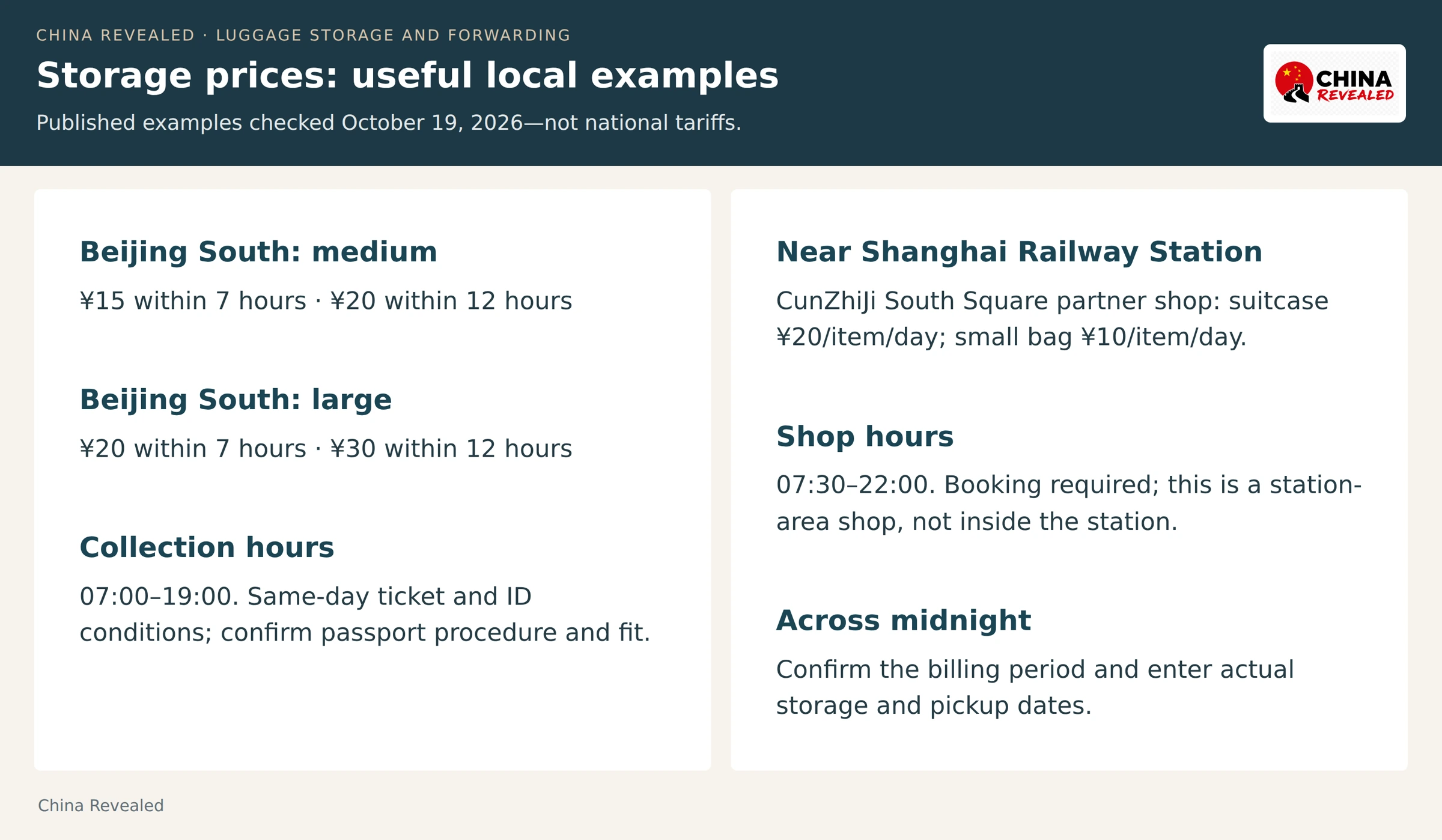
These are location-specific published examples checked on October 19, 2026, not a national price list. An eight-hour stay in Beijing South’s listed large cabinet falls in its ¥30 band, but must still finish by 19:00. Two suitcases at the Shanghai partner shop cost ¥40 for one billed day before any different category or extra arrangement.
For another locker, compare the actual total for your planned duration. Ask whether the cap applies per calendar day or per 24 hours, whether an incomplete hour is rounded up, and whether a deposit, service fee or overdue charge is added. If crossing midnight changes the billed days, a “¥20/day” listing can become ¥40.
I would pay a little more for a point beside the useful exit, with clear collection arrangements, rather than save money at a shop that adds a long return detour.
Send a suitcase to your next hotel with SF Express
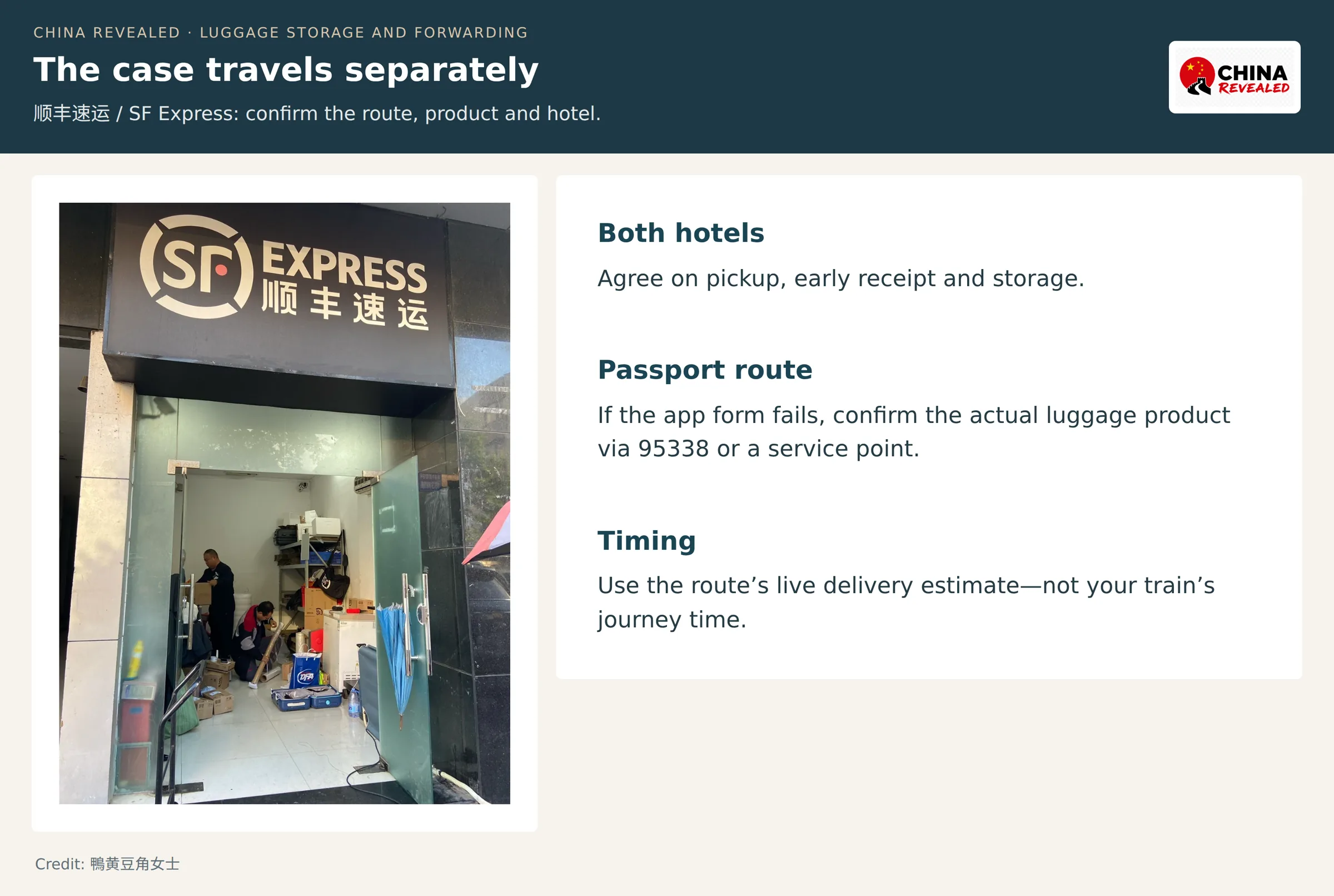
SF Express / 顺丰速运 is the courier option I would investigate first for hotel-to-hotel luggage. It is most useful when a case contains clothes and purchases you will not need during a side trip. It is much less useful if you need everything that evening.
The case travels through a courier network, independently of your train. “I take a two-hour high-speed train” does not mean “my suitcase arrives two hours later.”
1. Get agreement from both hotels
Ask the departure hotel whether a courier can collect from reception and at what time. Staff may help you communicate, but do not assume they will create the order or take responsibility for it.
Ask the receiving hotel whether it will accept the case before you arrive, how early, how long it will hold it, and whether storage has a fee. Get the exact Chinese hotel branch name, full address and a delivery contact that reception agrees to use. Include the reservation name and intended check-in date so the luggage can be matched to you.
A useful receiving-hotel message is:
I have a reservation under [name] for [dates]. May I send one suitcase by SF Express to your reception before arrival? Please confirm the earliest date you can receive it, any storage charge, the full Chinese hotel address, and the recipient name and delivery telephone number you want used.
Do not use a hotel’s phone number without its agreement. An account-verification number and a parcel-delivery contact are different fields; a landline will not fit a form that requires an 11-digit mainland mobile number.
2. Confirm a passport-compatible ordering route
Use SF’s official app, WeChat mini program or a local service point. Search for 顺丰速运 and identify the Send / 寄件 service. If the ordinary form does not offer the document or phone option you need, contact 95338 or visit a service point with the original passport before scheduling pickup.
SF’s published luggage-service privacy information includes passport processing, but that does not make every product screen identical. Ask staff to confirm the actual luggage product, sender verification, contact number and payment route. Use your real document details; do not solve an identity-field problem by entering somebody else’s identity number.
3. Compare the actual product, arrival estimate and all-in price
Enter the origin, destination, pickup time, packed weight and packed outer dimensions in SF’s official rate and transit-time tool. Compare the available SF Express / 顺丰特快 and SF Standard Express / 顺丰标快 products for that route. For 20 kg-plus luggage, ask about the relevant heavy-parcel service too.
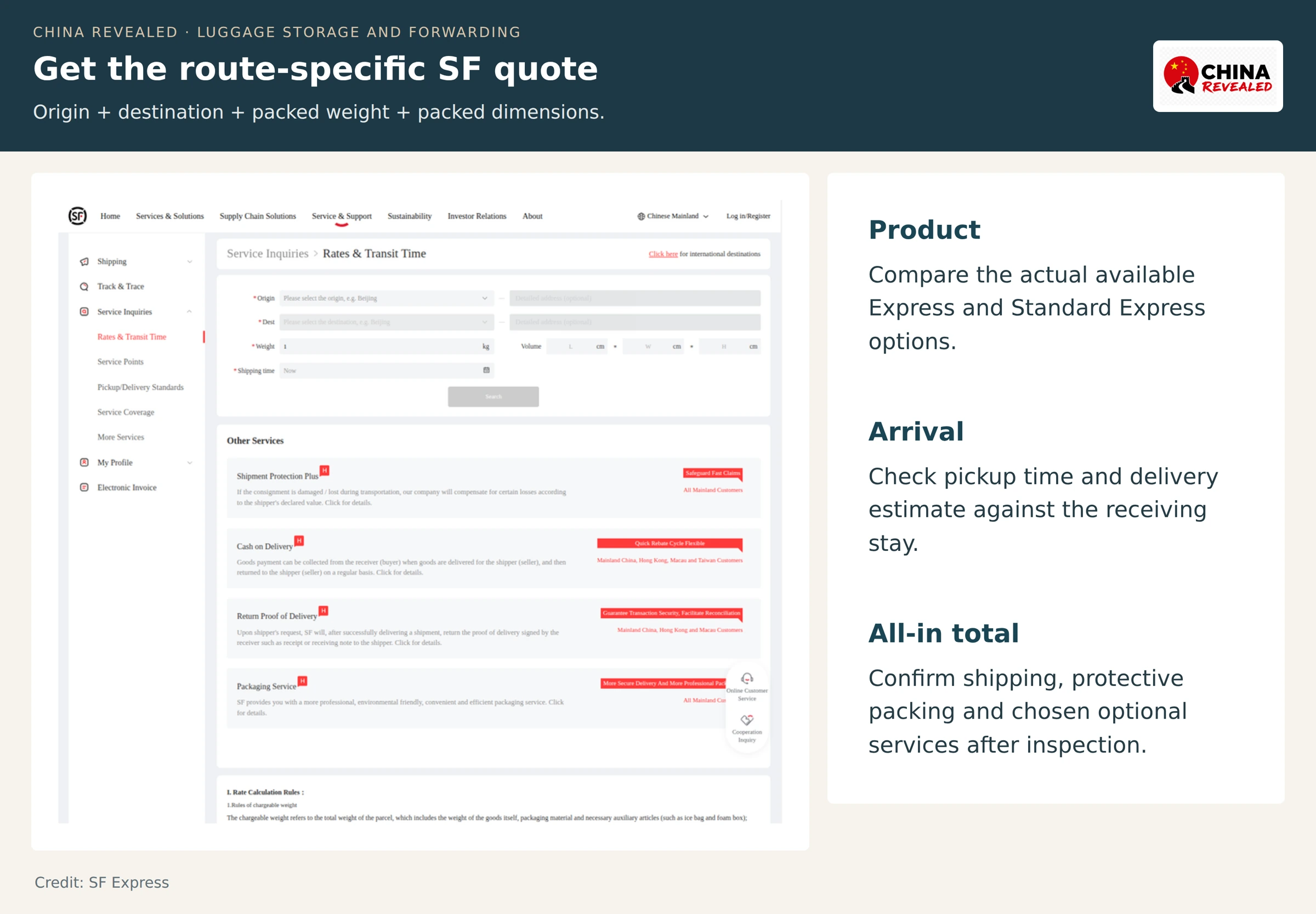
Choose the product around the receiving hotel’s acceptance window and your checkout date. I would leave at least one full day between the expected delivery and the end of the receiving stay, with more margin for remote addresses, holidays or a tight onward flight. That is a planning buffer, not an extra delivery promise.
There is no reliable nationwide “one suitcase for ¥50” price. Your budget is the route quote + packing or reinforcement + any chosen declared-value service or other charges. Have the courier confirm the final total after inspection, weighing and measurement.
4. Prepare the suitcase for inspection and transport
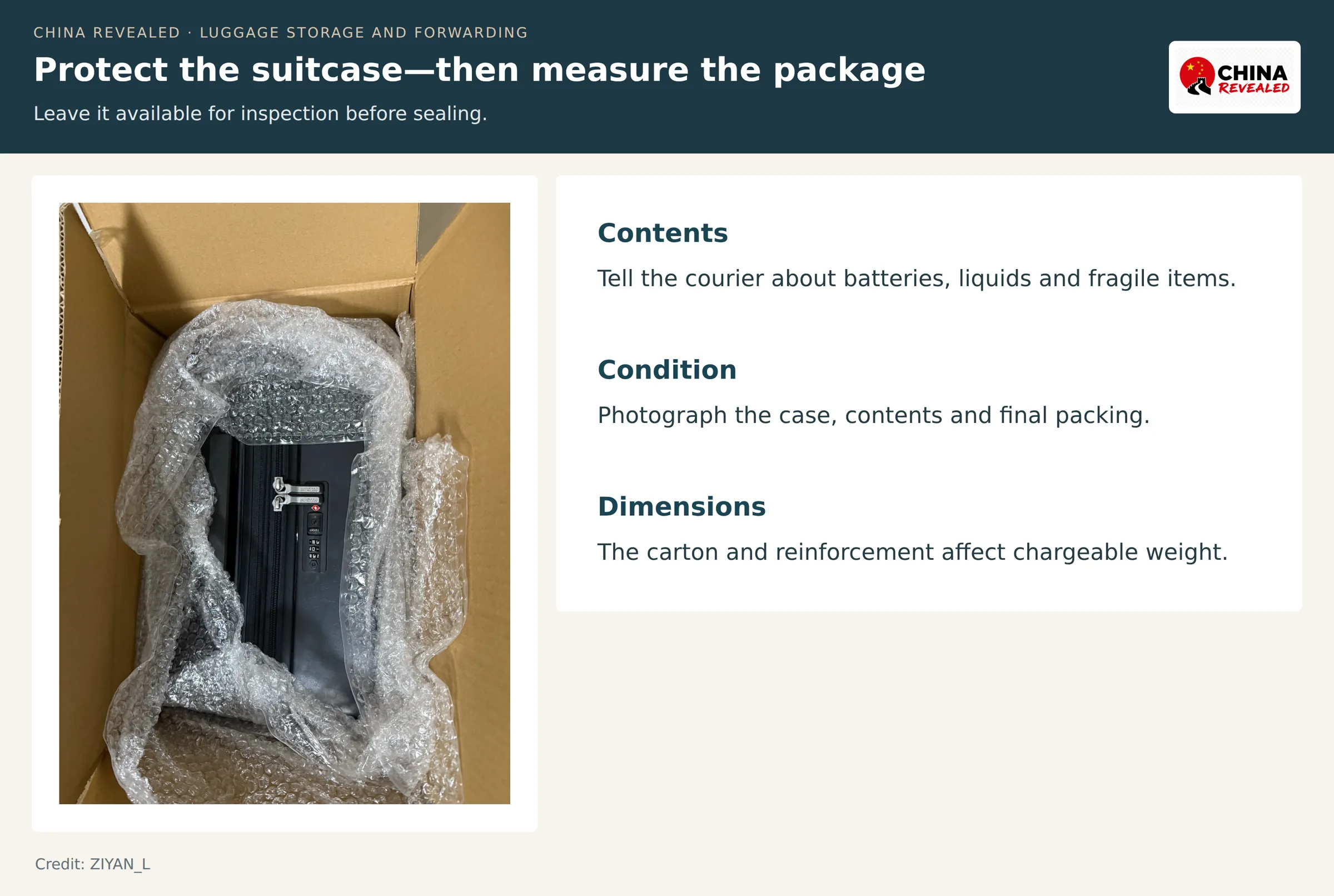
Keep the passport, money, cards, electronics you need, essential medicine and enough clothes/toiletries for the period without the case in your own small bag. Show the courier any batteries, liquids, aerosols, food or fragile items and ask about acceptance for the chosen product. Do not assume that something allowed on a train is accepted by that courier service.
Leave the case accessible for inspection before sealing. Ask whether it needs a carton or protective wrapping, especially around wheels, handles and corners. Photograph the outer condition and contents, then the final package. A protective carton changes the dimensions and can change the bill.
Why the weight on your hotel scale may not be the billed weight
SF compares actual weight with volumetric weight—a calculation based on the parcel’s size—and uses the applicable larger figure. The divisor is product- and route-specific. Its published mainland rules commonly use 6,000 for Express, and 12,000 for Standard Express below 30 kg on many routes; exceptions and rounding still apply.
For an illustrative 70 × 50 × 40 cm packed carton weighing 12 kg:
| Applicable calculation | Volumetric weight | Compare with 12 kg actual weight |
|---|---|---|
| 140,000 cm³ ÷ 6,000 | About 23.3 kg | Volume is higher, before billing increments |
| 140,000 cm³ ÷ 12,000 | About 11.7 kg | Actual weight is higher, before billing increments |

That is why a bulky but light suitcase can cost more than expected. It is a calculation example, not an SF shipment quote. Ask which divisor and chargeable-weight increment apply to your exact route and product; do not calculate every suitcase with one universal rule.
5. Track the handover and collect at the hotel
Save the waybill number / 运单号, chosen product, total charge, tracking access and hotel contact. A pickup appointment is not proof the case has been collected. Once it is in transit, follow tracking and tell the receiving hotel the number and expected date.
If you change hotels, contact SF from the original shipment and alert both properties before making another arrangement. Do not assume a parcel will follow a booking change automatically.
At the receiving hotel, ask reception to locate the case under your reservation name and waybill. Inspect the suitcase and any damage before discarding the packaging. For a problem, retain the carton, wrapping, condition photographs, payment record and value evidence and contact the carrier promptly. Declared value / 保价 is a carrier service, not a substitute for travel insurance or an automatic payment of the number you entered.
Railway luggage services: handling versus forwarding
You may see two railway-linked services with similar English descriptions. They solve different problems.
轻装行 / Light Travel is a ticket-linked same-city door-to-station or station-to-door handling service, publicly described for addresses within 35 km of participating stations. Depending on the ordered option, staff hand over at a station service cabinet or platform, or deliver from the arrival station to a local address. It does not provide the cross-city leg and does not waive train baggage limits.
Look in the Chinese 12306 app or supported mini program for 轻装行, select the eligible journey and read the actual handover location, deadline and price. Published booking windows are 48–4 hours before departure for door-to-station and 24–1 hour before arrival for station-to-door. With a foreign passport or a ticket booked through another platform, confirm that the journey and identity are accepted in this service’s flow; use 12306 or China Railway Express’s 95572 if necessary.
高铁便民托运 / station convenience forwarding is a separate shipping service at participating station desks or security-area service points. The railway’s public page lists reference first-weight charges of ¥23 with ¥10/kg for additional weight for standard service, or ¥18 with ¥6/kg for additional weight for economy service, with city-dependent variation. These are not SF’s general hotel-pickup rates; confirm the initial weight band, chargeable weight and current total at the service point.
The same page describes the fastest standard arrival as the next day before 18:00, and economy as the day after next before 23:59, depending on dispatch and destination. Those are earliest service descriptions—not a promise that your bag rides on your train. If you need this option, ask before the gate deadline, and confirm that the contents can be accepted for shipping.
When the locker, payment or collection goes wrong
| Problem | What I would do |
|---|---|
| Large lockers are full or the case will not fit | Ask the information desk for a staffed point; check your hotel or a nearby booked partner shop |
| Overseas phone or foreign card is rejected | Use the operator’s support or a staffed point with an accepted payment method; do not borrow identity details |
| Door does not open after payment | Stay at the cabinet, keep the order and compartment details, and contact the posted operator before paying again |
| Phone dies or collection proof is lost | Contact reception or the operator; bring the original passport and whatever order/bag details you have for its verification process |
| You will return after closing | Contact the point before it closes and arrange an agreed extension or earlier collection; paying more may not reopen the building |
| Security rejects an item | Ask staff about available, lawful storage or forwarding; a service that can hold a bag may still refuse the contents |
| The suitcase is missing or damaged | Report it immediately to the point/platform or carrier, retain records and photographs, and involve police for suspected theft |
Do not leave luggage unattended outside a locked shop or beside a full locker. If you cannot resolve storage in time, simplify the sightseeing plan. Missing a train because you saved a small storage fee is a poor trade.
Keep collection codes, bag-tag numbers and waybill access private. For a staffed handover to another person, arrange authorization with the operator first; forwarding a screenshot is not automatically sufficient.
Chinese phrases to show staff
| Show this | Meaning |
|---|---|
| 请问这里可以寄存行李吗? | Can I leave luggage here? |
| 我有一个大箱子,可以放得下吗? | I have a large suitcase. Will it fit? |
| 寄存处在安检里面还是外面? | Is storage before or after security? |
| 按小时还是按天收费?最晚几点取? | Is it charged by hour or day? What is the latest pickup time? |
| 我今天退房,可以寄存到下午六点吗? | I am checking out today. Can you hold my bags until 6 pm? |
| 可以寄存过夜吗?过了零点怎么算钱? | Can I leave it overnight? How is it charged after midnight? |
| 我用外国护照,可以办理吗? | Can I use a foreign passport for this service? |
| 我要用顺丰寄到下一个酒店。 | I want to send this by SF Express to my next hotel. |
| 请把酒店的中文地址和收件电话发给我。 | Please send me the Chinese hotel address and delivery contact number. |
| 请问预计哪天送到?运费和包装一共多少钱? | What day is delivery expected? How much are shipping and packing together? |
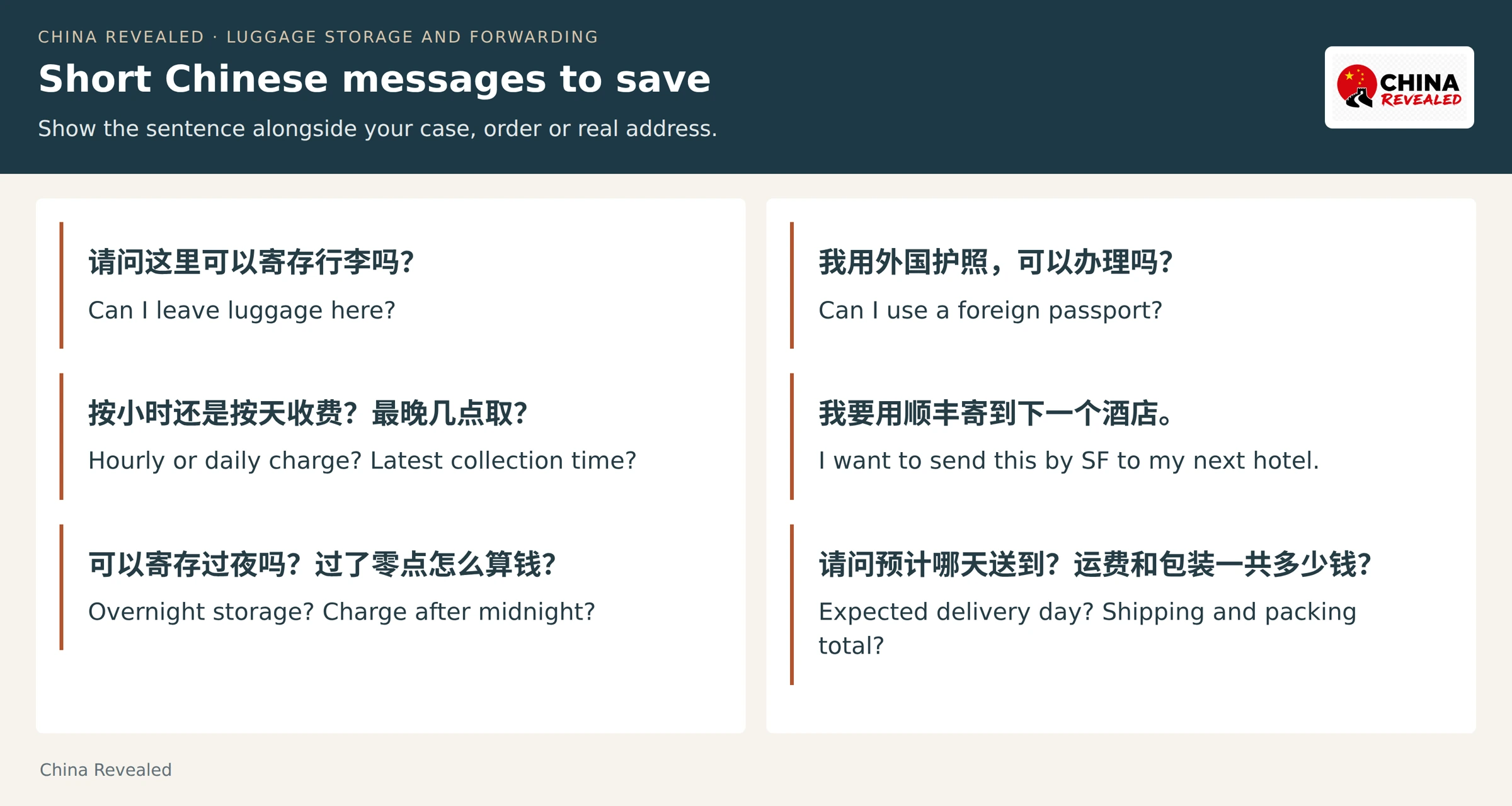
Show the sentence alongside your actual order, address or suitcase. For a longer explanation, use a translation app, but rely on the operator’s current booking terms for the price and collection deadline.
Three luggage plans that work with the itinerary
A final sightseeing day before an evening train
Suppose you check out in the morning and leave Beijing South that afternoon. If your hotel is on the useful route, ask it to hold the case, sightsee with a day bag, and return early enough to collect before your station buffer. If that creates a detour, investigate station-area storage before checkout instead.
Do not build the day around a waiting-hall storage facility until you have confirmed access and your passport procedure. Put the latest collection time in your calendar, then work backward from the train—not from the shop’s closing time.
Change hotels without carrying the case all afternoon
Ask the new hotel whether you can leave luggage before check-in. If yes, go there first, receive a tag and head out. If it has no luggage room, ask the old hotel about same-day post-checkout storage and compare the return detour with a partner shop near your afternoon destination.
This is usually a local storage problem, not a reason to pay for intercity shipping. The simplest answer is often one reception conversation.
A side trip with only a small bag
For a Shanghai–Hangzhou–Beijing itinerary, consider sending the nonessential case from Shanghai to your Beijing hotel while you spend several nights in Hangzhou. First establish that the receiving hotel accepts early delivery and that the live SF estimate leaves a buffer within the stay. If it does not, adjust the shipping plan rather than promise yourself same-day arrival.
Carry everything needed until the agreed delivery window has passed. Track the case during the side trip, update the hotel, and collect at reception in Beijing. Sending ahead is worthwhile when it removes awkward transfers and repeated packing—not when it replaces them with a courier deadline you cannot meet.
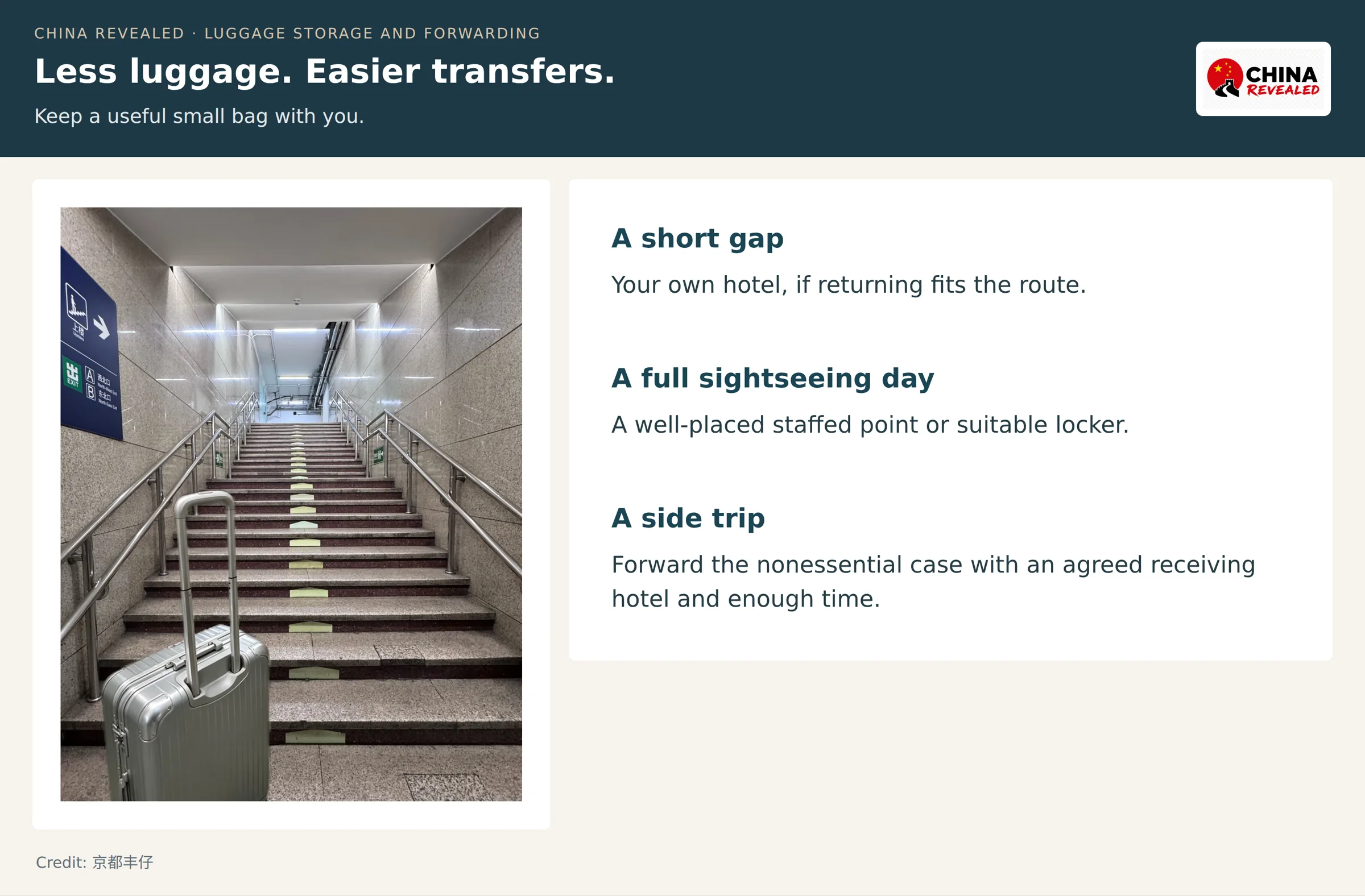
My rule: use the hotel for a short gap, a well-placed staffed point or locker for a sightseeing day, and forwarding for a nonessential case with enough time to travel separately. Keep the passport and a useful small bag with you whichever option you choose.
Service information and published examples checked October 19, 2026. Mainland domestic services are covered here; Hong Kong, Macau and international shipments need their own arrangements.
About China Revealed
China Revealed is an independent English-language travel guide dedicated to China.
We bring together China travel guides, destination information, local insights and practical travel resources in one place.
Our travel database covers China's provinces, cities, famous attractions, hidden gems, local cuisine, transportation, accommodation, visa requirements, digital payments, mobile connectivity and the other practical details travelers need to explore China.
We focus on depth, careful research and accuracy. Our guides combine official sources, detailed destination data, local knowledge and regularly updated information to give reliable, practical travel advice.
Whether you're visiting China for the first time or exploring beyond the popular destinations, China Revealed is an all-in-one resource for discovering the real China.
China Revealed — Your practical guide to China.
Some links on China Revealed, such as Trip.com booking links, are affiliate links. If you book through them, we may earn a commission at no extra cost to you. This does not change what we recommend.