

China Travel Budget: How Much Does a Trip to China Cost?
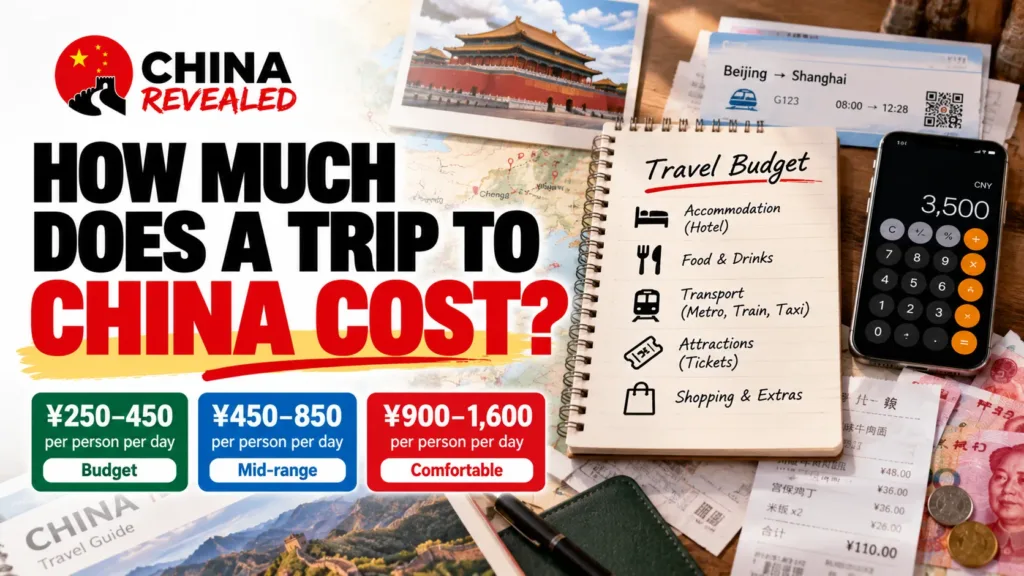
For a first China travel budget, I would allow about ¥250–450 per person per day on a budget, ¥450–850 mid-range, or ¥900–1,600 for a comfortable city trip, with long-distance tickets added separately. These are spending targets for two adults sharing a room. A solo traveler paying for the whole room needs more.
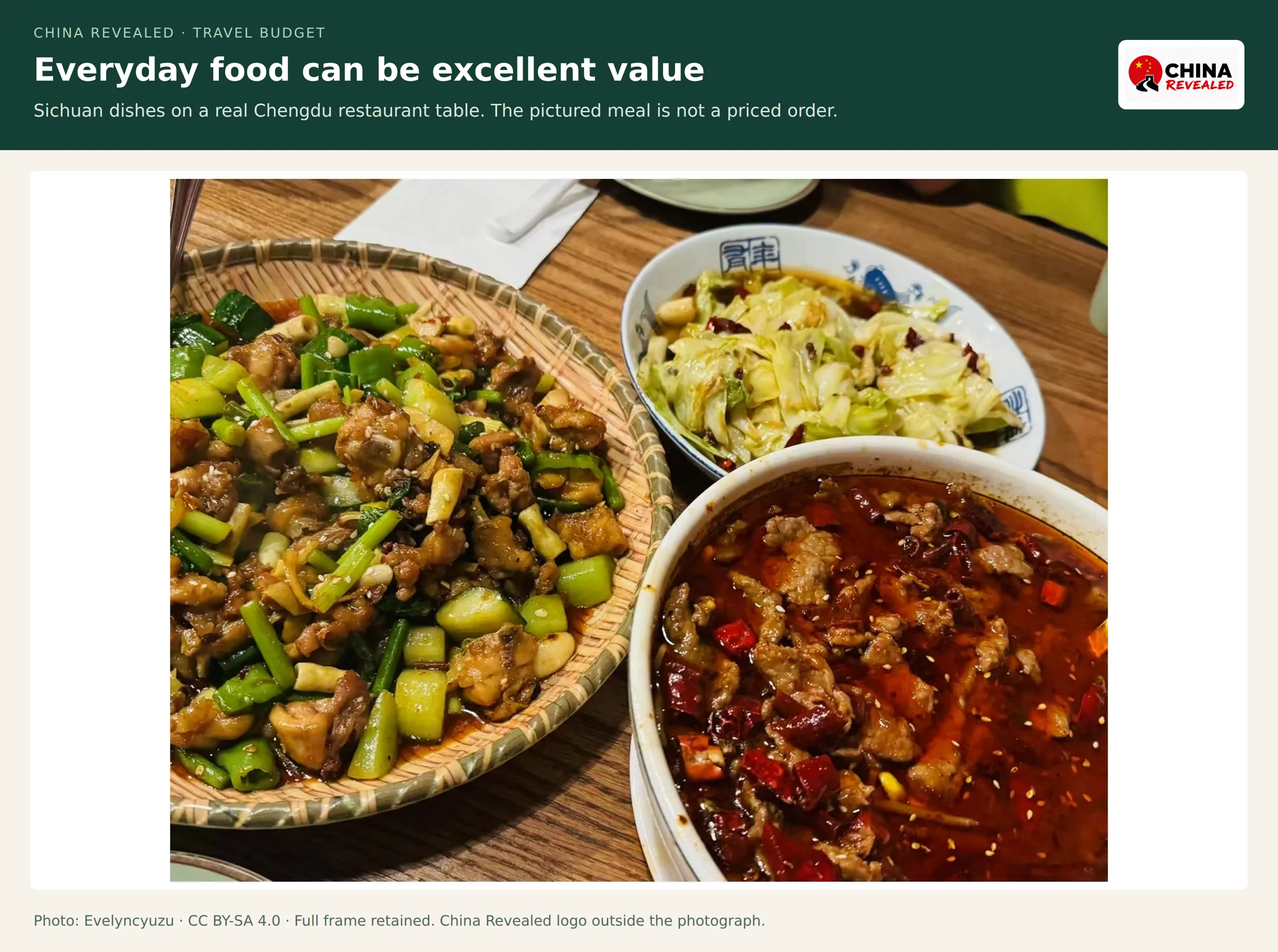
China can be excellent value for everyday food and public transport. What makes a trip expensive is usually a central hotel, repeated city changes, premium restaurants, and mountain or theme-park days—not a bowl of noodles or an ordinary metro ride. I would choose the route first, spend enough on a useful hotel location, and leave room for a few experiences worth paying for.

Quick takeaways
- Count rooms by night and food by day. A 10-day trip normally has nine hotel nights, not ten.
- A hotel price is usually per room; a taxi price is per car. Divide shared costs once, not twice.
- Everyday food and the metro are the easiest places to save. A budget trip does not have to mean eating badly or sleeping in dormitories.
- Add intercity tickets and transfers to the daily budget. A cheap flight without the required baggage may not be the cheapest journey.
- Keep a 10% contingency after pricing the route. International flights, visas, insurance, shopping and alcohol are outside the sample totals below.
In this guide
- 1. Three budgets and what they buy
- 2. Accommodation: buy the location and the right room
- 3. Food: everyday meals and the dinner worth paying for
- 4. Transport: city rides, transfers and intercity tickets
- 5. Tickets: ordinary sights versus expensive attraction days
- 6. How the city and travel date change the bill
- 7. What 7, 10 and 14 days cost
- 8. A 10-day mid-range budget, line by line
- 9. Extras, deposits and payment costs
- 10. Solo travelers, families and sensible savings
1. Three budgets and what they buy
Budget means a practical private room, small local restaurants, public transport and selected paid sights. It does not assume hitchhiking, overnight trains or surviving on instant noodles. Hanting and Jinjiang Inn are useful starting points for hotel comparisons, although the branch and room matter more than the brand.
Mid-range is the most useful starting point for many first-time visitors: a well-located double or twin room, good ordinary restaurants, second-class high-speed rail, and taxis when they save an awkward transfer. Ji Hotel is a useful mid-range benchmark; Atour can sit toward the upper end, depending on the property.
Comfortable buys more room space, better locations, more generous restaurant spending and more taxi flexibility. It is not a luxury budget. International five-star hotels, private guiding every day, business-class transport and tasting menus can take spending well above it.
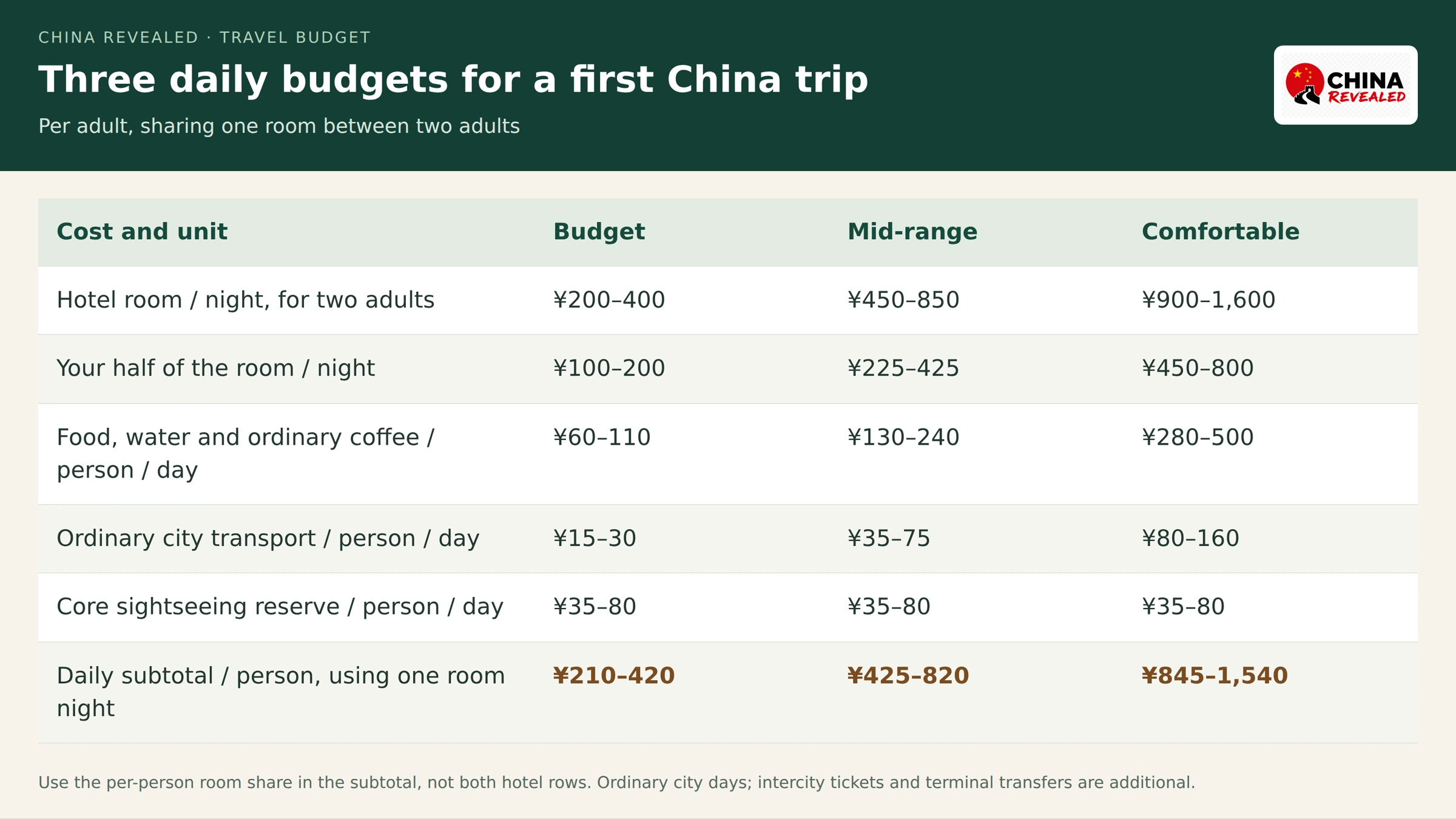
Daily budget table
| Cost and unit | Budget | Mid-range | Comfortable |
|---|---|---|---|
| Hotel room / night, for two adults | ¥200–400 | ¥450–850 | ¥900–1,600 |
| Your half of the room / night | ¥100–200 | ¥225–425 | ¥450–800 |
| Food, water and ordinary coffee / person / day | ¥60–110 | ¥130–240 | ¥280–500 |
| Ordinary city transport / person / day | ¥15–30 | ¥35–75 | ¥80–160 |
| Core sightseeing reserve / person / day | ¥35–80 | ¥35–80 | ¥35–80 |
| Daily subtotal / person, using one room night | ¥210–420 | ¥425–820 | ¥845–1,540 |
The subtotal uses your half of one room night, food, normal city travel and a modest sightseeing reserve. Do not add the full room price and your half together. The room bands are broad city-trip examples; the city-specific hotel table below is more useful when choosing actual stays.
The sightseeing line is money spread across the trip, not a charge collected every morning. One day might be a neighborhood walk; another might have several tickets. It covers ordinary core sightseeing, not Disneyland, a private guide or a full mountain-transport itinerary. The three tiers do not imply that the same adult admission ticket costs more for a comfortable traveler.
All amounts are Chinese yuan: ¥, RMB and CNY refer to the same currency here. These are normal-date planning ranges checked against available information on October 18, 2026. Once dates are fixed, replace the hotel and flight allowances with actual checkout totals. Use the booking service’s currency display for a conversion to a home currency rather than assuming a permanent dollar exchange rate.
2. Accommodation: buy the location and the right room
Hotels are usually the largest adjustable part of a China travel budget. The useful comparison is not “China hotel prices.” It is the same city, dates, neighborhood, room type and cancellation terms.
| City group: room / night | Budget | Mid-range | Comfortable |
|---|---|---|---|
| Beijing / Shanghai | ¥200–500 | ¥500–900 | ¥900–1,600 |
| Xi’an / Chengdu | ¥150–350 | ¥350–650 | ¥650–1,200 |
These figures are per room per night for two adults, before dividing. A ¥600 room is ¥300 per person when two share it, but ¥600 for a solo traveler using the same room. Beijing and Shanghai generally need a higher room allowance than Xi’an and Chengdu; a prime sightseeing location can erase that difference.
What I would pay extra for
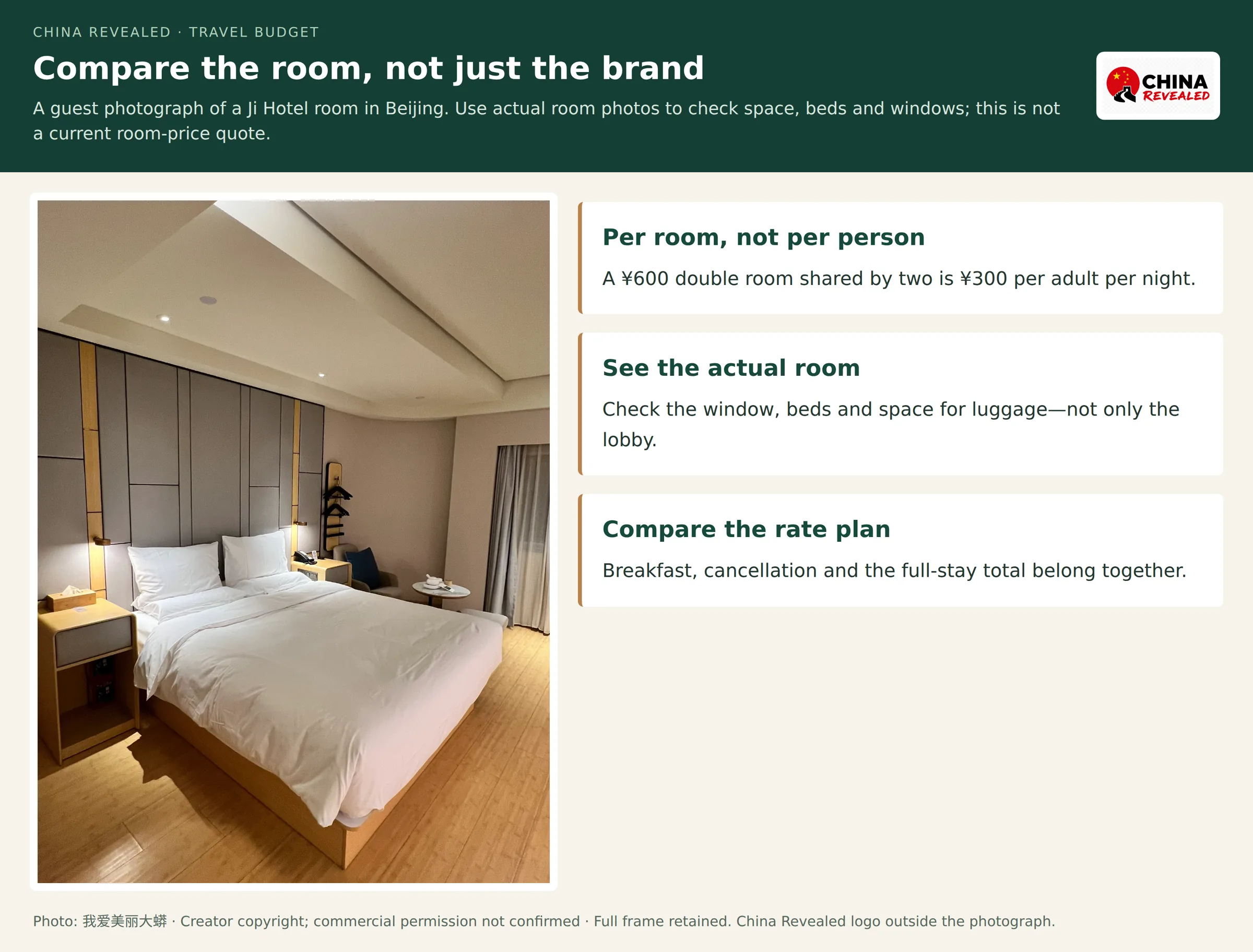
A useful metro entrance, an external window, enough room to open the suitcases, and recent reviews mentioning quiet nights are more valuable than a grand lobby. In Beijing, an apparently cheap outer-district hotel can add long journeys to every outing. In Shanghai, paying specifically for a Bund view is different from staying within an easy walk or metro journey of the waterfront.
Check the exact branch. “Hongqiao” in a Shanghai hotel’s name does not mean it is inside Hongqiao Railway Station. A brand can also have an older compact property and a much newer spacious one in the same city. Guest room photos are especially useful for seeing that difference.
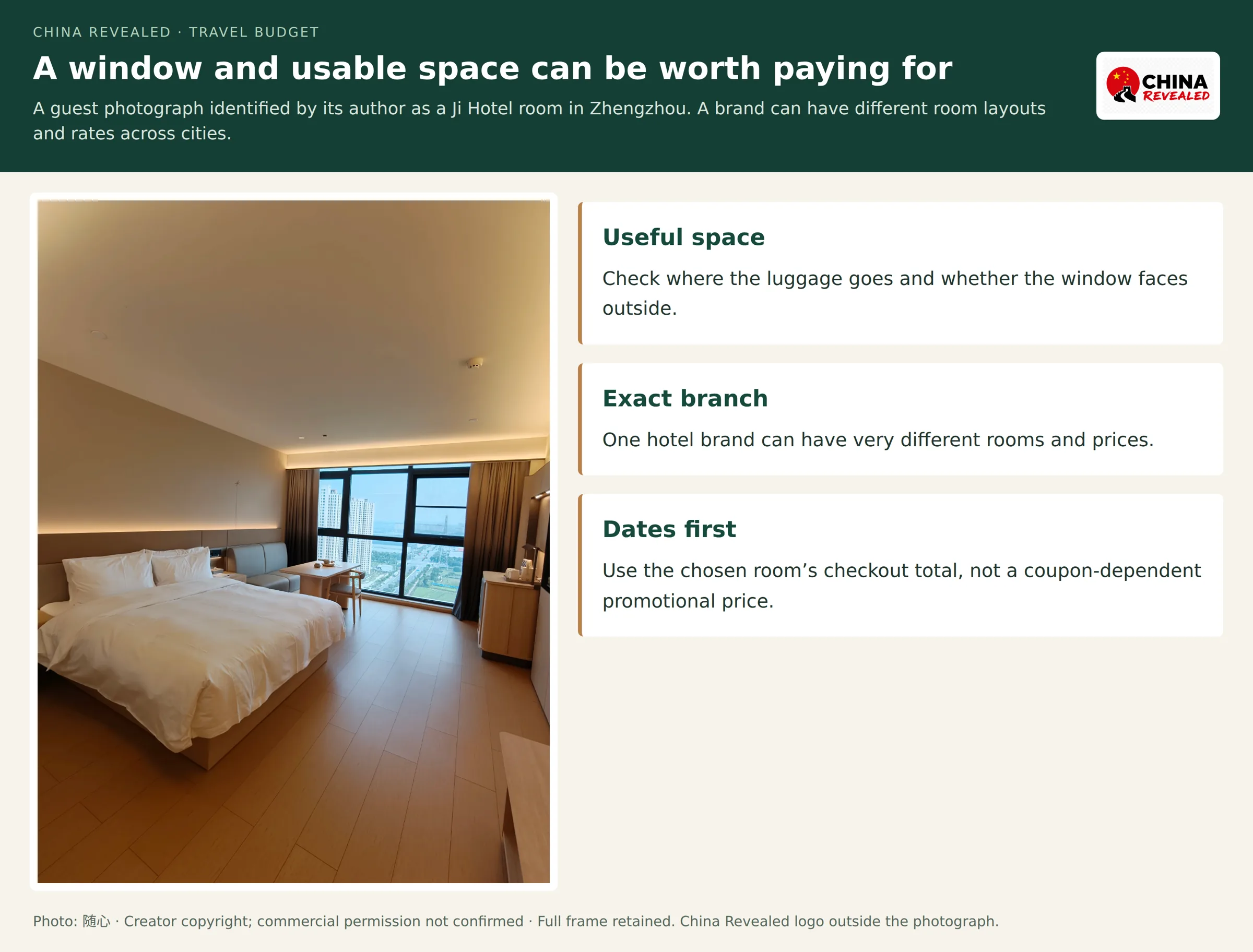
Compare the complete rate
Look at the bed arrangement, permitted guest count, private bathroom, window and room size. Then compare breakfast, cancellation and the full-stay total. A double room has one large bed; a twin room has two beds. An “inner window” may face a corridor rather than outdoors.
Breakfast is a rate-plan choice, not automatically included because the hotel has a restaurant. If two breakfasts are included, reduce the food allowance for those mornings. If the paid breakfast is expensive and there are good food shops nearby, room-only can be better value.
Bring each guest’s original passport and confirm the specific property’s reception and registration arrangements. Foreign travelers do not need a special “foreigner hotel” category. Our hotel-booking guide covers the branch, room, passport registration and payment checks.
For a morning arrival, ask about luggage storage before buying another room night. If a room is needed at 1 a.m., it will normally be the previous night’s booking, held for the late arrival. An early check-in or late checkout can cost extra; settle it before treating the room as available all day.
3. Food: everyday meals and the dinner worth paying for
Eating cheaply is one of the pleasures of traveling in China. Noodles, rice bowls, steamed buns and dumplings are everyday meals, not a fallback tourist diet. The price rises when a meal becomes a famous-name restaurant, a premium hot-pot order or a hotel dining experience.
| Food or drink | Useful planning range | Read the unit |
|---|---|---|
| Soy milk and one or two buns | ¥6–18 | Per person; buns are often priced individually |
| Ordinary noodle or rice meal | ¥12–30 | Per bowl or portion |
| More complete mall or chain meal | ¥25–60 | Per person or set meal |
| Regular xiaolongbao | ¥18–45 | Per basket; check the number of dumplings |
| Ordinary shared dishes | ¥40–100 | Per plate, not per diner |
| Bottled water | ¥2–6 | Per bottle in ordinary shops |
| Regular brewed coffee | ¥8–30 | Per cup; specialty cafés can be higher |
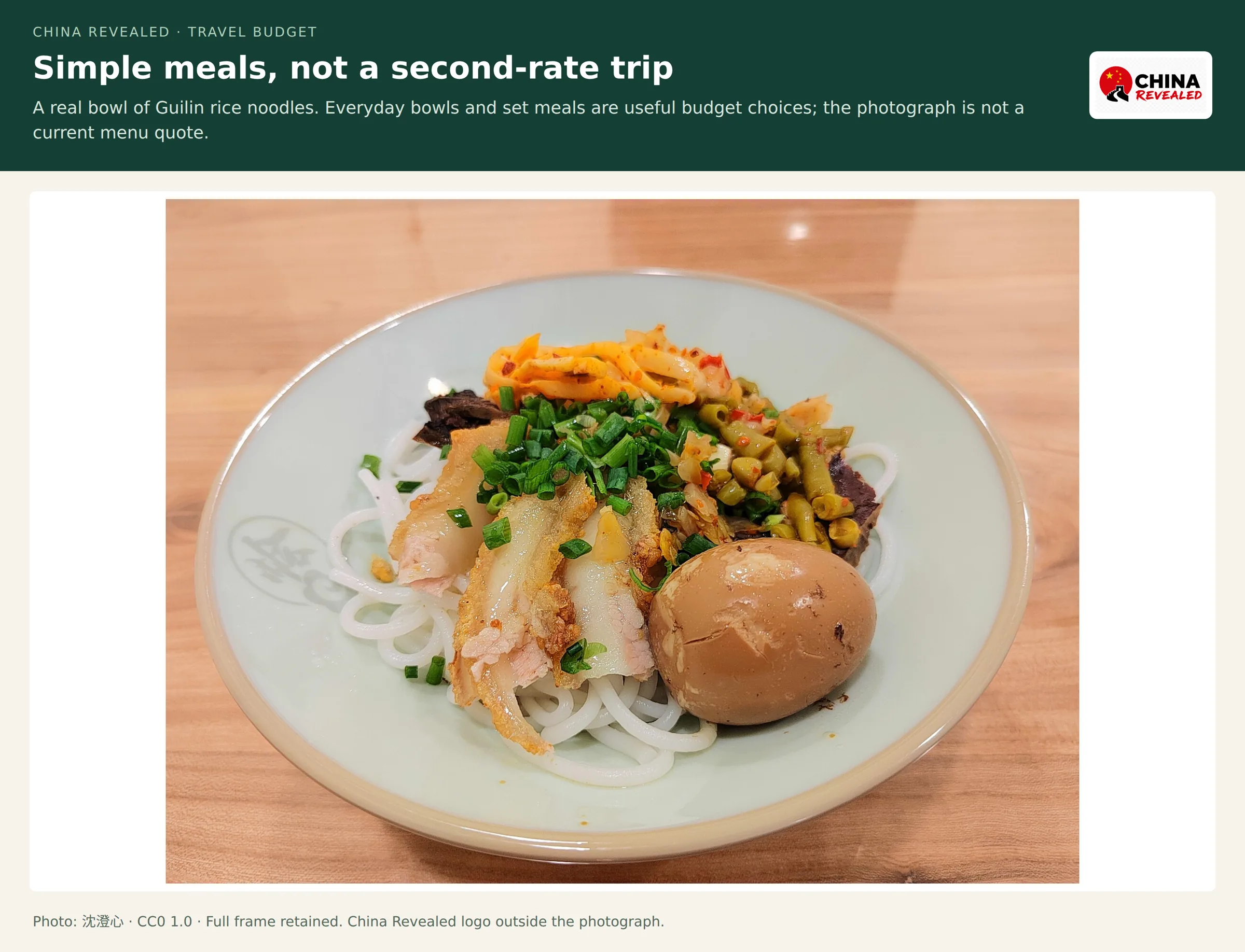

The daily food allowances are ¥60–110 budget, ¥130–240 mid-range and ¥280–500 comfortable, including three meals and ordinary water or coffee, but no alcohol. These are generous enough to make choices; they are not a requirement to spend that much every day. The comfortable band allows noticeably better restaurants and ingredients, not simply a larger bowl of the same noodles.
Shared food is where the arithmetic matters
In a normal Chinese restaurant, the meat, vegetables and soup are commonly sold as whole dishes. For two people, start with a couple of dishes and rice, then add more if necessary. Ordering a separate full set of plates for each diner can double the bill and leave a lot uneaten.
With hot pot, check 锅底 / broth base, 蘸料 / dipping sauce, meat portions and drinks. The base may be a whole-table charge, while sauce can be charged per diner. A hypothetical ¥360 complete bill for two is ¥180 each—not ¥360 each. Ask whether a two-person deal includes those extras before buying it.
A solo diner often gets better value from a noodle bowl, a rice meal, dumplings or an individual hot pot than from a large shared-dish order. Ask about 小份 / small portion or 半份 / half portion, but do not assume every kitchen offers them.
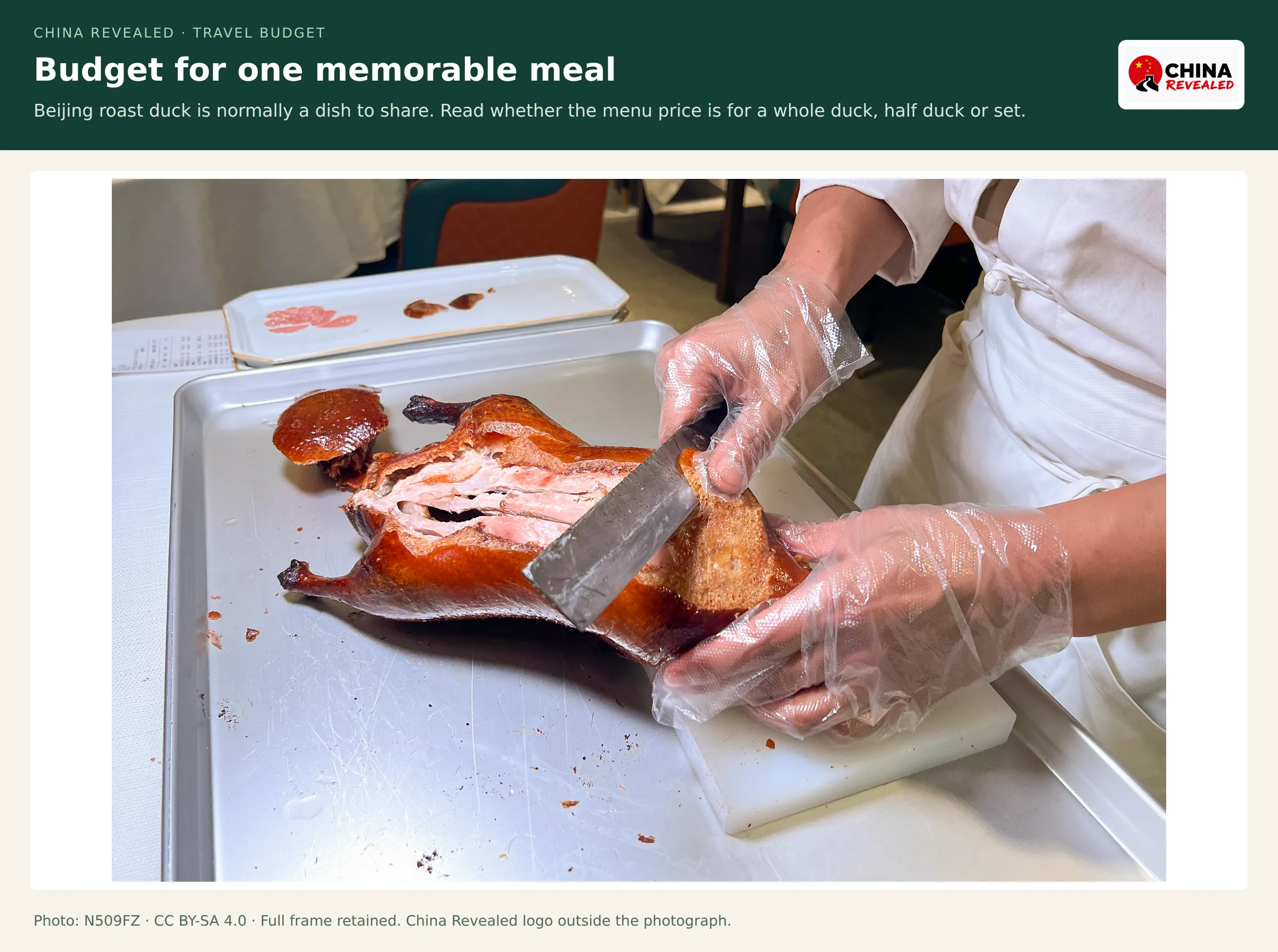

Spend on a meal, not on a queue
Leave room for one meal that belongs to the place: roast duck in Beijing, a Sichuan dinner in Chengdu or a good dumpling meal in Shanghai. Check the menu and recent guest photos before assuming a famous branch is worth its higher price. A roast-duck listing may be a whole duck, half duck or set; those are different purchases.
Use Dianping to compare the actual restaurant branch and menu. 人均 is an indicative average spend, not a promised bill. A prepaid set meal must fit the branch, time and number of diners.
Ordinary mainland restaurants do not normally expect a separate tip. An upscale restaurant may list a service charge, so read the menu footer and final bill. This is not a reason to add a Western-style tipping percentage to every meal.
4. Transport: city rides, transfers and intercity tickets
Keep three lines in the budget: movement within the city, airport or station transfers, and intercity tickets. They do different jobs. The most common mistake is to price a train or flight but forget both ends of the journey.
In the city
An ordinary urban metro ride in the main first-trip cities is often around ¥2–8, depending on city and distance. Beijing’s regular subway starts at ¥3; Shanghai’s metro starts at ¥3 for the first 6 km. Dedicated airport services have different prices.
Use ¥15–30 per person for a public-transport city day, around ¥35–75 for a metro-and-short-taxi mix, or ¥80–160 for more taxi flexibility. A couple sharing a taxi can find it good value for an awkward last stretch. In heavy traffic, the metro may still be the faster comfortable choice.
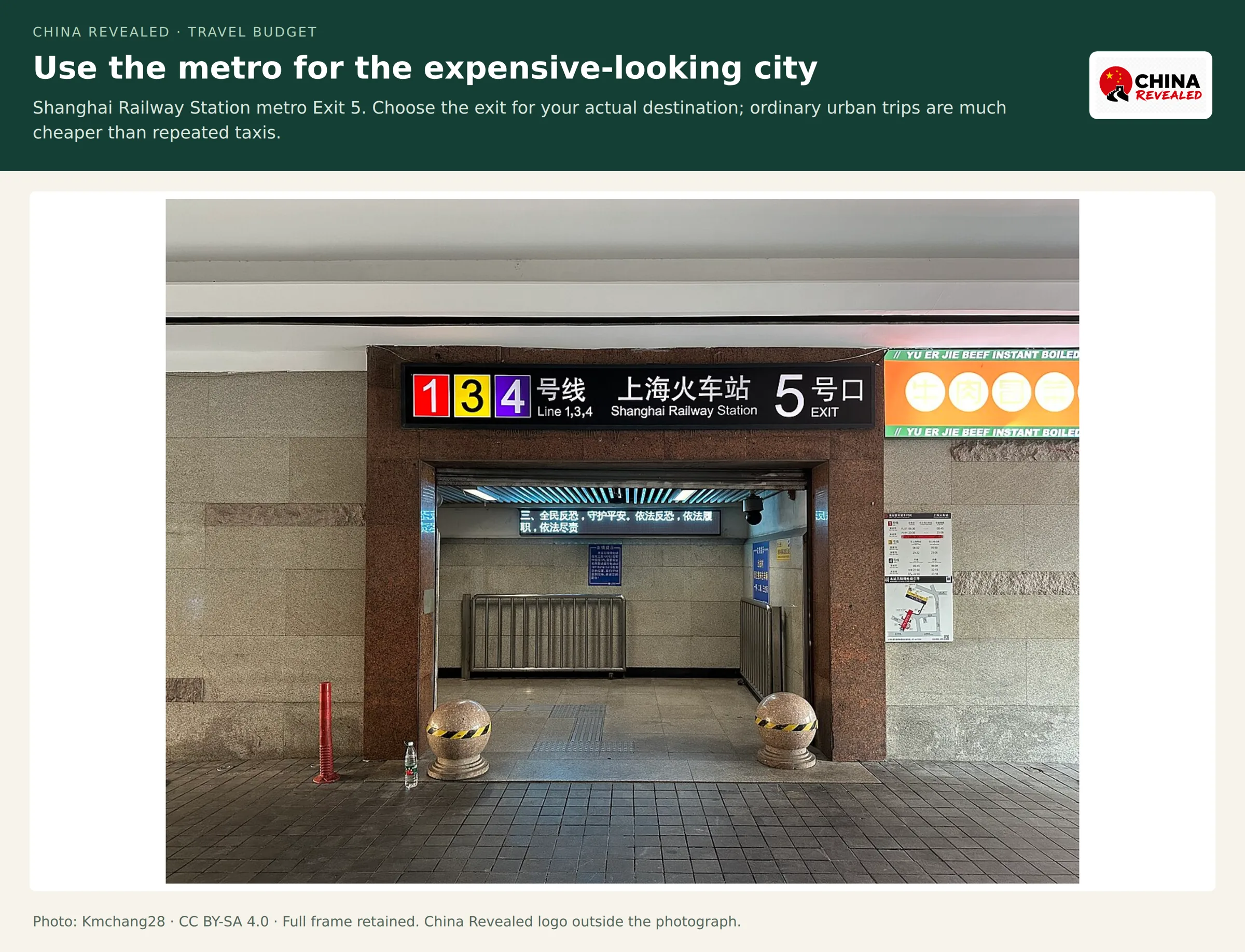

For the daily routine, use our metro, bus and shared-bike guide. A riding pass is useful only if it matches the trips actually planned; it is not automatically cheaper than a few single fares.
Airport and station transfers
| Example airport transfer | Taxi or ride-hailing allowance | Unit |
|---|---|---|
| Beijing Capital to a central hotel | ¥100–180 | Per car |
| Beijing Daxing to a central hotel | ¥180–300 | Per car |
| Xi’an airport to the central area | ¥90–150 | Per car |
| Chengdu Shuangliu to the city | ¥60–100 | Per car |
| Chengdu Tianfu to the city | ¥150–220 | Per car |
| Shanghai Pudong to the central area | ¥120–220 | Per car |
| Shanghai Hongqiao Airport to the central area | ¥50–100 | Per car |
These are planning allowances for a normal vehicle and reasonable hotel location. The exact destination, traffic, time and vehicle change the fare. A ¥150 car shared by two costs ¥75 each. A metro or airport express is priced per passenger instead.
A cheap room beside the airport can be a good departure-night choice, but a poor base for three sightseeing days. Compare the total room saving with the extra journeys and lost time. Full-day trips to the Great Wall or other out-of-town sights need their own return-transport allowance, not just an ordinary city-day fare.
High-speed rail and domestic flights
| First-trip connection | Travel time on the train or in the air | Per-person ticket allowance |
|---|---|---|
| Beijing South → Shanghai Hongqiao | Roughly 4½–7½ hours by high-speed train | ¥580–700, second class |
| Beijing → Xi’an North | Roughly 4–6 hours by high-speed train | ¥480–600, second class |
| Xi’an North → Chengdu East | Roughly 3–5 hours by high-speed train | About ¥270, second class |
| Xi’an → Shanghai | About 2½ hours flying | ¥700–1,100, economy with one checked bag |
| Chengdu → Shanghai | About 2¾ hours flying | ¥700–1,100, economy with one checked bag |
The flight amounts are budget placeholders before dates are chosen, not a claim that every flight is available in that band. Replace them after choosing the airport and travel day. The rail ranges also vary by service; a faster or differently routed train can have a different price.
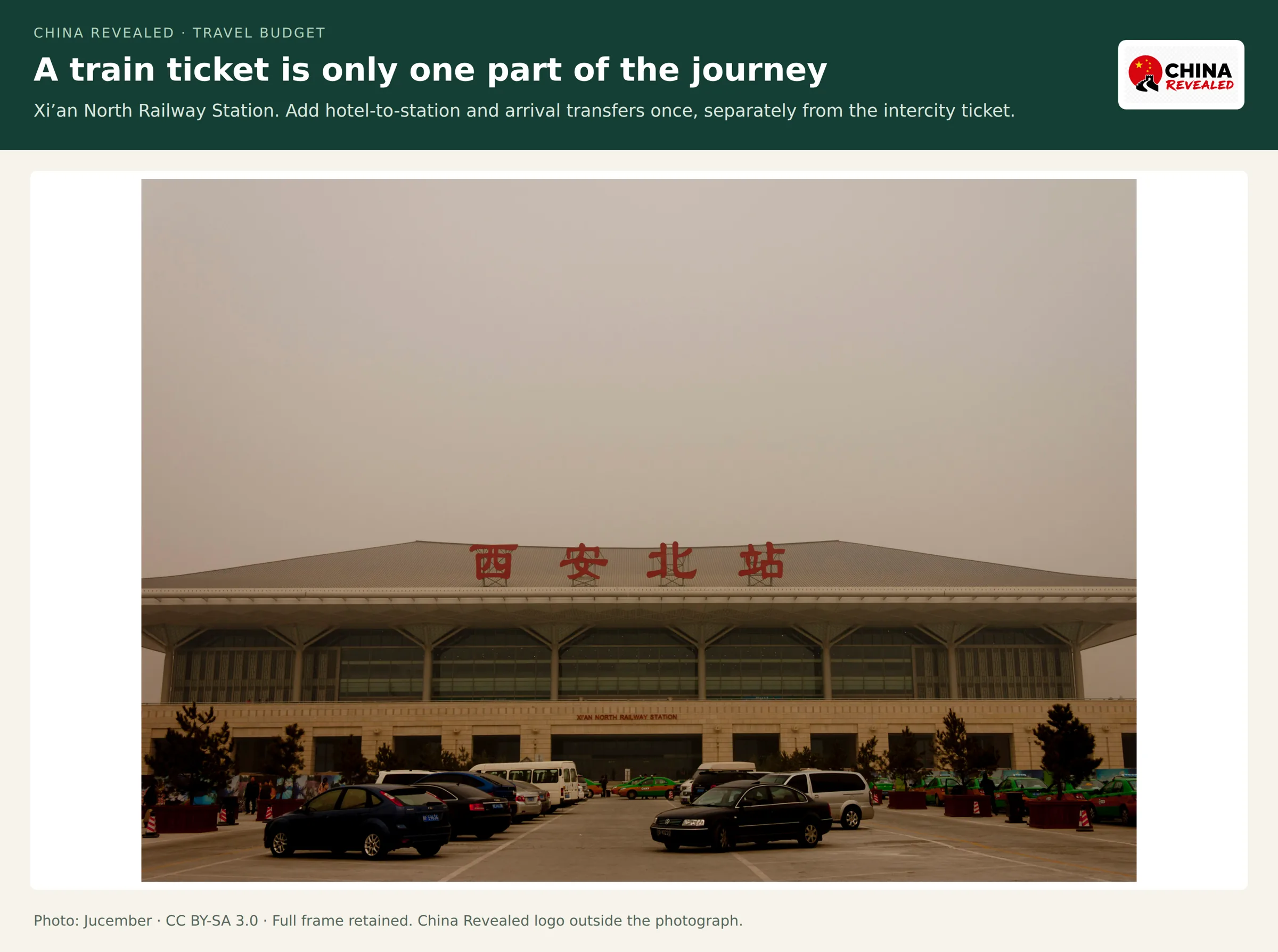

Second class is a sensible default even for a comfortable holiday. Spend more on first class if the extra seat space matters, not because second class is an unsuitable product. On the Beijing–Shanghai comparison, first class is roughly ¥970–1,120 rather than ¥580–700; business class can be around ¥2,000–2,430. Those upgrades should appear as a deliberate extra, not disappear inside a daily allowance.
For booking, use the high-speed train ticket guide. Check the full station name and include the hotel-to-station journey. A city name is not a precise departure station.
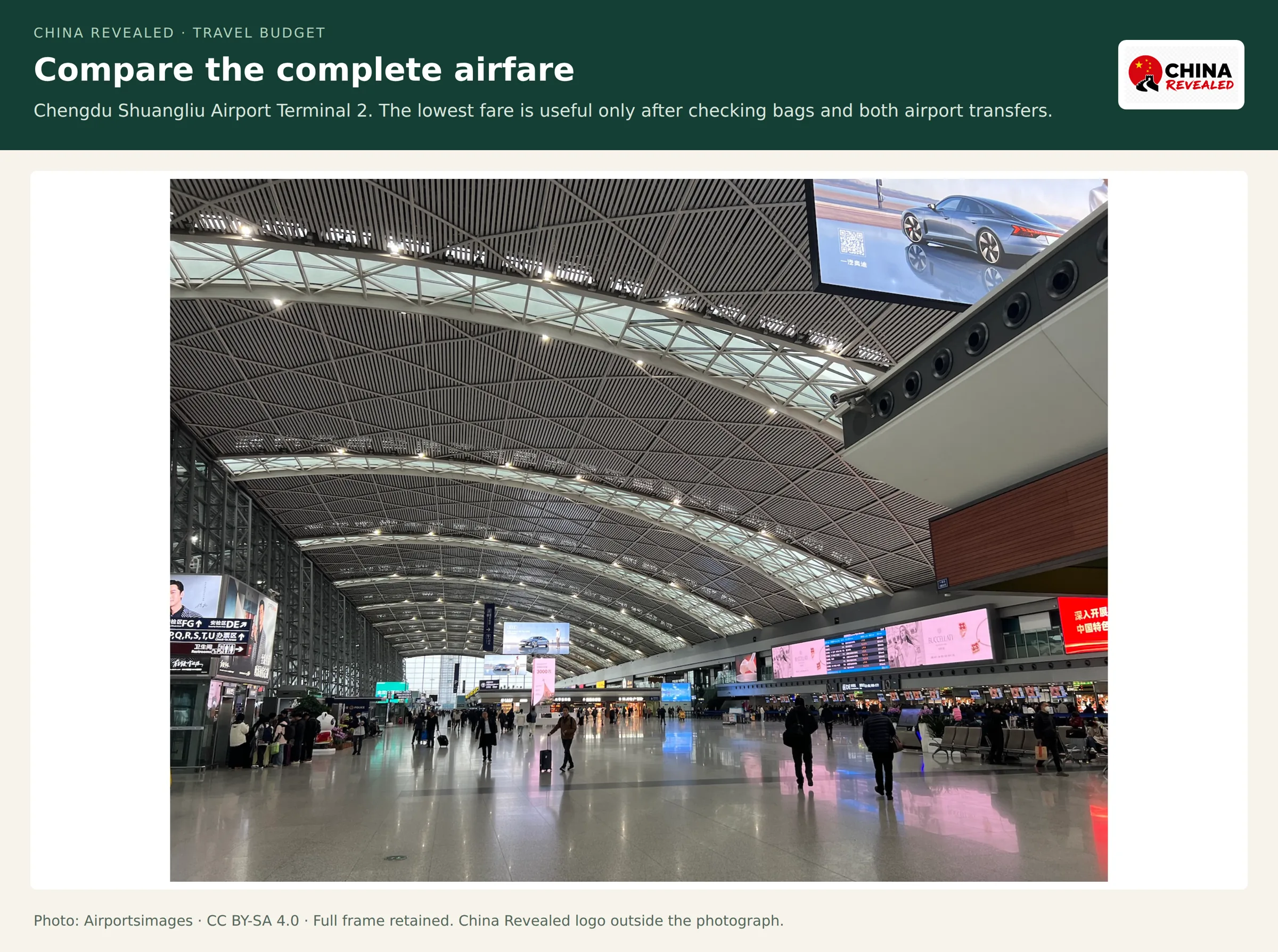

For flights, compare economy seat + required bags + both airport transfers. The lowest base fare may exclude checked baggage. Our domestic-flight guide explains the fare and baggage checks. Chengdu’s CTU and TFU, and Shanghai’s SHA and PVG, can produce very different transfer costs.
5. Tickets: ordinary sights versus expensive attraction days
China’s main cultural sights can be relatively modest expenses compared with the hotel. The expensive days are more likely to be a mountain itinerary with several lifts, a theme park, a show or a private guided excursion.
| Attraction | Standard adult starting point | What to price separately |
|---|---|---|
| Forbidden City / Palace Museum | ¥60 April–October; ¥40 November–March | Treasure Gallery and Clock Gallery: ¥10 each |
| Terracotta Warriors | ¥120 | Optional electric carts inside the sites |
| Chengdu Panda Base | ¥55 | Optional sightseeing bus: ¥30 |
| Yu Garden, the actual garden | ¥30–40 by season | Nearby shopping, meals and special night products |
| Mutianyu Great Wall | ¥40 admission | Internal shuttle, cable car or ropeway/toboggan, plus transport from Beijing |
| Wulingyuan core scenic area | ¥236; core ticket valid for four days | Optional elevators and cableways; Tianmen Mountain is separate |
| Shanghai Disneyland | The checked product displayed ¥499 as a starting price | Actual visit-date tier, food, Premier Access and souvenirs |
| The Bund waterfront walk | ¥0 basic admission | Cruise, observation deck and restaurants |
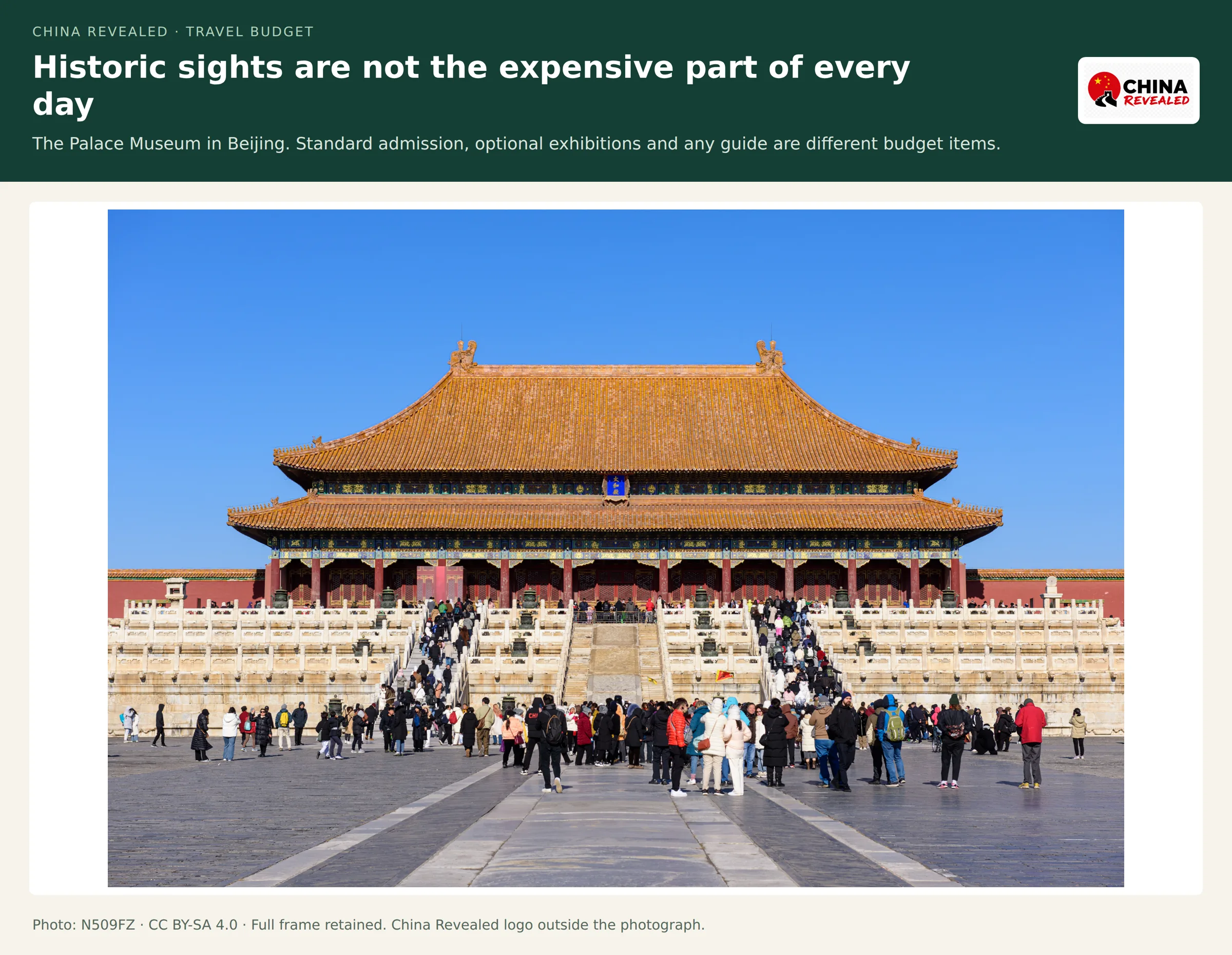

Do not turn a ¥40 ticket into a ¥40 day
Mutianyu‘s entrance is only the beginning. The shuttle and chosen cable car or ropeway are separate, as is the round trip from Beijing. In the sample budgets, ¥180–220 per person is reserved for the selected internal transport and rides, in addition to the ¥40 entrance. That is an editable planning allowance: replace it with the actual products selected. It is not an official combined tariff.
A day tour can make the transport side easier. Compare the complete included list, guide language and pickup rather than adding separate admission to a tour that already includes it. The attraction-ticket guide explains ticket versus combination versus tour purchases.
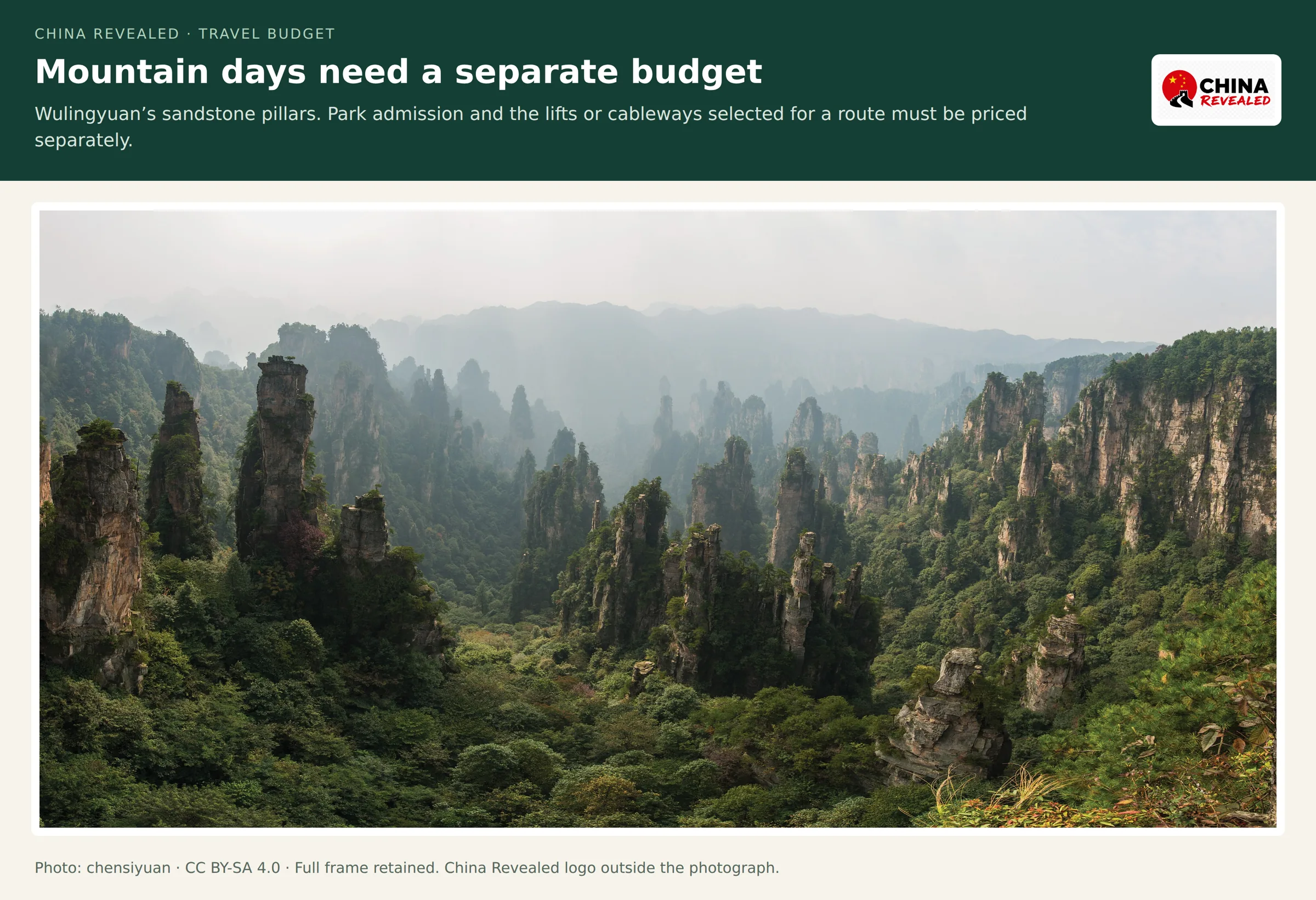

A mountain budget can be several tickets
At Wulingyuan, ¥236 core entry + ¥65 Bailong Elevator uphill + ¥72 Tianzi Mountain Cableway downhill = ¥373 per person before reaching the park from the hotel, buying food or choosing other extras. The core park buses are included in the core ticket; the named lift and cableway are not. The four-day validity does not mean paying ¥236 again on each of four consecutive park days.
Tianmen Mountain is a different attraction. Its ¥72 government-guided resource admission is not the price of a full cableway-and-escalator itinerary. For a real budget, open the dated route package and check everything already included. Do not add ¥72 again to a package that already contains admission.
For Disneyland, pick the actual day first and then price admission, transport, food and any Premier Access. It is an extra major day, not something to absorb into a small average sightseeing line. Children and older adults can have discounts, but eligibility and documents belong to the particular attraction; do not assume a foreign passport automatically receives every concession.
6. How the city and travel date change the bill
Beijing and Shanghai: keep more money for accommodation and transfers. A central room in a good location can justify its price, but buying a skyline room every night is a separate choice. Both cities also have rewarding public streets and neighborhoods that do not require an admission ticket.
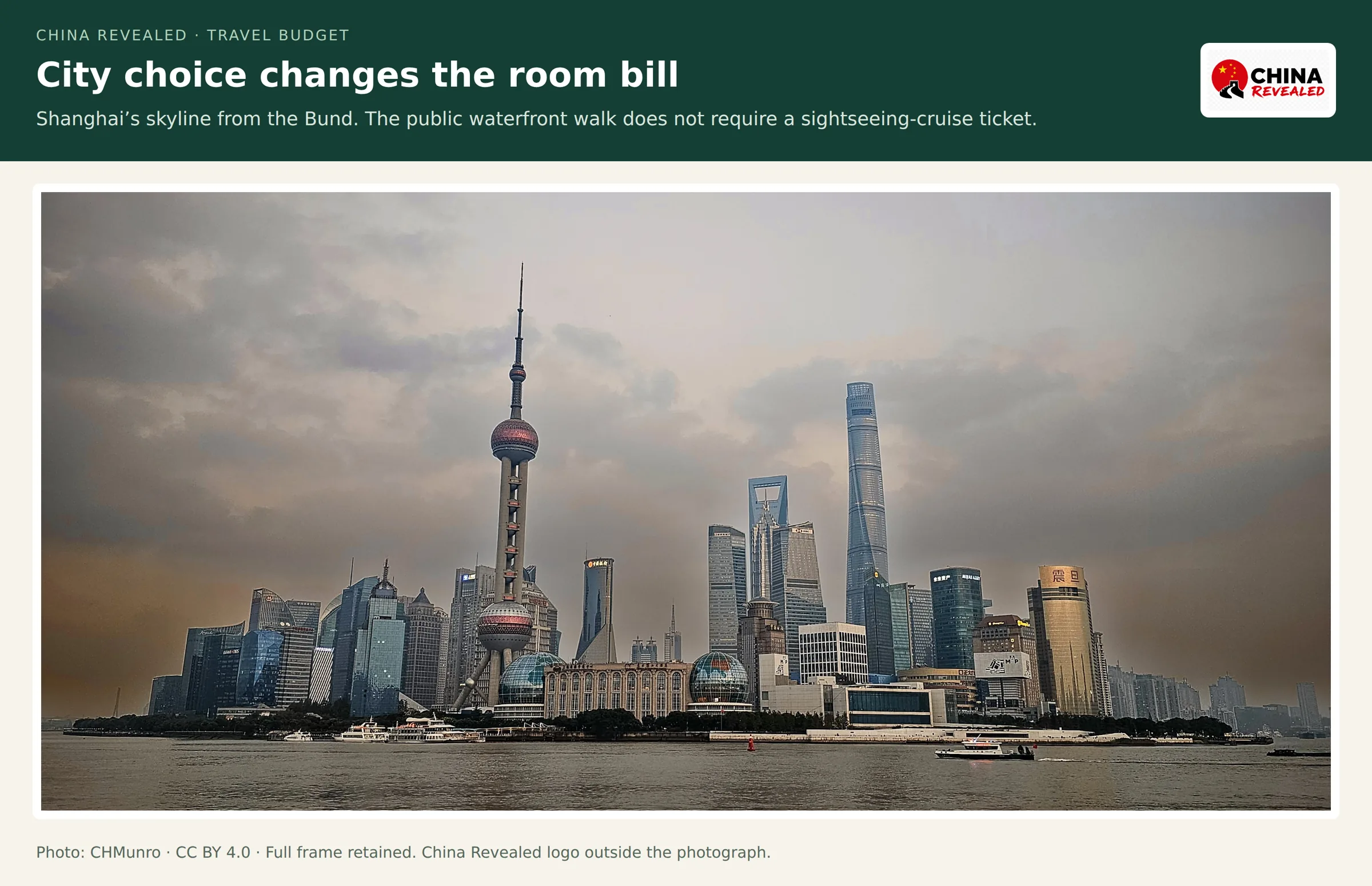

Xi’an and Chengdu: the same room budget often buys more, and ordinary local meals can be good value. The savings disappear if every meal is a famous restaurant and every outing uses a private vehicle. The Terracotta Warriors are outside central Xi’an; include that day’s transport.
Yangshuo and Zhangjiajie: a cheaper guesthouse does not automatically make the whole destination cheaper. Boats, cableways, park access and repeated rides between the station, town and attraction can become a substantial part of the bill. Price the activities before comparing only hotel rates.
During National Day, the Labour Day break, Spring Festival travel periods and popular school-holiday weeks, the useful question is what the specific room and route cost on the chosen dates. Hotel and flight prices can rise while some standard attraction prices remain unchanged. Do not assume every category goes up by the same percentage.
I would choose ordinary weekdays outside the main domestic breaks for a straightforward first sightseeing trip. Use the weather, holiday and crowd guide before fixing dates, then reprice the rooms and flights. A 10% everyday contingency is not a substitute for checking peak-date prices.
Book hotels, flights, train tickets, attractions and other travel services on Trip.com.
7. What 7, 10 and 14 days cost
The following are per-person ground budgets for two adults sharing one room, with a 10% contingency already included. They cover room share, food, core sightseeing, local transport, airport and station transfers, the scheduled out-of-town visits, and the listed intercity tickets.
| Trip length | Budget | Mid-range | Comfortable |
|---|---|---|---|
| 7 days / 6 nights | ¥2,300–4,200 | ¥4,100–7,100 | ¥7,200–12,400 |
| 10 days / 9 nights | ¥3,700–6,700 | ¥6,200–10,600 | ¥10,500–18,200 |
| 14 days / 13 nights | ¥4,900–8,700 | ¥8,200–14,000 | ¥14,100–24,400 |
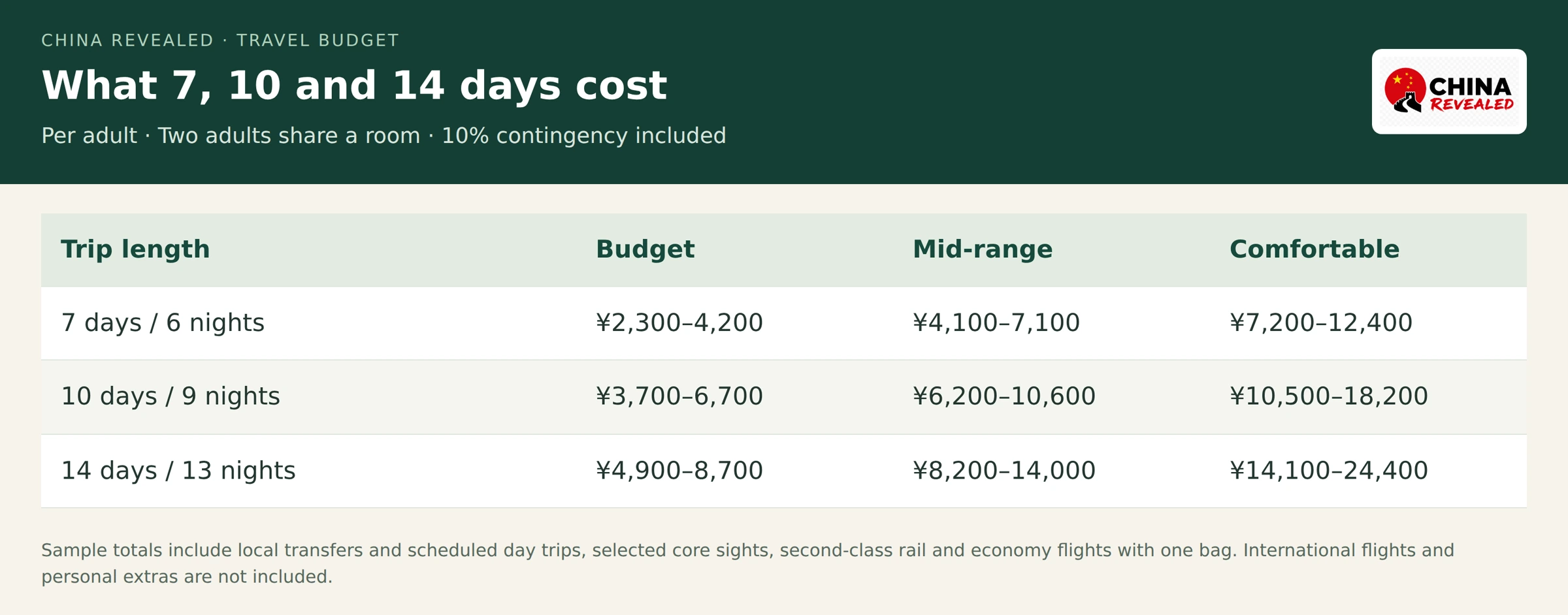
The routes behind the numbers are deliberately simple:
7 days / 6 nights: Beijing → Shanghai. Three nights in each city; one second-class high-speed train, allowed at ¥580–700 per person. Core paid sights are the Palace Museum, Mutianyu with a selected ride/internal-transport allowance, the Temple of Heaven and Yu Garden.
10 days / 9 nights: Beijing → Xi’an → Shanghai. Three nights in each city; Beijing–Xi’an rail plus Xi’an–Shanghai economy with a checked bag, allowed at ¥1,180–1,700 altogether. Add the Terracotta Warriors and Xi’an City Wall to the seven-day core sight list.
14 days / 13 nights: Beijing → Xi’an → Chengdu → Shanghai. Four nights in Beijing and three in each subsequent city; two second-class trains and one economy flight with a checked bag, allowed at ¥1,450–1,960 altogether. Add the Panda Base and Wuhou Shrine to the ten-day core list.
All three spending tiers use the same core sights and second-class/economy intercity baseline. The difference is room choice, eating and local transport comfort. First-class rail, business flights, private guides, Disney, major shows and a Yangshuo or Zhangjiajie replacement are visible additions to reprice—not hidden assumptions.
For the day-by-day sequence and which stops to leave out, use our 7-, 10- and 14-day China itineraries. The figures here are a planning framework, not a tour-package quote.
These are not seven, ten or fourteen daily averages multiplied blindly. Hotels use six, nine or thirteen nights; food uses the calendar days. The model’s local-transport line already includes the scheduled airport/station transfers and out-of-town travel. Do not add the daily city allowance a second time.
Not included: international flights, visa or entry-related costs, travel insurance, mobile-data purchases, shopping, alcohol and optional upgrades. Those belong in separate rows because they depend strongly on origin, nationality and personal choices. The 10% contingency is money kept available, not a fee charged by a booking platform.
8. A 10-day mid-range budget, line by line
A useful working example is two adults using ¥600 rooms in Beijing and Shanghai, a ¥450 room in Xi’an, and ¥180 per person per day for food. These are example assumptions, not a live set of reservations.
| 10-day mid-range example: per person | Amount |
|---|---|
| Hotels, your half of 9 nights | ¥2,475 |
| Food: 10 days × ¥180 | ¥1,800 |
| Local travel, transfers and Great Wall round trip | ¥900 |
| Core admissions and selected Great Wall rides | ¥548 |
| Intercity: rail ¥550 + flight with bag ¥900 | ¥1,450 |
| Subtotal | ¥7,173 |
| 10% contingency | ¥717 |
| Planning total, rounded | ¥7,900 |
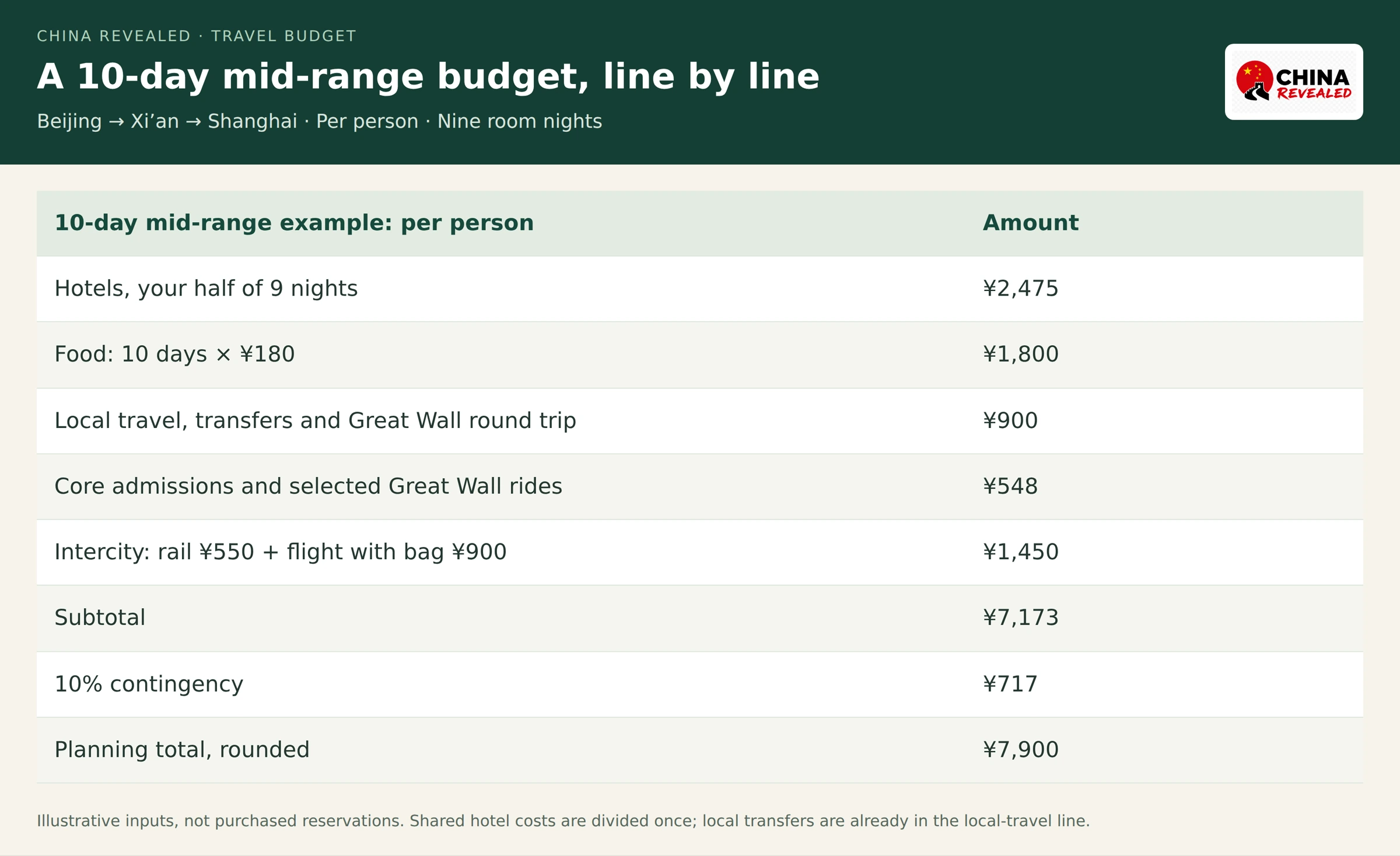
The hotel line is calculated as three Beijing nights × ¥600 + three Xi’an nights × ¥450 + three Shanghai nights × ¥600, divided by two adults. The ticket line uses ¥550 for the train and ¥900 for the flight including a bag. The ¥900 local line includes city rides, the necessary airport/station transfers and the return Great Wall outing.
The sightseeing figure includes peak-season core tickets for the stated sights, plus a ¥200 placeholder for the selected Mutianyu internal transport and rides. If a chosen tour includes those, remove the duplicate lines. If a cheaper room includes breakfast, reduce food rather than treating the included meal as an extra expense.
To adapt the example in a personal spreadsheet, the useful formula is: shared accommodation + food + local travel and transfers + intercity tickets + actual admission products + chosen extras, then add a contingency. Keep refundable deposits outside that consumption total.
9. Extras, deposits and payment costs
A deposit is money tied up, not another room night
A hotel may take a security payment or card preauthorization at check-in. Record the amount and expected release route, but do not count a refundable deposit as both a travel cost and available contingency. There can be a delay before released funds are usable again.
If a room is prepaid online, the reception deposit can still be separate. Ask about the accepted payment method before arriving with a tightly budgeted card balance. Keep the deposit receipt and the final hotel bill together.
Small purchases accumulate
Mobile data, laundry, bottled drinks beyond the food allowance, luggage storage, early check-in and paid late checkout need their own lines when relevant. A hotel’s self-service laundry may be included or charged; staff-washed items may be priced per piece. Read the property price list rather than assuming that “laundry available” means included.
Check the final amount on a third-party booking, the card’s foreign-transaction terms and any wallet fee displayed before confirming payment. There is no useful universal surcharge to add to every China purchase. Compare the actual payment currency and bank terms; a seemingly convenient home-currency display is not automatically the best exchange value.
What I would not cut
Keep the insurance and a functioning payment/internet backup. Do not save a small room difference at the cost of an unworkable arrival, or rely on an unusually cheap nonrefundable flight while still deciding the route. A necessary extra room night after a disrupted connection costs more than a marginally better-priced noodle lunch saves.
10. Solo travelers, families and sensible savings
Solo travelers: change the hotel calculation first. Paying the full private-room rate, rather than half, is the biggest difference. In the ten-day worked example, the other adult’s ¥2,475 room share becomes an additional ¥2,475 for a solo guest using those same rooms. Shared-taxi costs may also rise; noodle shops and individual meals can keep food manageable.
Families: enter the actual room occupancy and children’s ages before comparing prices. Two adults with children may need a family room, an approved extra bed or two rooms. Breakfast and attraction concessions can be separate. A taxi may still be one vehicle charge if everyone and the luggage fit safely; hotel and rail costs do not follow that same rule.
The strongest savings come from fewer city changes, a sensible hotel near useful transport, and ordinary meals between the special ones. Dropping one unnecessary flight can save more than chasing small discounts across an entire week. A place close to a working metro entrance is often better value than a cheaper room described only as “near the city.”
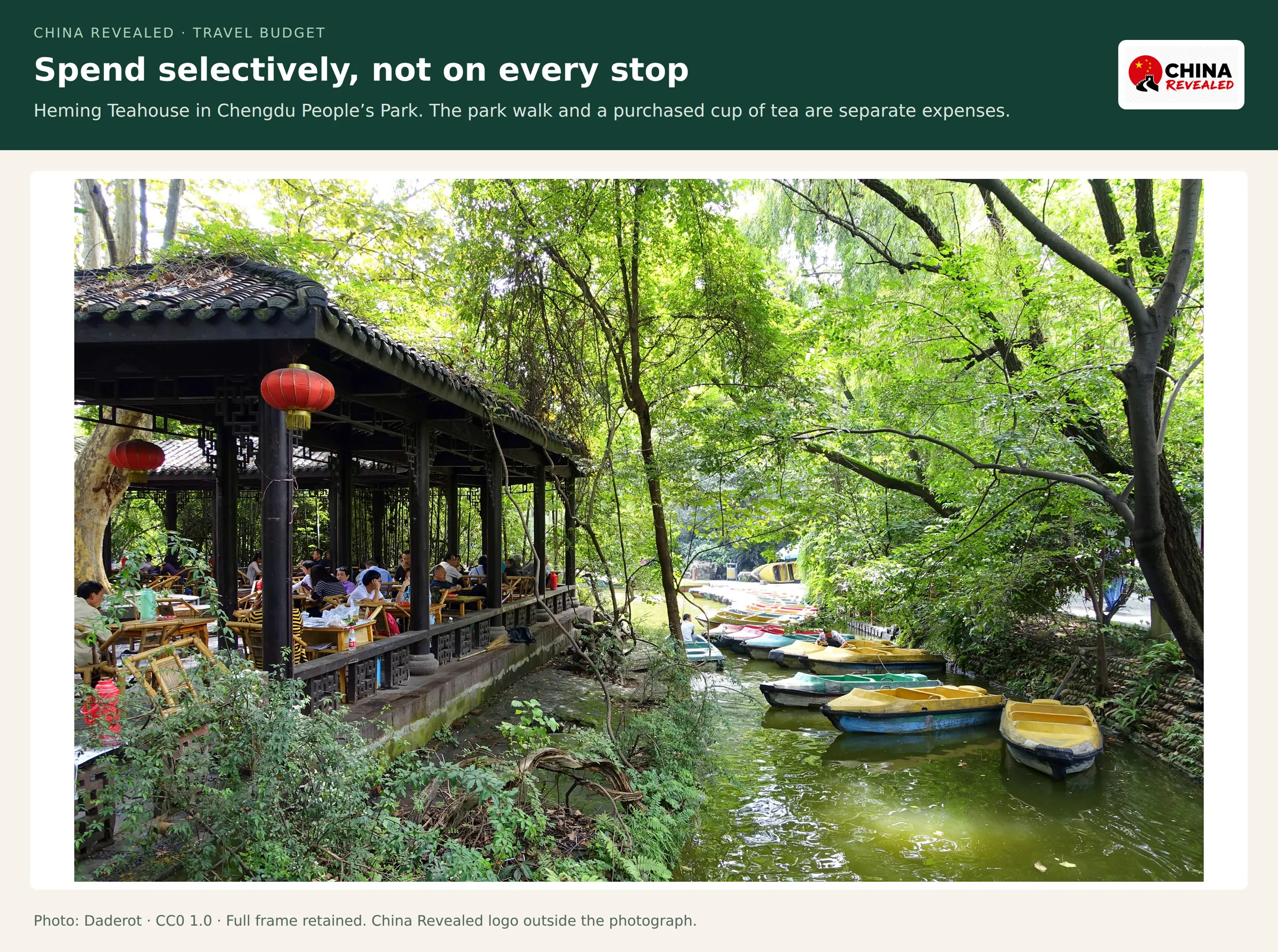

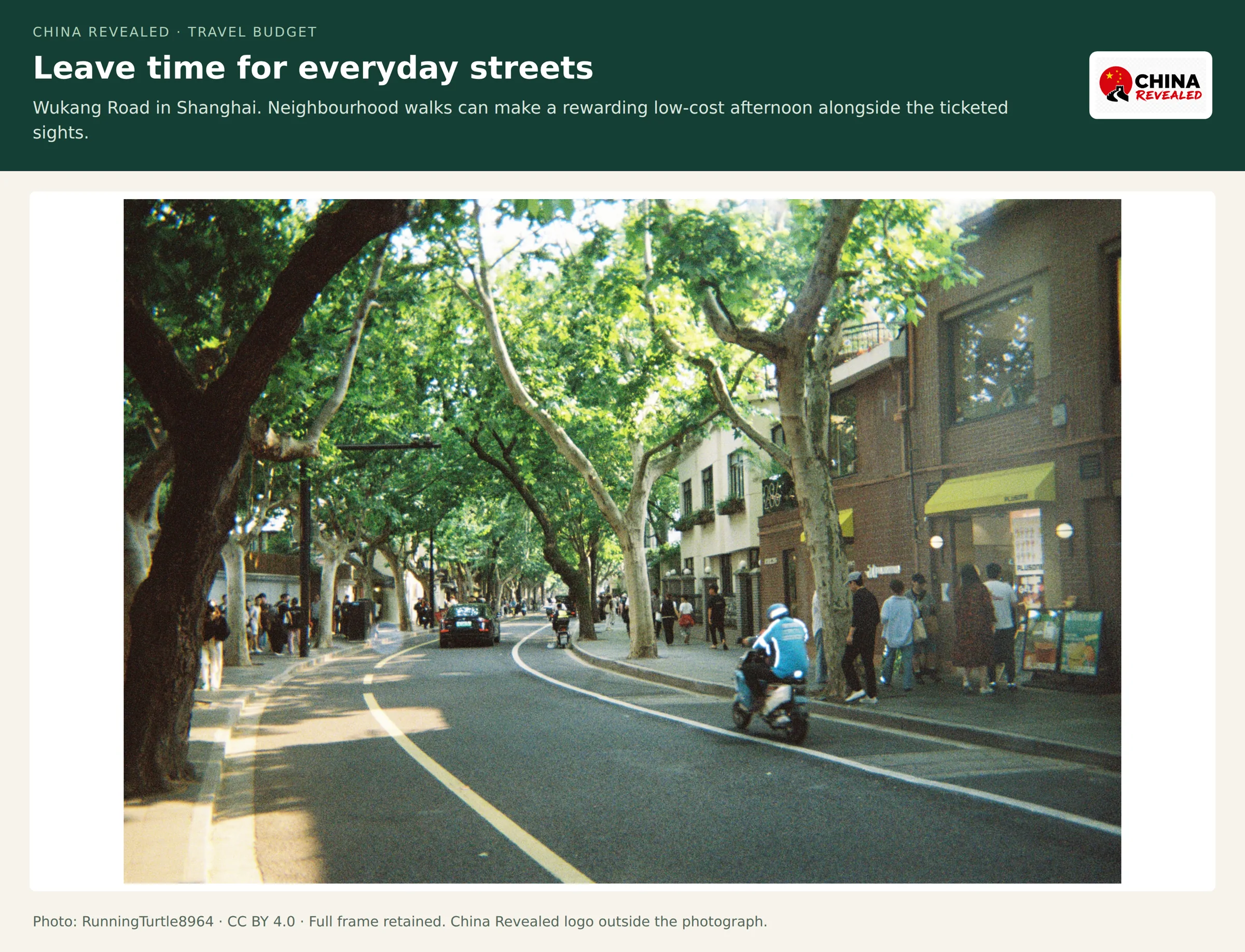
Mix a major paid attraction with an unhurried low-cost afternoon. A park walk, a neighborhood market or a cup of tea can make the trip feel more connected to the place than another hurried ticketed stop. Buy the tea when wanted; do not mistake access to a public park for a promise that everything inside it costs nothing.
My preference for a first trip is mid-range accommodation, ordinary good food, second-class trains and selective taxis, with one or two restaurant or attraction upgrades chosen deliberately. That is usually a more satisfying use of money than buying the most expensive version of every category—or trying to save on every small item.
Budget inputs and public-price references checked October 18, 2026. All amounts in this guide are RMB/CNY.

About China Revealed
China Revealed is an independent English-language travel guide dedicated to China.
We bring together China travel guides, destination information, local insights and practical travel resources in one place.
Our travel database covers China's provinces, cities, famous attractions, hidden gems, local cuisine, transportation, accommodation, visa requirements, digital payments, mobile connectivity and the other practical details travelers need to explore China.
We focus on depth, careful research and accuracy. Our guides combine official sources, detailed destination data, local knowledge and regularly updated information to give reliable, practical travel advice.
Whether you're visiting China for the first time or exploring beyond the popular destinations, China Revealed is an all-in-one resource for discovering the real China.
China Revealed — Your practical guide to China.
Some links on China Revealed, such as Trip.com booking links, are affiliate links. If you book through them, we may earn a commission at no extra cost to you. This does not change what we recommend.