

China Tourist Scams: Common Traps and How to Avoid Them

China tourist scams are easier to spot when three things become clear: who chose the business, what the complete price is, and whether the purchase matches what was promised. A stranger-led tea ceremony, a supposedly closed attraction, an unexpected shopping detour and an inflated taxi quote are different versions of the same problem: someone else takes control of the decision before the traveler understands the cost.
The useful response is not to distrust every conversation. Choose the venue or provider independently, check the full total before starting, and keep the order or receipt. That leaves room for the things worth enjoying in China, including its tea culture, local shops and spontaneous conversations.
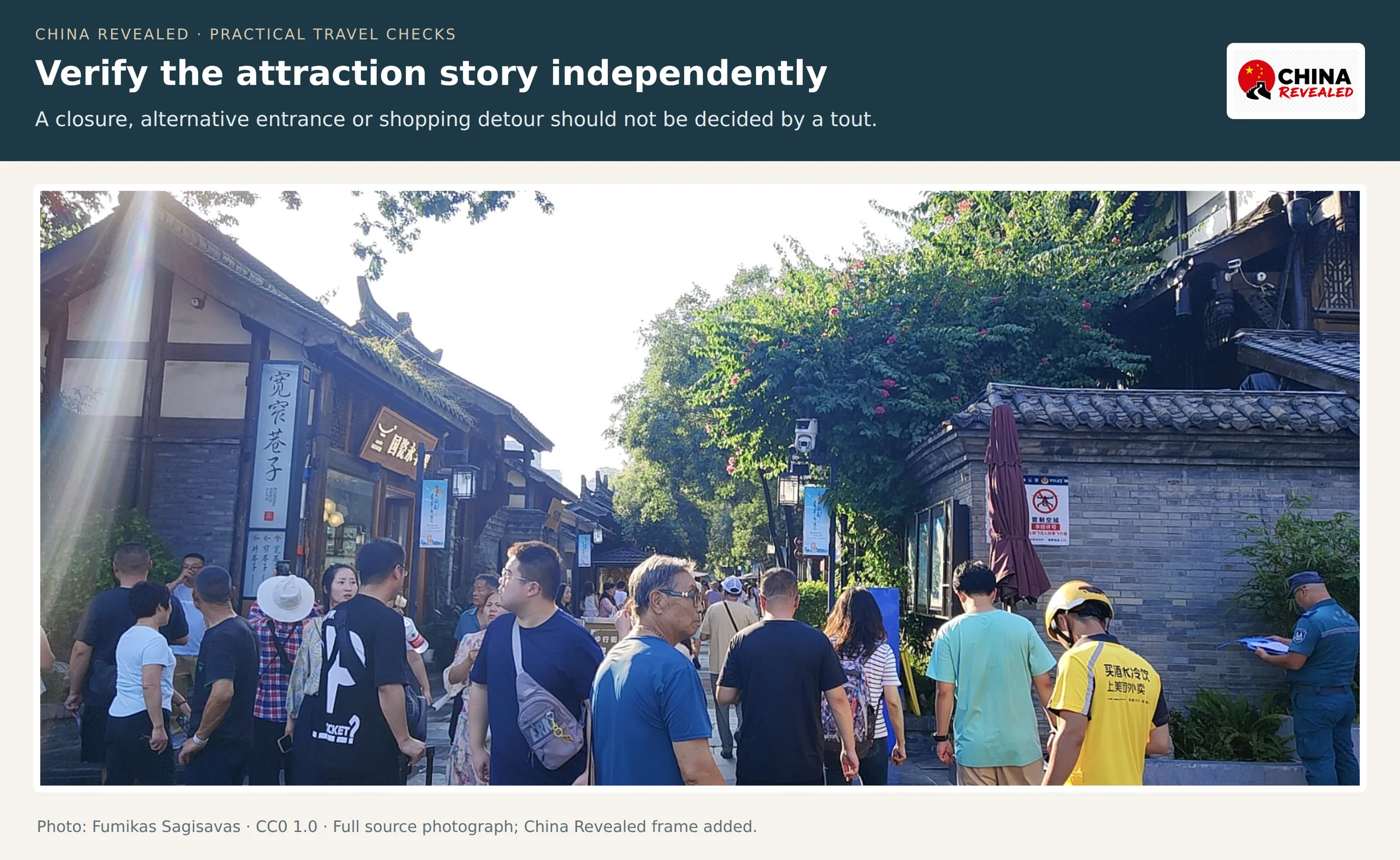
Quick takeaways
- Tea, bar and art invitations: do not follow a new acquaintance to an unknown business without checking its menu and complete charges.
- Attractions and tours: verify a closure with actual venue staff; check the exact attraction, ticket inclusions and shopping stops before paying.
- Restaurants and shops: confirm whether the price is per person, per dish, per item or by weight. Mainland 1 jin / 斤 = 500 g.
- Taxis: use the official queue or the ride in your own app. For an ordinary 10 km Beijing trip, allow roughly CNY35–45 in lighter daytime traffic or CNY45–60 around rush hour, not a bare distance-only calculation.
- Payments and disputes: do not share a verification code or pay an unexpected fee to unlock a refund. Keep evidence; use 110 for threats or suspected crime.
In this guide
- Six traps to recognize quickly
- Tea, bar and art invitations
- Attraction touts and ticket traps
- Cheap tours and shopping detours
- Restaurant bills and weight pricing
- Taxi overcharging and off-app rides
- Payment and fake-refund traps
- What to do if something goes wrong
- Chinese phrases to save on your phone
- Common questions
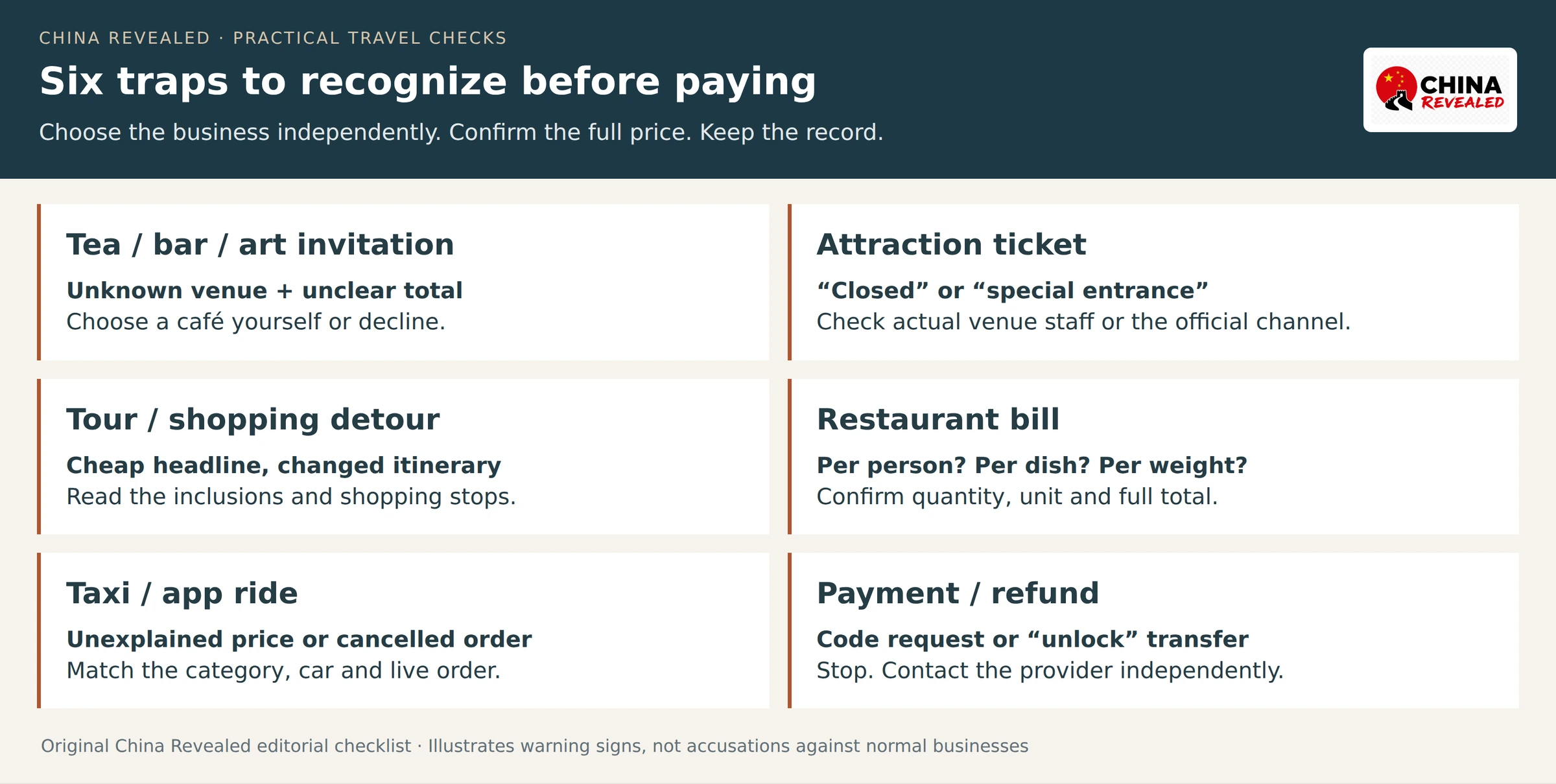
Six traps to recognize quickly
The warning sign is usually a change in the transaction, not the setting itself. A tea shop can be legitimate, a taxi can be properly licensed, and a tour can include optional extras. Trouble starts when the venue, route, charges or conditions change without clear agreement.
| Situation | Warning sign | Best first move |
|---|---|---|
| Tea, drinks or an art visit | A new acquaintance insists on one venue; prices remain unclear. | Choose a public café independently or decline. |
| Attraction tickets | A seller says it is closed or offers entry despite a sold-out date. | Ask actual attraction staff or check the official channel. |
| Cheap tours and shopping | The visit becomes a shop stop or the advertised attraction is substituted. | Check the written itinerary and inclusions before booking. |
| Restaurant bills | A small headline price becomes a per-person or weight-based total. | Confirm the unit, quantity and complete cost before preparation. |
| Taxi rides | A large unexplained fixed demand or a request to cancel the app order. | Compare the same route and category; keep the trip in the app. |
| Payments and refunds | Someone asks for a login code or a separate transfer to release money. | Stop and contact the provider through the actual order. |
Tea, bar and art invitations
The classic tea-house setup starts with an ordinary encounter near a visitor area. Someone asks for a photograph, practices English or begins an interesting conversation. They then suggest a tea ceremony at a nearby venue of their choosing. The tasting starts without a clear total, several teas or extras are supplied, and a large bill appears afterward.
A bar invitation can follow the same pattern. An art-gallery or “student exhibition” invitation can become pressure to buy a painting. The relevant combination is a stranger selecting the business, unclear charges and pressure once inside. Speaking English or being friendly is not evidence of a scam.
The easiest point to say no
Decline before entering an unknown venue: 不用了,谢谢 — No, thank you. Continue walking. A long explanation about the next appointment is unnecessary.
If the conversation is genuinely interesting, suggest a public café of your own choosing with a visible menu. Someone insisting that only one particular venue will do has given a useful reason to end the invitation.
If a tea experience is something the traveler actually wants, ask for the complete price for the group before it begins. Clarify whether each tea, tasting, snack, room and service is charged separately. A price “from CNY…” or “a little for each tea” is not the final total.
Enjoy tea without buying the invitation
An established park teahouse or a restaurant with a visible drinks menu is a straightforward alternative. Choose it independently, check the price and settle into the experience. A premium tea or formal ceremony can legitimately cost more than a casual cup; the question is whether its full cost was explained and accepted.
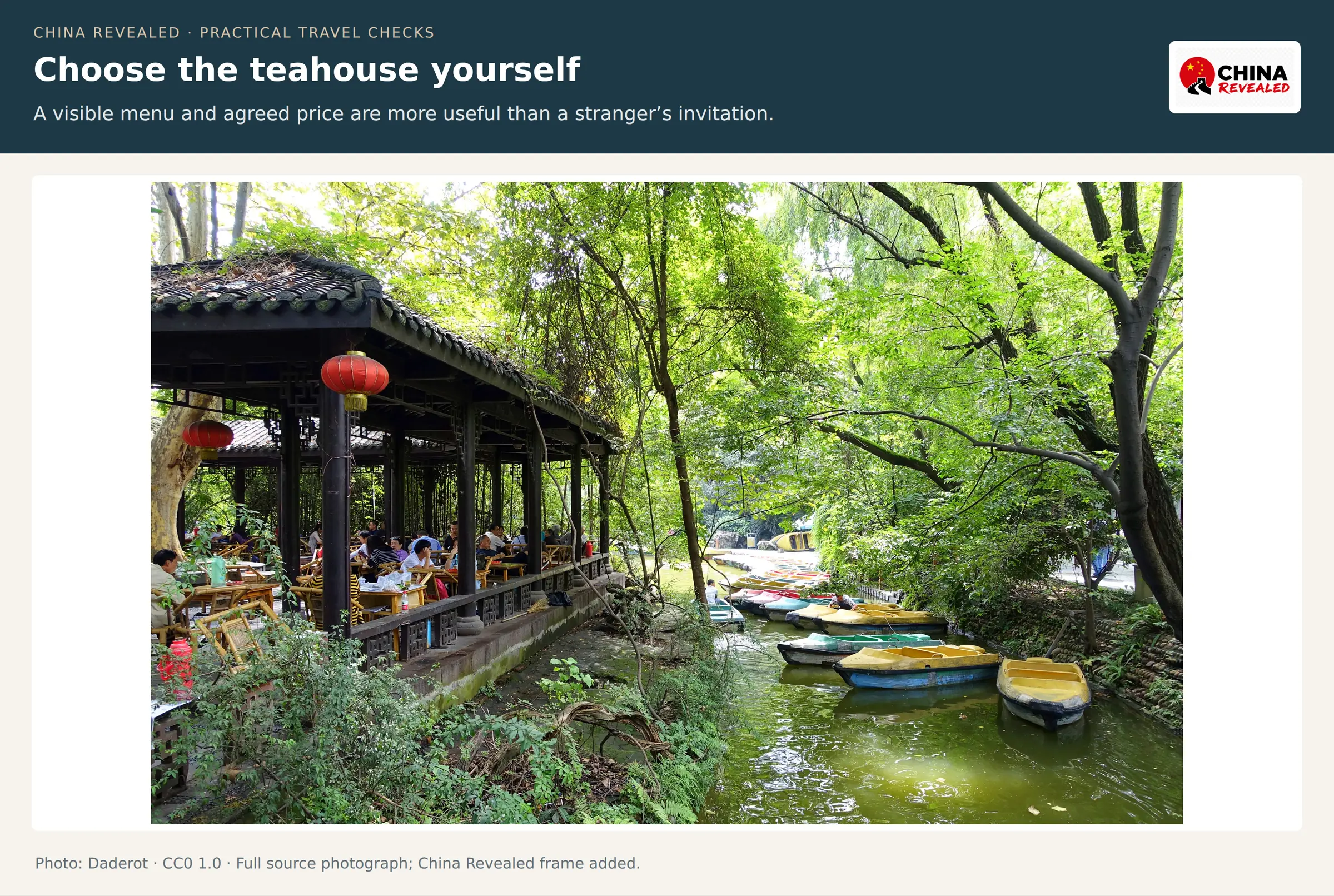
The normal teahouse photographed here illustrates independently chosen tea culture, not a scam venue. If staff block the exit, threaten the visitor or prevent departure, stop treating it as ordinary bargaining. Request police help through 110, avoid a physical confrontation, and get to a staffed public place when possible.
Attraction touts and ticket traps
“The attraction is closed,” “foreigners cannot buy tickets” and “the official entrance has a long queue” are useful sales pitches because they create a problem and immediately offer a paid solution.
A closure, passport restriction or sold-out date can be real. Verify it through the attraction’s own channel or staffed ticket office. Someone selling a replacement tour is not an independent source about whether the original attraction can be visited. If there is already a booking, show the confirmation to actual staff before buying another ticket.
A special entrance is not a substitute for a valid ticket
A seller may promise entry despite a sold-out date or offer a screenshot under another person’s name. The important details remain the visitor’s passport, date, time slot, ticket type and official entry instructions. A claim that those details do not matter is a reason to stop.
Use the attraction’s official channel or a recognized booking platform such as Trip.com that supports the destination and passport type. Check the supplier and confirmation, not just the payment screen. Sending money to someone in a personal chat is not the same as receiving a confirmed ticket.
The China attraction-ticket guide explains the difference between payment, processing and confirmed admission. Do not head to the gate with an order that has not actually confirmed.
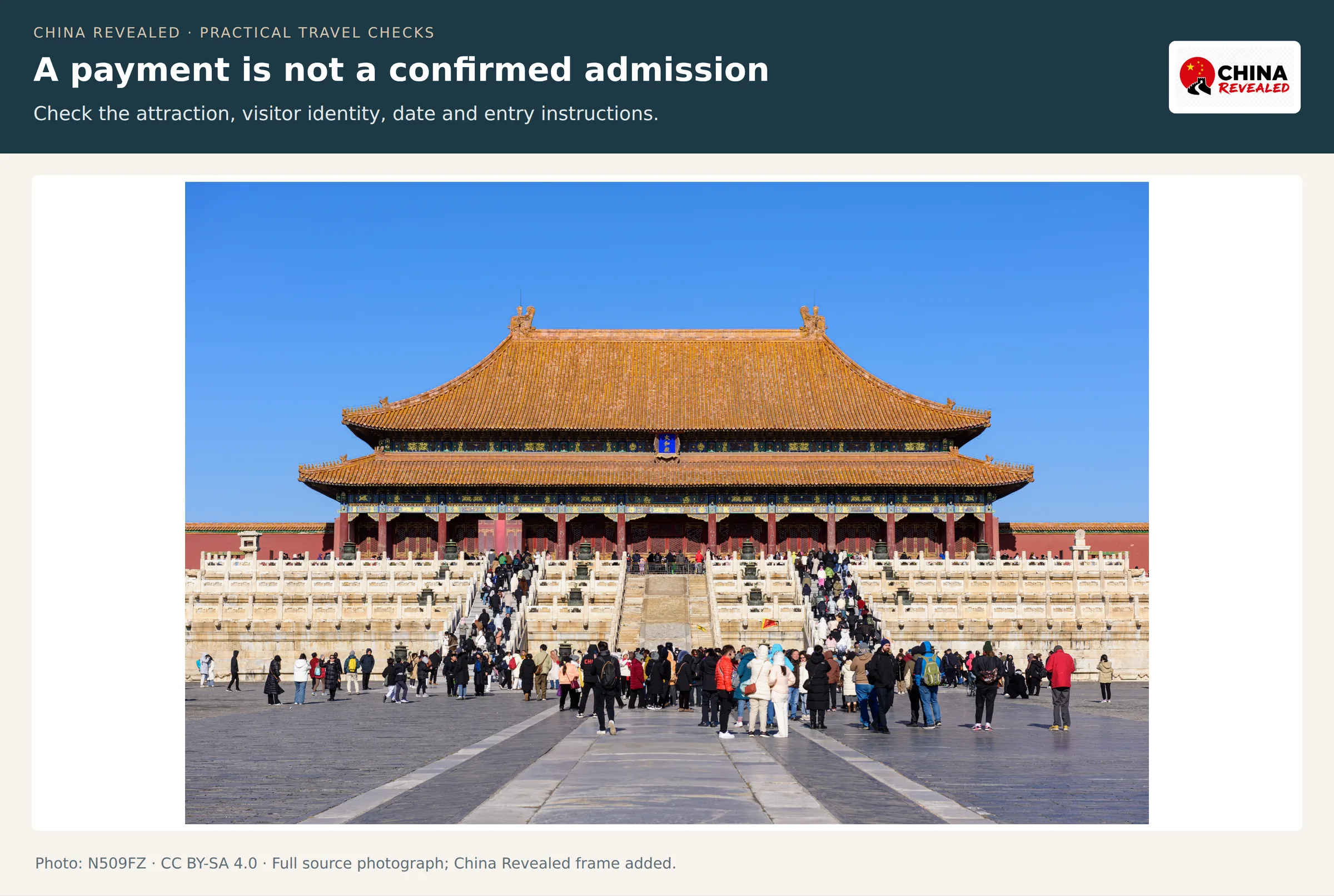
Check that the name identifies the real attraction
A “Terracotta Warriors visit” should identify the actual museum, not merely a workshop, shop or nearby exhibit. A “Great Wall trip” needs a named section of the wall. A vague famous name on a sales board does not establish what the traveler will see.
When the original attraction really is unavailable, choose the alternative independently. Another museum, neighborhood walk or public-transit outing is preferable to buying a rushed replacement while a seller stands beside the traveler urging a decision.
Book hotels, flights, train tickets, attractions and other travel services on Trip.com.
Cheap tours and shopping detours
A low advertised tour price is only meaningful if the itinerary and inclusions are clear. Before paying, check the exact attraction, sightseeing time, return transport, admission, guide and any shopping stops. Ask whether cable cars, shuttles, boats or shows are included or optional.
A shopping-heavy tour can leave far less time at the attraction than its headline suggests. A driver can also redirect a simple ride into a souvenir, tea, jade or art shop. Police have documented schemes involving drivers steering visitors into pressured purchases. That is a reason to keep control of the destination, not to assume every driver recommendation is dishonest.
Keep a transport booking a transport booking
If the driver proposes a shop the passenger did not request, say 我只去这个地址,不去商店 — I am only going to this address, not to a shop. There is no obligation to buy because someone has provided a ride, introduced a seller or served a sample.
A guide’s recommendation may involve a commercial relationship. Decide on the purchase independently: compare the exact item elsewhere, ask for a receipt and check any stated return conditions. “Only available now,” an unusually large discount or a claim of special access does not verify quality or value.
Expensive is not automatically fraudulent
A souvenir shop charging more than a local supermarket is not by itself a scam. Nor is every jade item, tea product or craft counterfeit. The problem is a false description, concealed charge, substituted product or pressure that prevents an informed choice.
If an item’s value depends on being a particular material, origin, age or handmade product, get the description in writing and consider an independent seller. A sales story or certificate supplied by the seller is not a reason to make an immediate high-value purchase. Leave the shop if the explanation remains unclear.
Clearly disclosed attraction extras are different from undisclosed compulsory shopping. A chosen cable car, boat or show can be a normal paid service. Compare the whole day and its inclusions, rather than treating every extra charge as deception.
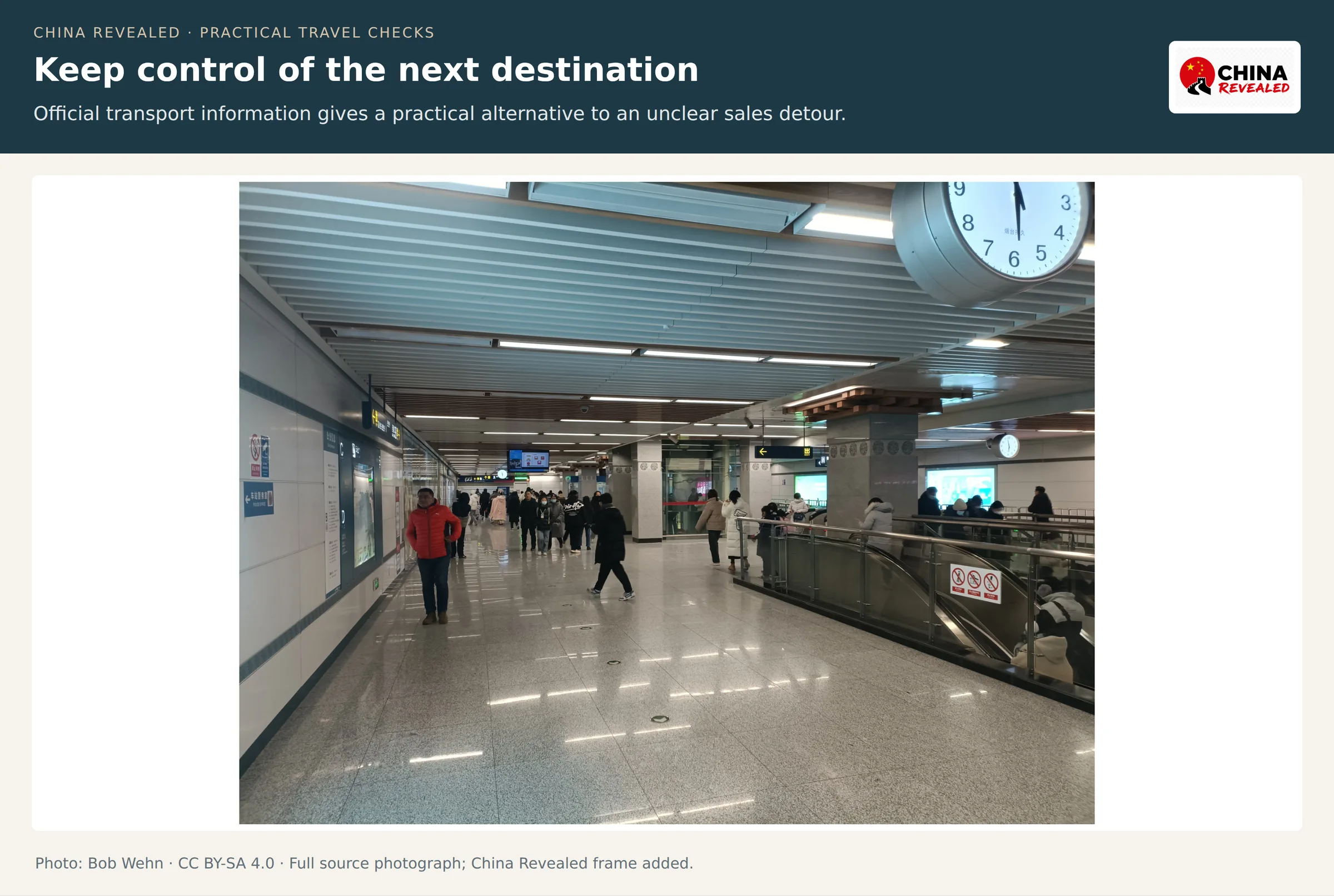
Signed exits and official transport information give the traveler a way to leave a sales detour and make an independent plan.
Restaurant bills and weight pricing
At a restaurant, a surprising total can come from deception or from misunderstanding the unit. Before ordering, confirm whether the amount is per person, per dish, per serving or by weight.
A noodle bowl or individual set meal is generally priced by the serving. Shared dishes are priced as whole dishes, not automatically per person. Live seafood may be sold by weight with a separate cooking fee. In mainland China, one jin / 斤 is 500 g, so one kilogram is two jin.

The small number may not be the full price
For a clearly labeled example, a fish at CNY88 per jin costs CNY176 for a 1 kg fish. Add an agreed CNY20 cooking fee, and the total is CNY196. The “88” was never the whole-fish price.
For live seafood, ask staff to show the weight and complete total before preparation. If a menu uses a market price rather than a fixed amount, establish the current price first. Once the item has been cooked, resolving a misunderstanding is much harder.
Check listed tea, covered tableware, per-person and cooking charges before accepting them. A clear charge agreed in advance is different from an unexplained item added to the final bill. Asking for a breakdown is more effective than assuming every table charge is fraudulent.
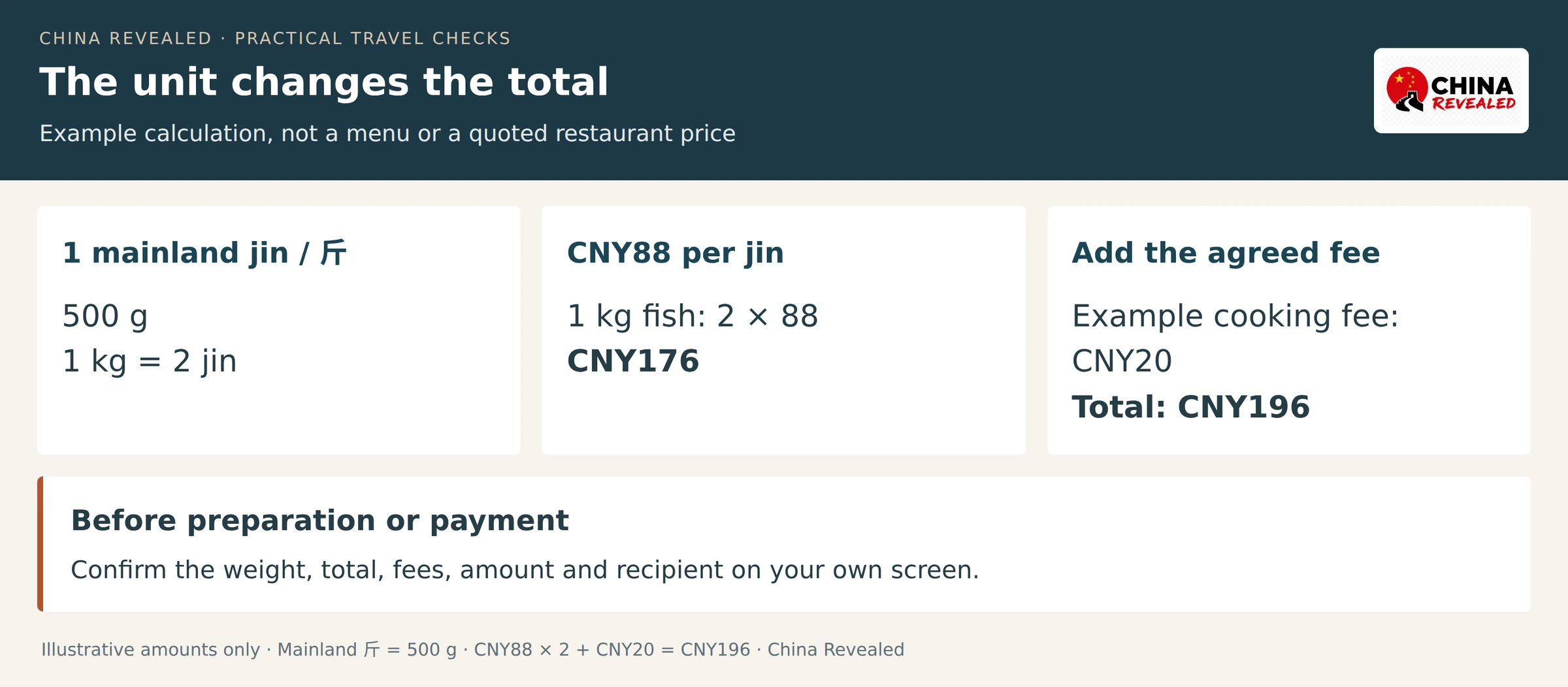
Check the bill while the details are still available
Compare the number of dishes, portions and chargeable people with what was ordered. Ask for an unexplained item to be identified. Photograph the menu and bill if the terms are disputed; those records establish what was displayed and charged.
For a group, confirm the total for everyone, not a vague amount “each.” The same habit helps with a tea tasting, guided activity or private transfer: agree on the purchase and its unit before it starts.
Taxi overcharging and off-app rides
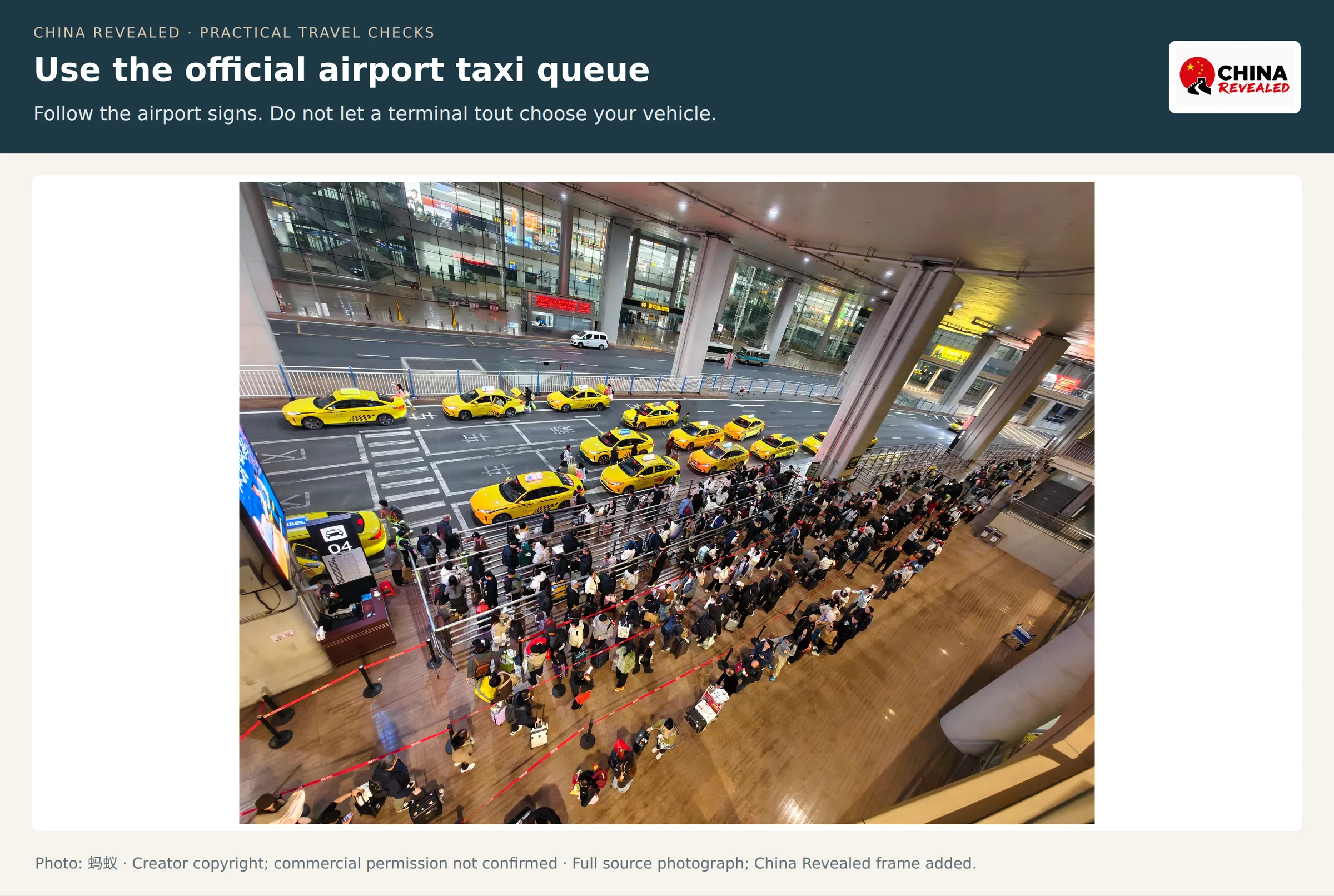
Taxi pricing is one part of this guide, not a reason to distrust every ride. The useful checks are the booked category, correct car, exact destination and fare system. Use the official staffed airport queue or a ride booked in the traveler’s own app; do not let a person inside arrivals choose the vehicle while taking hold of the luggage.
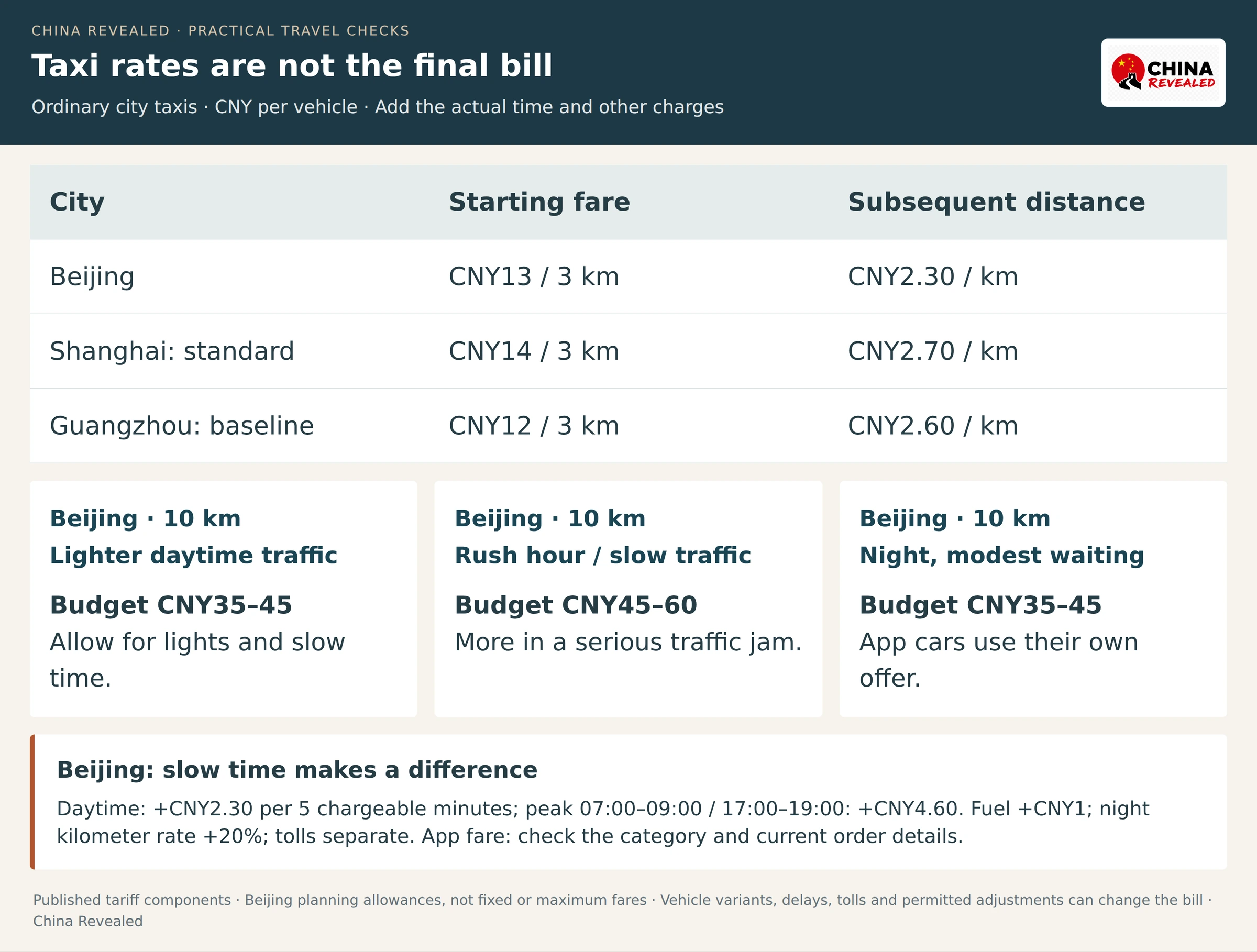
Read the tariff, then allow for real traffic
These are published daytime starting fares and ordinary distance rates, not final journey prices. Vehicle variants and permitted operator adjustments can differ.
| City and ordinary taxi category | Daytime starting fare | Subsequent distance rate |
|---|---|---|
| Beijing | CNY13 / first 3 km | CNY2.30 per km |
| Shanghai, standard city taxi | CNY14 / first 3 km | CNY2.70 per km |
| Guangzhou, published baseline | CNY12 / first 3 km | CNY2.60 per km |
Beijing: add the CNY1 fuel surcharge. Nighttime, 23:00–05:00, raises the basic kilometer rate by 20%. Below 12 km/h or during requested waiting, each 5 chargeable minutes adds CNY2.30 at ordinary daytime hours, or CNY4.60 in the published peaks 07:00–09:00 and 17:00–19:00. The portion beyond 15 km has a 50% one-way distance addition; actual tolls are separate.
Shanghai: some published vehicle categories start at CNY16 rather than CNY14. Nighttime adds 30%; low-speed or requested waiting is charged as 1.5 km per 4 minutes, with longer-distance, holiday and permitted operator rules also relevant. Guangzhou: low-speed waiting has a CNY44/hour baseline; night, longer-trip and operator adjustments can change the fare. Other cities need their own current tariff.
For an ordinary 10 km Beijing ride, budget roughly CNY35–45 in lighter daytime traffic, CNY45–60 around rush hour, or CNY35–45 for a night taxi with modest waiting. Serious delays can cost more. These are whole-car planning allowances, not fixed price bands. For illustration, 20 chargeable minutes of daytime peak waiting takes the basic 10 km example to about CNY49; 30 minutes takes it to about CNY58.
Match the car and keep the order
An app’s economy car, premium car and metered taxi are different products. Check the actual order’s fare details, estimate or fixed offer, waiting, night terms and tolls. DiDi does not have one national “CNY1.60 per km” rate.
Match the full plate and vehicle with the live order. Do not get in simply because someone says “DiDi,” and do not cancel the booking to take an unrelated cash ride. Check the payment state before paying again. Phone-number endings used to match a passenger are not SMS login codes or payment PINs.
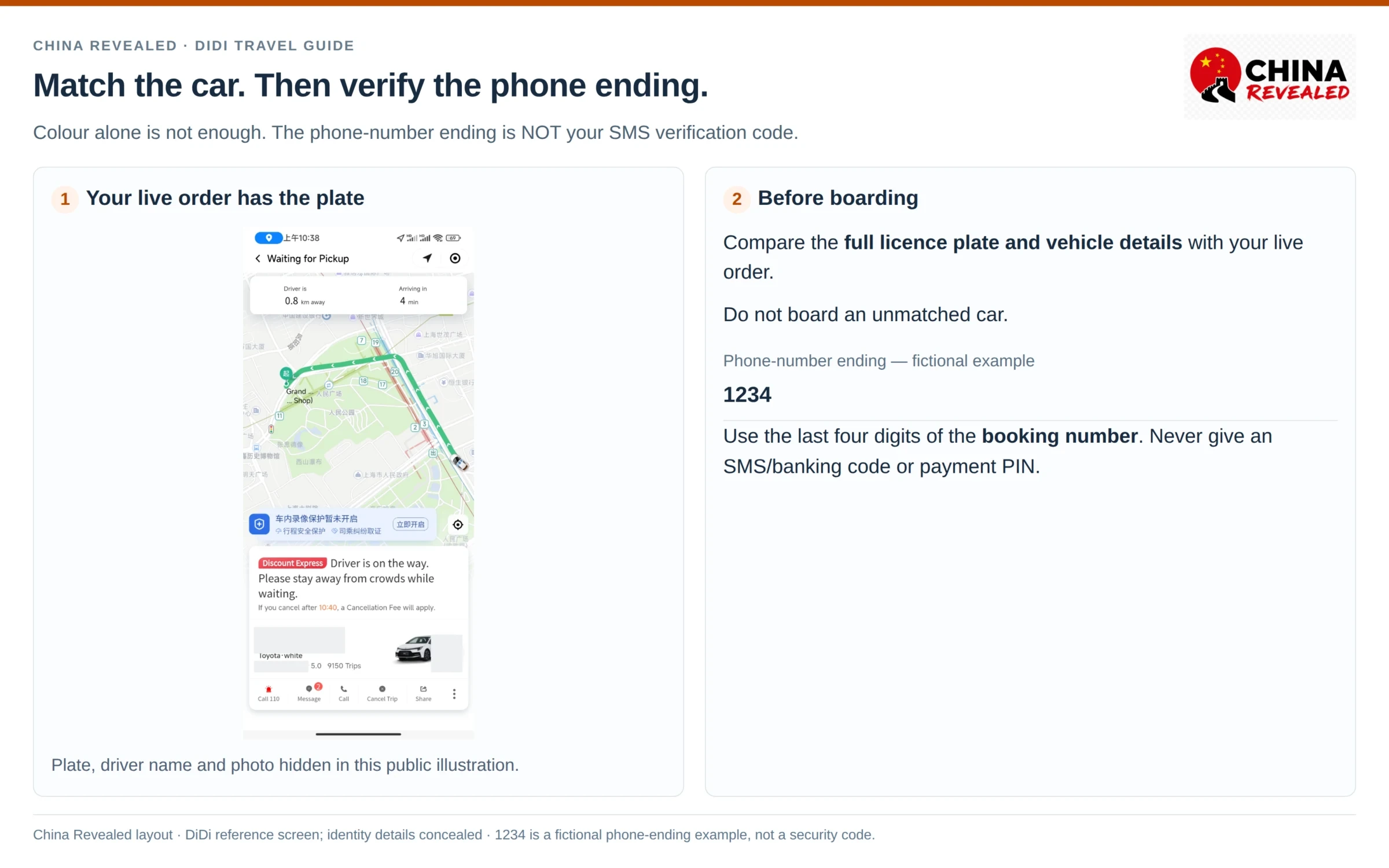
The DiDi guide for foreign visitors covers the app steps. An unexplained CNY500–600 demand for a simple 10 km ordinary ride is a reason to stop and compare, but a long intercity transfer, large vehicle or sightseeing charter is a different purchase.
For an airport trip, put the exact terminal and full hotel address into the app and compare the same vehicle category. Do not compare Pudong with Hongqiao, Capital with Daxing, or Tianfu with Shuangliu. Airport distance, traffic and tolls can legitimately put a trip well into the hundreds; an unexplained extra “airport service fee” still needs an explanation.
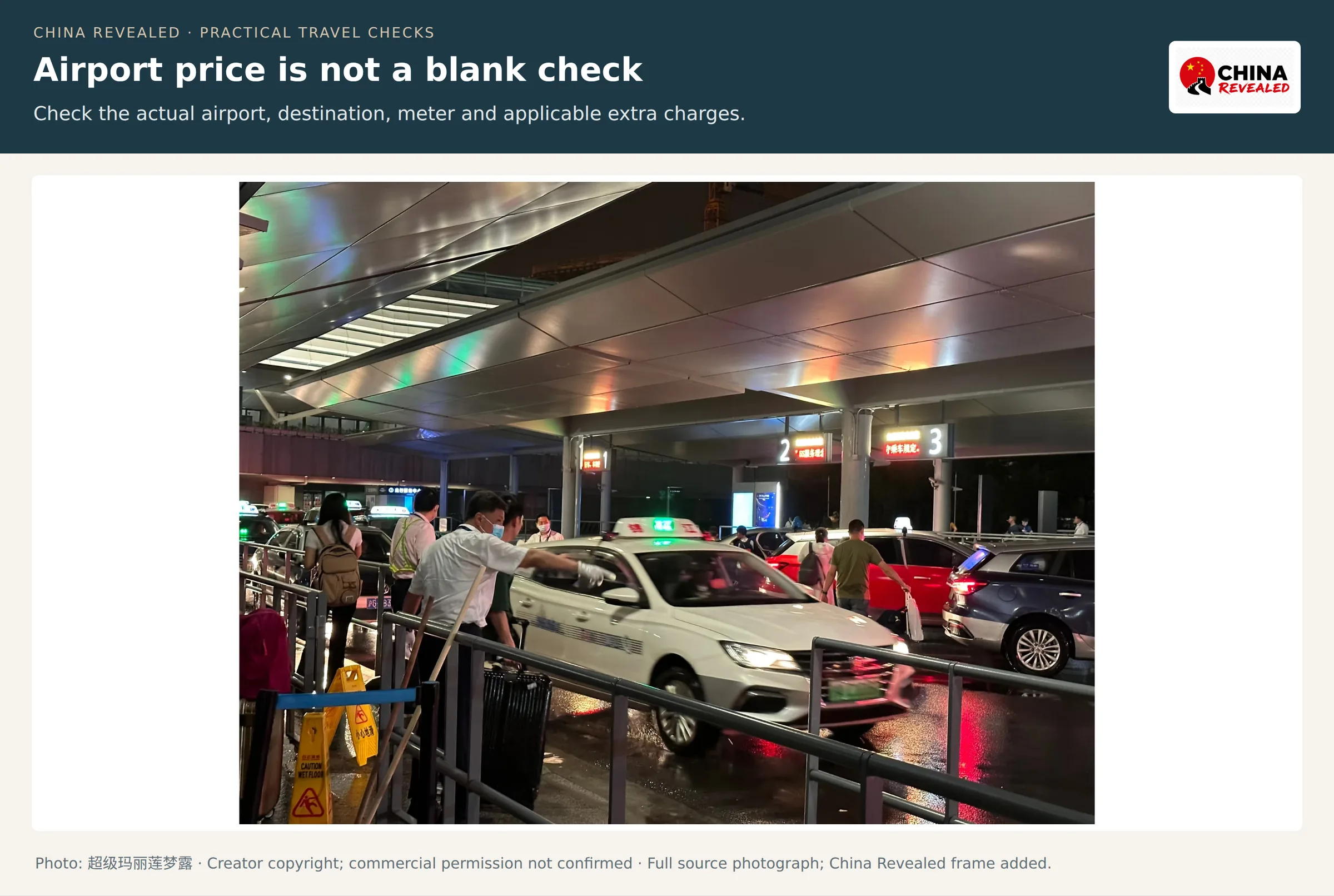
If the route seems wrong, check the exact destination in Amap. One-way roads and closed entrances can explain a detour; an unsolicited shop stop is different. Keep the actual route and fare receipt if there is a dispute.
Payment and fake-refund traps
A correct price is not enough if the payment goes to the wrong place. Look at the amount and recipient on the traveler’s own screen before confirming, and compare them with the business and bill.
A small trader may legitimately use a personal collection account; that alone does not prove a scam. An unexplained recipient, changed payment destination or demand for a larger amount is a reason to stop and ask. Do not use a replacement QR code supplied by a passerby offering to “help.” Use the business’s own payment process.
“The payment failed—pay again”
Check the wallet’s transaction record and the order status first. A successful payment and a pending transaction are different. Do not make an immediate second transfer based only on someone else’s statement. If there is a duplicate charge, keep both transaction records and ask the business or provider to reconcile them.
The same principle applies to a hotel, tour or ticket bought through a platform. A later chat message asking for a separate payment does not establish a legitimate booking problem. Open the original order and contact the supplier through its verified channel.
“Pay a fee to get the refund”
Treat an unexpected refund-unlocking transfer, login-code request or payment-PIN request as a reason to stop. Contact the platform through the actual app or website, not a link, phone number or QR code supplied by the person making the demand. A refund to investigate is not a reason to give a stranger control of the account.
Keep communication attached to the order whenever possible. For an unauthorized card charge, contact the card issuer through its official app or the number on the card and follow its dispute process. Do not give account access to someone promising to recover the money.
What to do if something goes wrong
First decide whether it is a billing disagreement or an immediate safety problem. A disputed menu item or ride charge can often be reported through the business or platform. Threats, a blocked exit or suspected crime need police assistance.
Get somewhere safe before arguing about the bill
At an airport, station or attraction, ask the staffed service desk or official transport staff for help. If someone is threatening the visitor or preventing departure, call 110 and give the exact location. Keep calm and avoid physical confrontation.
Do not put safety at risk to collect a perfect photograph. Once safe, write down the business name, address, vehicle details and time while they are fresh.
Keep evidence that explains the purchase
Save the quoted menu or price, booking confirmation, receipt, payment transaction and relevant messages. For a tour, include the promised attraction and inclusions; for a restaurant, the ordered quantity and final bill; for a ride, the car plate, route and fare.
A payment screenshot may show that money changed hands without proving what was promised. The strongest compact record connects the offer, supplied service and amount paid.
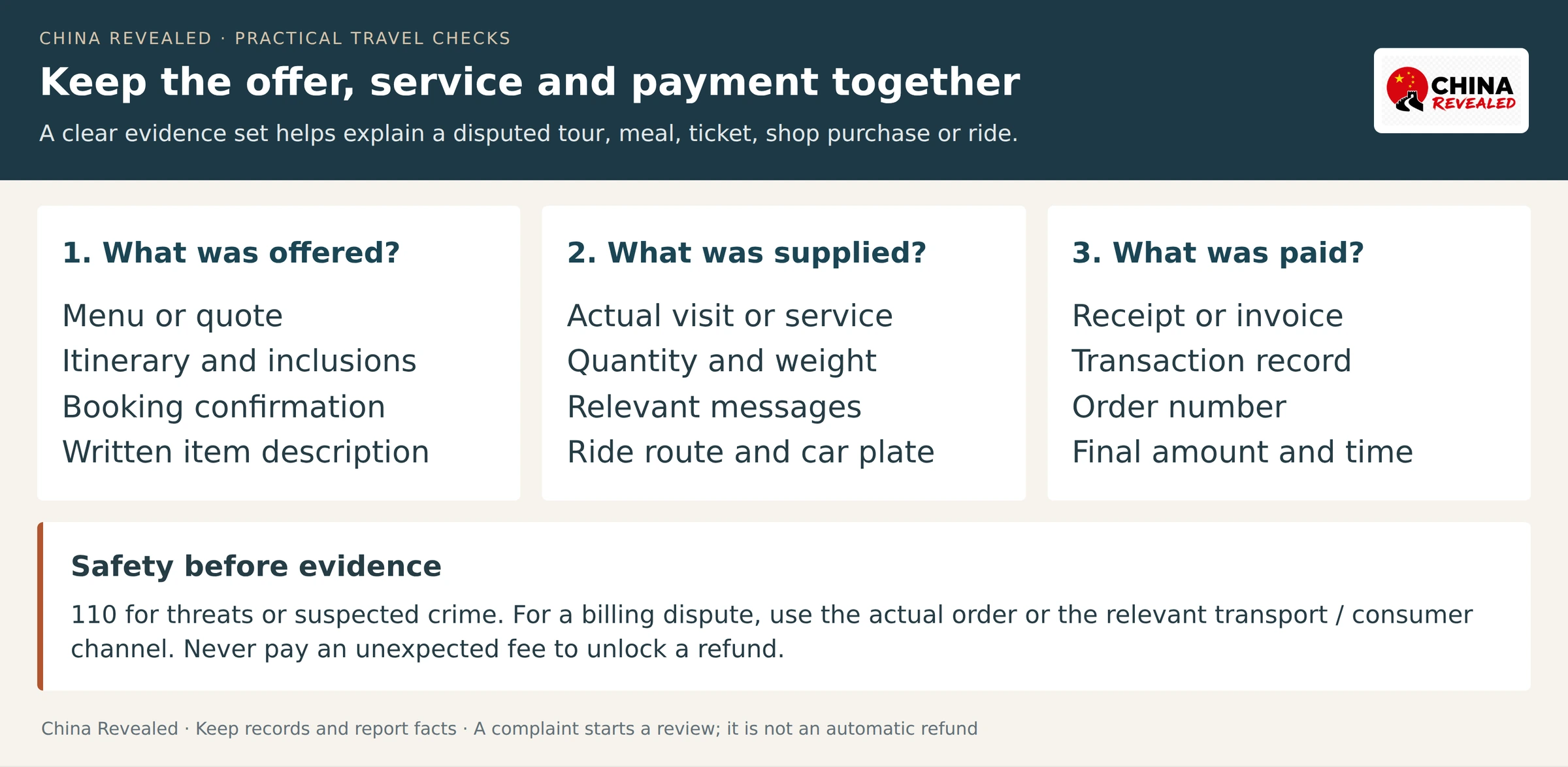
For a taxi, ask 请给我车费发票 — Please give me the taxi-fare receipt before leaving. For an app ride, open the journey in My Trips / Help, choose the disputed order and include its fare, route and messages. For a hotel, attraction or tour, use the help entry attached to that booking.
Use the right local channel
| Number | Best use |
|---|---|
| 110 | Police assistance for threats, being prevented from leaving or suspected crime. |
| 12328 | Transport complaints, including taxi overcharging or service issues. |
| 12315 | Consumer complaints about business prices, undisclosed charges or deceptive selling. |
| 12345 | Local government assistance or referral if the relevant local route is unclear. |
Ask the hotel or a trusted Chinese speaker to help with a nonurgent report if needed. If a short-code hotline does not connect on the phone or roaming plan, use the provider’s in-app help or ask a staffed desk to call locally.
Describe the facts rather than only saying “it was expensive”: what price was shown, what was agreed, what changed and what was charged. Keep the reference number and replies. A complaint starts a review; do not expect an automatic instant refund.
Chinese phrases to save on your phone
Show one sentence at a time alongside the actual price, address or receipt.
| Chinese | Meaning |
|---|---|
| 不用了,谢谢。 | No, thank you. |
| 请给我看价目表。 | Please show me the price list. |
| 一共多少钱? | How much is it altogether? |
| 这是整车的价格,还是每个人的价格? | Is this for the whole car or per person? |
| 我只去这个地址,不去商店。 | I am only going to this address, not to a shop. |
| 请打表。 | Please use the meter. |
| 请给我车费发票。 | Please give me the taxi-fare receipt. |
| 请帮我报警。 | Please help me call the police. |
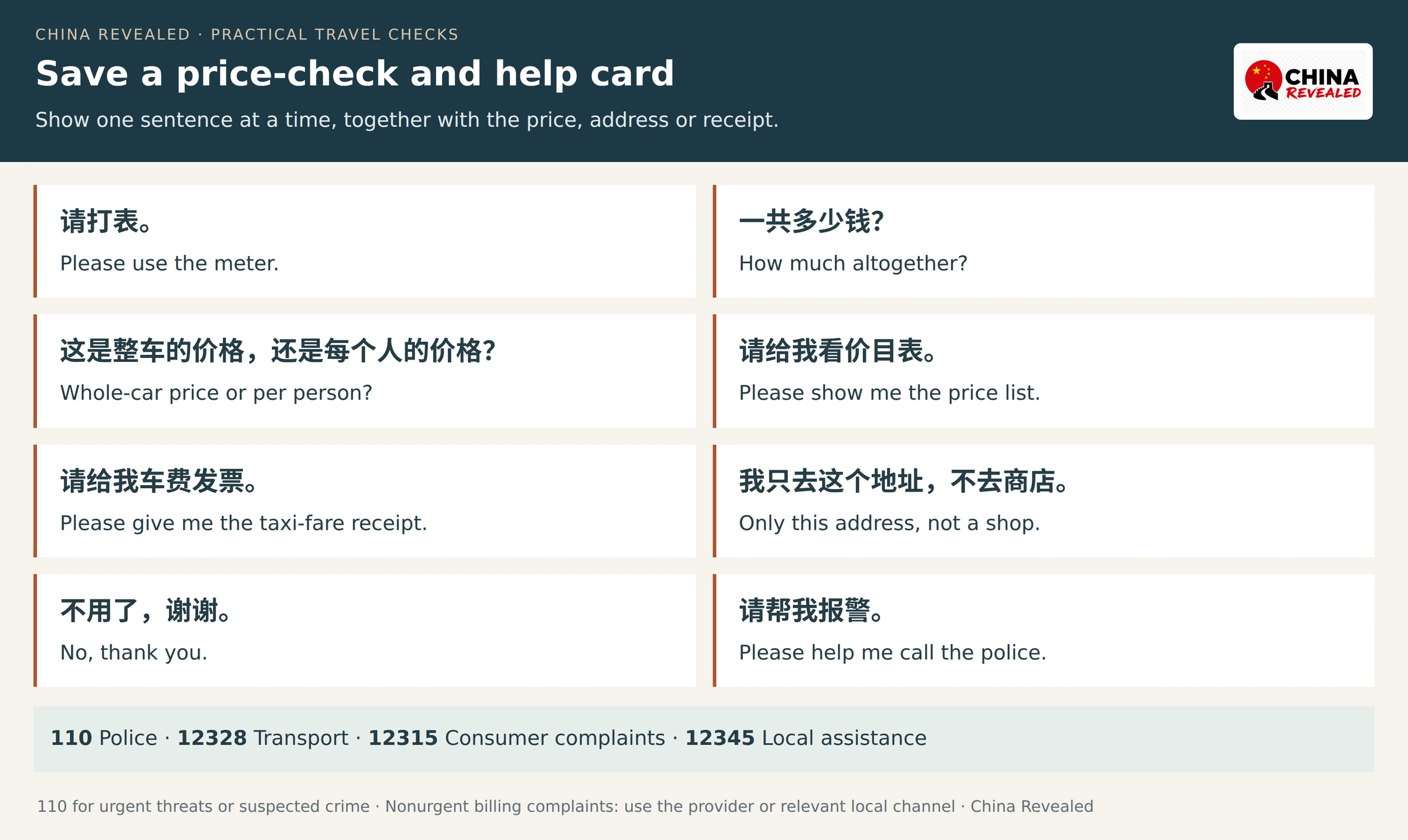
The basic Mandarin guide has more phrases for asking directions, ordering and checking a price. Show the relevant sentence rather than handing an unlocked phone to an unfamiliar person.
Common questions
Is China a difficult place to travel because of scams?
A few recognizable transaction traps are worth knowing; they should not define the trip. The practical habits are choosing the provider independently, understanding the full price and keeping records. The separate China safety guide covers wider travel safety.
Should every friendly stranger be avoided?
No. Conversation is not the warning sign. Insistence on one unknown business, unclear costs and pressure to buy are much more useful signals. A polite refusal is enough if the invitation is unwanted.
Is a price above an app estimate proof of fraud?
No. Check whether the original offer was an estimate, fixed fare or metered taxi and whether traffic, tolls, waiting or changed stops explain the difference. Compare the actual service and terms, not a bare per-kilometer calculation.
Are separately charged cable cars or table fees scams?
Not simply because they are separate. A chosen, clearly disclosed service is different from an unexpected compulsory charge. Ask what is included and what is optional before accepting the service.
What is the most useful rule to remember?
Choose independently, confirm the full total, and keep the record. Those three habits apply to tea, transport, tickets, tours, restaurants and shops without making every ordinary interaction feel suspicious.
About China Revealed
China Revealed is an independent English-language travel guide dedicated to China.
We bring together China travel guides, destination information, local insights and practical travel resources in one place.
Our travel database covers China's provinces, cities, famous attractions, hidden gems, local cuisine, transportation, accommodation, visa requirements, digital payments, mobile connectivity and the other practical details travelers need to explore China.
We focus on depth, careful research and accuracy. Our guides combine official sources, detailed destination data, local knowledge and regularly updated information to give reliable, practical travel advice.
Whether you're visiting China for the first time or exploring beyond the popular destinations, China Revealed is an all-in-one resource for discovering the real China.
China Revealed — Your practical guide to China.
Some links on China Revealed, such as Trip.com booking links, are affiliate links. If you book through them, we may earn a commission at no extra cost to you. This does not change what we recommend.