


Get to know Shapingba District

- Administrative area
- District · 市辖区
- Part of
- Chongqing
- Chinese name
- 沙坪坝区
- Local areas
- District guide
Shapingba is part of Chongqing’s central urban area, not one of the municipality’s distant counties. It is best explored as several distinct neighbourhoods rather than as a single attraction: the old commercial streets of Ciqikou (磁器口), the wooded foothills and memorial sites of Geleshan (歌乐山), and the education and retail quarter around Shapingba’s rail-and-metro centre. These contrasts make the district a useful way to understand how Chongqing’s river trade, wartime history and modern city life meet.
Ciqikou: from river port to living street quarter
Begin at Ciqikou Ancient Town (磁器口古镇), a protected historic-and-cultural street district beside the Jialing River (嘉陵江). Its setting makes more sense on foot: the commercial lanes climb and branch among hills, while the old port lies below by the water. The name recalls the town’s porcelain trade; it was also a busy land-and-water market before the wharf’s function faded after 1958. Today, historic-looking lanes sit alongside newer pedestrian streets, cafés, craft shops and food stalls.
From Line 1’s Ciqikou Station (磁器口站), a February 2024 route report describes Exit 2 and a roughly 100-metre walk to the rebuilt pedestrian street. Station approaches can change with construction, so follow the signed public way to the pedestrian street if the exit arrangement differs when you arrive. From there, cross beneath the Huangjueping archway (黄桷坪牌坊) and wander the older lanes; continue downhill toward the former waterfront if you want to see how the town relates to the river. The route is steep in places, with steps and uneven paving.
Give the busy main lane time, but also look into the side alleys and the connected newer quarters. You can browse local craft and snack shops, sit for tea, or watch demonstrations where a venue is actually operating. Ciqikou mahua (磁器口麻花), a fried twisted-dough snack, is associated with the old market; shops sell different flavours and styles, so one shop’s recipe is not a district-wide standard. Treat river piers and boat services as a separate, date-sensitive outing: the sources here do not establish a current public sailing timetable or return service.
Geleshan: memorial sites in a wooded setting
The foothills of Geleshan hold a separate, solemn cluster of sites associated with wartime and civil-war imprisonment and the Hongyan story. The former Baigongguan (白公馆) and Zhazi Cave (渣滓洞) prison sites are not interchangeable buildings or a single entrance; each has its own visitor approach. The memorial cemetery and exhibition spaces help visitors understand the people and events behind these sites. Allow time to read the interpretation, and keep the memorial setting in mind: speak quietly, respect barriers and posted rules, and avoid photographing other visitors without permission.
For the Geleshan Revolutionary Memorial Exhibition Hall (歌乐山革命纪念馆陈列馆), the official museum visitor guide gives Metro Line 1 to Lieshim Tomb Station (烈士墓站), Exit 2B, then about 500 metres on foot. For Baigongguan, it lists bus 210, T003, and the Geleshan scenic-area shuttle; it also describes transferring from Lieshim Tomb Station to bus 210 and getting off at Baigongguan (白公馆) stop. From Baigongguan to Zhazi Cave, the guide lists T003 or the scenic-area shuttle, or a 1.7-kilometre uphill walk. Check the museum’s current notices for closures, admission and any reservation requirement before setting out; the route guide is not a live timetable.
A district shaped by learning
Shapingba’s cultural identity also comes from its schools. During the War of Resistance against Japan, universities and intellectuals relocated to Chongqing, and many gathered in the Shapingba area. The district’s later university-town campuses extend that educational role into today. This is a working academic quarter rather than one all-access attraction: visit a named museum, gallery or event only after checking its own public hours and campus-entry rules.
Getting around
For Ciqikou, use Line 1 to Ciqikou Station and the signed pedestrian approach; the dated route above identifies Exit 2. The Chongqing government lists buses 202, 220, 224, 237, 261, 467, 503, 553 and 843, plus sightseeing services T003 and T198, to Ciqikou West Gate (磁器口西门). For the Geleshan memorials, use Line 1 to Lieshim Tomb Station, then the museum-listed bus or shuttle connections for the separate sites. Return by reversing the same route and checking that day’s service.
Shapingba covers several distinct areas, so there is no useful single taxi address or district-wide drop-off point. For a car, enter the exact Chinese attraction name—磁器口古镇, 白公馆, or 渣滓洞—and use only a currently signed public passenger drop-off near that attraction’s visitor entrance. Do not ask to be driven into Ciqikou’s pedestrian lanes or assume a memorial-site service road is open to general traffic. The sources reviewed do not confirm a permanent legal curbside drop-off at each site; follow current on-site restrictions.
Visit note: Ciqikou is a public street quarter, while the memorial sites are managed visitor attractions. Opening days, reservation rules, access arrangements and any performance or boat schedule can change independently. Check the relevant official attraction notice for your visit date; do not assume a show, boat or shuttle operates simply because it appears in an older guide.
Explore Shapingba District
Core places to explore, with English and Chinese names.
Places to explore around Shapingba District
 Yinglongmen gateway and stepped pedestrian approach at Ciqikou, Chongqing. Photo: Xiumuzidiao · CC BY 4.0
Ciqikou磁器口
Ciqikou is a hillside historic quarter in Shapingba where stone lanes, old port geography, teahouses and newer cultural-retail spaces meet above the Jialing River.
Read the place guide →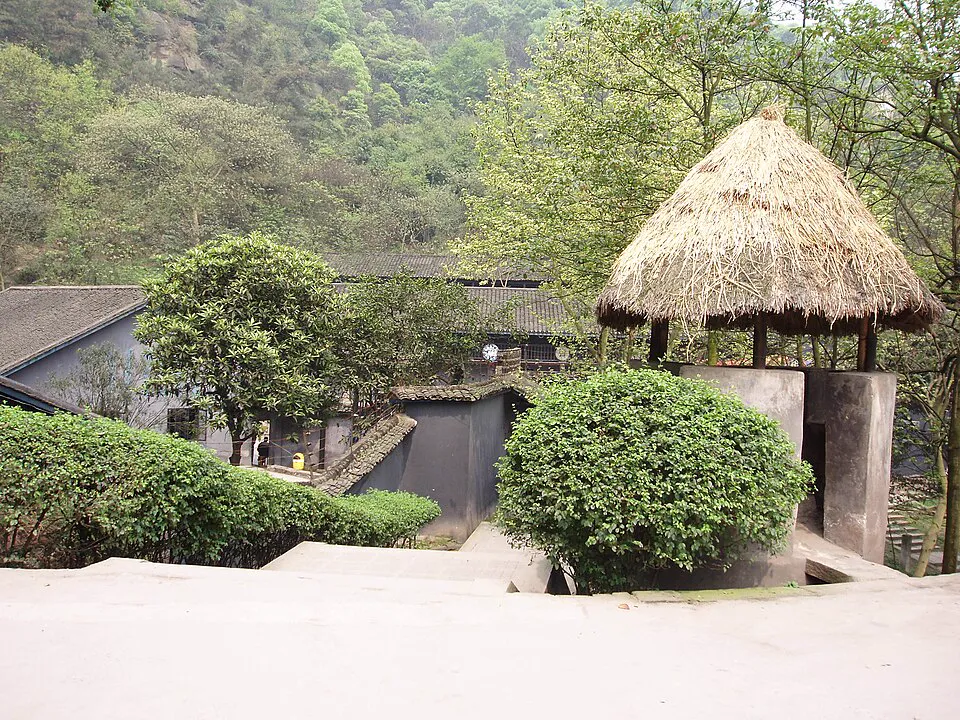 The preserved cells and courtyard sit beneath the wooded hills at Zhazidong. Photo: Fanghong · CC BY-SA 3.0
Zhazidong渣滓洞
A compact memorial in Chongqing’s wooded Geleshan foothills where the separate courts, cells and interrogation spaces of a former wartime detention site make a difficult chapter of the city’s history tangible.
Read the place guide →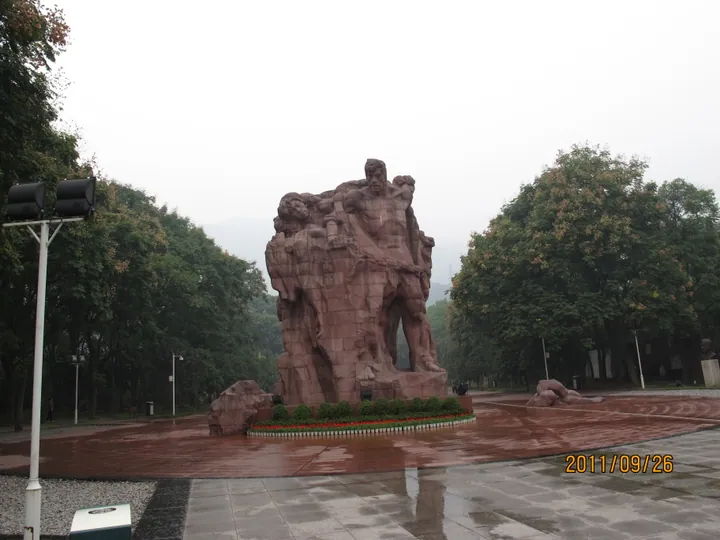 The martyrs' memorial statue at the Geleshan cemetery park, Shapingba District, Chongqing · 重庆沙坪坝区歌乐山烈士陵园塑像 Source-recorded photograph date: Taken on 26 September 2011.
Geleshan歌乐山
A wooded mountain outing in Shapingba, on Chongqing’s western side, for forest paths, fresh air and broad hillside scenery. Treat the forest park as a nature visit; the nearby Red Rock memorial sites are separate destinations, not interchangeable park entrances.
Read the place guide → AI illustration; an interpretive view, not a photograph. AI 示意图,非景点实拍。
Ronghui Hot Springs融汇温泉
A commercial bathing complex in Shapingba’s Lishuwan area, with indoor spa facilities and outdoor hot-spring pools; check which areas are open and included before you go.
Read the place guide →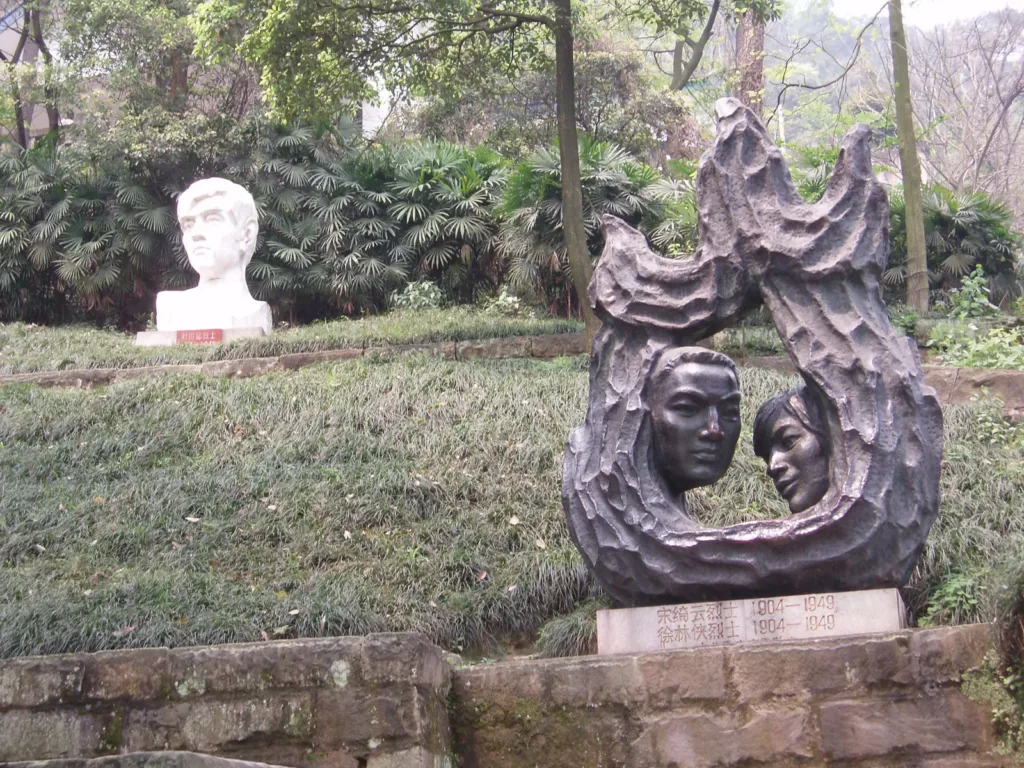 A memorial sculpture and a martyr’s bust in the landscaped cemetery grounds at Geleshan. Photo: Fanghong · CC BY-SA 3.0
Geleshan Martyrs Cemetery and Hongyan Historic Sites歌乐山烈士陵园与红岩旧址群
A solemn hillside memorial landscape in Shapingba brings together the martyrs’ tomb, Red Crag sculpture and exhibition hall, and former prisons at Baigongguan and Zhazidong. The wider Hongyan museum network also has separate sites elsewhere in Chongqing.
Read the place guide → AI illustration · AI 示意图(仅供参考,非该地点实拍)
Luo Zhongli Art Museum罗中立美术馆
At Sichuan Fine Arts Institute’s Huxi campus, this art museum pairs a courtyard-like, tile-clad building with changing displays of contemporary art, institute collections and the Rent Collection Courtyard.
Read the place guide → AI illustration · AI 示意图(仅供参考,非该地点实拍)
Chongqing 1949 Grand Theatre重庆1949演艺
A purpose-built immersive theatre near Ciqikou stages Chongqing 1949, a rotating, multi-ring production about the city’s Red Rock history and the final days before its 1949 liberation.
Read the place guide →Local life & food
Shapingba District local specialties
沙坪坝区特色美食 · 6 specialties to discover
 Ciqikou Fried Dough Twists 磁器口麻花AI illustration · AI 示意图(仅供参考,非实拍)
A crisp, hand-twisted fried-dough snack associated with Ciqikou Old Town in Chongqing, sold in sweet, savory and spicy variations.
Read the dish guide →Chen’s Mahua 陈麻花AI illustration · AI 示意图(仅供参考,非实拍)
A Ciqikou-rooted Chongqing take on mahua, the crisp, twisted fried-dough snack. Chen Changyin’s family lineage is associated with Ciqikou, but mahua is a wider Chinese snack and “Chen mahua” is not the exclusive name of one seller.
Read the dish guide → Gele Mountain spicy chicken 歌乐山辣子鸡
A bold Chongqing-style shared dish of small chicken pieces wok-tossed with dried chilies and Sichuan peppercorns: look for crisp, savory bites among the red peppers, and mind the small bones.
Source ↗Read the dish guide →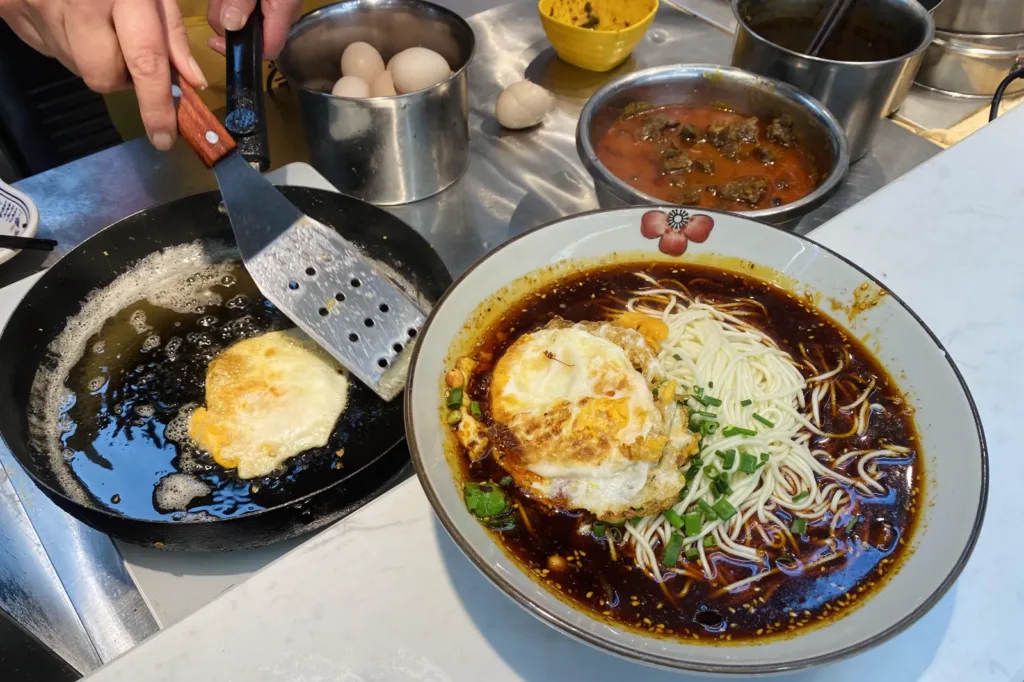 Chongqing xiaomian 重庆小面
Chongqing xiaomian is an everyday wheat-noodle bowl built around a fragrant, spicy-numbing seasoning base. Order it plain or with toppings such as peas and minced-meat sauce; shops vary between broth and dry-mixed servings.
Source ↗Read the dish guide → Maoxuewang blood-curd stew 毛血旺AI illustration · AI 示意图
A bold Chongqing jianghu-cuisine share dish of tender blood curd, assorted offal and vegetables in a hot, aromatic broth. Modern restaurant versions are usually red and richly seasoned, but ingredients and heat vary.
Source ↗Read the dish guide →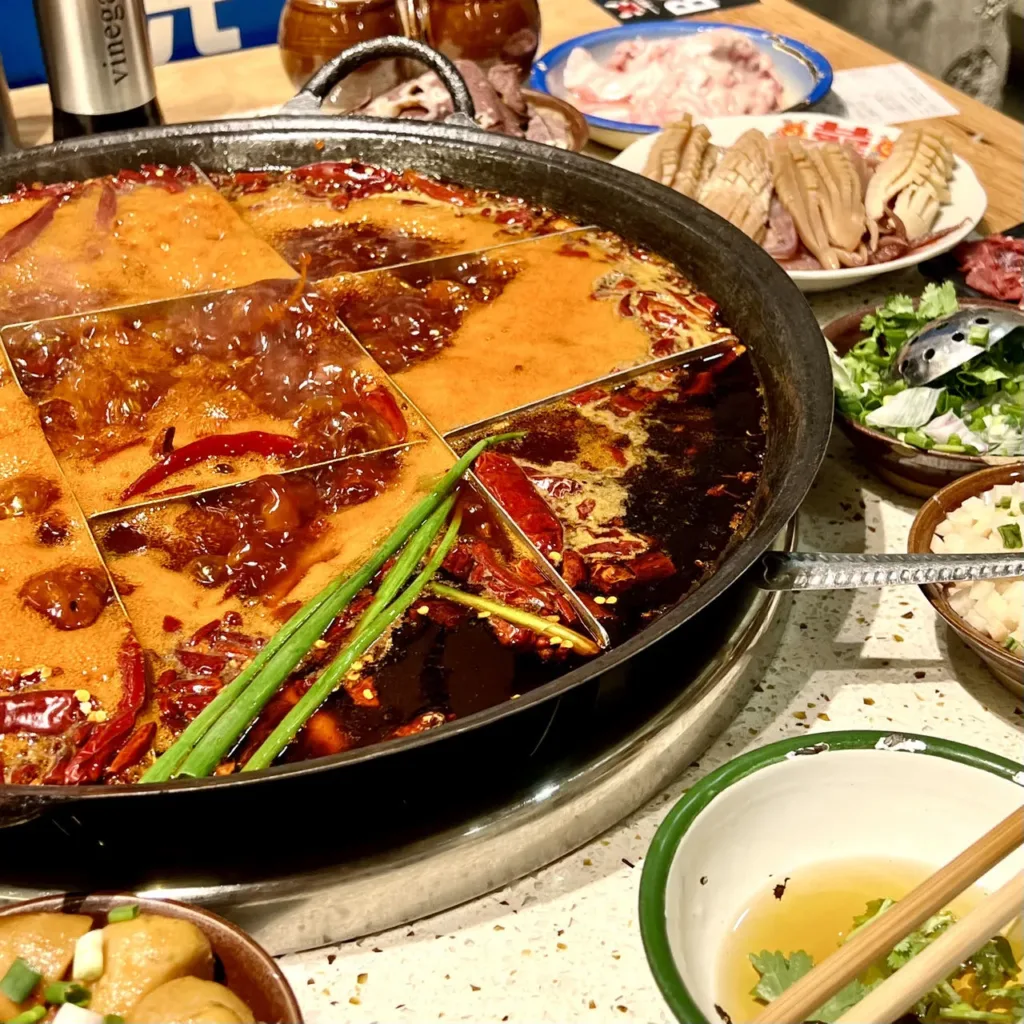 Chongqing hotpot 重庆火锅
A communal Chongqing meal built around a bubbling, usually chili-red broth, fragrant with Sichuan pepper and often enriched with beef tallow. Diners cook thin-sliced meats, offal, tofu and vegetables at the table; each restaurant’s broth and ingredient selection differs.
Source ↗Read the dish guide →More dishes from across Chongqing are in the Chongqing food guide.
Plan your visit
Getting there
Shapingba District is about 10 km (straight-line distance) from central Chongqing. Search for 沙坪坝区 in a map app to find stations and your accommodation.
Where to stay →Build your route
Ciqikou and Zhazidong are about 2 km apart (straight-line distance). The linked place guides have entrance and visit details.
Continue with Chongqing →More in Chongqing
Sources & geographic information
Administrative names and parent areas: Official geographic directory (dmfw.mca.gov.cn) · Reference date 2026-09-06.
Official administrative update
Official administrative update
Background text adapted from Shapingba, Chongqing — Wikipedia contributors, under CC BY-SA 4.0. Text has been shortened and reorganized; source revision 1368196033.
Photo: Geleshan · Nyx Ning · CC BY-SA 3.0. Resized for the web; the photo itself has not been edited. Thumbnails may show a cropped view.

Map data © OpenStreetMap contributors. Pins mark approximate centres, not entrances or boundaries.
Image credits & notes (1)
- The skyline of Shapingba District, Chongqing. Photograph date recorded by the source: 2009-01-18 15:49:04.Photo: Oliver Ren · CC BY-SA 3.0Resized for the web; the photo itself has not been edited. Thumbnails may show a cropped view.
