


Get to know Tianshui

Photo adjustments
Full frame retained; proportionally resized and converted to WebP. No retouching or changes to the photographed subject. Card displays may crop the view.
- Administrative area
- Prefecture-level city · 地级市
- Part of
- Gansu
- Chinese name
- 天水市
- Local areas
- 7 local areas
Area & population
- Area in the source
- 14,280.00 km²
- Population · 2020 census
- 2,984,659
- Administrative seat
- Qinzhou District
Source: cited geographic source, as of the dates shown.
Setting and landscape
The prefecture straddles the Yangtze and Yellow River basins: the city drains to the Yellow River, but the far side of South Mountain (南山), a few li away, lies in the Yangtze basin. Citing its pleasant climate, the city’s culture and tourism bureau calls Tianshui the Jiangnan of Gansu (陇上江南).
History
Excavations at the Dadiwan Site (大地湾遗址) in Qin’an County (秦安县) show people living here 8,000 years ago; finds include painted pottery the city government counts among China’s oldest, broomcorn millet over 7,000 years old and F901, a palace-style building over 5,000 years old. The bureau calls Tianshui, also known as Qinzhou (秦州), the cradle of the Qin people. Many battles of Zhuge Liang’s (诸葛亮) Three Kingdoms campaigns were fought here, and battlefields such as Jieting (街亭) survive. Official Fuxi rites began in the Ming dynasty, centred on the Fuxi Temple (伏羲庙); the Taihao Fuxi Ceremony (太昊伏羲祭典), held each summer solstice, entered the first national intangible heritage list in 2006.
What to see
The Maijishan Grottoes, in hills southeast of the city, take their name from a wheatstack-shaped peak. Carving began under the Later Qin (384–417); its caves, best known for clay sculpture, are linked by plank walkways across a sheer cliff. This World Heritage site lies in a national 5A scenic area that also includes Xianrenya (仙人崖). With Daxiangshan (大像山) in Gangu County (甘谷县) and Shuiliandong (水帘洞) in Wushan County (武山县), it forms what the bureau calls a “hundred-li grotto corridor”.
In the city stands the Fuxi Temple, first built in the Ming Chenghua reign; Nanguo Temple (南郭寺) is where the poet Du Fu (杜甫) stayed. Guatai Mountain (卦台山), 17 km from the city above an S-bend of the Wei, is where legend says Fuxi devised the eight trigrams.
Food and local products
Tianshui guagua (天水呱呱), a breakfast staple, is buckwheat starch stirred in a pot for about an hour; its name is a sound-shift of guoba (锅巴), the pot crust, and its making technique entered Gansu’s provincial intangible heritage list in 2017. The viral Tianshui malatang (天水麻辣烫) pairs hand-rolled starch noodles, tofu and vegetables with local Sichuan pepper and Gangu chili. Jiangshui noodles (浆水面) and hot-and-sour tripe soup (酸辣肚丝汤) are other local foods, and Tianshui carved lacquer (雕漆) has been on the national intangible heritage list since 2008.
Getting oriented
Tianshui lies midway between Lanzhou, Xi’an, Yinchuan and Chengdu, and the Longhai Railway (陇海铁路), the Baoji–Lanzhou high-speed line (宝兰客专) and the Lianyungang–Khorgas Expressway (连霍高速) cross it east to west.
Highlights
- Maijishan Grottoes 麦积山石窟: Cliff caves begun under the Later Qin (384–417), noted for clay sculpture and on the World Heritage list.
- Dadiwan Site 大地湾遗址: Neolithic site in Qin’an County with early painted pottery, carbonised millet and the palace-style building F901.
- Fuxi Temple 伏羲庙: Temple in the city’s Xiguan (西关) area, first built in the Ming Chenghua reign; a national key protected site.
- Tianshui guagua 天水呱呱: Buckwheat-starch breakfast whose making technique entered Gansu’s provincial intangible heritage list in 2017.
Sources for this guide
基本概况-天水市人民政府 (天水市情简介) · Tianshui Municipal People's Government
石窟文化-天水市人民政府 · Tianshui Municipal People's Government
大地湾文化-天水市人民政府 · Tianshui Municipal People's Government
公祭伏羲大典-天水市人民政府 · Tianshui Municipal People's Government (city festival service centre)
舌尖上的非遗|天水呱呱!你吃过吗?-天水市人民政府 文化和旅游局 · Tianshui Municipal Bureau of Culture and Tourism (article from Qinzhou District culture and tourism)
旅游概况-天水市人民政府 文化和旅游局 · Tianshui Municipal Bureau of Culture and Tourism
总体概况-天水市人民政府 文化和旅游局 · Tianshui Municipal Bureau of Culture and Tourism
雕漆技艺 - 中国非物质文化遗产网·中国非物质文化遗产数字博物馆 · China Intangible Cultural Heritage Network (ihchina.cn)
天水麻辣烫 佳肴何其美-天水市人民政府 文化和旅游局 · Tianshui Municipal Bureau of Culture and Tourism
Original English written from the listed sources and checked sentence by sentence against quoted extracts by a separate reviewer. Updated 2026-09-30.
Explore Tianshui
Core places to explore, with English and Chinese names.
Maijishan Grottoes 麦积山石窟
Dadiwan Site 大地湾遗址
Fuxi Temple 伏羲庙
Nanguo Temple 南郭寺
Shuiliandong Grottoes 水帘洞石窟
Xuanyuan Culture Scenic Area 轩辕文化景区
Daxiangshan Grottoes 大像山石窟
Yuquan Taoist Temple 玉泉观
Tianshui Ancient City 天水古城
Xianrenya Cliff Temples 仙人崖
Shimen Mountain 石门山
Qinzhou District 秦州区
Maiji District 麦积区
Qingshui County 清水县
Qin'an County 秦安县
Gangu County 甘谷县
Wushan County 武山县
Zhangjiachuan Hui Autonomous County 张家川回族自治县
Places to explore around Tianshui
 Maiji Shan Caves · 麦积山石窟
Maijishan Grottoes麦积山石窟
Maijishan’s caves occupy the faces of a rounded hill whose shape suggested a stack of grain. Stairs and narrow galleries connect openings high on the cliffs, while painted clay figures give the interiors their particular…
Read the place guide → Dadiwan Site (大地湾遗址), Tianshui. Photograph: "仰韶文化人头形器口彩陶瓶".
Dadiwan Site大地湾遗址
Dadiwan’s excavations reveal successive generations of settlement, with houses, hearths, pottery and traces of cultivation. The large F901 building stands out through its organised rooms, substantial supports and central hearth…
Read the place guide → The main gate hall of Fuxi Temple in Tianshui, Gansu · 甘肃天水伏羲庙大门 Source-recorded photograph date: Taken on 29 December 2010.
Fuxi Temple伏羲庙
Tianshui’s Fuxi Temple honours the legendary culture hero through a sequence of courtyards and timber halls. The main Xiantian Hall combines a seated Fuxi image with a ceiling patterned around trigrams and hexagrams, connecting…
Read the place guide → Nanguo Temple · 南郭寺
Nanguo Temple南郭寺
Nanguo Temple occupies a wooded hollow on Huiyin Mountain above Tianshui. Ancient trees spread through its courts, while the Beiliu Spring and poetry inscriptions connect the place with Du Fu’s stay in Qinzhou. The compound is…
Read the place guide → The entrance gate of the Water Curtain Cave Grottoes Scenic Area, Wushan County, Tianshui · 天水市武山县水帘洞石窟风景区大门 Source-recorded photograph date: 2024-08-21 14:47:15.
Shuiliandong Grottoes水帘洞石窟
Shuiliandong Grottoes (水帘洞石窟) is a cave-temple complex in the Zhonglou Mountain gorge of Wushan County, Tianshui, Gansu, named for the natural cave whose lip carries a curtain of water in rain.
Read the place guide → AI illustration · AI 示意图(仅供参考,非该地点实拍)
Xuanyuan Culture Scenic Area轩辕文化景区
Xuanyuan Culture Scenic Area (轩辕文化景区) is the label this entry carries for the group of Yellow Emperor sites in Qingshui County, Tianshui, Gansu. The sites it groups under that label include Xuanyuan Valley at Baihe village in Shanmen town, together with Xuanyuan Square, Xuanyuan Lake Park and the Xuanyuan Ancestral Hall in the county town.
Read the place guide → Daxiangshan Grottoes (大像山石窟), Gangu County. Photograph: "甘谷唐代大佛 2010.10 - panoramio".
Daxiangshan Grottoes大像山石窟
Daxiang Mountain (大像山) is a cave-temple and hall complex built up the cliffs of Wenqi Mountain at the western end of the Qinling, 2.5 km south-west of Gangu county town in Tianshui, Gansu, and named for the great Buddha image cut at its summit.
Read the place guide →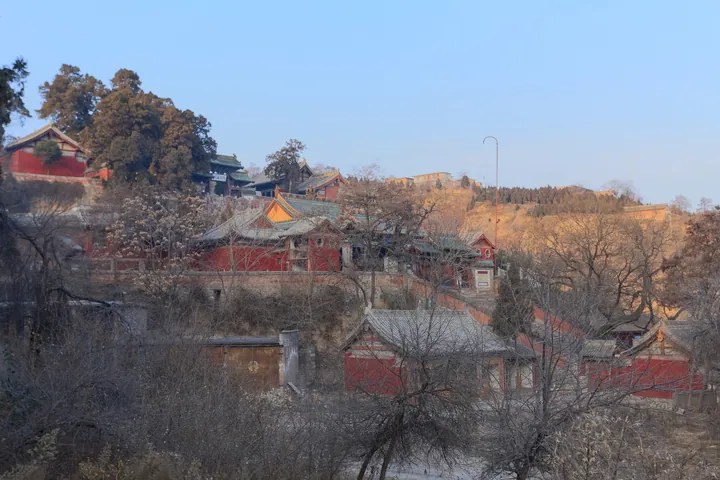 Yuquan Guan temple complex on the hillside at golden hour, Tianshui · 天水玉泉观建筑群,秦州区 Source-recorded photograph date: 2014-01-03 17:19:43.
Yuquan Taoist Temple玉泉观
Tang-founded Taoist temple in Tianshui with over 90 Ming and Qing buildings, Yuan Quanzhen steles and a cypress with braided roots.
Read the place guide → Tianshui Ancient City · 天水古城
Tianshui Ancient City天水古城
Tianshui Old City (天水古城) is the historic core of Qinzhou District, Tianshui, Gansu, whose Xiguan quarter is the only area in the city where a long-standing historic residential building cluster survives.
Read the place guide → Xianrenya Cliff Temples · 仙人崖
Xianrenya Cliff Temples仙人崖
Xianrenya (仙人崖) is a cliff-side temple and cave site inside the Maijishan scenic area of Maiji District, Tianshui, Gansu, 15 km from the Maijishan Grottoes and built up three cliffs whose summits and overhanging faces carry its temples.
Read the place guide → AI illustration · AI 示意图(仅供参考,非该地点实拍)
Shimen Mountain石门山
Shimen Mountain (石门山) is one of the five sub-scenic areas of the Maijishan national 5A-grade scenic area in Maiji District, Tianshui, Gansu, 50 km from the urban district and named for the natural stone gate its two facing peaks form.
Read the place guide →Local life & food
Tianshui local specialties
天水市特色美食 · 12 specialties to discover
 Tianshui guagua 天水呱呱AI dish illustration · AI 菜品示意图
Guagua is soft but substantial, with an earthy grain flavor beneath a sharp, spicy dressing.
Source ↗Read the dish guide → Tianshui malatang 天水麻辣烫
Expect a savory, chili-fragrant coating, with chewy noodles and vegetables providing contrasting textures. The visible red color does not precisely predict heat.
Source ↗Read the dish guide →
Photo adjustments
Resized proportionally to a maximum 640 px long edge, EXIF orientation applied where present, and encoded as WebP. No crop or subject alteration.
 Tianshui Cold Noodle Sheets 天水面皮AI illustration · AI 示意图(仅供参考,非实拍)
Tianshui Cold Noodle Sheets (天水面皮), also called niangpi (酿皮), are steamed wheat-flour sheets cut into strips and dressed with chilli oil and sesame paste, and the Qinzhou District (秦州区) government lists them among the best-known snacks of Tianshui (天水).
Read the dish guide → Jiangshui sour-broth noodles 浆水面AI illustration · AI 示意图
The broth is light but distinctly tangy, with soft vegetables and chewy noodles offering a refreshing contrast to richer meat soups.
Source ↗Read the dish guide →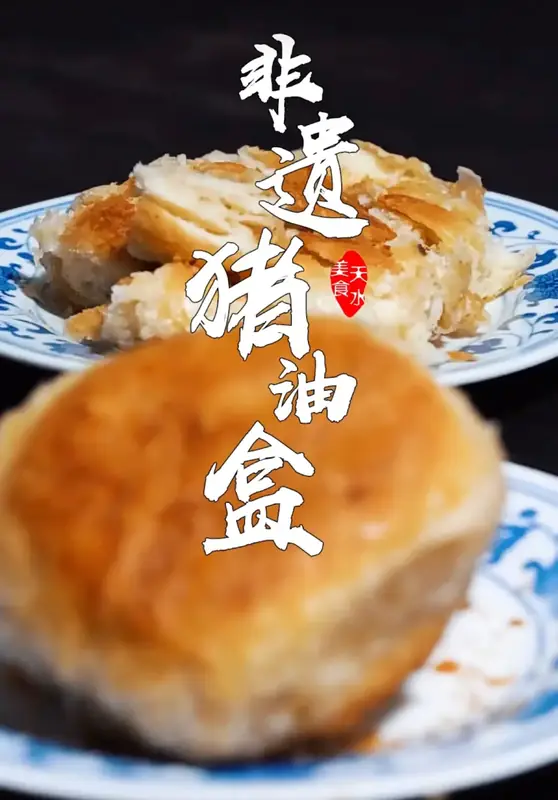 Flaky Lard Pastry 猪油盒
Flaky Lard Pastry (猪油盒) is a pan-fried pastry of Tianshui (天水), Gansu, made from fine wheat flour and raw pork leaf lard with a layer of youshu (油酥), a fat-and-flour pastry paste, rolled into the dough.
Read the dish guide →Photo adjustments
EXIF orientation normalized; resized without changing aspect ratio; converted to WebP. No subject edits.
 Noodles with Thick Gravy 打卤面
Noodles with Thick Gravy (打卤面) is a traditional Gansu snack as it is made in Tianshui (天水), where it is called dalumian (大卤面): hand-pulled wheat noodles more than two centimetres wide under a stir-fried meat and vegetable topping finished with a thick starch gravy.
Read the dish guide →
Photo adjustments
EXIF orientation normalized; resized without changing aspect ratio; converted to WebP. No subject edits.
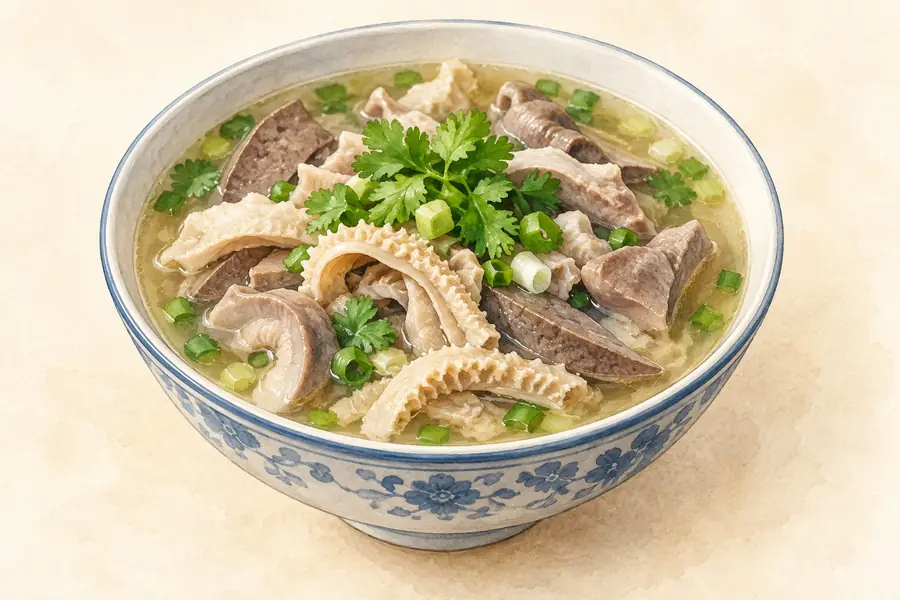 Qin'an Hot and Sour Tripe Soup 秦安肚丝汤AI illustration · AI 示意图(仅供参考,非实拍)
Qin'an Hot and Sour Tripe Soup (秦安肚丝汤) is a thickened soup of shredded tripe from Qin'an (秦安) County in Tianshui (天水), Gansu, and is listed as a Gansu provincial intangible cultural heritage food.
Read the dish guide → Gangu Crisp Pastry Rings 甘谷酥圈圈AI illustration · AI 示意图(仅供参考,非实拍)
Gangu Crisp Pastry Rings (甘谷酥圈圈) are ring-shaped baked pastries from Gangu County (甘谷县) in Tianshui (天水), Gansu, which the Gangu County news centre calls the county's most representative traditional snack.
Read the dish guide →All dish names · 全部菜名 (12)
- Tianshui guagua · 天水呱呱
- Tianshui malatang · 天水麻辣烫
- Tianshui Cold Noodle Sheets · 天水面皮
- Jiangshui sour-broth noodles · 浆水面
- Flaky Lard Pastry · 猪油盒
- Noodles with Thick Gravy · 打卤面
- Qin'an Hot and Sour Tripe Soup · 秦安肚丝汤
- Gangu Crisp Pastry Rings · 甘谷酥圈圈
- Wushan Baked Ring Cakes · 武山油圈圈
- Qingshui Dumpling Soup · 清水扁食
- Tianshui Hodgepodge Soup · 天水杂烩
- Drinking Cold Plate · 酒碟
More dishes from across Gansu are in the Gansu food guide.
Counties & districts in Tianshui
7 areas belong directly to Tianshui.
7 areas
Qinzhou District 秦州区
Qinzhou, formerly romanized as Tsinchow, is a district and the seat of the city of Tianshui, Gansu province, China. It is named for its former position as the seat of the medieval Chinese province of Qinzhou.
Explore the area →DistrictMaiji District 麦积区
Maiji District (simplified Chinese: 麦积区; traditional Chinese: 麥積區; pinyin: Màijī Qū) is a district of the prefecture-level city of Tianshui in the southeast of Gansu Province, China, bordering Shaanxi…
Explore the area →CountyQingshui County 清水县
Qingshui County (simplified Chinese: 清水县; traditional Chinese: 清水縣; pinyin: Qīngshuǐ Xiàn; lit. 'clearwater') is a county in Gansu province, China, bordering Shaanxi province to the east.
Explore the area →CountyQin'an County 秦安县
Qin'an County is a county in the east of Gansu province, China. It is under the administration of the prefecture-level city of Tianshui.
Explore the area →Show fewer areas
Gangu County 甘谷县
Gangu County is a county in the southeast of Gansu province, China. It is under the administration of Tianshui City and is the most populous county in Gansu.
Explore the area →CountyWushan County 武山县
Wushan County (simplified Chinese: 武山县; traditional Chinese: 武山縣; pinyin: Wǔshān Xiàn) is a county in the east of Gansu Province of China.
Explore the area →Autonomous countyZhangjiachuan Hui Autonomous County 张家川回族自治县
The Zhangjiachuan Hui Autonomous County (simplified Chinese: 张家川回族自治县; traditional Chinese: 張家川回族自治縣; pinyin: Zhāngjiāchuān Huízú Zìzhìxiàn, Xiao'erjing: جْاکِاچُوًا خُوِذُو ذِجِشِیًا) is an autonomous county…
Explore the area →No areas match this name.
Plan your visit
Getting there
Search for 天水市 in a map app to find stations and your accommodation.
Where to stay →Build your route
Maijishan Grottoes and Dadiwan Site are about 75 km apart in a straight line. The linked place guides have entrance and visit details.
Continue with Gansu →More in Gansu
Sources & geographic information
Administrative names and parent areas: Official geographic directory · Reference date 2026-09-06.
Photo: Maijishan Grottoes · MarsmanRom · CC BY-SA 3.0. Wikimedia thumbnail; fitted to the ranking-card frame.

Photo: Dadiwan Site · 三猎 · CC BY-SA 4.0. Full frame retained; EXIF orientation normalized, proportionally resized to at most 800 pixels and converted to WebP. No generated pixels or subject changes. Cards may crop the display.

Photo: Fuxi Temple · ❤的方向 · CC BY-SA 3.0. Full frame retained; proportionally resized and converted to WebP. No retouching or changes to the photographed subject. Card displays may crop the view.

Photo: Nanguo Temple · Zicheng zic · CC BY 4.0. EXIF orientation normalized; resized without changing aspect ratio; converted to WebP. No subject edits.

Photo: Shuiliandong Grottoes · STW932 · CC0. Full frame retained; proportionally resized and converted to WebP. No retouching or changes to the photographed subject. Card displays may crop the view.

Photo: Daxiangshan Grottoes · shannabian · CC BY 3.0. Full frame retained; EXIF orientation normalized, proportionally resized to at most 800 pixels and converted to WebP. No generated pixels or subject changes. Cards may crop the display.

Photo: Yuquan Taoist Temple · Zhangzhugang · CC BY-SA 3.0. Full frame retained; proportionally resized and converted to WebP. No retouching or changes to the photographed subject. Card displays may crop the view.

Photo: Tianshui Ancient City · Source photographer · License not provided. EXIF orientation normalized; resized without changing aspect ratio; converted to WebP. No subject edits.
Photo: Xianrenya Cliff Temples · Source photographer · License not provided. EXIF orientation normalized; resized without changing aspect ratio; converted to WebP. No subject edits.
Map data © OpenStreetMap contributors. Pins mark approximate centres, not entrances or boundaries.