


Get to know Pingquan
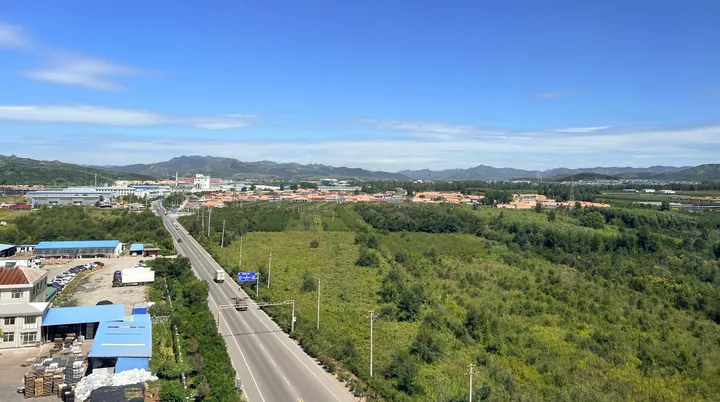
- Administrative area
- County-level city · 县级市
- Part of
- Chengde
- Chinese name
- 平泉市
- Local areas
- County-level city guide
Area & population
- Area
- 3,295.50 km²
- Population · 2020
- 399,378
- Administrative seat
- Pingquan (平泉镇)
Source: English Wikipedia, as of the dates shown.
Pingquan is easiest to understand as a borderland town with two very different scales. The settled centre carries the memory of Bagou, its Qing-era name and merchant-street past; the wider county-level city rises into wooded valleys and grassland around Mount Mayu, described in local official and cultural sources as the headwater area of the Liao River. Today, the government presents the city as part of the Hebei–Liaoning–Inner Mongolia border region and as a major base for over-summer shiitake production.
A slow town walk gives more context than a list of distant attractions. Around Zezhou Garden (泽州园), the Yelü Abaoji statue, dark-grey Jiuri Hall (就日馆), the old Zhanyun Jiuri archway (瞻云就日牌楼) and the spring form a historical axis described in local accounts. Bagou Street (八沟大街) recalls the Qing-period trading town, while the garden and surrounding streets remain part of the everyday centre rather than a sealed heritage compound.
The mountain story is equally important. Mount Mayu (马盂山), also called Guangtou Shan (光头山), is described as Pingquan’s highest peak at 1,738 metres, with grass and wild flowers on its summit and the Liaoheyuan National Forest Park (辽河源国家森林公园) around the source landscape. The Khitan ancestor legend says that a white-horse rider from Mount Mayu met a woman travelling with a blue-ox cart; the story became a national intangible cultural-heritage project and still informs local cultural memory. Treat it as a living origin tradition, not as a reason to turn a legend into a literal archaeological claim.
What to notice
For a first look at the town, search for 泽州园 Zé Zhōu Yuán, 就日馆 Jiù Rì Guǎn, 瞻云就日牌楼 Zhān Yún Jiù Rì Pái Lóu and 八沟大街 Bā Gōu Dàjiē in a Chinese map app. The useful experience is the relationship between the garden, water and civic streets: a compact urban setting where Liao-period associations and the later Bagou trading identity are presented alongside ordinary public space. Do not assume that the town’s sites form one ticketed scenic area or one managed entrance; they serve different civic and cultural functions.
A dedicated mountain outing is a different undertaking. Search for 辽河源国家森林公园 Liáo hé Yuán Guójiā Sēnlín Gōngyuán and confirm the current operating season, road condition and visitor entrance before leaving the town. The English-language Xinhua page records the park as a winter landscape, but a seasonal photograph is not proof of current opening or access. A scheduled public shuttle to the forest park is not confirmed in the sources used here, so arrange a local taxi or charter only after confirming where the driver will drop you and how you will return.
Local food
Pingquan’s most visible food story starts with shiitake mushrooms rather than a single restaurant. The municipal government describes the city as a major over-summer shiitake base and gives the local mushrooms a firm texture, thick caps, short stout stems and a clean taste. Look for locally identified mushroom dishes or market produce, but do not assume that every mushroom dish or packaged product was grown in Pingquan.
The other distinctive bowl is Pingquan mutton soup (平泉羊汤), also known by its older name Bagou mutton offal soup (八沟羊杂汤). A Hebei tourism feature describes a stock made with sheep offal, bones and head, with careful trimming and a long-cooked broth. It records both a clearer soup and a richer, fat-based version; diners may add coriander, chilli oil and pepper, often with a freshly baked shaobing. The dish is built around offal, so ask about ingredients and preparation if you avoid particular meats, fats or spices. No single shop or fixed recipe is being recommended here.
Getting there and getting back
Pingquan is a district-wide destination, not a single attraction with one entrance. The city government lists the Beijing–Shenyang high-speed railway, Jinzhou–Chengde railway, Chengchao Expressway, G101 and G508 among its regional connections. For a visitor, the two railway names matter most.
- Pingquan North Station (平泉北站) is on the Beijing–Harbin high-speed railway, also described in official railway material as the Beijing–Shenyang passenger dedicated line. A Beijing transport update says Beijing Chaoyang–Pingquan North high-speed services were changed from peak services to daily services in the January 2025 timetable. Search the exact station name 平泉北站 Píng Quán Běi Zhàn in 12306 for your travel date; do not confuse it with Pingquan Station.
- Pingquan Station (平泉站) is the conventional-rail station on the Jinzhou–Chengde railway. A current Pingquan Town planning document places the line through the eastern part of the town and identifies the station at Baimaozi Village; use 平泉站 Píng Quán Zhàn as the rail destination when that is the station shown on your ticket.
For the central town, show a driver the Chinese destination 泽州园 Zé Zhōu Yuán or 八沟大街 Bā Gōu Dàjiē and confirm the return pickup before travelling onward. For the mountain excursion, use the full Chinese name 辽河源国家森林公园 Liáo hé Yuán Guójiā Sēnlín Gōngyuán, not an English translation alone. There is no verified metro or fixed visitor bus route in the sources reviewed here, and no fare, journey time or station-exit number is supplied. Check the live train timetable and local road conditions before setting out, and return to the same named station or pre-arranged pickup point rather than assuming the two railway stations are interchangeable.
Access notes
Pingquan’s town centre and its remote mountain scenery should be planned separately. The rail stations put you in the wider Pingquan area, not at a forest-park entrance. Current visitor rules, seasonal closure and any operator-run transfer for Liaoheyuan should be confirmed directly before a trip. No blanket passport, ticket or reservation rule is asserted for the whole county-level city; individual facilities may have their own requirements.
Explore Pingquan
Core places to explore, with English and Chinese names.
Plan your visit
Getting there
Pingquan is about 60 km (straight-line distance) from central Chengde. Search for 平泉市 in a map app to find stations and your accommodation.
Where to stay →More in Chengde
Sources & geographic information
Administrative names and parent areas: Official geographic directory (dmfw.mca.gov.cn) · Reference date 2026-09-06.
Background text adapted from Pingquan — Wikipedia contributors, under CC BY-SA 4.0. Text has been shortened and reorganized; source revision 1368172229.
Map data © OpenStreetMap contributors. Pins mark approximate centres, not entrances or boundaries.
Image credits & notes (1)
- Wolong Town in the valley of Pingquan, seen from a hillside · 平泉市卧龙镇山谷俯瞰Photo: N509FZ · CC BY-SA 4.0 · taken 2022-08-24Resized for the web; the photo itself has not been edited. Thumbnails may show a cropped view.
