


Get to know Chongzhou

- Administrative area
- County-level city · 县级市
- Part of
- Chengdu
- Chinese name
- 崇州市
- Local areas
- County-level city guide
Area & population
- Area
- 1,090.00 km²
- Population · 2020 census
- 735,723
- Administrative seat
- Chongyang Subdistrict
Source: English Wikipedia, as of the dates shown.
Start in the historic center
In central Chongzhou, make the Yanhuachi Museum (罨画池博物馆) the anchor for a compact heritage walk. The museum brings together Yanhuachi, the former Chongqing Prefectural Confucian Temple (崇庆州文庙), and Lu You Shrine (陆游祠): a garden, ritual architecture and a memorial to the Song poet who served in Shu Prefecture. Walk through the connected precinct rather than expecting three separate destinations.
Lu You Shrine reopened after renovation in November 2025. Its displays use themed rooms, historical objects and multimedia to connect the poet’s life and writing with his time in Shu; allow time to read the exhibits, not just photograph the garden. The city government also identifies the newly opened Huayang Guozhi Museum (华阳国志馆) as a local-history option, but current opening hours and booking arrangements were not confirmed in the sources consulted.
Taxi destination: 崇州市罨画池博物馆 Chóngzhōu Shì Yǎnhuà Chí Bówùguǎn. A published listing gives 文庙街169号, while another address field on the same listing gives 大东街54号; use the Chinese venue name and confirm the current entrance/address with the venue before dispatch rather than assuming one curb or gate. Ask the driver to use a lawful signed passenger drop-off or parking area. No verified numbered metro exit or dedicated visitor drop-off was found. The garden precinct is within the old city, where the town's historic-street experience continues around Xiaodong Street (小东街); keep the museum and surrounding street walk as one area, not duplicate attractions.
Choose an old town, not a checklist
Chongzhou's “old-town triangle” is formed by Jiezi (街子), Yuantong (元通) and Huaiyuan (怀远). They are separate settlements with different reasons to visit, not three interchangeable “ancient streets.” Jiezi is the best-known old-town stop in the northern foothills: stroll its lanes and river-side setting, then look for the local heritage and craft activity rather than expecting a single museum-style route. Do not fold neighboring Qingcheng Mountain or other places outside Chongzhou into this district.
Yuantong developed as a riverside market and transport town. Its old lanes, surviving guild halls and large historic residences such as Huang Family Courtyard (黄家大院) make it a better choice for reading the town's former commercial life. Huaiyuan is associated with rattan weaving; visit working craft and food businesses respectfully, and ask before photographing makers or entering private premises. The municipal culture bureau identifies Huaiyuan rattan weaving and Daoming bamboo weaving as protected craft traditions, and describes a local workshop where visitors can watch bamboo weaving and buy finished objects.
For a hands-on craft stop, Daoming Bamboo Village (道明竹艺村) is a rural village destination, not an indoor museum. Look for bamboo-work demonstrations and contemporary uses of woven bamboo; demonstrations depend on who is working and should not be assumed to run to a fixed daily timetable. The local government identifies the village as a core cultural-tourism area and describes its bamboo-weaving base as an active visitor experience. Pair it with nearby countryside only if you have time for the rural distances between stops.
Wetland and mountain country
The urban core gives way to a broad rural landscape: fields and Sichuan farmstead clusters, the Qimu River wetland area, and mountain country around Jiguanshan and the Giant Panda National Park. These are separate outings, not a walkable extension of the old town. Chongzhou's official profile places 280 square kilometres of the Giant Panda National Park within the city and identifies Jiguanshan as habitat for protected wildlife; these facts do not guarantee wildlife sightings or open access to every protected area. The city also promotes the Qimu River Wetland Park, Tianfu International Slow City and countryside destinations such as Wuxing Village; check site-specific access and seasonal conditions before setting out.
Getting there and moving between areas
There is no metro station in Chongzhou itself. Chengdu–Pujiang railway trains serve Chongzhou Station (崇州站) from Chengdu West; the official 12306 site is the place to check the current train and return options for your travel date. A 2024 report described bus transfers immediately outside the station, including routes 313 to Jiezi and 306 to Huaiyuan; it also reported route 302 linking the Chongzhou tourist-transport hub with Wansheng (万盛) on Chengdu Metro Line 4. These are dated route reports, not a verified 2026 timetable, so confirm that the bus and return service are running before relying on them.
For a first visit, the rail station is the practical gateway; allow a separate transfer from it to the town or countryside destination. For Jiezi, use 街子古镇 Jiēzi Gǔzhèn or 街子古镇游客中心 Jiēzi Gǔzhèn Yóukè Zhōngxīn as the Chinese taxi destination; for Yuantong, Huaiyuan and Daoming Bamboo Village, enter the Chinese place name and confirm the public visitor entrance or signed public parking/drop-off locally. No single address or gate serves the whole district. Ask drivers to stop only at lawful passenger drop-off points, not in a lane or at a blocked residential frontage. The station-to-town buses reported in 2024 provide a useful option when confirmed locally; in rural areas, do not assume a convenient return bus will be available later in the day.
Tickets and visit planning
The old-town streets and rural villages are not one unified ticketed attraction. Admission, opening hours and advance booking for individual museums, temple buildings, craft businesses and commercial experiences vary. No current official, site-wide ticket or reservation schedule was confirmed for this guide; check the relevant venue's own notice before travel, especially for the museum precinct and any demonstration or paid activity. A sensible visit is to spend a half-day in the urban heritage core or choose one old town, then plan another day for a rural or mountain area rather than attempting to cover Chongzhou in one circuit.
Guide sources
- Chongzhou Municipal Government: City Profile
- Chongzhou Culture and Tourism Bureau: Heritage Protection Reply
- Chongzhou Municipal Government: 2025 Chongzhou Half Marathon and Tourism Guide
- Chongzhou Municipal Government: 2026 Tourism Promotion
- Sichuan Online: Lu You Shrine Reopens after Renewal
- People’s Daily Online Sichuan: Rail and Bus Connections at Chongzhou Station
- China Railway 12306 Official Ticketing and Travel Information
- Ctrip: Yanhuachi Listing with Conflicting Address Fields
Explore Chongzhou
Core places to explore, with English and Chinese names.
Places to explore around Chongzhou
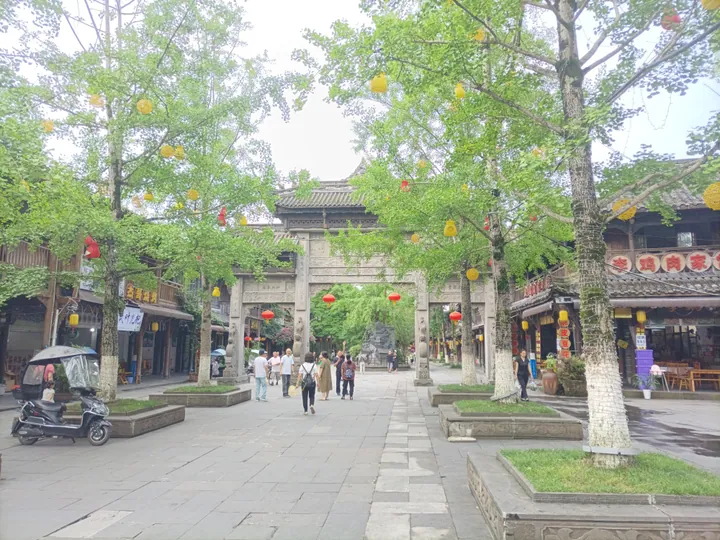 A gate archway decorated with lanterns on a street in Jiezi Ancient Town, Chongzhou · 成都市崇州市街子古镇挂灯笼的牌楼街道 Source-recorded photograph date: 2024-07-11.
Jiezi Ancient Town街子古镇
In Chongzhou, northwest of central Chengdu, Jiezi is a walkable old-town district of late Qing-era shopfronts and lanes at the foot of Fengqi Mountain. Look for the decorated Character-Storehouse Pagoda, the covered gallery on Ruilong Bridge and local history sites; reach it by intercity train to Qingchengshan and bus 102, or by taxi to the signed public drop-off near the town entrance.
Read the place guide →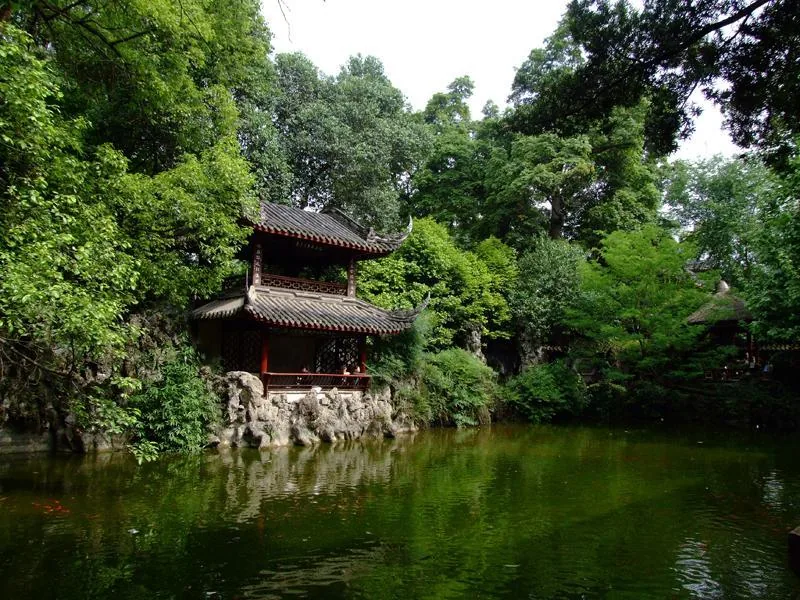 Pond and garden pavilion at Yanhua Pond Garden in Chongzhou, photographed in 2008.
Yanhua Pond Garden罨画池
A compact historic garden in central Chongzhou, where a pond-and-pavilion landscape, the Chongzhou Prefectural Confucian Temple, and the Lu You Shrine form one heritage visit. Follow the garden paths first, then the temple axis and the shrine displays; confirm current admission and opening details before setting out.
Read the place guide → Yuantong Ancient Town · 元通古镇
Yuantong Ancient Town元通古镇
Walk Yuantong’s market lanes and riverside edges to see how a western Sichuan town grew around river trade. Its old streets, timber-and-tile buildings and historic bridge setting are best explored slowly; access to individual courtyards and current event schedules should be checked locally.
Read the place guide →Plan your visit
Getting there
Chongzhou is about 40 km (straight-line distance) from central Chengdu. Search for 崇州市 in a map app to find stations and your accommodation.
Where to stay →Build your route
Jiezi Ancient Town and Yanhua Pond Garden are about 25 km apart (straight-line distance). The linked place guides have entrance and visit details.
Continue with Chengdu →More in Chengdu
Sources & geographic information
Administrative names and parent areas: Official geographic directory (dmfw.mca.gov.cn) · Reference date 2026-09-06.
Background text adapted from Chongzhou — Wikipedia contributors, under CC BY-SA 4.0. Text has been shortened and reorganized; source revision 1357674778.
Photo: Jiezi Ancient Town · Xiumuzidiao · CC BY 4.0. Resized for the web; the photo itself has not been edited. Thumbnails may show a cropped view.

Photo: Yanhua Pond Garden · 本本一世 · CC BY-SA 3.0. Resized for the web; the photo itself has not been edited.

Photo: Yuantong Ancient Town · sc.chinadaily.com.cn. Resized for the web; the photo itself has not been edited.
Map data © OpenStreetMap contributors. Pins mark approximate centres, not entrances or boundaries.
Image credits & notes (1)
- The West River and nearby housing in Chongzhou, Sichuan.Photo: MNXANL · CC BY-SA 4.0 · taken 2019-08-14Resized for the web; the photo itself has not been edited. Marks added by the source remain. Thumbnails may show a cropped view.
