


Get to know Jiange County
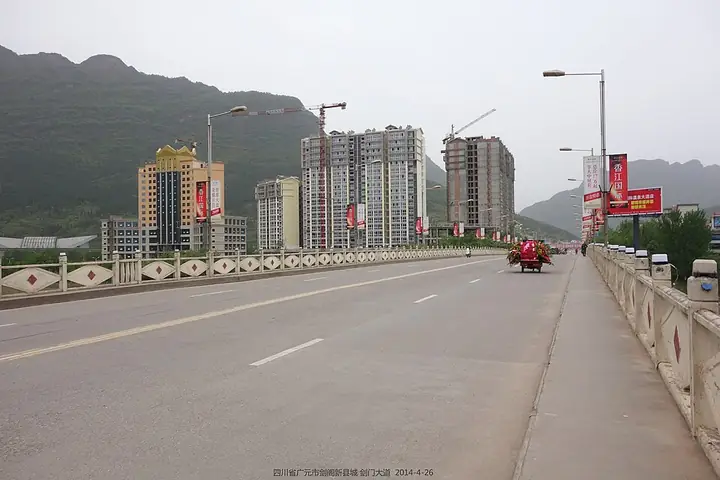
Photo adjustments
Full-frame source proportionally resized and converted to WebP for display. No subject alteration. Source-supplied marks and edits remain; cards may crop the view.
- Administrative area
- County · 县
- Part of
- Guangyuan
- Chinese name
- 剑阁县
- Local areas
- County guide
Area & population
- Area in the source
- 3,204.00 km²
- Population · 2010
- 457,656
- Administrative seat
- Pu'an
Source: cited geographic source, as of the dates shown.
History
Jiange's history is tied to the Shu Roads (蜀道). Chinese Wikipedia records that at the end of the Three Kingdoms period the Shu Han general Jiang Wei (姜维) fell back to Jiange to hold off the Wei army of Zhong Hui (钟会), while Deng Ai (邓艾) slipped round by the Yinping road and took Chengdu. Deng Ai and his son Deng Zhong (邓忠) share a tomb on Guyu Shan (孤玉山), about 10 kilometres outside the county town.
At the end of 1949 troops of the First Field Army under He Long (贺龙) entered Sichuan through Jiange from Gansu. In June 2000 the State Council moved the county seat from Pu'an (普安镇) to Xiasi (下寺镇).
What to see
Jianmen Pass stands in Jianmenguan town (剑门关镇) and is counted with Yanmen, Hangu and Xianxia among the four great ancient passes of China. Tradition credits Zhuge Liang (诸葛亮) with fortifying the gap between two cliffs, and Li Bai's poem "Hard Is the Road to Shu" (蜀道难) describes it. The gate tower has been rebuilt several times; the present one went up on the Qing-dynasty site after the 2008 Wenchuan earthquake.
The Cuiyun Corridor is the core of the Jianmen Shu Road Site (剑门蜀道遗址), a national key cultural relic protection unit. According to People's Daily Overseas, its Jiange section keeps 7,778 planted cypresses along the route, with an average age of 1,050 years, which the paper describes as the world's largest and best-preserved group of roadside trees. In 2025 the offices of the National Cultural Heritage Administration, the National Forestry and Grassland Administration and the Ministry of Housing and Urban-Rural Development put the Jianmen Shu Road Site and the Jiange cypresses on their first joint list of protected sites paired with ancient trees. People's Daily notes that the corridor is also a national forest park.
The county's other national-level sites include Jueyuan Temple (觉苑寺) and the Taoist cave temple and carvings of Heming Shan (鹤鸣山), and its provincial list includes the Jianzhou Confucian temple (剑州文庙) and the Jianxi Bridge (剑溪桥).
Food and local products
Jianmenguan tofu (剑门关豆腐) is a Chinese geographical-indication product. Chinese Wikipedia also names Jianmen ham (剑门火腿) and Jiange walking sticks (剑阁手杖) as well-known local products.
Highlights
- Jianmen Pass 剑门关: One of the four great ancient passes of China, described in Li Bai's "Hard Is the Road to Shu".
- Cuiyun Corridor 翠云廊: 7,778 ancient roadside cypresses averaging 1,050 years old in the Jiange section.
- Jueyuan Temple 觉苑寺: National key cultural relic protection unit.
- Jianmenguan tofu 剑门关豆腐: Chinese geographical-indication product.
Sources for this guide
剑阁县近期已投入70万元加强翠云廊古柏保护--旅游--人民网 · People's Daily Online
首批“国保单位·古树名木”协同保护名录公布_新闻频道_央视网(cctv.com) · People's Daily Overseas Edition, republished by CCTV
剑阁县 - 维基百科,自由的百科全书 · Wikipedia (Chinese) · CC BY-SA 4.0
剑门关 - 维基百科,自由的百科全书 · Wikipedia (Chinese) · CC BY-SA 4.0
Original English written from the listed sources and checked sentence by sentence against quoted extracts by a separate reviewer. Updated 2026-09-25.
Explore Jiange County
Core places to explore, with English and Chinese names.
Places to explore around Jiange County
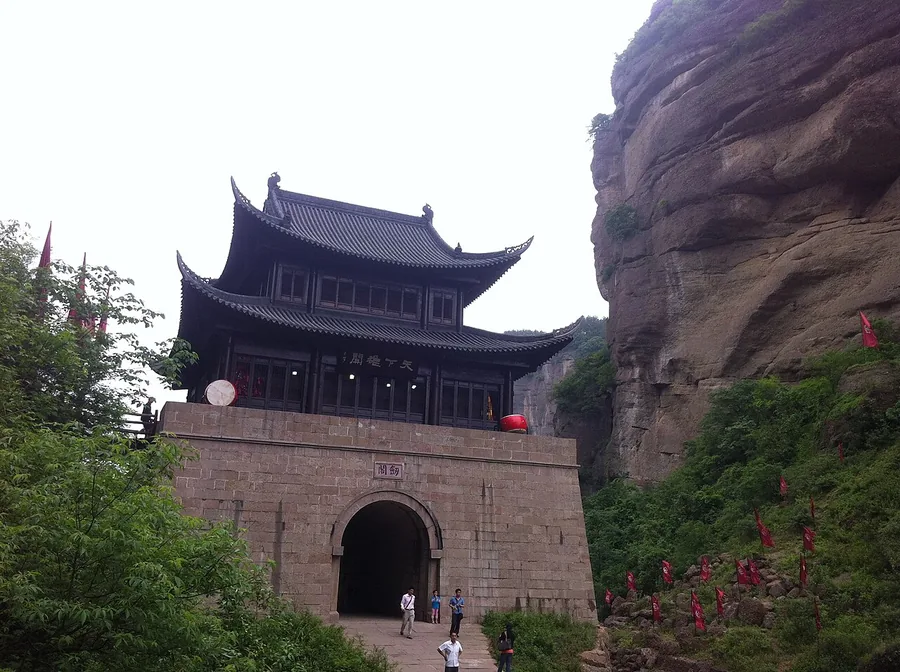 The reconstructed gate tower at Jianmen Pass beneath the surrounding cliffs. Photographed on 13 May 2012.
Jianmen Pass剑门关
Jianmen Pass occupies a narrow break in the steep cliffs of Dajian Mountain. The landscape explains its defensive role on the old Shu Roads more clearly than a timeline alone: the rock walls form the gateway, with the built gate…
Read the place guide →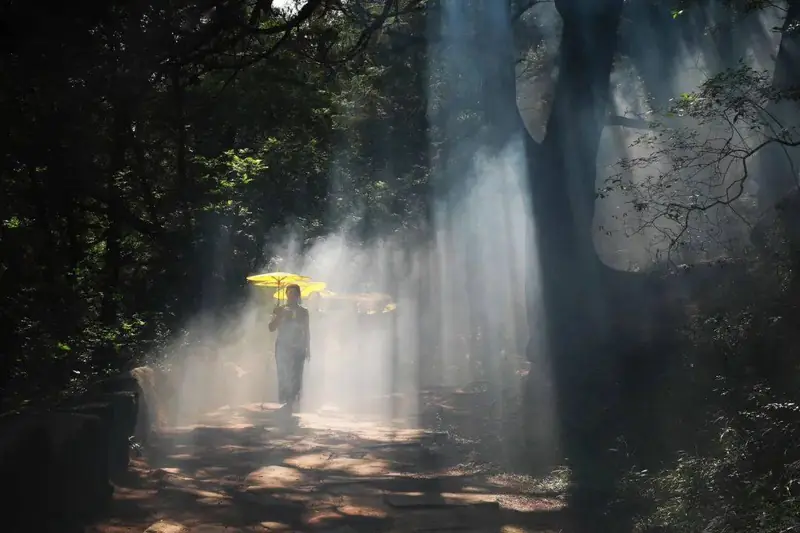 Lanmaqiang Ancient Shu Road · 拦马墙古蜀道
Lanmaqiang Ancient Shu Road拦马墙古蜀道
Lanmaqiang is a roughly six-kilometre stretch of the ancient Shu road in Liangshan township, Jiange county, Guangyuan, Sichuan, named for a wall which a Sichuan Daily essay glosses literally as one used in old times to hold horses back. The same essay says it is the only such surviving wall section on the whole ancient Shu road.
Read the place guide → Cuiyun Corridor · 翠云廊
Cuiyun Corridor翠云廊
Cuiyunlang is the cypress-lined stretch of the ancient Shu road centred on the old town of Jianzhou in Jiange county, Guangyuan, Sichuan, running north to the old town of Zhaohua, south to Langzhong in Nanchong, and west to Zitong in Mianyang. It stands on the Jinniu Road, whose core section is the Jianmen Shu road, designated by the State Council in 2006 as a sixth-batch national key cultural relic protection unit.
Read the place guide →Plan your visit
Getting there
Jiange County is about 35 km in a straight line from central Guangyuan. Search for 剑阁县 in a map app to find stations and your accommodation.
Where to stay →Build your route
Jianmen Pass and Lanmaqiang Ancient Shu Road are both listed here. The linked place guides have entrance and visit details.
Continue with Guangyuan →More in Guangyuan
Sources & geographic information
Administrative names and parent areas: Official geographic directory · Reference date 2026-09-06.
Some facts checked against 剑阁县 — Wikipedia contributors, CC BY-SA 4.0.
Some facts checked against 剑门关 — Wikipedia contributors, CC BY-SA 4.0.
Photo: Jianmen Pass · ping lin · CC BY-SA 3.0. Proportionally resized and converted to WebP without cropping, retouching or changing the photographed subject.

Photo: Lanmaqiang Ancient Shu Road · Source photographer · License not provided. EXIF orientation normalized; resized without changing aspect ratio; converted to WebP. No subject edits.
Photo: Cuiyun Corridor · Source photographer · License not provided. EXIF orientation normalized; resized without changing aspect ratio; converted to WebP. No subject edits.
Map data © OpenStreetMap contributors. Pins mark approximate centres, not entrances or boundaries.