

Explore the region
Why Chengde feels different
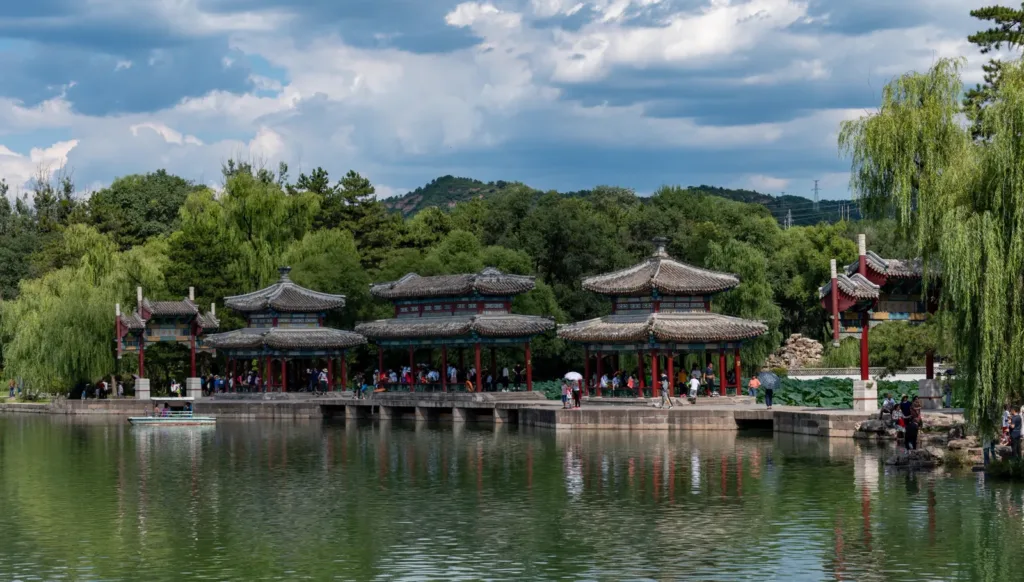
Chengde is best understood through a landscape rather than a single monument. The Qing Mountain Resort was not only a summer garden: it was a working imperial complex of palaces, administrative buildings and ceremonial spaces, set among lakes, pastureland and forests. The outlying imperial temples occupy the surrounding hills, so the city’s signature view is a meeting of garden, mountain and religious architecture rather than one isolated palace.
That setting also explains the city’s political history. Qing emperors used Chengde in summer to handle government affairs, receive leaders from ethnic communities and meet foreign envoys. Look for the deliberate changes in scale and material: calm water and wooded slopes inside the resort, then large temple terraces and roofs outside its walls. Treat the Mountain Resort and each temple as separate visits. The UNESCO inscription describes one heritage property, but it does not establish one shared entrance or ticket for every component.
The wider municipality reaches from the southeastern edge of the Inner Mongolian Plateau to the Yan Mountains. Its official overview describes a landscape of uplands, low mountains, rivers and Danxia rock forms, with four distinct seasons and marked day–night temperature changes. This is why Chengde works best as more than a palace stop: the urban heritage core and the northern grassland-and-forest country belong to the same municipality, but they are different travel settings.
Culture here is not only monumental. Fengning Manchu paper-cutting, a national-level intangible cultural heritage from Fengning Manchu Autonomous County, is mainly made through positive-cutting with fine, long fringes. Documented forms include window decorations, festival pieces and household ornament. It is a useful way to notice everyday craft traditions in the wider city, not a promise that a live demonstration will be running on a particular day.
A local taste
For a concrete food experience, look for 二仙居碗坨, often rendered as Erxianju bowl tuo or fried buckwheat jelly. A Xinhua-affiliated Hebei report describes a mixture based on buckwheat flour and green-bean flour, with five-spice powder and pepper; the mixture is kneaded, boiled while stirred, cooled into a set block, sliced and pan-fried. It is served with sesame paste, garlic, vinegar, soy sauce and sesame oil. The same source notes that pork blood may be used but can be omitted, so ask about the batch if pork or a particular ingredient matters to you.
Scope and getting oriented
Chengde is a prefecture-level city in Hebei, not just the built-up area around the Mountain Resort. The municipal government lists 11 direct areas: Shuangqiao District (双桥区), Shuangluan District (双滦区), Yingshouyingzi Mining District (鹰手营子矿区), Pingquan City (平泉市), Chengde County (承德县), Xinglong County (兴隆县), Luanping County (滦平县), Longhua County (隆化县), Fengning Manchu Autonomous County (丰宁满族自治县), Kuancheng Manchu Autonomous County (宽城满族自治县), and Weichang Manchu and Mongol Autonomous County (围场满族蒙古族自治县).
For the heritage core, put the exact Chinese destination on your map or in a ride-hailing request: 承德避暑山庄 for the Mountain Resort, or the separate Chinese name of the temple you intend to visit. Do not use a city-level pin as though it were an entrance. The resort, the outlying temples and the remote plateau areas should not be treated as one walkable circuit.
Arriving and returning
Use the station name printed on your ticket. The high-speed option is 承德南站 (Chengde South Railway Station), on the 京哈高铁 Beijing Chaoyang–Chengde South section. The official city release lists the segment through Beijing Chaoyang, Shunyi West, Huairou South, Miyun, Xinglong County West, Anjiang and Chengde South; check the date-specific timetable before booking.
承德站 (Chengde Railway Station) is a different station for conventional trains. A current English rail reference lists its visitor address as 承德市双桥区车站路235号 and advises checking the live schedule rather than treating its timetable as fixed. If your ticket says 承德站, do not get off at 承德南站.
The air gateway is 承德普宁机场 (Chengde Puning Airport), in Xiaolianghou, Tougou Town, Chengde County, rather than in the historic centre. The provincial transport authority identifies the airport by this Chinese name and location.
For an airport transfer, the Chengde transport bureau lists Airport Bus Line 2 (机场2号线) as a round trip between 承德南站 and 承德普宁机场. Its published stop sequence is 承德南站—科技大厦—南互通枢纽站—汽车东站—世纪城五区—行政中心—火车站(武烈河大桥)—喇嘛寺村南—汽车北站—双峰寺隧道—承德机场, with the reverse direction providing the return from the airport to the city and railway side. The same notice says departures are coordinated with flights and asks passengers to check the live service through the bus hotline 966789 or the operator’s website; do not rely on an old fixed timetable, fare or airport connection.
Before leaving the city, re-check the exact return station or airport on your booking. For a temple or mountain extension, arrange the return from that specific Chinese destination rather than assuming that a city-centre bus or the airport line serves the scenic site directly.
Combine your visit
Separate visits for a first stay in Chengde:
-
Chengde Mountain Resort承德避暑山庄
Begin with the imperial garden and palace setting.
-
Puning Temple普宁寺
Make a separate visit for its wooden Guanyin and temple layout.
-
Putuo Zongcheng Temple普陀宗乘之庙
Add the monumental hillside complex if another visit slot is available.
This sequence is an editorial suggestion based on the features described in the sources. Access to individual buildings or areas should be checked locally; no travel time or shared admission is implied.
Find Chengde overview
承德 · 承德市
The pin marks the area, not the entrance.
More places nearby
Approximate straight-line distances between map pins, not travel distances.
Chengde Mountain Resort 承德避暑山庄
4 km awayChengde Mountain Resort was both an imperial summer residence and a working Qing court. Its southern palace area leads into an expansive designed landscape of lakes, open ground and forested hills. The contrast is deliberate…
View guide →Pule Temple 普乐寺
5 km awayPule Temple stands on raised ground east of the Wulie River, with Bangchui Peak behind the surrounding landscape. Its lower halls lead to Xuguang Pavilion, a circular, double-eaved building on square terraces. The interplay of…
View guide →Chengde Museum 承德博物馆
6 km awayChengde's museum beside Puning Road provides an indoor counterpart to the Mountain Resort and surrounding temples. Its displays explore imperial garden culture, Qing court life and Tibetan-Han Buddhist art, helping explain the…
View guide →Sources & visit information
Sources checked on 25 October 2026. Hours, tickets, reservations and transport can change; confirm with the operator before you go.
Image credits & notes (1)
- Xiahu Lake and its waterside pavilions in Chengde Mountain Resort, Chengde, Hebei, China. Photo: xiquinhosilvaPhoto: CC BY 2.0