


Get to know Xinzhou District
- Administrative area
- District · 市辖区
- Part of
- Wuhan
- Chinese name
- 新洲区
- Local areas
- District guide
Area & population
- Area
- 1,500.00 km²
- Population · 2020
- 860,377
Source: English Wikipedia, as of the dates shown.
Xinzhou is where Wuhan opens into a larger rural landscape. The district lies on the north side of the Yangtze in Wuhan’s northeast, with the Jianghan Plain giving way to low hills toward the Dabie range. Its administrative seat, Zhucheng, is about 55 km from Wuhan’s municipal government, and the district stretches far enough that a visit is best planned as a road-based outing rather than a walk between nearby sights.
The appeal is the change of scene. At Jiujie, Wenjin Academy ties a real place to the Analects story of Zilu asking where to cross a river. Around Daoguanhe, a reservoir sits among 72 hills, with Bao’en Chan Temple and Wanfo Pagoda as its most recognisable landmarks. At the southeastern edge, Zhangdu Lake is a wetland linked to the Yangtze; its name refers to water rising high enough to be crossed by boat and then settling back into a lake.
Xinzhou works particularly well for visitors who enjoy seeing how a metropolitan municipality becomes countryside: an old academy, reservoir roads, village landscapes, orchards and wetland edges rather than one enclosed landmark. The district government’s suggested routes connect Wenjin Academy, Chenglouzhai, Daoguanhe and Jiangjun Mountain, or combine Zhangdu Lake with Fengwa Ancient Village and other rural stops. Treat those as full-day or weekend frameworks, not as a promise that every stop is open every day.
What to explore
Wenjin Academy and Jiujie
Wenjin Academy (问津书院) stands in Kongzihe Village, at the southern foot of Kongzi Mountain in Jiujie. Its name refers to the Analects episode in which Confucius sends Zilu to ask the way to a ford. The surviving academy was repaired in 2012, is listed as a Hubei provincial cultural-relic site, and was rated a national 3A tourist attraction in 2021.
This is the district’s clearest cultural anchor: look at the academy as a historic educational complex and as a place-name with a literary story, not as a generic temple. The surrounding route is rural, so allow time for the approach and for a return ride. The official page gives the visitor address as Kongzihe Village, Jiujie Subdistrict, Xinzhou District and lists a public-transport route via Xinrongcun Passenger Terminal, Zhucheng Coach Terminal and Kongzihe Village; verify departures before leaving Wuhan.
Daoguanhe reservoir hills
Daoguanhe Scenic Area (道观河风景区) is the district’s strongest landscape stop. Its 72 peaks fold around Daoguanhe Reservoir, with water and wooded slopes changing the view as the road turns. Bao’en Chan Temple, Tongchan Lake, the reservoir dam and Wanfo Pagoda give the broad setting a sequence of places to pause. Hubei’s water-resources authority also describes the area as carrying both landscape and local revolutionary-history associations.
Come for the combination rather than a single viewpoint: reservoir water, low mountain roads, temple architecture and the scale of a working rural scenic area. Do not assume that a district-level description supplies current entrance hours, tickets, boat operation or every internal shuttle. Check the named attraction before setting out, especially after heavy rain or outside the main visitor season.
Zhangdu Lake wetland
Zhangdu Lake (涨渡湖) lies in southeastern Xinzhou and is connected with the Yangtze. The district’s route guide explains the name through the lake’s changing water conditions: high water becomes a crossing, while lower water leaves the lake. That setting supports a different kind of visit from Daoguanhe—open wetland views, water-edge vegetation and a slower rural pace.
The water forest is a seasonal landscape, not an all-year guarantee of the same appearance. Plan daylight for the wetland and confirm which boardwalks, boats or nature activities are operating. Keep to marked paths and managed viewing areas; a wetland is not a place to enter the water or approach birds for photographs.
Fengwa Ancient Village and the rural east
Fengwa Ancient Village (凤娃古寨) in Fenghuang Town is a separate rural stop, not part of Wenjin Academy or Daoguanhe. The district government’s route guide describes more than 20 Ming- and Qing-period buildings, together with folk performances and craft or intangible-culture demonstrations. It fits a countryside route when you want built heritage and staged local customs alongside fields and village roads.
Other recommended stops—such as Chenglouzhai, Huachaohewan and the “Rice-field Memory” rural area—are better treated as route options than as interchangeable city-centre attractions. Check the day’s programme and access conditions before making one of them the sole reason for a long drive.
Getting there and moving around
Wuhan Metro’s Yangluo Line, also called Line 21, runs from Houhu Avenue to Jintai and serves the Yangluo side of Xinzhou, including Yangluo, Yangluo Development Zone, Shigang and Jintai. It is useful for the district’s eastern urban and industrial edge, but a Line 21 station is not a direct arrival point for Wenjin Academy, Daoguanhe or Zhangdu Lake. Those inland and wetland visits still need a road transfer.
For Wenjin Academy, the Xinzhou government lists Xinrongcun Passenger Terminal → Zhucheng Coach Terminal → Jiujie Kongzihe Village as the public-transport sequence. Its driving directions use the Wuying Expressway via Wangji exit, or the Daguang Expressway via Xinzhou Daoguan exit, then continue toward Jiujie. These are the clearest published directions found for a named attraction, but not a guarantee of today’s coach timetable.
For a multi-stop day, use the Chinese names 问津书院 Wènjīn Shūyuàn, 道观河风景区 Dàoguànhé Fēngjǐngqū, 涨渡湖 Zhǎngdù Hú and 凤娃古寨 Fèngwá Gǔzhài in Amap or another China-capable map, and arrange the return leg before leaving the last stop. The attractions are dispersed across an administrative district; do not plan on walking between them or on finding a frequent tourist shuttle. Recheck the venue’s latest notice for opening, tickets and seasonal activities before departure.
Guide sources
- Geographical location — Xinzhou District People’s Government
- Wenjin Academy — Xinzhou District People’s Government
- Daoguanhe Water Conservancy Scenic Area — Hubei Provincial Department of Water Resources
- Two recommended rural-tour routes in Xinzhou — Xinzhou District Culture and Tourism Bureau
- Xinzhou District: all-region tourism landscapes — Wuhan Municipal People’s Government
- Wuhan Metro Line 21 (Yangluo Line) opened — China Railway Signal & Communication
- Wuhan tourism transport — Hubei Provincial People’s Government
- Xinzhou: Wuhan east, meeting mountains, porpoises and time — Changjiang Daily
Explore Xinzhou District
Core places to explore, with English and Chinese names.
Places to explore around Xinzhou District
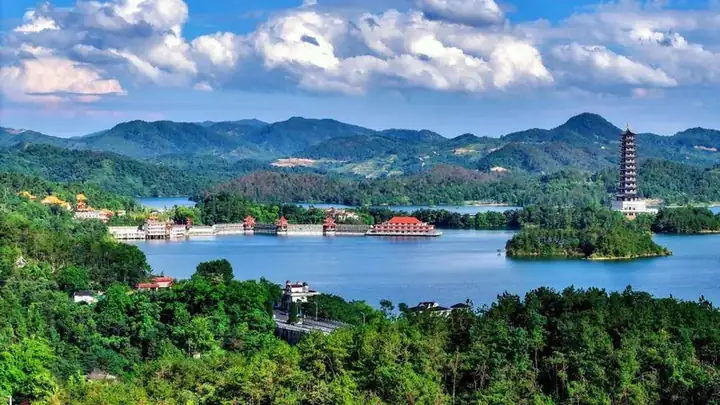 Daoguanhe Scenic Area ·
Plan your visit
Getting there
Xinzhou District is about 55 km (straight-line distance) from central Wuhan. Search for 新洲区 in a map app to find stations and your accommodation.
Where to stay →Build your route
Start with Daoguanhe Scenic Area. The linked place guides have entrance and visit details.
Continue with Wuhan →More in Wuhan
Sources & geographic information
Administrative names and parent areas: Official geographic directory (dmfw.mca.gov.cn) · Reference date 2026-09-06.
Background text adapted from Xinzhou, Wuhan — Wikipedia contributors, under CC BY-SA 4.0. Text has been shortened and reorganized; source revision 1323584580.
Photo: Daoguanhe Scenic Area · slt.hubei.gov.cn. Resized for the web; the photo itself has not been edited.
Map data © OpenStreetMap contributors. Pins mark approximate centres, not entrances or boundaries.
Image credits & notes (1)
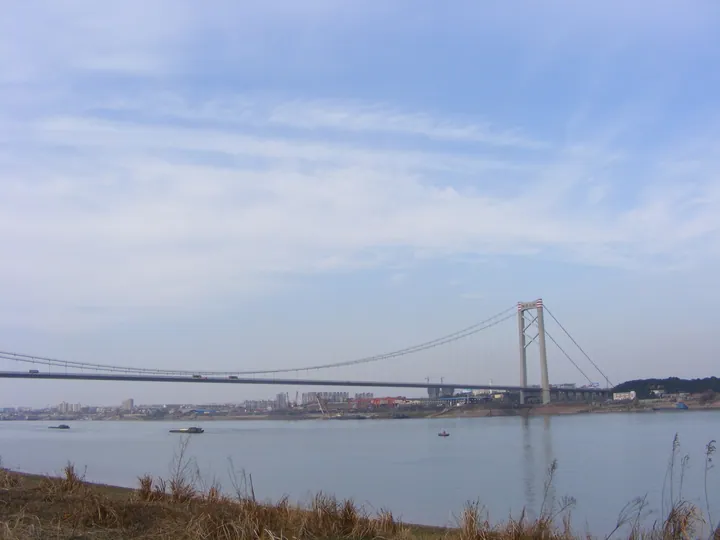
- Yangluo Bridge over the Yangtze River in Xinzhou District, Wuhan · 武汉市新洲区阳逻长江大桥 Source-recorded photograph date: Taken on 18 February 2010.Photo: fading · CC BY-SA 3.0Resized for the web; the photo itself has not been edited. Thumbnails may show a cropped view.
