


Get to know Hongshan District

- Administrative area
- District · 市辖区
- Part of
- Wuhan
- Chinese name
- 洪山区
- Local areas
- District guide
Area & population
- Area
- 480.20 km²
- Population · 2020
- 2,554,403
Source: English Wikipedia, as of the dates shown.
A district of water, hills and campuses
Hongshan is an administrative district of Wuhan, not one of the city’s three historic towns. It curves around Wuchang and Qingshan in a broad half-ring; Ezhou lies to the east, Jiangxia to the south, and Xinzhou faces it across the Yangtze to the north-east. The district government describes a mostly plain landscape broken by low hills and many lakes, including East Lake, South Lake, Qingling Lake and Tangxun Lake.
That geography explains the district’s visitor character. The Lumo Road–East Lake side is a good place to combine a museum or botanical garden with a waterside walk. The university belt around Luonan and the more intensely developed Optics Valley side feel different: campus streets, research institutions, shopping and large daily commuter flows sit close together. Wuhan’s government describes the Optics Valley area as a major technology and employment corridor, where the metro now carries both students and office workers.
Start with the East Lake university belt
The Yifu Museum of China University of Geosciences (中国地质大学逸夫博物馆) is at 388 Lumo Road, on the south side of the university’s west campus, beside East Lake and the foot of Nanwang Hill. Its six permanent galleries cover planets and Earth, the origin and evolution of life, minerals and rocks, gems, mineral resources and a donated collection. Dinosaur skeletons, minerals and fossil displays make it a more distinctive stop than a general city museum, while the campus fossil forest and outdoor geological exhibits extend the visit beyond the main building. The museum’s visitor-contact page gives the address and says that buses 59 and 709 reach the “Geological University” stop from the Fuxingpo and Hongshan areas; confirm current service and visitor arrangements before setting out.
The Wuhan Botanical Garden of the Chinese Academy of Sciences is a separate destination, not a second name for the museum or for the garden’s Guanggu research campus. Its public-facing Moshan site is on the shore of East Lake at the southern foot of Moshan, and the garden describes it as an 886-mu plant-conservation and research garden with more than 13,000 plant resources and 17 specialist collections, including kiwifruit, aquatic plants, wild fruit trees and medicinal plants. The garden lists the Moshan address as Lumo Road Te 1; its separate Guanggu campus is at Jiufeng 1st Road 201, so keep the two Chinese destinations distinct when ordering a taxi.
These two venues are best treated as a half-day East Lake-side cluster, not as points that can be reliably covered by a short walk from any one metro exit. Check each venue’s current opening, ticket and reservation notices separately; a district page does not establish the operating rules of an individual museum or garden.
A taste tied to the district
When it is in season, look for Hongshan caitai (洪山菜薹), the purple-stemmed flowering Chinese cabbage associated with this part of Wuhan. A Wuhan municipal English account dates cultivation in Hongshan back more than 1,700 years and identifies two small core growing areas—at Baotong Buddhist Temple and near Shipailingxi Road—for what it calls the most authentic form. Treat it as a seasonal local vegetable rather than a single restaurant recommendation: ask what is available that day, and do not assume that every dish labelled caitai comes from those protected core plots.
Getting around
Hongshan is large and internally varied, so choose the exact venue before planning the last leg. For the Optics Valley core, Optics Valley Square (光谷广场) is a practical interchange: Wuhan’s government reports that Line 2 and Line 11 connect there, while Line 11 also links with Line 2 at Huquan (虎泉) and with Line 8 at Mashan (马房山). Line 2’s university-side corridor includes Baotong Temple (宝通寺), Jiedaokou (街道口), Guangbutun (广埠屯), Huquan and Yangjiawan (杨家湾) before Optics Valley Square; use these as corridor references, not as a promise that any one station is the nearest entrance to an East Lake venue.
For the museum, the venue’s own bus guidance—59 or 709 to the Geological University stop—can be more direct than changing metro lines. For the botanical garden, give the driver 武汉植物园磨山园区,武汉市洪山区鲁磨路特1号 and check that the result is the Moshan visitor site rather than the Guanggu campus. For either venue, keep the Chinese name and full address ready, and confirm the return route after the visit.
Explore Hongshan District
Core places to explore, with English and Chinese names.
Places to explore around Hongshan District
 Yifu Museum at China University of Geosciences (Wuhan), seen from its landscaped campus grounds with geological stone displays. Photo: Zhangmoon618 · Public domain
China University of Geosciences Yifu Museum中国地质大学逸夫博物馆
A university geology museum beside Wuhan’s East Lake, with six permanent galleries, dinosaur fossils, minerals and gems, and a campus fossil forest. It is a compact way to see how Wuhan’s earth-science university turns its teaching collections into a public museum.
Read the place guide →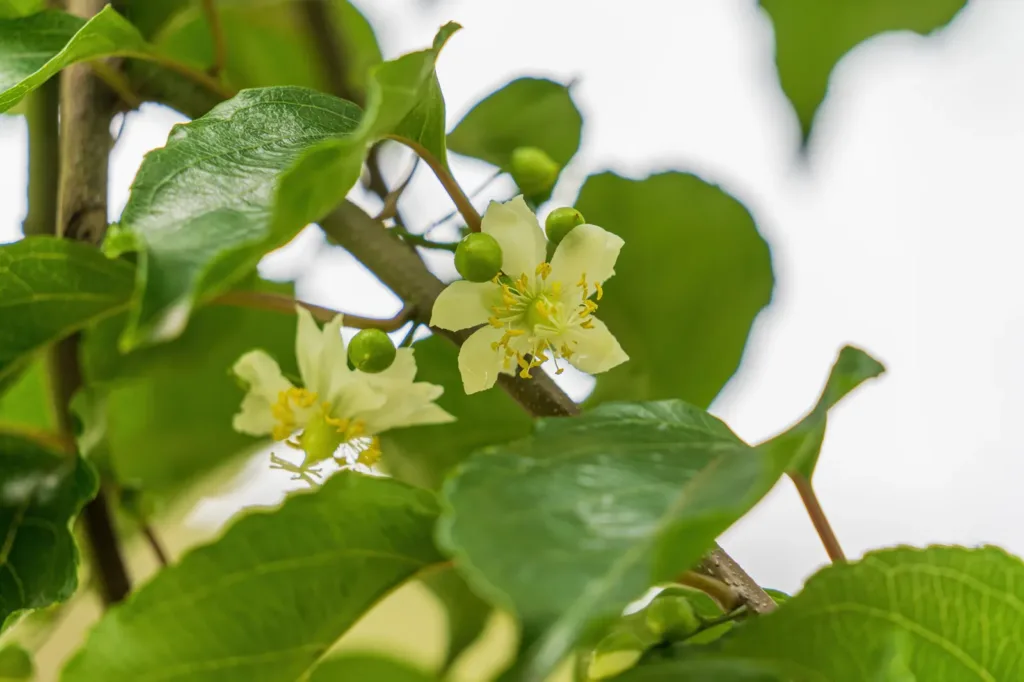 Actinidia macrosperma at Wuhan Botanical Garden, a close view of the garden’s kiwifruit-related plant collections. Photo: Sun Jiao · CC BY 4.0
Wuhan Botanical Garden of the Chinese Academy of Sciences中国科学院武汉植物园
A research-led public botanical garden on the southern shore of East Lake, Wuhan Botanical Garden is especially rewarding for its aquatic-plant collections, kiwifruit conservation work and plant displays that turn regional ecology into something visitors can walk through.
Read the place guide →Plan your visit
Getting there
Hongshan District is about 10 km (straight-line distance) from central Wuhan. Search for 洪山区 in a map app to find stations and your accommodation.
Where to stay →Build your route
China University of Geosciences Yifu Museum and Wuhan Botanical Garden of the Chinese Academy of Sciences are about 4 km apart (straight-line distance). The linked place guides have entrance and visit details.
Continue with Wuhan →More in Wuhan
Sources & geographic information
Administrative names and parent areas: Official geographic directory (dmfw.mca.gov.cn) · Reference date 2026-09-06.
Background text adapted from Hongshan, Wuhan — Wikipedia contributors, under CC BY-SA 4.0. Text has been shortened and reorganized; source revision 1372074317.
Map data © OpenStreetMap contributors. Pins mark approximate centres, not entrances or boundaries.
Image credits & notes (1)
- Optics Valley Square in Hongshan District, Wuhan. Photo: 2021-04-13.Photo: PuntoGut · CC BY-SA 4.0Resized for the web; the photo itself has not been edited. Thumbnails may show a cropped view.
